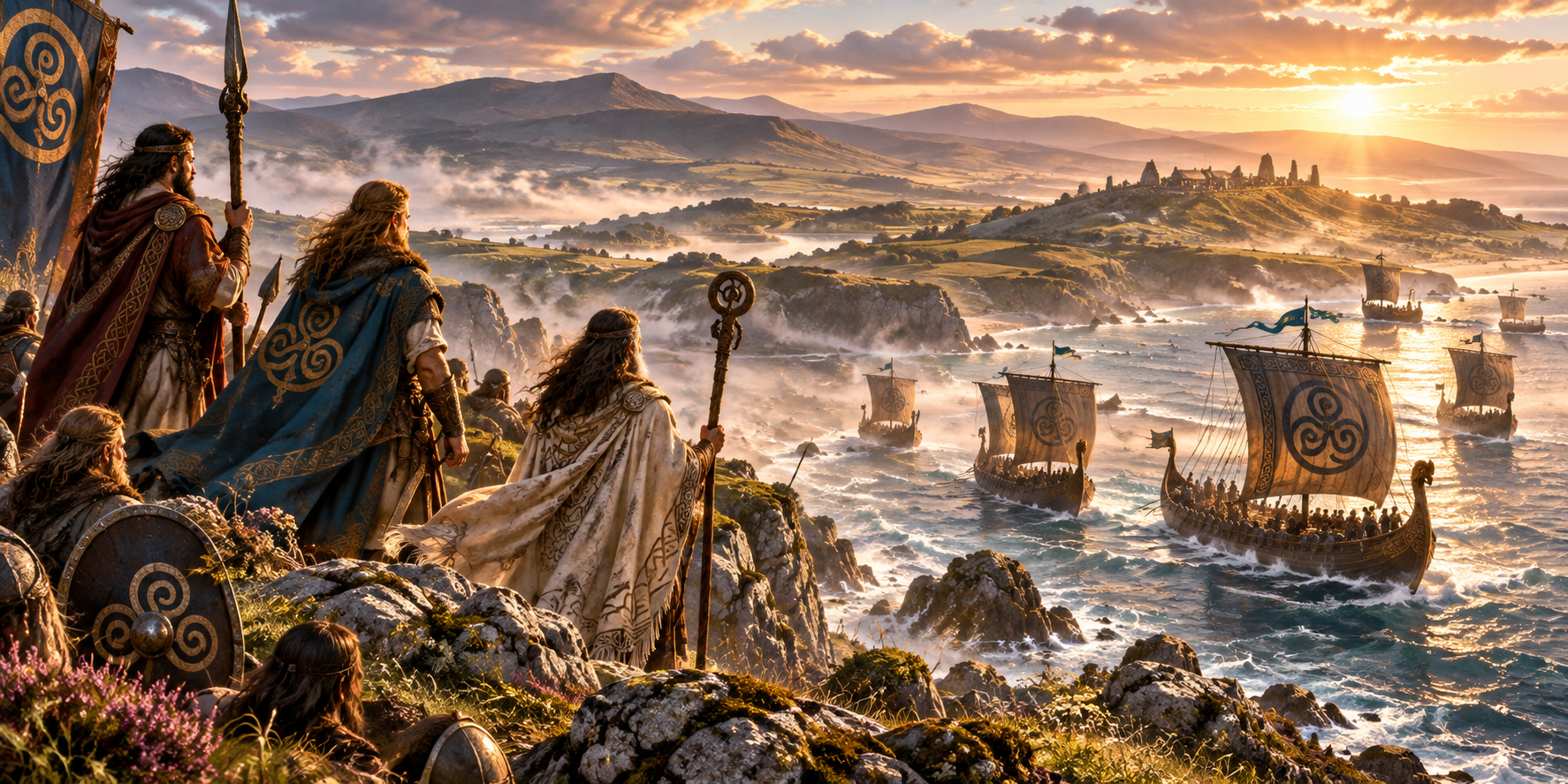
After the great battles of Mag Tuired, the Tuatha Dé Danann ruled Ireland.
They had defeated the Fir Bolg. They had overcome the Fomorians. But Irish tradition still had one final arrival in store. From across the sea came a new people: the Milesians, descendants of Míl Espáine.
Their arrival would mark the end of the Tuatha Dé Danann's rule and the beginning of a new stage in the legendary history of Ireland.
the Milesians
The Milesians, or Sons of Míl, are the people who appear at the end of the traditional sequence of invasions of Ireland.
Their story is told primarily in the Lebor Gabála Érenn, the Book of the Invasions of Ireland, a medieval compilation bringing together different traditions concerning the supposed peoples who arrived on the island.
According to this account, the Milesians came from distant lands and were genealogically connected with ancient inhabitants of Ireland.
Their most important ancestor was Míl Espáine, whose name is usually translated as “Míl of Hispania.”
Although Míl had other sons, among the most important figures in this tradition are:
- Éber Finn
- Éremón
- Amergin, poet, warrior, druid, and judge
According to the medieval accounts, the Milesians arrived in Ireland from Hispania.
Míl Espáine
Although the Milesians take their name from Míl Espáine, the story of their ancestor is much more complex.
Míl Espáine is a figure constructed within an extensive genealogy connecting the Milesians with numerous later generations and with biblical and legendary figures.
The Lebor Gabála Érenn thus constructs an enormous genealogy intended to place the inhabitants of Ireland within a universal history.
This is one of the work's most fascinating characteristics. Ireland does not appear in isolation. Its legendary past is connected with other lands, other peoples, and other genealogies.
The Story of Ith
But before the Milesians arrived in Ireland, something happened that would change the fate of the island.
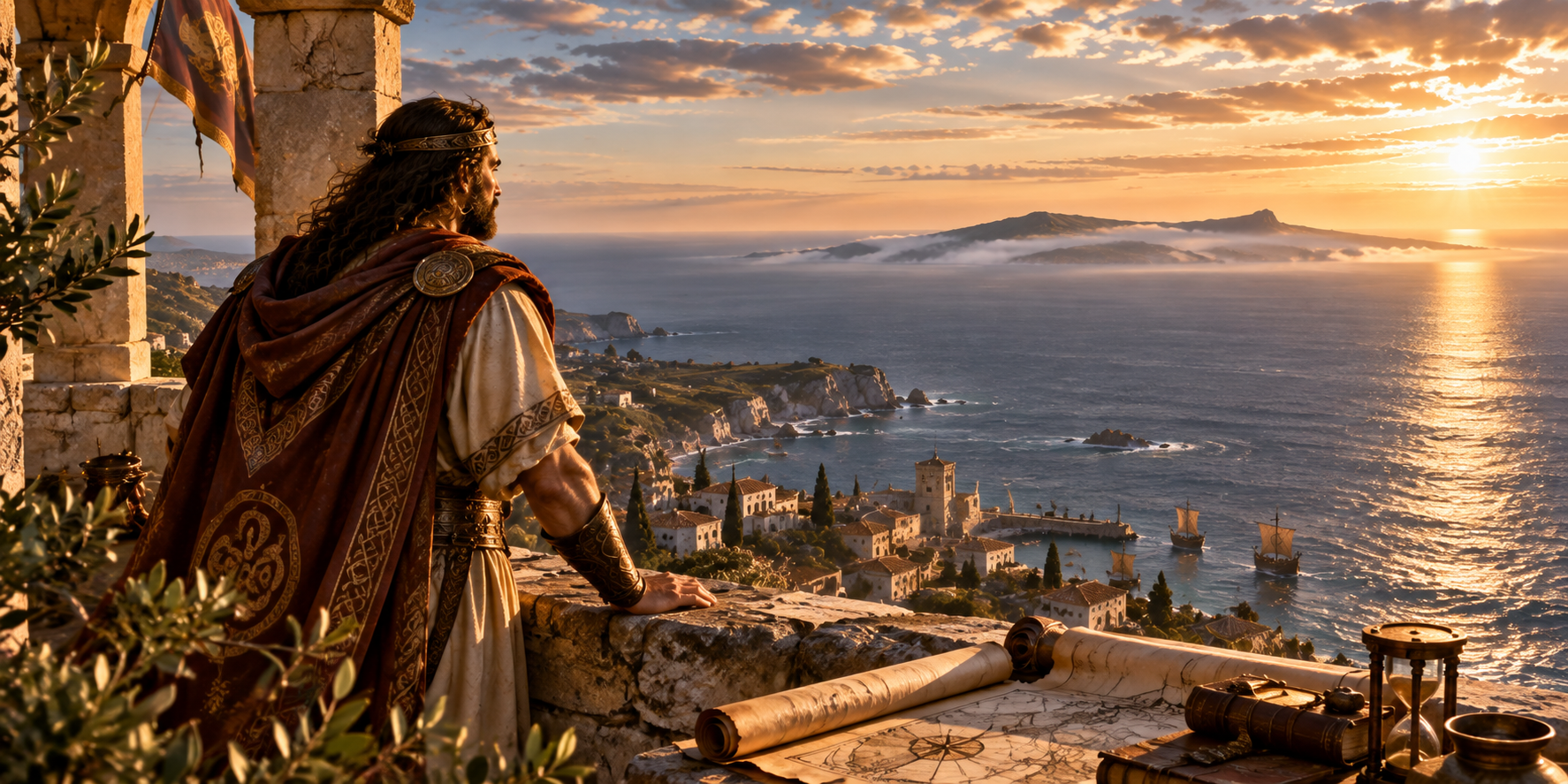
One of their ancestors, Ith, saw Ireland from a tower in Hispania. From there, he spotted an unknown land across the sea. He decided to travel there accompanied by some of his men.
When he arrived in Ireland, he found the country ruled by the Tuatha Dé Danann, who had recently defeated the Fomorians.
Ith was initially received peacefully and even intervened to help settle a dispute between the three kings of the Tuatha Dé Danann. However, his words about the wealth and beauty of Ireland aroused the rulers' suspicions.
Fearing that he had come to seize the island, the Tuatha Dé Danann eventually killed him. When the Milesians received the news, they decided to avenge his death. And so they prepared an expedition to conquer Ireland.
The Arrival of the Milesians
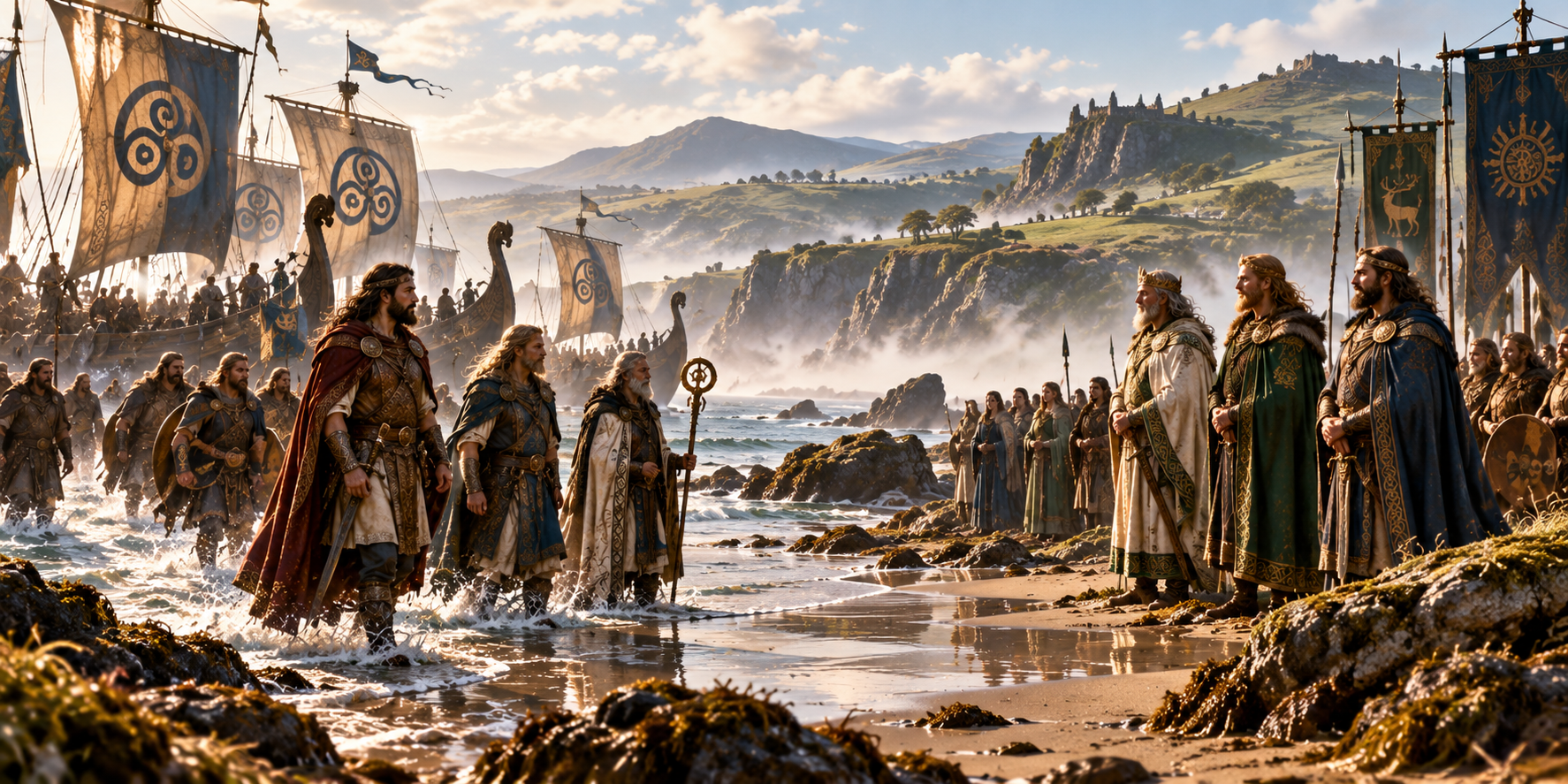
The Milesians crossed the sea toward Ireland.
When they arrived, they claimed the island as their own. But the Tuatha Dé Danann were not prepared to abandon it without a fight. After meeting with the three kings of the Tuatha Dé Danann, the Milesians accepted a condition.
They had to return to their ships and sail away from the coast. They would sail until they were nine waves away, and then attempt to land again. If they managed to reach the shore, Ireland would be theirs. The Milesians accepted.
And then began the confrontation that would decide who would rule Ireland.
The Storm of the Tuatha Dé Danann
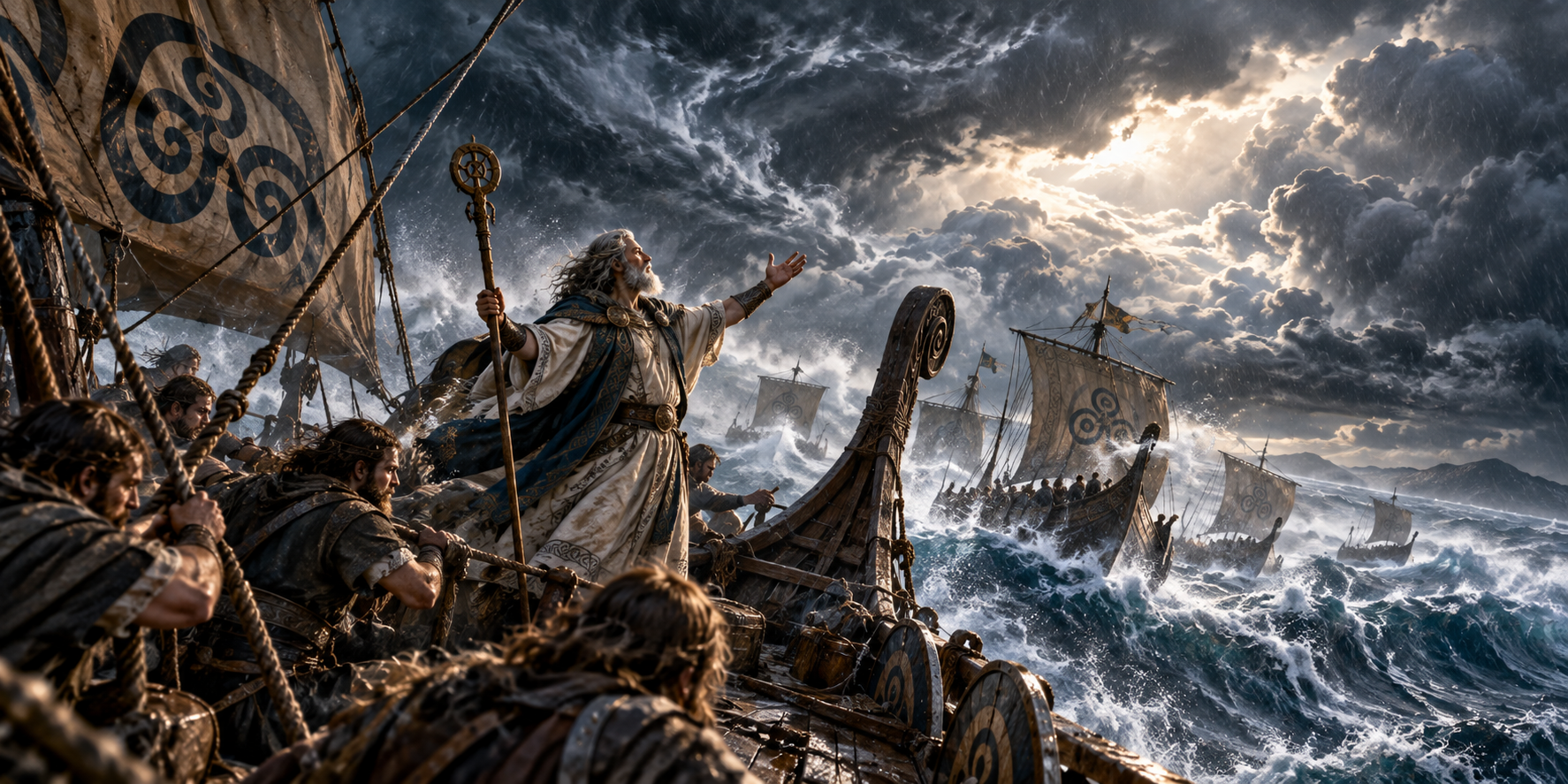
When the Milesians returned, the Tuatha Dé Danann resorted to their magical powers. The druids conjured a storm that scattered the invaders' ships.
The Milesian ships were dispersed, and many of the invaders came close to being lost at sea.
Then Amergin, the Milesian poet and druid, intervened. He also used his magical knowledge and recited a famous poem addressed to Ireland, invoking its mountains, rivers, and lands.
The storm eventually disappeared. The surviving ships managed to reach the island, and the Milesians were able to continue their conquest.
The Battles
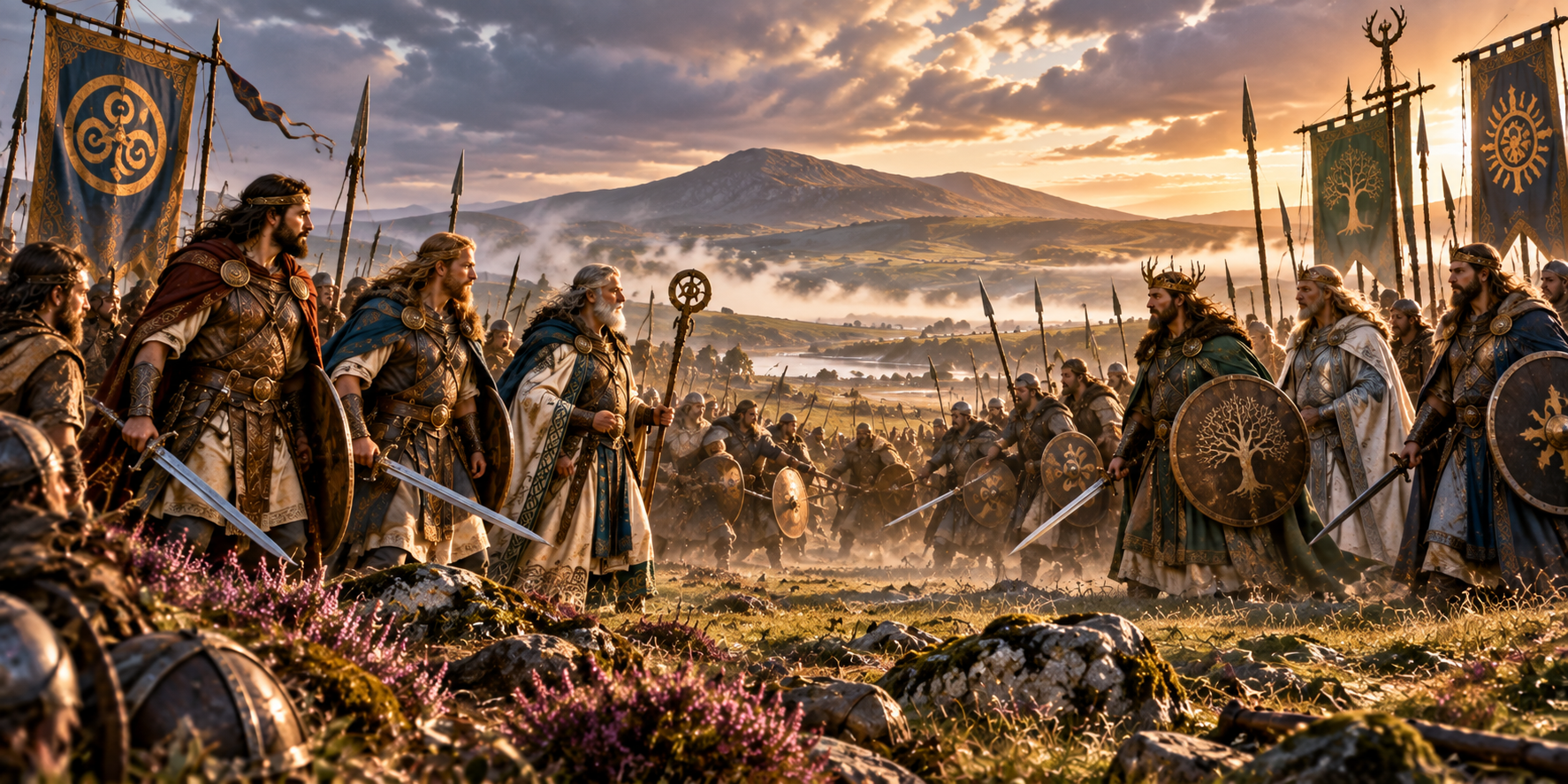
The tradition preserved in the Lebor Gabála Érenn records several confrontations connected with the arrival of the Milesians.
The Battle of Sliabh Mis
This was one of the first major confrontations between the Milesians and the Tuatha Dé Danann. According to tradition, the battle was fought on the third day after the landing.
Tradition places it at Sliabh Mis, in County Kerry.
The Milesians managed to prevail and continued their advance through Ireland.
The Battle of Life
The Lebor Gabála Érenn also mentions the batalla de Lefe.
In this encounter, the Tuatha Dé Danann once again resorted to magic and summoned monstrous giant-like creatures through their druidic arts.
The Sons of Míl, including Éber, Éremón, and Ír, fought against them.
This battle does not appear with the same importance in every version of the Milesian tradition, but it forms part of the account preserved in the Lebor Gabála Érenn.
The Battle of Tailtiu
Finally came the decisive confrontation.
In Tailtiu, the Milesians faced the three Tuatha Dé Danann kings: Mac Cuil, Mac Cecht y Mac Gréine.
All three died during the battle. According to tradition:
- Amergin killed Mac Gréine.
- Éber killed Mac Cuil.
- Éremón killed Mac Cecht.
The three queens — Ériu, Fódla, and Banba— also die in this tradition.
With the defeat of their kings, the visible rule of the Tuatha Dé Danann came to an end.
The Division of Ireland
After defeating the Tuatha Dé Danann, a new era began.
The Milesians divided the territory, with Éber Finn and Éremón receiving the southern and northern halves of Irelandrespectively.
Later tradition associated this division with the Eiscir Riada, an ancient formation of hills and glacial deposits crossing the island from the vicinity of Galway to Dublin.
Éremón became associated with the exercise of sovereignty, while Éber received the southern half.
But peace between the brothers would not last long.
The Tuatha Dé Danann Withdraw into the Hidden World
The Tuatha Dé Danann had lost their visible dominion over Ireland.
But tradition tells that, rather than abandoning the island completely, they withdrew into the world of the sídhe, associated with the hills and ancient burial mounds scattered throughout the Irish landscape.
From then on, they would live in a hidden world.
Later tradition would associate them with the Aos Sí themselves, the “People of the Mounds,” or beings associated with the sídhe. Thus, the ancient supernatural rulers of Ireland ceased to appear as visible sovereigns and became part of the Otherworld..
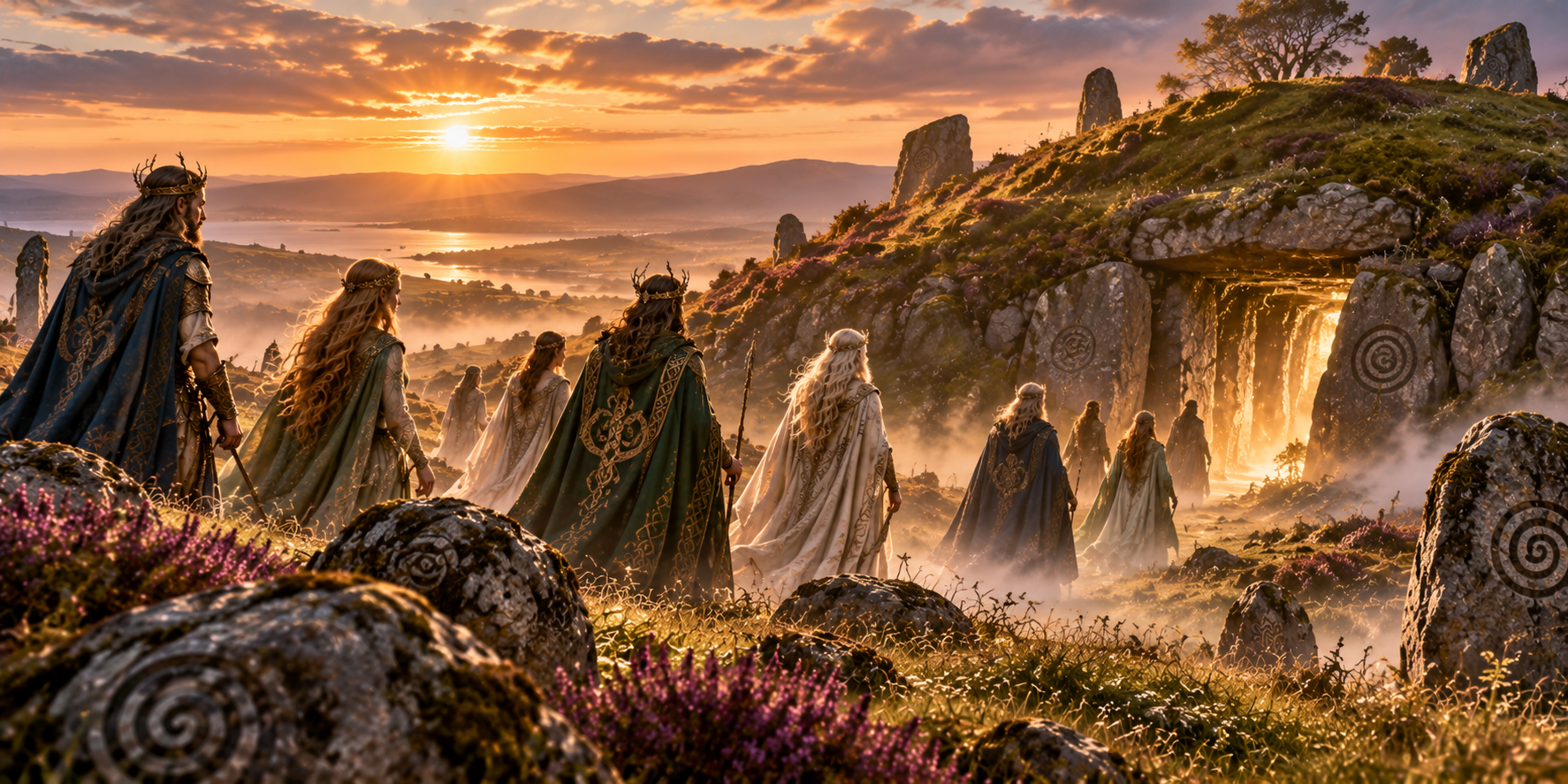
The hills remained. And, according to tradition, so did they.
Amergin and the Land of Ireland
The arrival of the Milesians also left behind one of the most famous poems in Irish tradition.
Amergin, the Milesian poet and druid, recited a poem connected with the land itself upon landing.
“I am the wind of the sea…”
“I am the ocean…”
“I am the mountain…”
Tradition thus makes Amergin a figure closely connected with Ireland itself.
He is not simply a warrior. He is also a poet, druid, judge, and mediator. And his words accompany the Milesians at one of the fundamental moments of their story: their arrival in the land they would eventually claim as their own.
A New Ireland
With the arrival of the Milesians, the great sequence of mythical invasions of Ireland comes to an end. The supernatural peoples are left behind. The Fir Bolg had disappeared as a dominant power. The Fomorians had been defeated. The Tuatha Dé Danann had ruled Ireland.
Now the Milesians arrived. And with them began the world of the legendary ancestors of the Irish people.
The gods had not disappeared. They had simply changed their place. They hid beneath the hills. And there, according to tradition, they continued to live.
The Brothers Éber Finn and Éremón
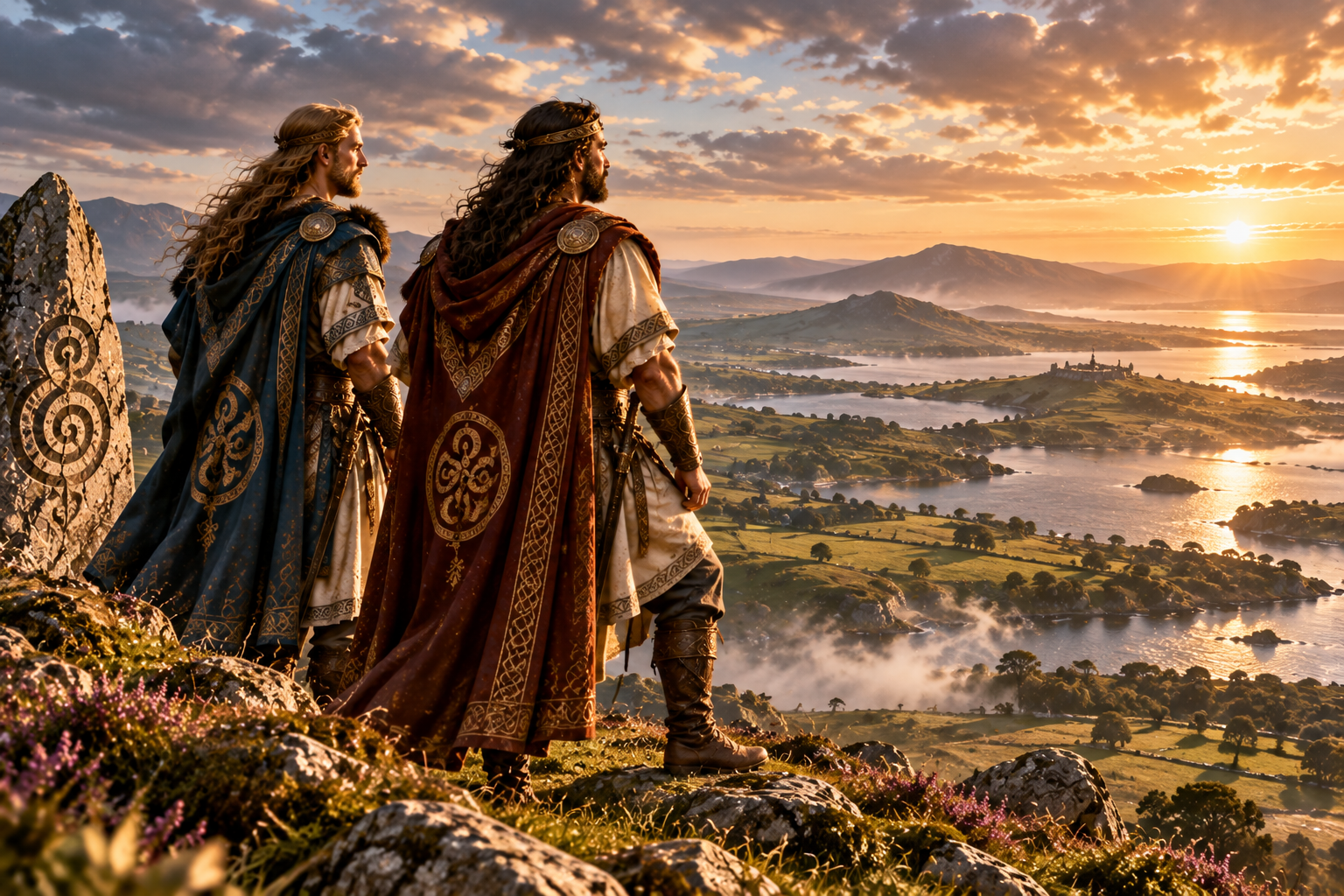
After the conquest of Ireland, tradition presents Éber Finn and Éremón as the two great protagonists in the division of power.
Éber received the southern half of the island, while Éremón received the northern half. This division became one of the great genealogical motifs of Irish tradition: two brothers, two territories, and two lines of descent that would eventually explain the legendary origins of different peoples and dynasties.
The Eiscir Riada came to play a symbolic role as the boundary between their territories within this traditional construction.
The Conflict Between Brothers
Peace between the brothers did not last long. Medieval sources preserve different versions of the conflict that ended with the death of Éber Finn.
The Lebor Gabála Érenn records a battle between Éber and Éremón at Airget Ros, while the Annals of the Four Masters place the confrontation at Geissill, identified with modern-day Geashill.
The reason for the conflict also appears in different forms in the traditions. One version connects the dispute with the division of the territory and Éber's claims over certain lands.
In any case, the outcome was the same: Éber Finn died, and Éremón remained sole ruler.
Tradition thus presents the first great division among the Milesians as the beginning of a new stage in the legendary monarchy of Ireland.
Amergin
Amergin did not disappear after the conquest. Throughout the invasion narrative, he continued to play a fundamental role as a poet, judge, and mediator.
However, a tradition preserved in the Lebor Gabála Érenn tells that he later confronted his brother Éremón at the Battle of Bile Tened, in Mide, where he died.
A Story That Continued to Live
The story of the Milesians left a profound mark on Irish tradition. For centuries, genealogists and medieval writers used these stories to construct an explanation of Ireland's past.
The accounts blended:
- genealogies,
- mythology,
- local traditions,
- biblical stories,
- place names,
- and memories of ancient peoples.
The result was an enormous narrative about how Ireland had been populated again and again.
The Milesians were not merely the last invaders in the mythical history. They also became the legendary ancestors from whom medieval genealogies could explain the origins of different peoples, territories, and dynasties.
Curiosities
Banba, Fódla, and Ériu
As they advanced through Ireland, the Milesians encountered the three female figures associated with the land: Banba, Fódla, and Ériu.
Amergin acted as poet and mediator and, according to tradition, agreed that the island would forever retain the name of Ériu.
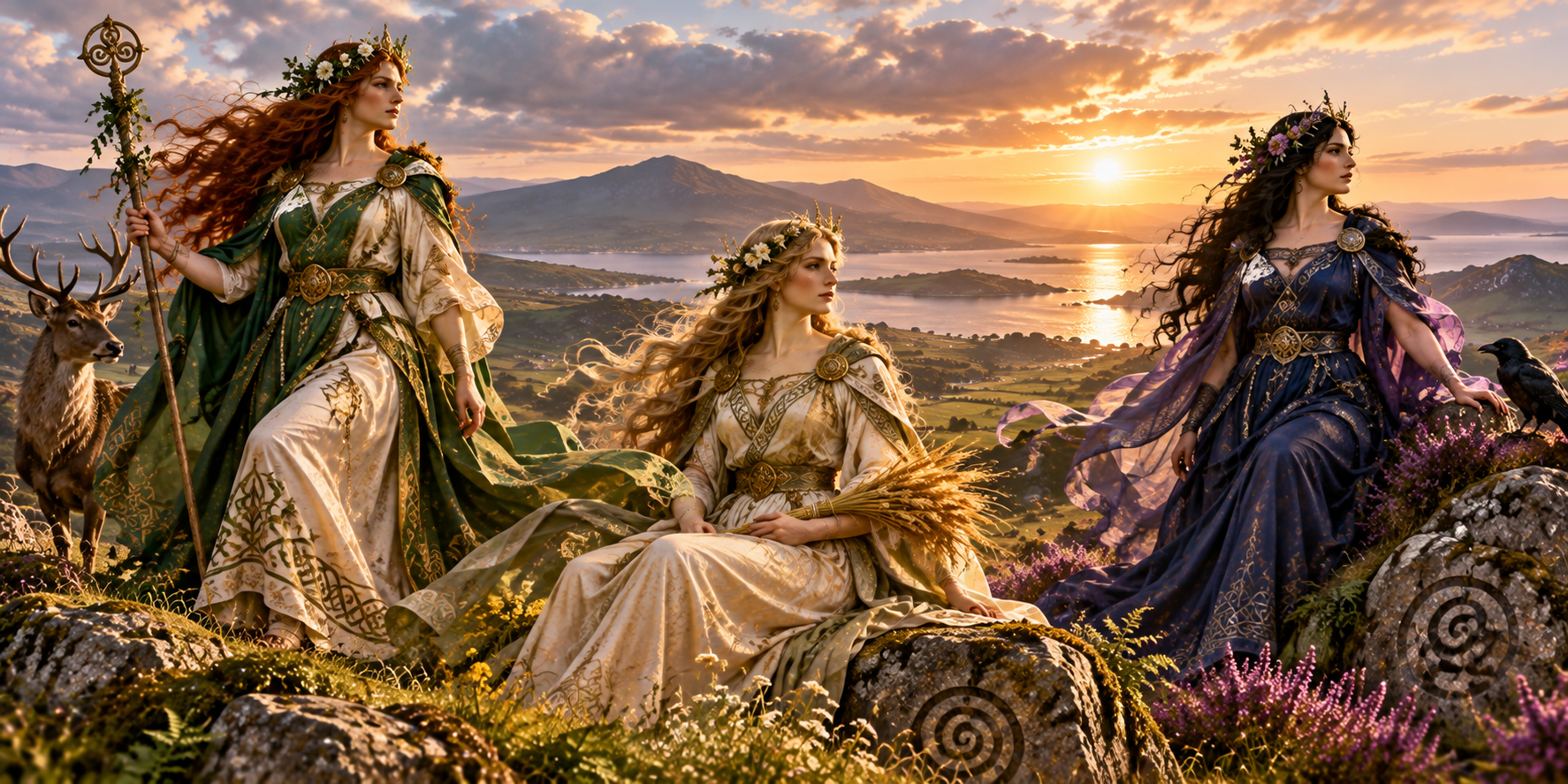
The Irish name Éire derives from Éiru.
The Mythical Kings Who Became Part of Genealogies
La historia de los Milesios no terminó en las páginas de la mitología.
The story of the Milesians did not end in the pages of mythology. During the Middle Ages, Irish genealogists used Éber Finn and Éremón as legendary ancestors of different lineages and dynasties that did exist historically.
From them, genealogies were constructed linking various ruling families of Ireland to these ancient mythical conquerors. Thus, characters originating in a legendary narrative eventually appeared as ancestors of historical kings and dynasties.
Among the groups traditionally connected with these lineages were the Uí Néill, the Connachta, the Eóganachta, and the Dál gCais.
The Éremonians: Descendants of Éremón
Within medieval genealogies, Éremón appears as the legendary ancestor of numerous lineages in northern and central Ireland.
Among the groups traditionally connected with this line are:
The Uí Néill: one of the most powerful and influential dynasties of medieval Ireland, associated genealogically with Éremón. This tradition also includes the ancestry attributed to Niall of the Nine Hostages.
The Connachta: the collection of royal lineages associated with the province of Connacht.
Clan Colla and Uí Maine: groups and lineages that also appear within the complex medieval genealogies associated with the descendants of Éremón.
Some medieval genealogies even connected this line with the Dál Riata and, through them, with the dynastic traditions of Scotland.
The surnames and families later associated with these major groups are numerous, including O'Neill, O'Donnell, O'Connor, O'Reilly, and Gallagher.
The Éberians: Descendants of Éber Finn
Medieval genealogies associated Éber Finn primarily with the lineages of southern Ireland, especially with Munster.
Among the groups traditionally connected with this line are:
The Dál gCais: the powerful Munster group that achieved enormous political importance during the Middle Ages.
Brian Boru: one of the most famous historical figures later associated with this genealogical tradition. He was King of Munster and later one of the principal contenders for the title of High King of Ireland.
The Eóganachta: the great dynasty of Munster, linked in medieval genealogies with the southern line.
Among the surnames and families later associated with these lineages are O'Brien, McCarthy, O'Sullivan, O'Mahony, MacNamara, and O'Carroll.
The Milesians had begun as characters in a legendary story. Centuries later, their names would become part of the genealogical trees of families and dynasties that belong to the documented history of Ireland.
The End of an Era
Within Irish mythological tradition, the arrival of the Milesians represents the end of the age of the great supernatural peoples.
The Milesians came from the sea and forever changed the destiny of mythical Ireland. The Fir Bolg had disappeared as a dominant power. The Fomorians had been defeated. The Tuatha Dé Danann had ruled Ireland, then left the visible world and withdrew beneath the hills.
The gods had not disappeared. They had simply changed their place. They hid beneath the hills. And there, according to tradition, they continued to live.
Because some stories do not end when a people loses its kingdom.
Follow the Footprints
Visit It Today...
Hill of Tara — County Meath
The Milesians form part of the tradition explaining the succession of peoples who ruled mythical Ireland.
Tara, associated for centuries with sovereignty and the great kings of Ireland, preserves an archaeological landscape made up of numerous monuments and enclosures.
Among its principal features are:
- Lia Fáil, the Stone of Destiny, traditionally associated with one of the great treasures of the Tuatha Dé Danann..
- Forradh, where the Lia Fáil currently stands.
- Ráth na Ríogh,enclosure of the Kings.
- Teach Chormaic, Cormac's House
The Sídhe
Numerous burial mounds and hills throughout Ireland became associated in later folklore with the Aos Sí.
Many of these monuments were built thousands of years before the medieval stories about the Tuatha Dé Danann appeared.
Over time, these places became incorporated into Ireland's supernatural imagination and eventually came to be regarded, within popular tradition, as dwellings of beings from the Otherworld.
Newgrange – Brú na Bóinne
The great Neolithic monument of Brú na Bóinne, built around 3200 BC, is thousands of years older than the medieval accounts of the Tuatha Dé Danann and the Milesians.
Newgrange forms part of one of Ireland's most important archaeological landscapes and, over time, also became associated with ancient mythological traditions.
Inber Scéine — Kenmare River, County Kerry
Milesian tradition associates this estuary with the arrival of the survivors of the expedition.
The place was named after Scéne, the wife of Amergin, who died during the journey to Ireland.
Inber Colptha — Mouth of the River Boyne
Tradition places the landing of one of the Milesian groups here.
The Lebor Gabála Érenn also explains that Colptha, the son of Míl, was the first to land there, and that the harbor took its name from him.
Today, the area around the mouth of the Boyne forms part of a landscape deeply connected with some of Ireland's oldest traditions.
Sliabh Mis — County Kerry
The mountain where tradition places one of the first major battles of the Milesian conquest against the Tuatha Dé Danann.
Tailtiu — Teltown, County Meath
The place associated with the decisive battle in which the three kings of the Tuatha Dé Danann — Mac Cuil, Mac Cecht, and Mac Gréine — met their deaths.
Gaeshill / Airge Ros — County Offaly
Two places appear in medieval sources when recounting the later conflict between Éber and Éremón.
. The Annals of the Four Masters place the battle at Geissill Geissill, identified with Geashill.
The Lebor Gabála Érenn, by contrast, gives Airget Ros as the setting of the confrontation.
Bile Tened
A place associated with the death of Amergin at the hands of his brother Éremón.
The Lebor Gabála Érenn places the confrontation and death of the Milesian poet and judge here. Today, it is identified with Moynalty, County Meath.