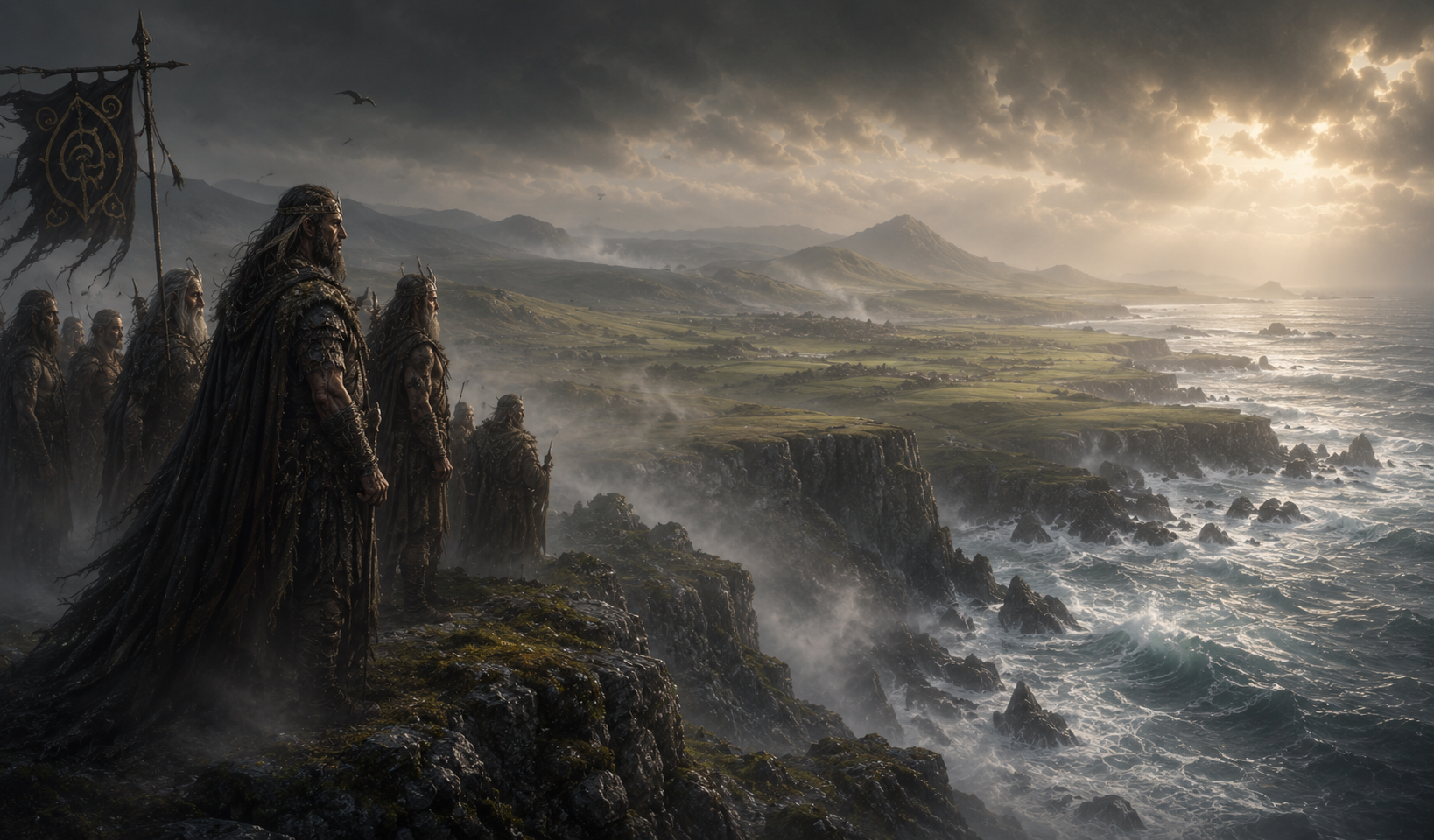
Before the Tuatha Dé Danann. Before the Fir Bolg. Even before many of the mythical peoples arrived in Ireland, the legends already spoke of a dark presence associated with the island.
They were Fomorians.
Mysterious, powerful, and feared, they appear time and again in the tales of the Lebor Gabála Érenn (The Book of the Taking of Ireland), becoming one of the most important peoples in all of Irish mythology.
They were not simply the enemies of a single people.
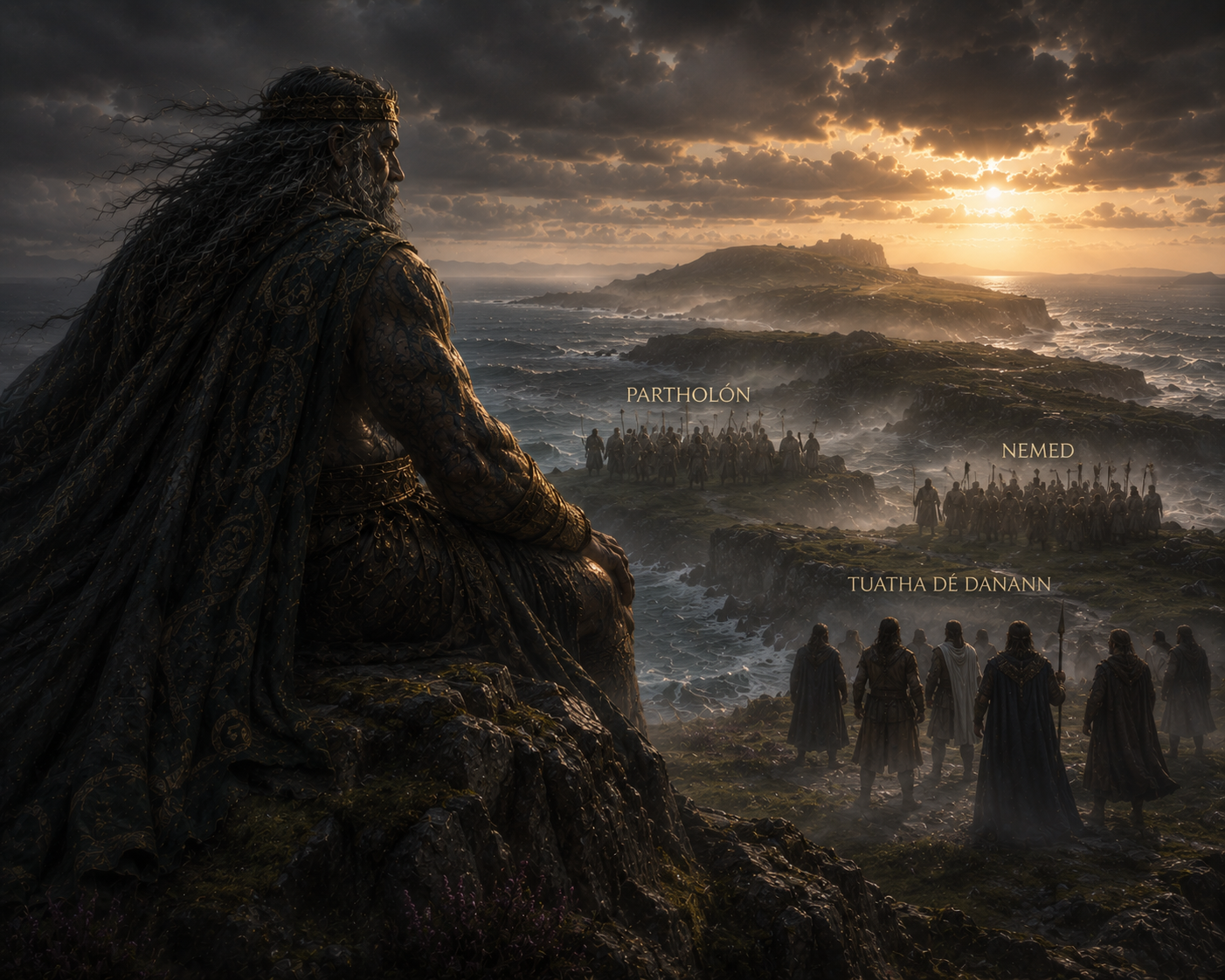
- They fought against Partholón.
- They fought against Nemed.
- They fought against the Tuatha Dé Danann.
And for generations, they became one of the great forces that shaped the mythical destiny of Ireland.
Who Were the Fomorians?
Answering this question is not easy. Medieval Irish sources do not always agree on their origins and present different versions of their story.
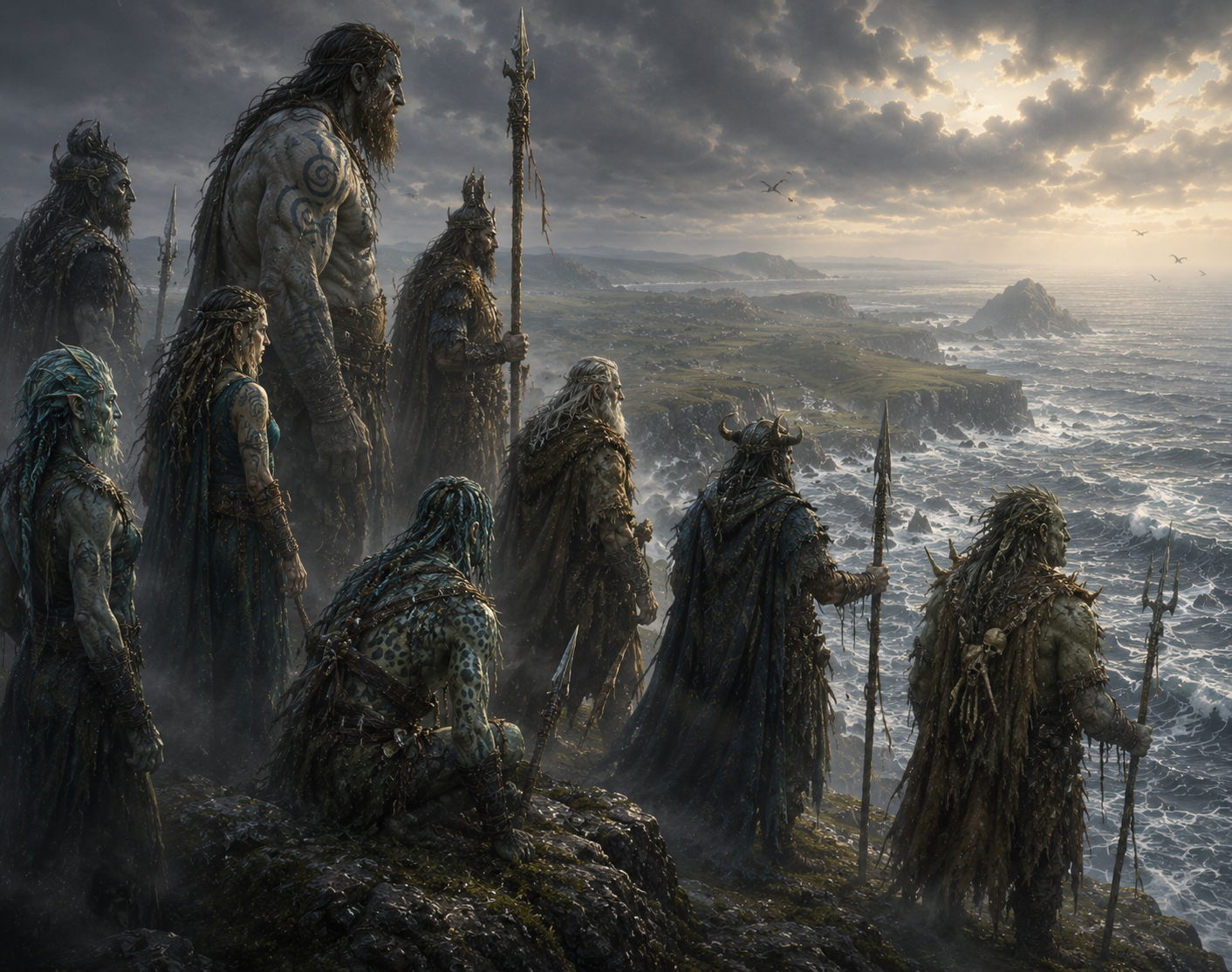
In some accounts, they appear as supernatural beings connected to the sea. In others, as ancient inhabitants of Ireland. They are also described as giants, warriors, pirates, or powerful entities associated with the primal forces of nature.
Their very name has been the subject of debate for centuries.
Some scholars have connected the term with ideas associated with the sea, the underworld, or dark and chaotic forces.
What is certain is that, within Irish tradition, the Fomorians represent something far greater than simply an enemy people. In many tales, they embody the wild and dangerous forces that constantly threaten order and prosperity.
The Lords of Chaos
While other peoples attempt to cultivate the land, establish settlements, and build a new society, the Fomorians often appear as a force of destruction.
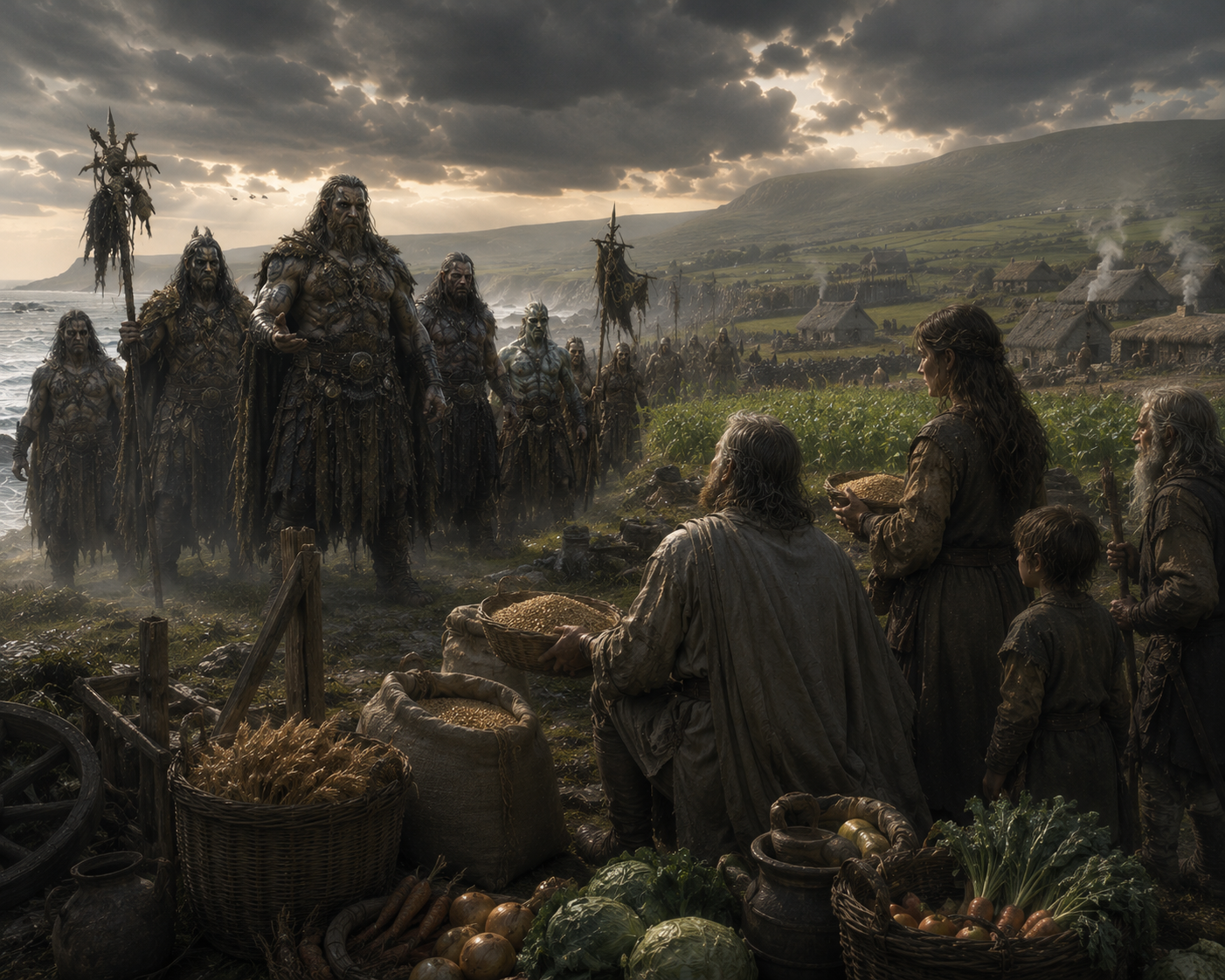
In the legends, they demand tribute, unleash conflicts, impose burdens upon their enemies, and use their power to dominate those they consider weaker.
For this reason, many scholars have interpreted the Fomorians as a mythical representation of chaos opposed to order.
They are not simply the villains of the story. They represent that which constantly threatens the balance of the world.
The Fomorians and the Tuatha Dé Danann
Although they often appear as adversaries, the relationship between the Fomorians and the Tuatha Dé Danann is far more complex than that of two enemy peoples.
There are marriages, alliances, and family ties between them. One example is Elatha, a Fomorian king and the father of Bres, who would later become king of the Tuatha Dé Danann.
In fact, some of the most important figures in Irish mythology descend from both lineages.
Early Fomorian Leaders
In the earliest mythical invasions, the sources do not yet present a clear list of great Fomorian kings. Instead, different chiefs or leaders appear in connection with different conflicts, such as:
- Cichol Gricenchos, defeated by Partholón at Magh Itha
- Conand, lord of Conand's Tower
- Morc, who led the Fomorian fleet against the Nemedians
Over time, the traditions would focus their attention on other, far better-known rulers whose stories occupy a prominent place within the Irish Mythological Cycle.
Fomorian Kings
Among the most important kings are:
- Indech
- Elatha
- Tethra
- Balor
The Fomorians appear under the rule of different kings depending on the period and tradition. However, Balor is by far the most famous.
Balor: The Most Famous of the Fomorians
If there is one name associated with the Fomorians, it is Balor.
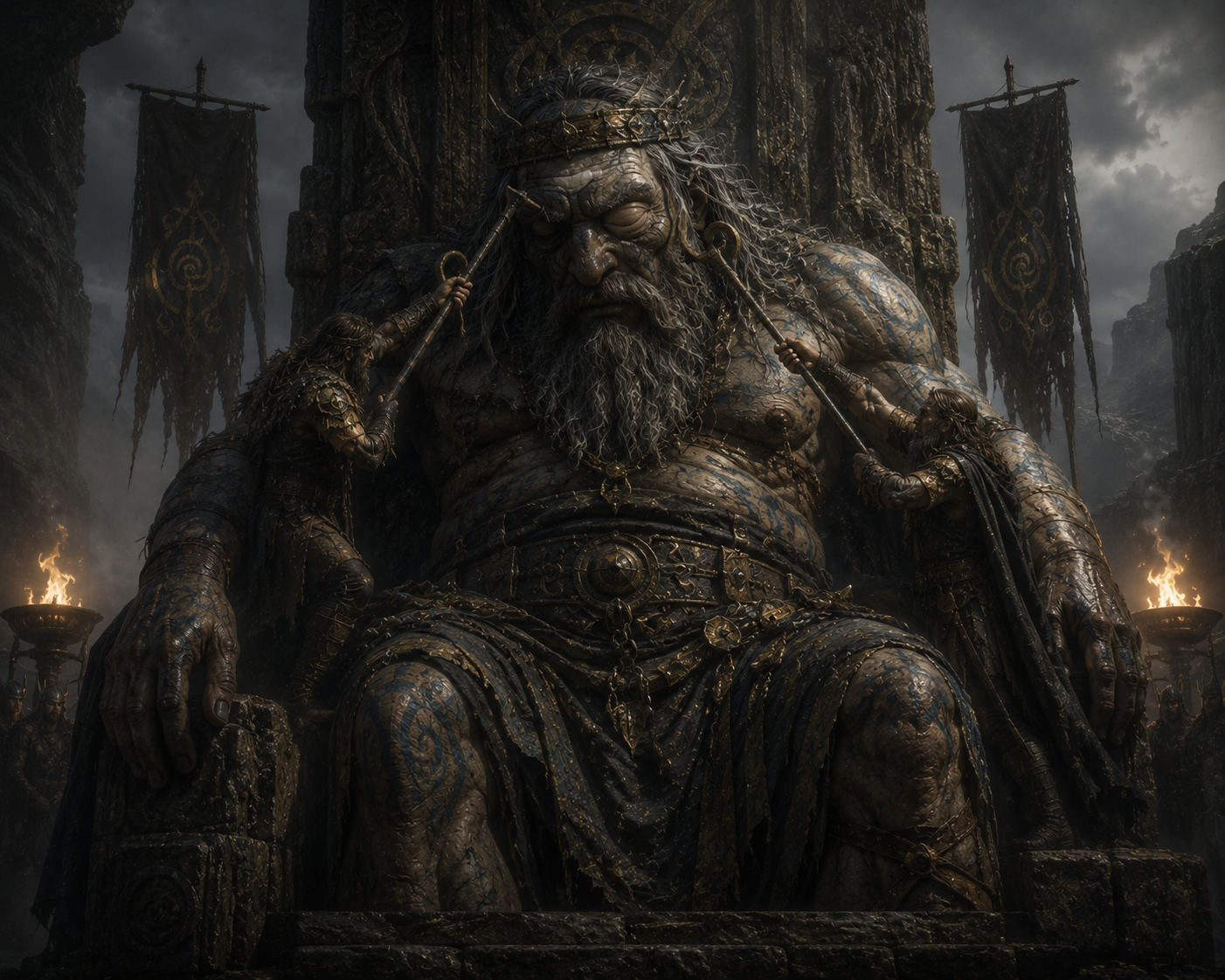
Balor was one of their most feared kings. The legends describe him as a giant of immense power whose eye could bring destruction and death. His figure would become one of the most famous in all of Irish mythology.
However, his story is closely connected to another figure destined to change the fate of Ireland: Lugh.
The Prophecy of Balor Buarainech usually appears as Balor's father.
Buarainech aparece normalmente como el padre de Balor.
The sources vary as to whether Balor had a single wife. However, his most famous story revolves around his daughter Ethniu (Eithne) and a prophecy.
The Prophecy
According to tradition, a druid announces a prophecy to Balor:
“You will die at the hands of your grandson.”
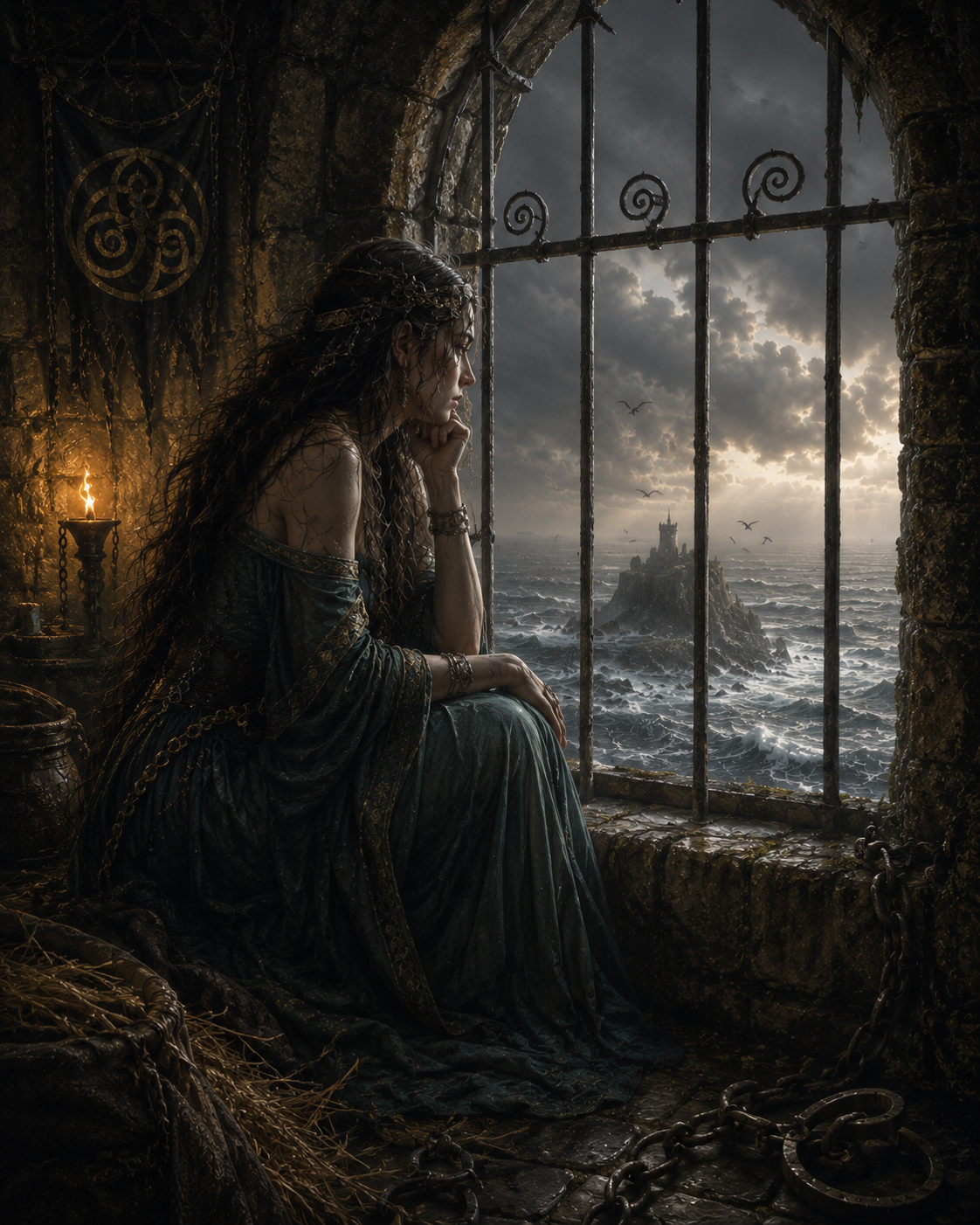
To prevent it from coming true, Balor imprisons Ethniu on an island, in a tower, or in an isolated fortress, intending to ensure that she never has children.
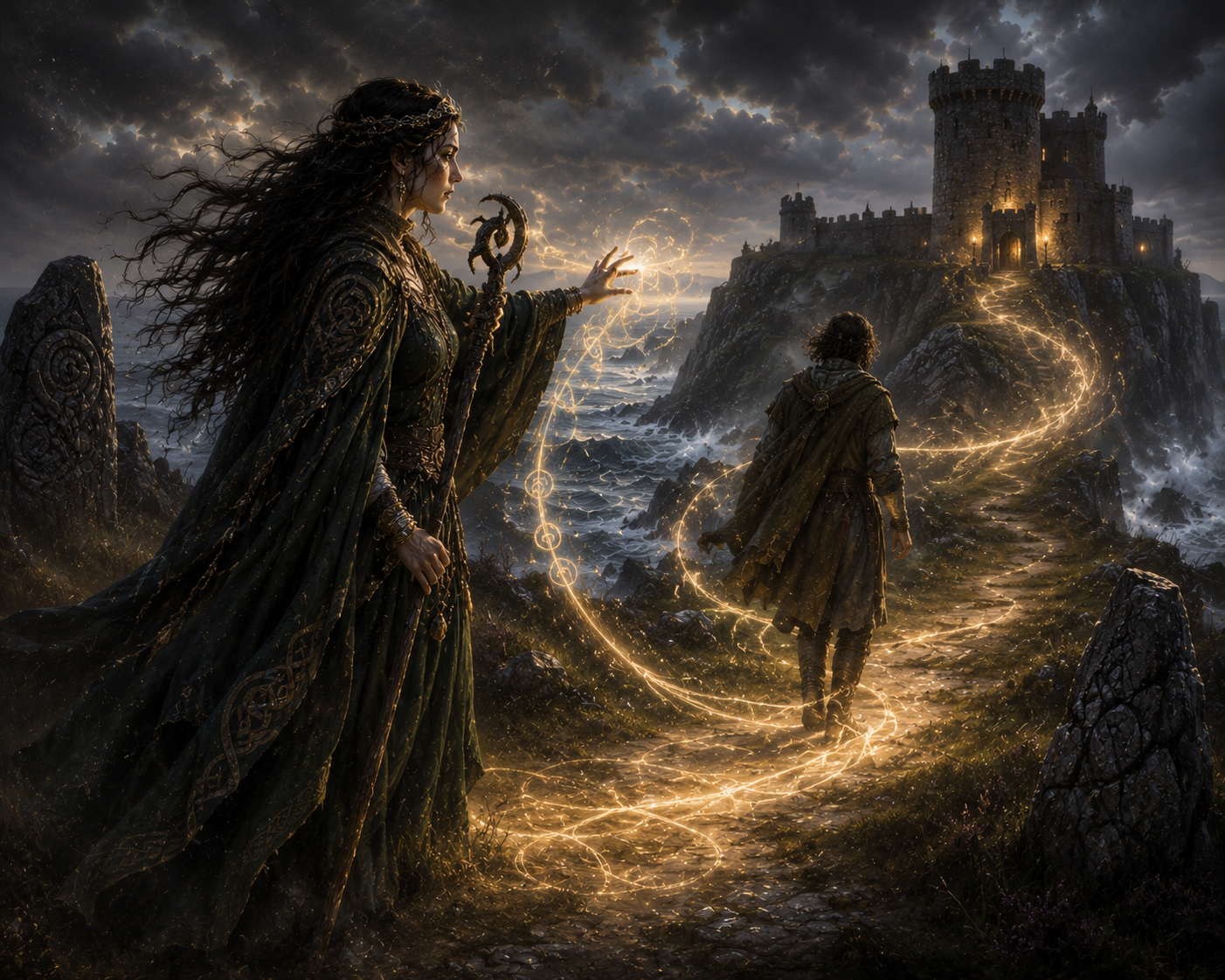
Biróg (or Birog), a powerful druidess or sorceress, knows of the prophecy and decides to help bring it to fulfilment. Using her magic, she leads Cian to the fortress where Ethniu is imprisoned.
There, the two meet and conceive a child. From their union, Lughis born, destined to fulfil the prophecy.
From this point onward, the different Irish traditions begin to diverge in some details of the story.
In some versions, Ethniu gives birth to triplets. When Balor discovers the pregnancy, he orders the children to be killed. They are wrapped in cloth or placed in a sack and thrown into the sea.
One of them survives: Lugh.
Biróg intervenes once again and rescues the child from the sea before giving him to his father, Cian. Lugh is raised by different figures, including the sea god Manannan mac Lir and Tailtiu, depending on the tradition.
In other versions, Ethniu and Cian have only one child: Lugh.
Balor likewise attempts to dispose of the child by throwing him into the sea, but he:
- is rescued by Biróg;
- is raised in secret by the Tuatha Dé Danann.
In some versions, the confrontation between Balor and Lugh eventually becomes one of the most important moments of the Second Battle of Mag Tuired.
Cian (Cían) is the son of the healing god Dian Cécht, one of the great gods of the Tuatha Dé Danann.
Years later, Cian will be murdered by the three sons of Tuireann, giving rise to another important Irish legend: The Fate of the Children of Tuireann, in which Lugh demands compensation for his father's death.
The Eye of Balor: His Famous Weapon
Depending on the version or Irish source, Balor's eye could:
- kill with its gaze;
- destroy armies;
- release devastating energy;
- spread disease;
- wither life.
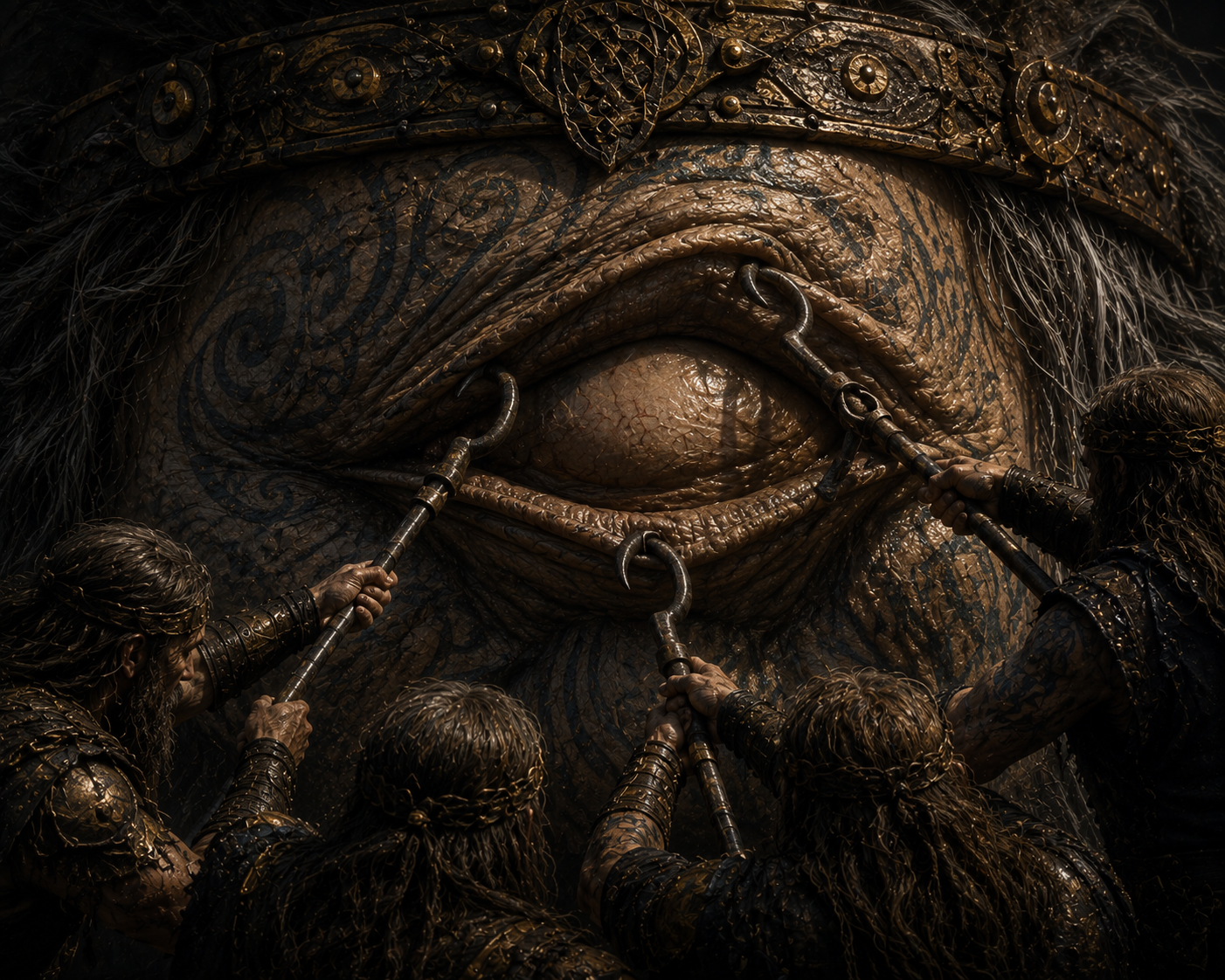
However, Balor could not open his eye easily. It was so powerful and heavy that he needed help to raise the eyelid. Some accounts describe several warriors using hooks to open it.
Of the various traditions associated with his eye, the best known tells that Balor spied upon druids while they were performing magical rituals. The fumes produced by their spells reached his eye, which from that moment acquired its devastating power.
The Enemies of Partholón
When Partholón and his people arrived in Ireland, the Fomorians were already part of the island's mythical landscape.
The legends tell that the two peoples eventually faced each other in battle.
Partholón emerged victorious, but that conflict marked the beginning of a long rivalry that would reappear time and again in later generations.
The Domination of the Nemedians
Centuries later, they arrived Nemed's people and his followers. With them, the Fomorians once again played a central role.
The sources tell that they imposed extremely harsh tributes upon the Nemedians.
Some versions claim that they demanded two-thirds of their children, their crops, and their cattle. That oppression eventually provoked a great rebellion and one of the most important wars in Irish mythical tradition.
More Than Simple Villains
Although they often appear as antagonists, the Fomorians are far more complex than the villains of a story.
Some legends reveal alliances and family ties between them and the Tuatha Dé Danann.
This reflects an idea frequently found in Irish mythology: the world is not divided between absolute good and absolute evil.
Opposing forces are connected to one another and form part of the same reality.
Connections with Other Mythologies
The story of Balor belongs to a type of tale that appears in many cultures and reflects an idea repeated throughout mythology: the more you try to escape fate, the more you contribute to its fulfilment.
Among the best-known examples are:
- Cronus attempts to prevent his children from overthrowing him in Greek mythology.
- Acrisius imprisons Danaë to prevent the birth of Perseus in Greek mythology.
- Herod orders the Massacre of the Innocents in an attempt to eliminate Jesus in Christian tradition.
- Kansa attempts to prevent Krishna from killing him in Hindu mythology.
- The gods of Asgard take measures to prevent Loki's children from bringing about Ragnarök in Norse mythology.
None of them manages to escape the prophecy.
The Legacy of the Fomorians
The Fomorians appear time and again throughout the Irish Mythological Cycle.
They are the shadow that accompanies the successive invasions. The threat that returns whenever stability seems to have been achieved. And the force against which heroes, kings, and entire peoples must measure themselves.
The story of Balor and Lugh will culminate during the Second Battle of Mag Tuired, where the prophecy will ultimately be fulfilled exactly as foretold.
For this reason, more than a specific people, the Fomorians represent a constant presence within the mythical history of Ireland.
Because when Partholón, Nemed, or the Tuatha Dé Danann arrive in Ireland, they will already be there.
Follow the Footprints
Visit It Today...
The Tory Island (Toraigh) lies off the coast of County Donegal, in northwestern Ireland. Today, it remains home to a small community and retains a deep connection with the ancient legends of the Irish Mythological Cycle.
Dún Bhaloir (Balor's Fort) stands at the eastern end of Tory Island, on a spectacular promontory surrounded by towering cliffs. Irish tradition identifies this place with the fortress of the Fomorian king Balor and connects it with some of the most famous episodes in Irish mythology, including the legends of Conand's Tower and the birth of the hero Lugh.
The Conand's Tower, according to Irish tradition, was located on Tory Island, where medieval texts place the fortress of the Fomorians. Although its exact location remains unknown, the island continues to serve as the traditional setting of this important legend, associated with the spectacular promontory of Dún Bhaloir and with Tor Mór, the highest point on the island.