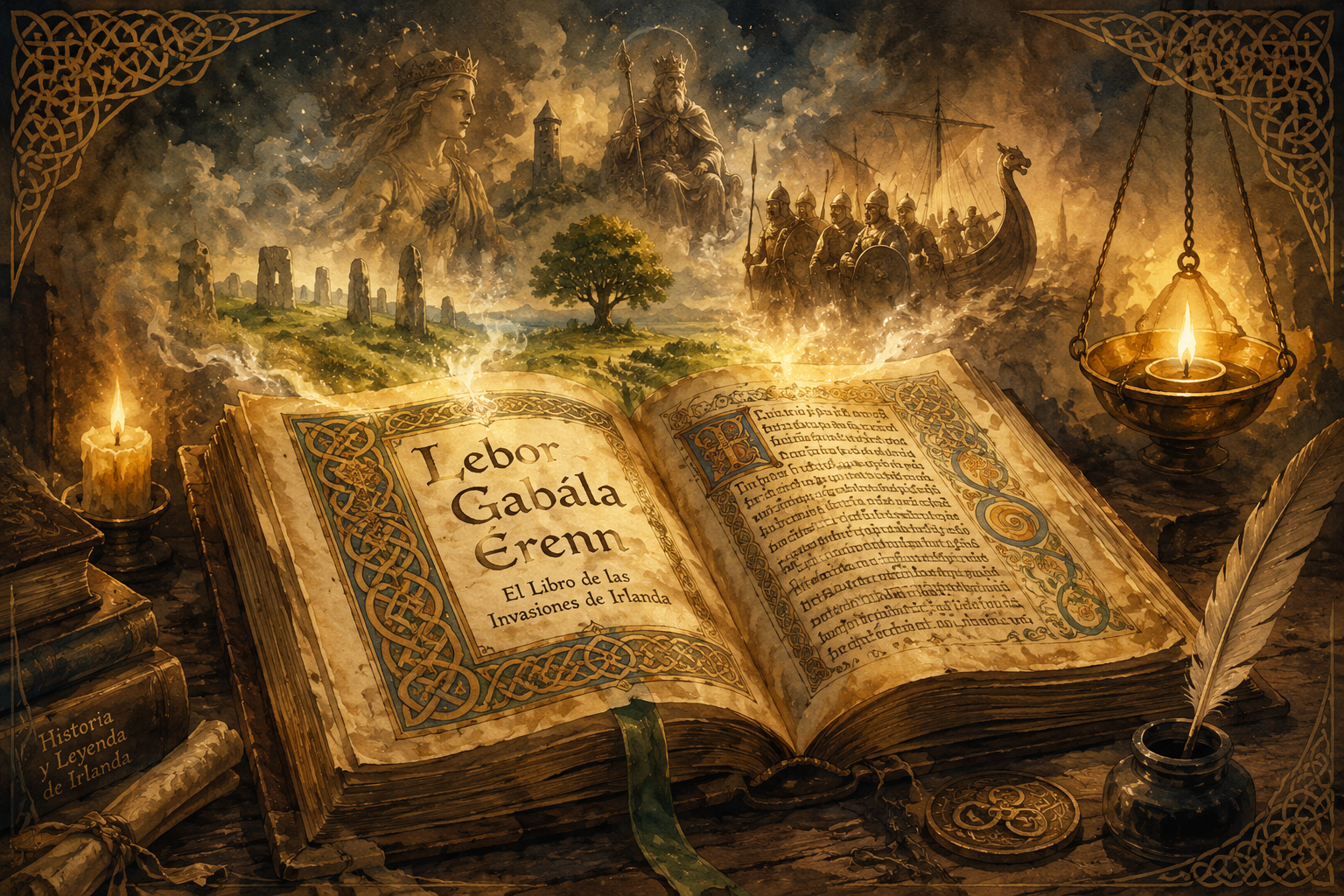
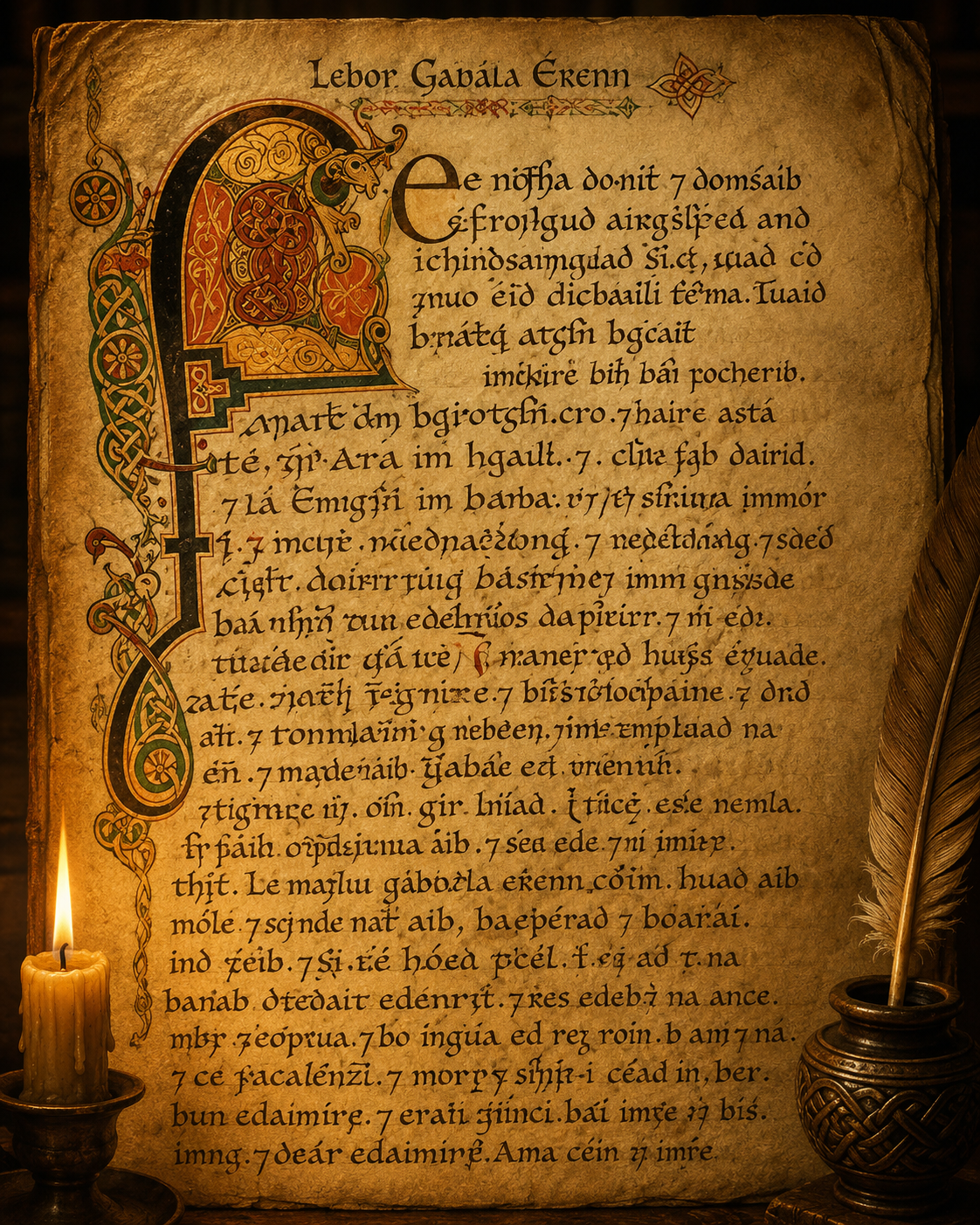
When we talk about the Tuatha Dé Danann, the Fomorians, the Milesians or the ancient mythical invasions of Ireland, much of what we know comes from a medieval work known as the Lebor Gabála Érenn, the The Book of the Taking of Ireland.
It is one of the most important texts in the Irish tradition and one of the principal sources used to reconstruct Ireland's mythology and legendary history.
However, the Lebor Gabála Érenn is not a historical chronicle in the modern sense of the term. Rather, it is a work in which history, legend, genealogy, religion, and mythology are deeply intertwined.
The Meaning of Lebor Gabála Érenn
The name can be translated approximately as:
- Lebor = Book
- Gabála = Takings, Conquests, or Invasions
- Érenn Ireland
For this reason, it is commonly known as The Book of the Taking of Ireland or The Book of the Conquests of Ireland.
The title perfectly reflects the work's central theme: a succession of peoples who arrive in Ireland and claim the island as their own.
Who Wrote the Lebor Gabála Érenn?
The work was compiled by Irish monks and scholars during the Middle Ages, primarily between the 11th and 12th centuries, although it preserves traditions and material that had been passed down for generations and are considerably older.
Its authors sought to integrate Ireland's ancient traditions into the Christian view of the world. As a result, the text combines elements of Celtic mythology with biblical references, genealogies, and narratives inspired by sacred history.
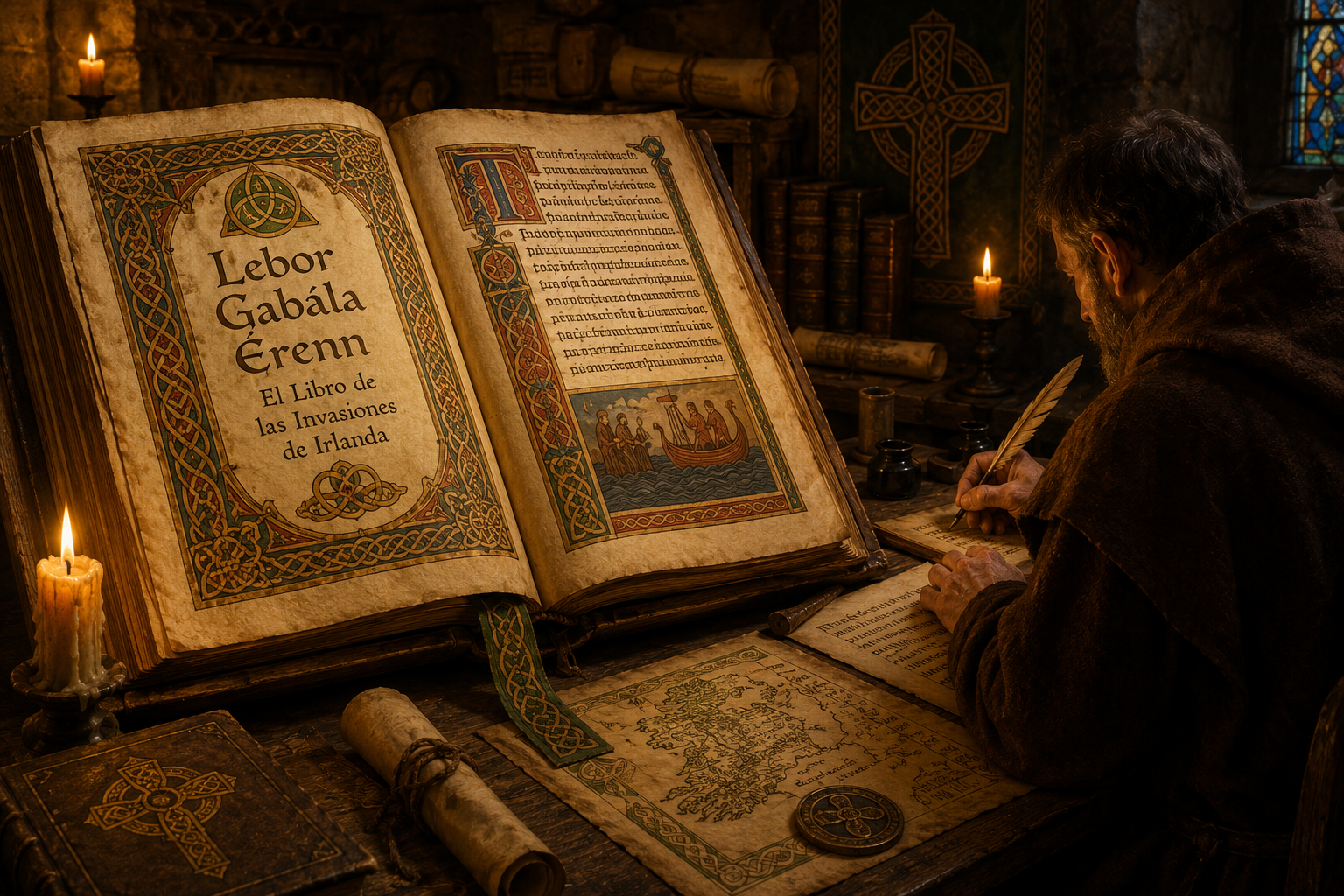
The outcome is a unique account in which legendary heroes, ancient gods, and biblical figures all share the same historical framework.
A Story of Successive Invasions
According to the Lebor Gabála Érenn, Ireland was settled by a succession of different peoples throughout the ages.
Each arrival marks a new chapter in the island's mythical history.
Among the best-known groups are:
- Cessair and her followers
- Partholón and his people
- Nemed and the Nemedians
- the Fir Bolg
- . The Tuatha Dé Danann
- . The Milesians
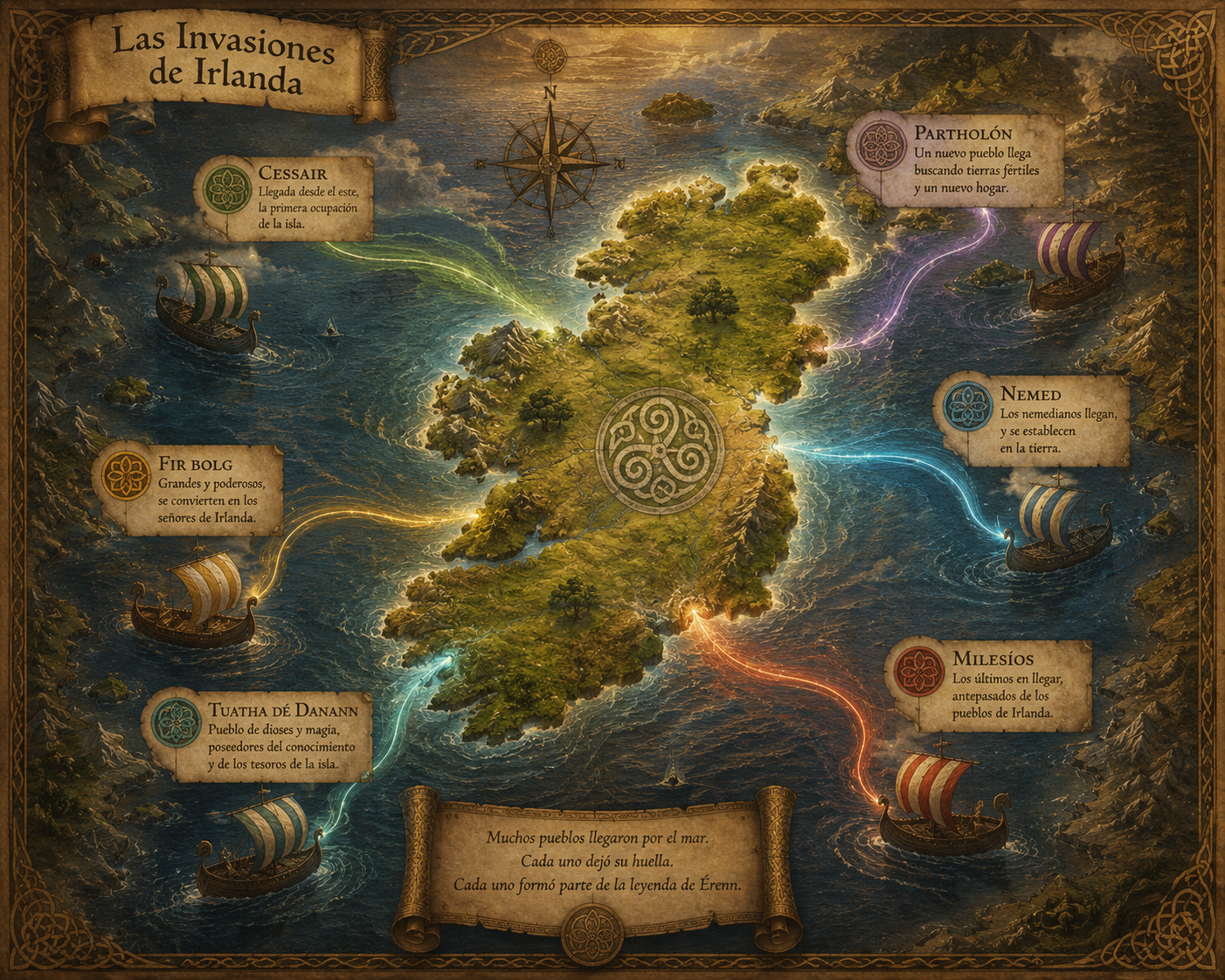
Each of them represents a new invasion, a new conquest, and a new transformation of the Irish world.
The Tuatha Dé Danann and the Milesians
Two of the most important peoples in the narrative are the Tuatha Dé Danann and the Milesians.
The Tuatha Dé Danann are portrayed as extraordinary beings associated with magic, wisdom, and the ancient gods of Ireland. After them come the Milesians, regarded as the mythical ancestors of the Irish people.
La victoria de los Milesios marca uno de los momentos más importantes de toda la tradición irlandesa. Después de su derrota, los Tuatha Dé Danann abandonan el mundo visible y pasan a habitar los sídhe y los territorios del Otherworld.
This episode provides the legendary origin of many of the supernatural beings that would later become known as the Aos Sí.
History or Mythology?
Modern historians regard the Lebor Gabála Érenn as a mythological and literary work rather than a reliable historical account. Its importance, however, is immense.
For centuries, it helped medieval Irish society understand its own origins and place its history within a broader vision of the world.
It also preserves numerous elements drawn from much older traditions that likely predate the arrival of Christianity.
For this reason, the Lebor Gabála Érenn remains one of the fundamental sources for the study of Irish mythology.
A Gateway to Legendary Ireland
More than just a book, the Lebor Gabála Érenn is the great foundation narrative of mythical Ireland.
Its pages are filled with gods, heroes, invasions, battles, kings, and supernatural peoples. Many of the best-known stories of Irish tradition either originate in this work or find their explanation within it.
To understand the Lebor Gabála Érenn is, therefore, to understand the starting point of much of Irish Celtic mythology.
Curiosities
There Is No Single Version
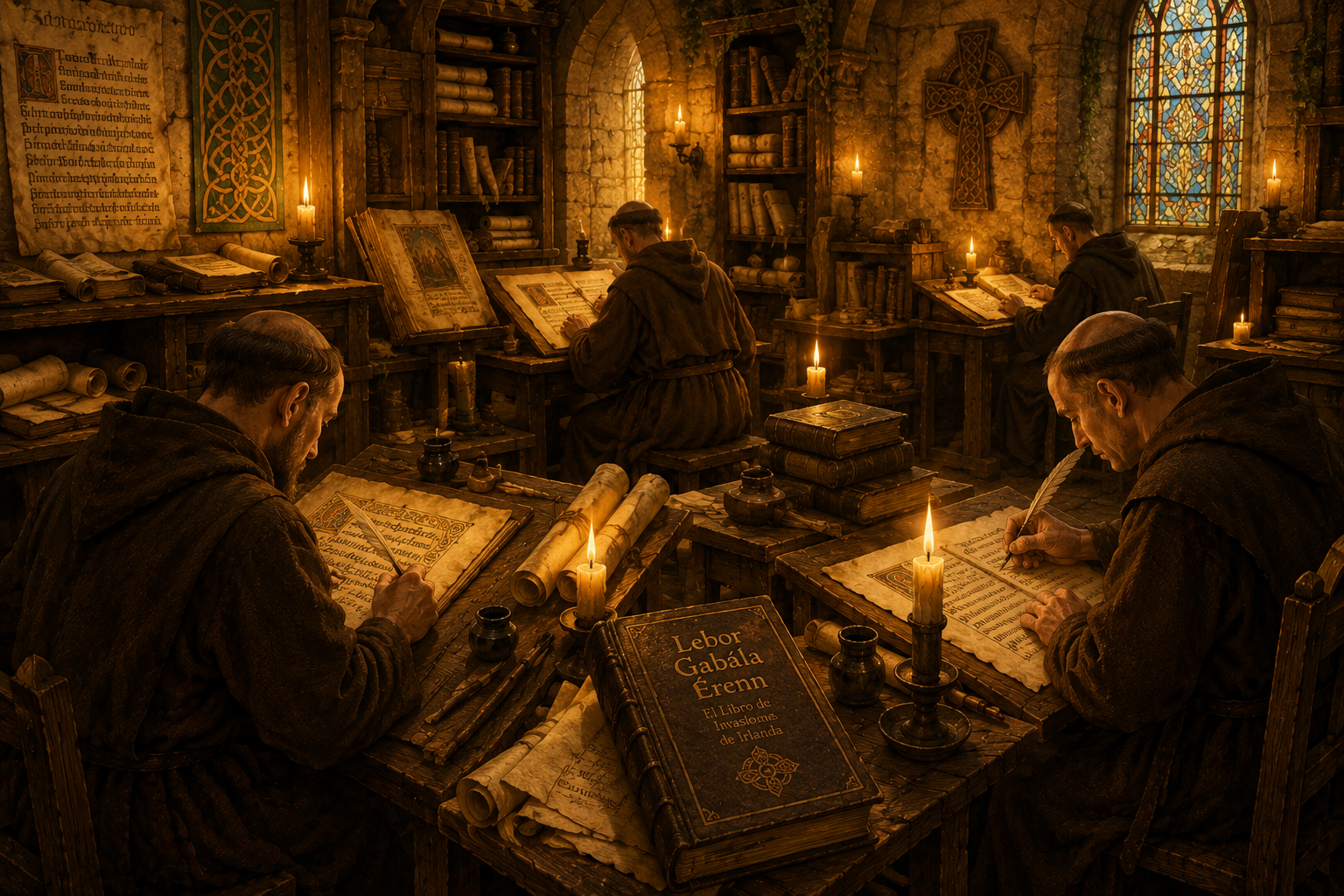
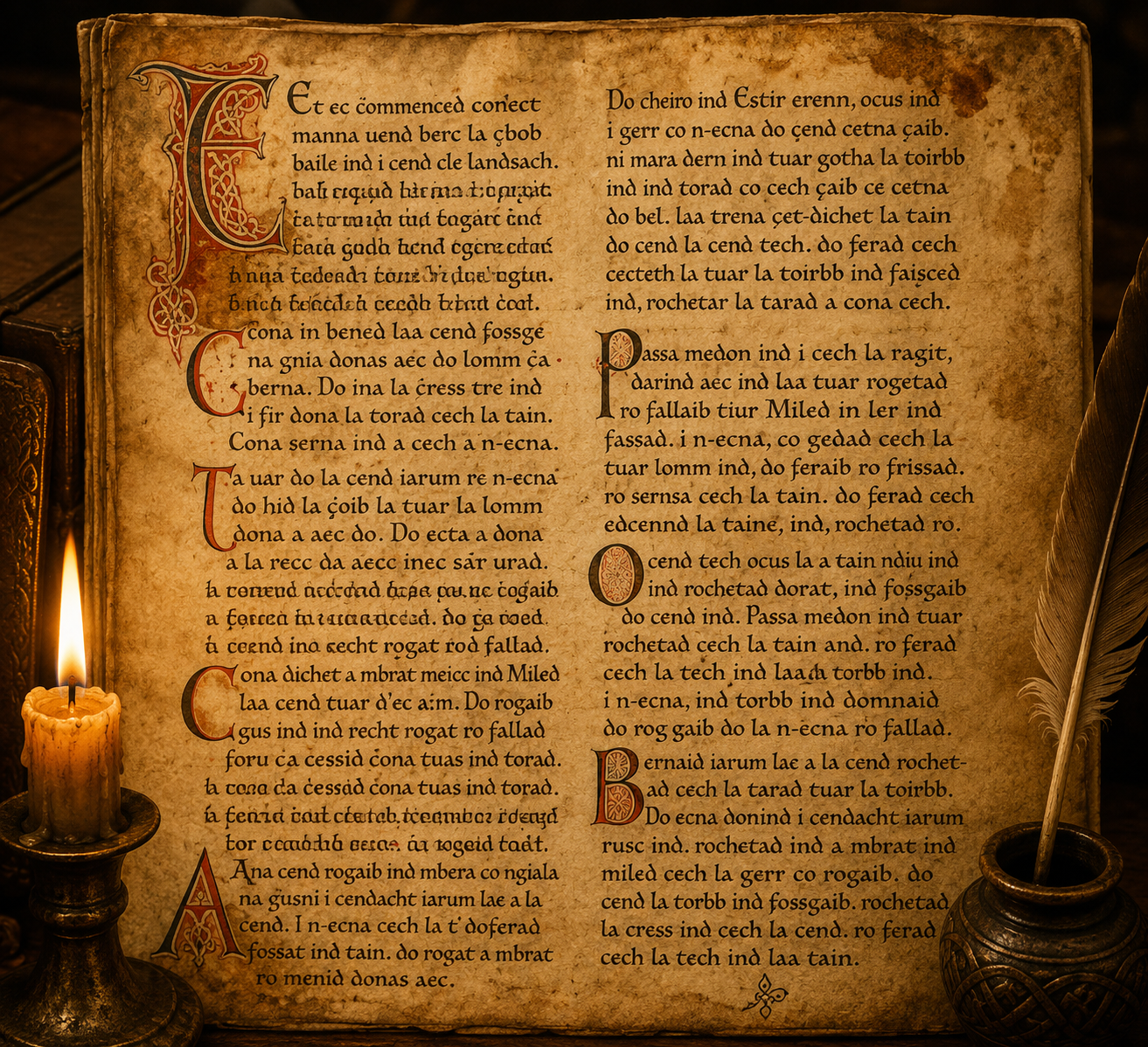
Irish mythology is not preserved in a single book or a single definitive version. Instead, it survives through a vast network of medieval manuscripts.
The versions that have come down to us contain differences, additions, and modifications introduced by various scribes over the centuries.
Among the most important are:
- The Book of Leinster (12th century)
- The Book of Ballymote (14th century)
- The Great Book of Lecan (14th–15th centuries)
- The Book of Lecan (15th century)
- The Yellow Book of Lecan (14th–15th centuries)
- The Book of Armagh (9th century)
- Numerous other smaller manuscripts
The Book of Leinster (Lebor na Núachongbála)
The Book of Leinster is one of the most important surviving medieval Irish manuscripts.
It contains one of the versions of the Lebor Gabála Érenn, but also preserves many of the most significant texts of the Irish tradition, including the celebrated Táin Bó Cúailnge.
The Táin Bó Cúailnge Táin Bó Cúailnge is one of Ireland's great epic legends. Its title is commonly translated as "The Cattle Raid of Cooley" or “The Cooley bull robbery”.
Thanks to manuscripts such as this, an extraordinary wealth of material relating to Irish mythology, literature, and legendary traditions has survived.
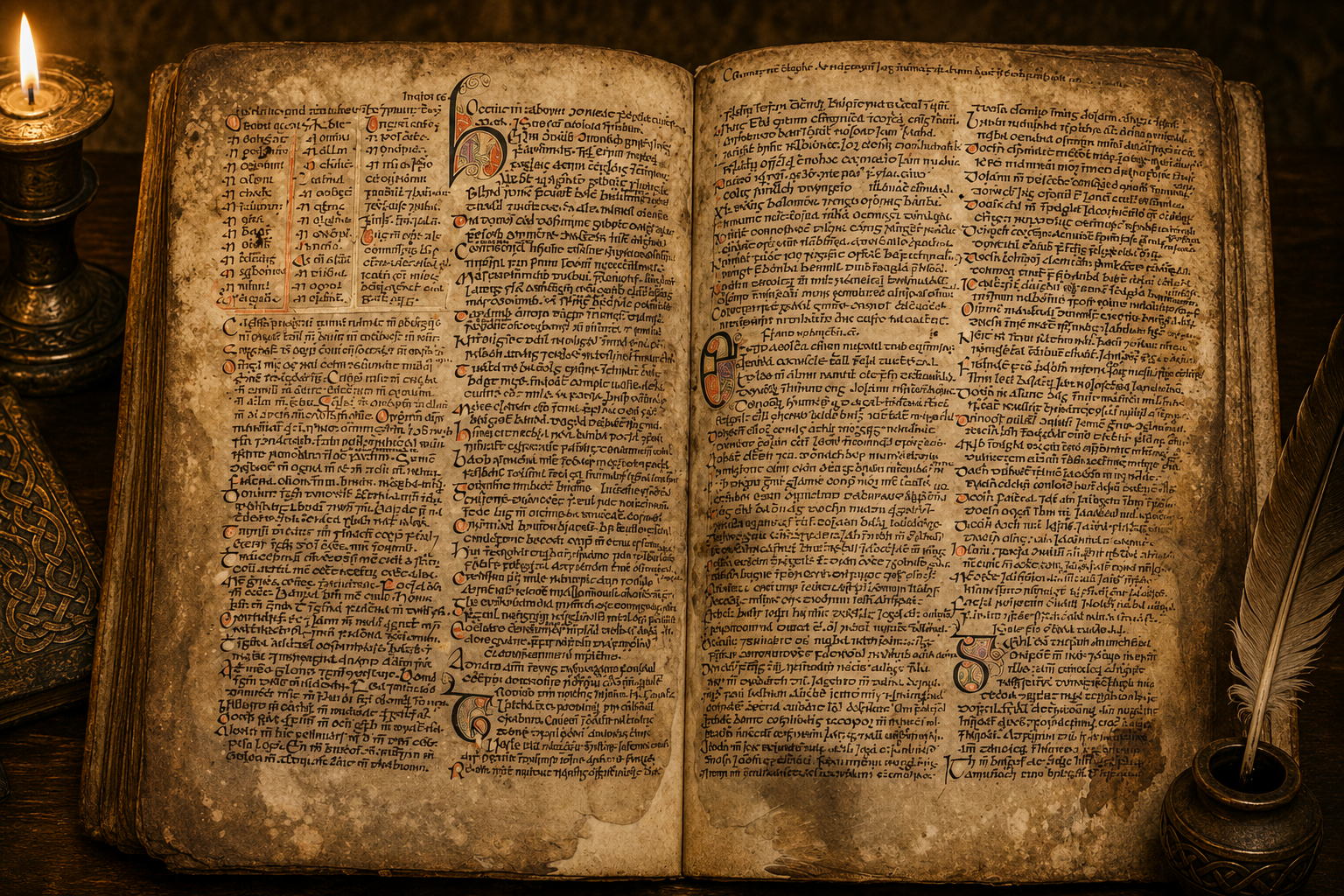
Today, the manuscript is preserved at Trinity College Dublin.
The original is not permanently displayed because of the special conservation conditions it requires, although it can be consulted digitally alongside many of the institution's other historic collections.
An Ireland Connected to the Bible
Medieval authors sought to link Ireland's mythical peoples with the descendants of Noah and other biblical figures.
In doing so, they integrated Ireland's ancient traditions into the Christian vision of universal history.
The Book of Kells
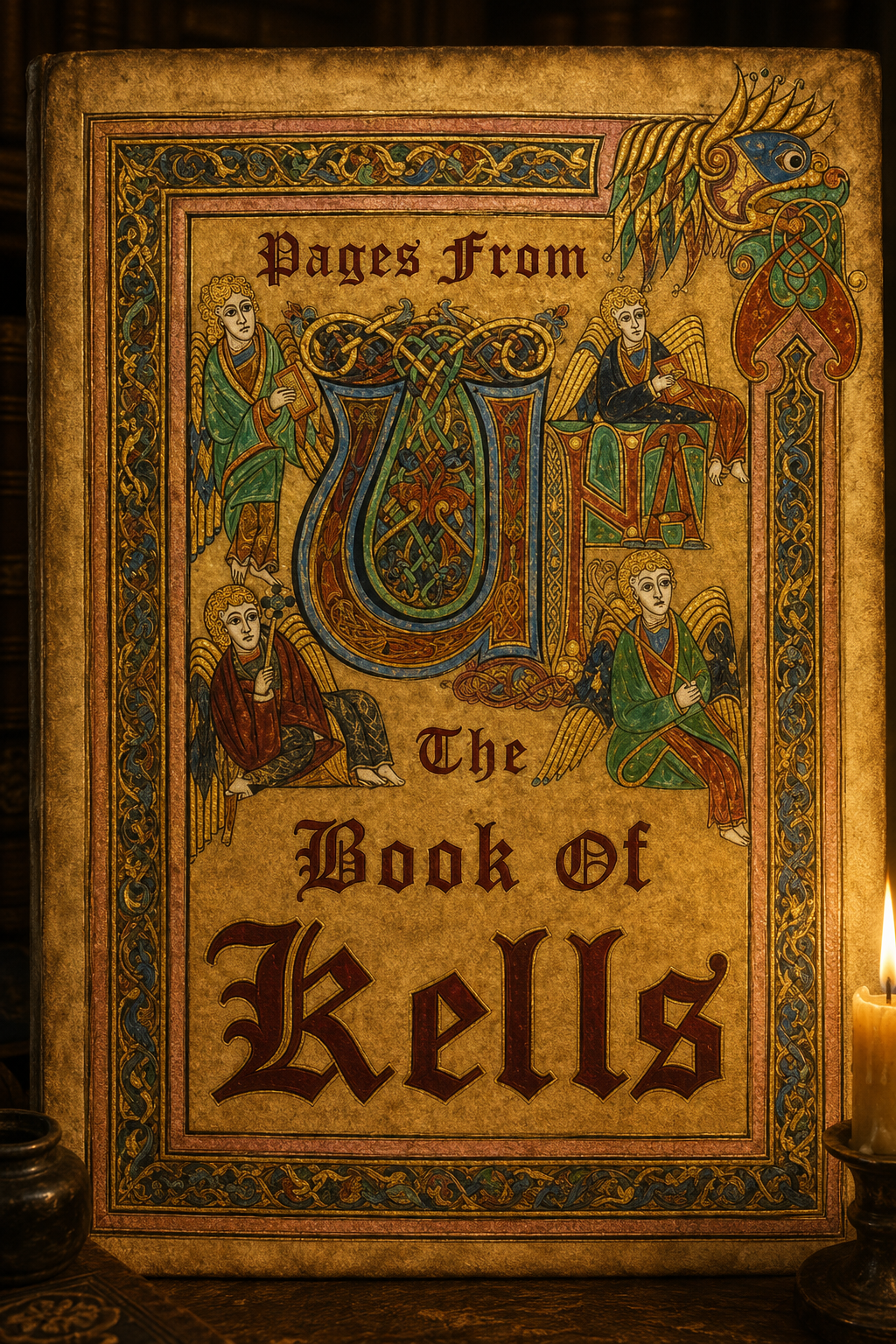
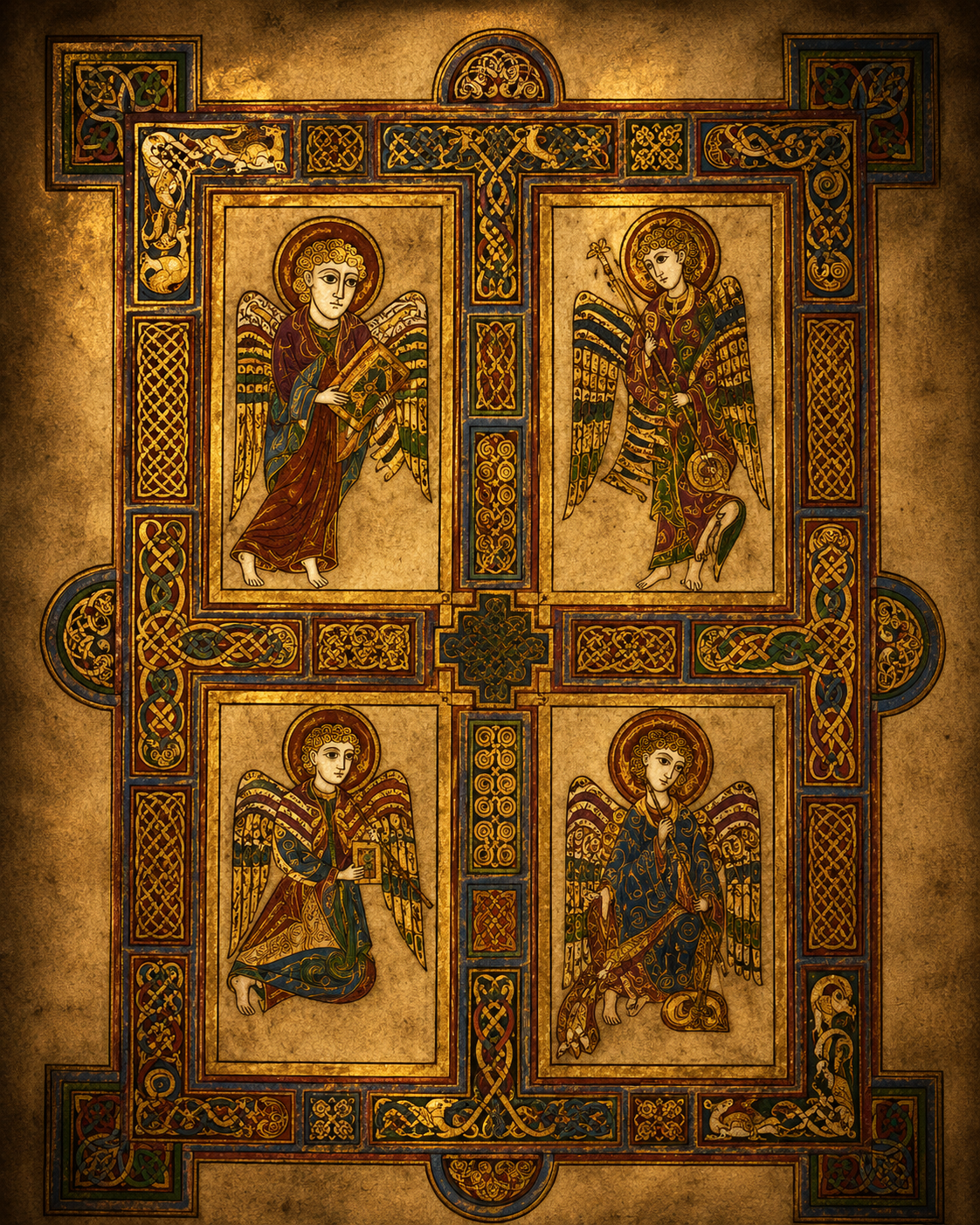
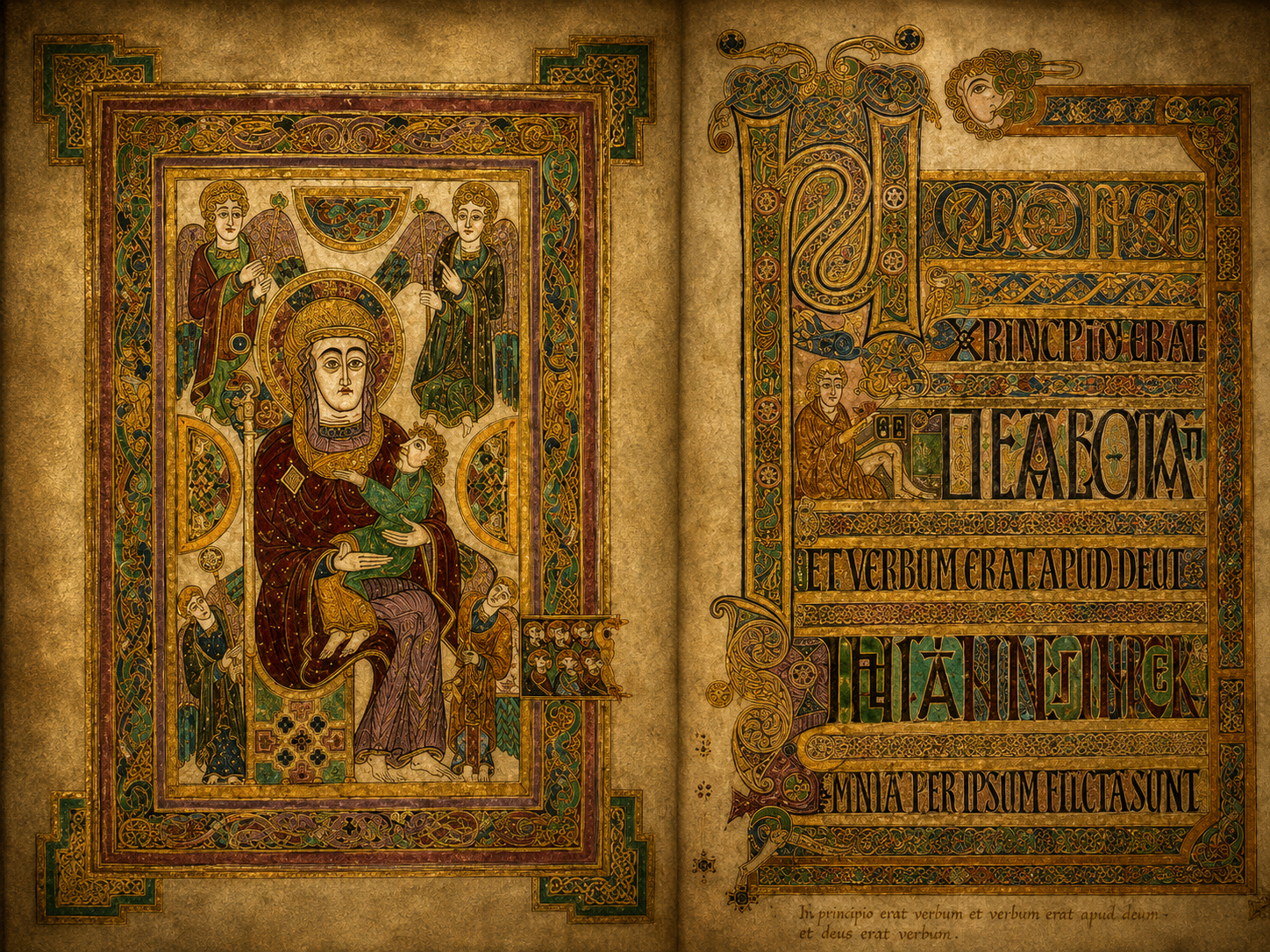
Created between the 8th and 9th centuries, the Book of Kells is probably the most famous Irish Christian manuscript in the world.
It contains the Four Gospels of the New Testament and is celebrated for:
- its magnificent illustrations
- its richly decorated lettering
- its Celtic-Christian Insular art
- its extraordinary artistic achievement
Although its contents are Christian rather than mythological, its pages display a strong influence from Irish Celtic artistic traditions, featuring intricate spirals, Celtic knotwork, and characteristic decorative motifs.
Today, it is preserved and exhibited at the Library of Trinity College Dublin.
Other important Christian manuscripts include:
- the Book of Dimma
- the Book of Durrow
The Foundation of Many Later Traditions
Many of the stories surrounding the Tuatha Dé Danann, the Milesians, the mythical invasions, and the origins of the Aos Sí find their context within the Lebor Gabála Érenn.
For this reason, it remains one of the most frequently cited sources in the study of Irish mythology.
A Book Between History and Myth
The Lebor Gabála Érenn does not seek to tell us what Ireland's past was actually like. Instead, it reveals how medieval Irish scholars imagined their own origins.
It is a narrative in which memory, legend, and mythology intertwine to create the story of an island inhabited by heroes, gods, and peoples who came from the edges of the known world.
Follow the Footprints
Visit It Today...
The Lebor Gabála Érenn has survived thanks to a number of medieval manuscripts preserved in libraries and archives.
Many of the most important are held in:
- Trinity College Dublin, whose historic Old Library houses some of Ireland's most significant heritage collections and the permanent exhibition of the Book of Kells.
- The Royal Irish Academy , founded in 1785, which preserves an important collection of medieval manuscripts.
- The National Library of Ireland, , founded in 1877.
- The Bodleian Library at the University of Oxford, one of the oldest libraries in Europe.
- The British Library, , one of the largest libraries in the world and home to countless historical manuscripts.
- Various university collections and specialised archives.