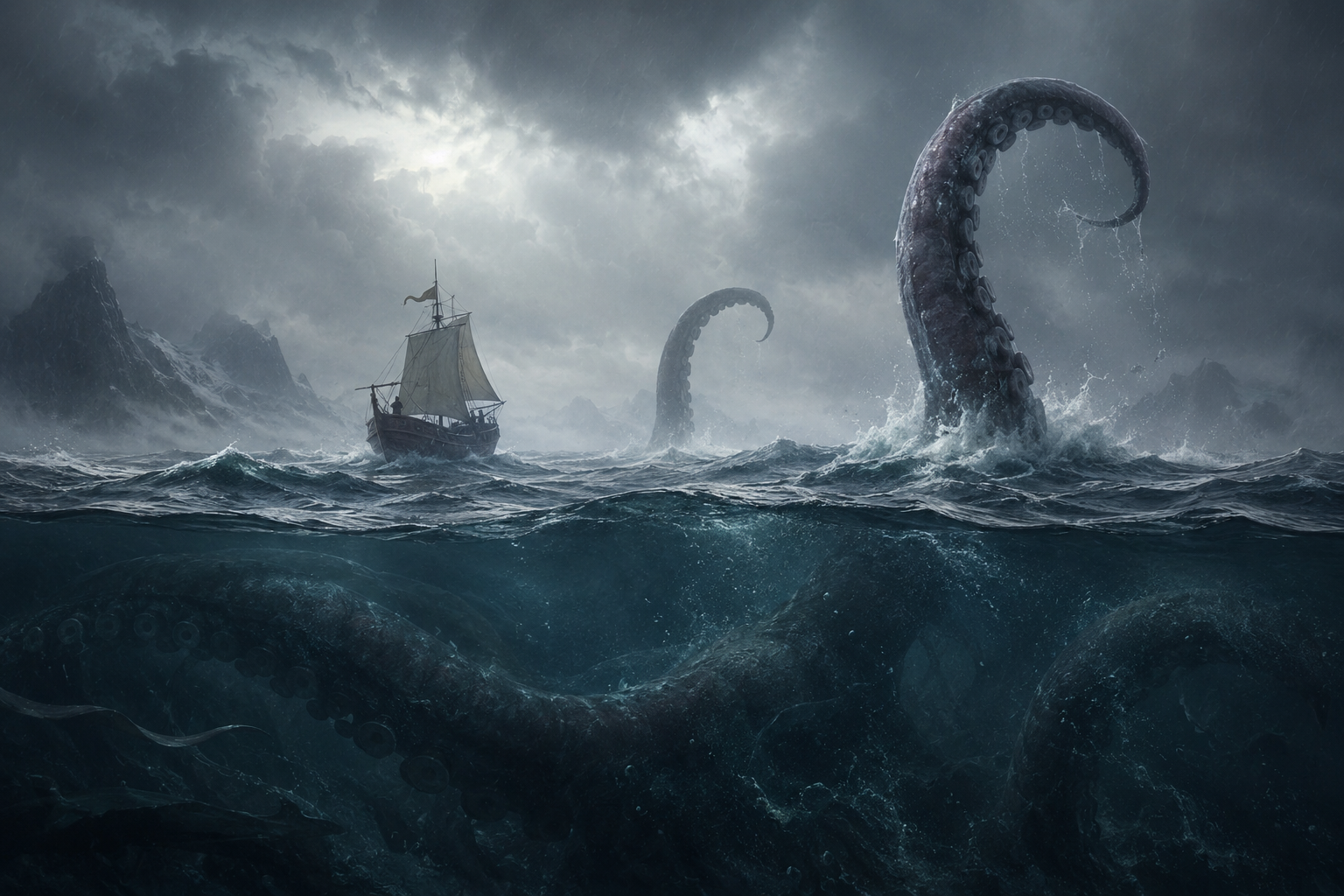
Long before it appeared in novels, films, or video games, sailors from Northern Europe spoke of a gigantic creature that dwelled in the depths of the ocean.
A beast so enormous that some claimed to mistake it for an island. That creature was the Kraken.
Today, it is considered one of the world's most famous sea monsters, but its origins lie in the ancient traditions and stories of Scandinavian sailors.
Caught between reality, legend, and the fear of the unknown, the Kraken became one of the most feared creatures of the northern seas.
Description of the Kraken
The earliest descriptions portray the Kraken as a colossal sea creature.
Its size was said to be so immense that it dwarfed any known ship. When it surfaced, some sailors believed they were looking at a small rocky island. Only when it began to move did they realize it was no solid ground.
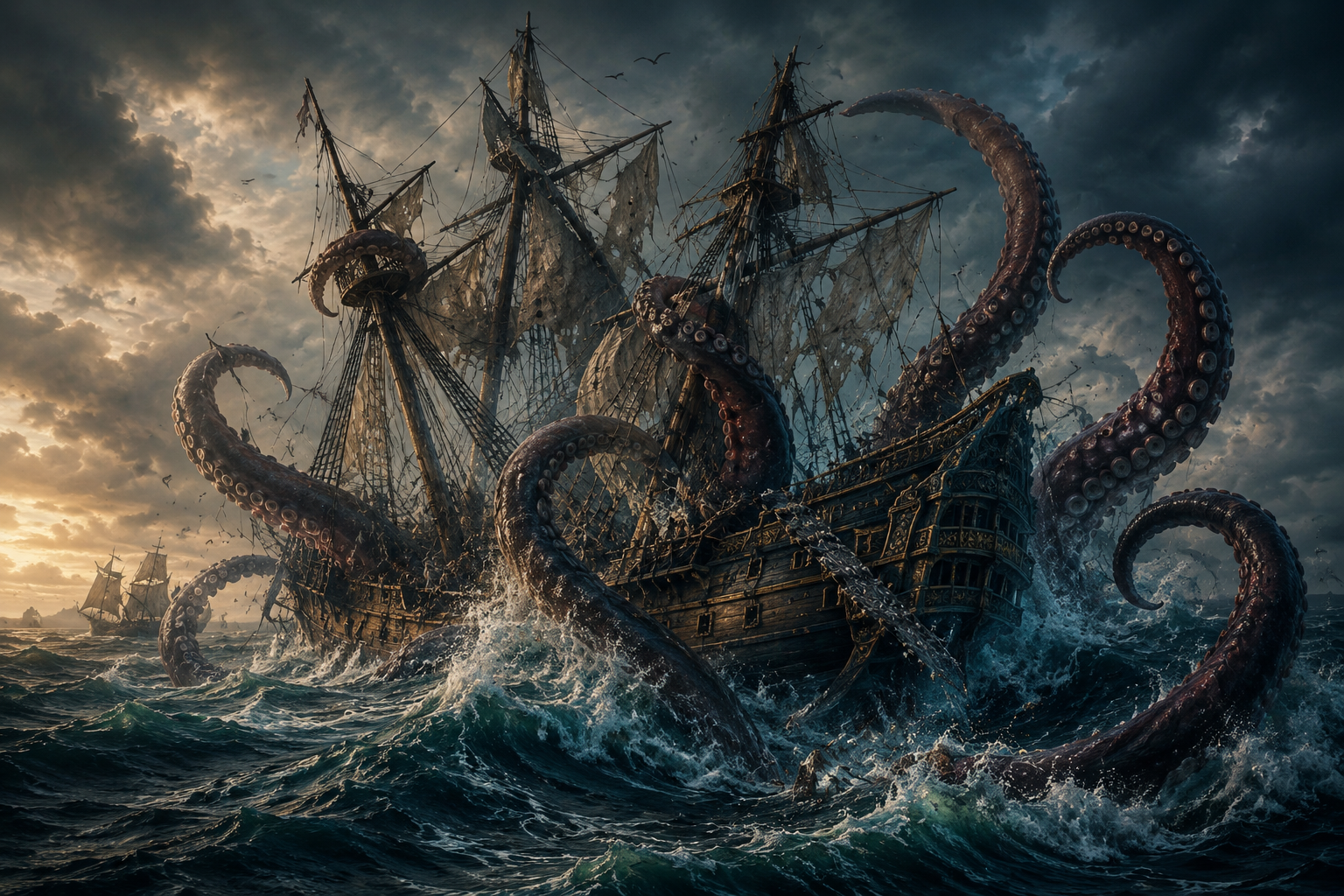
According to legend, the Kraken could sink entire ships with its enormous tentacles or drag them into the depths.
The most widely accepted explanation for its name is that it comes from the Norwegian word krake, , meaning something strange, monstrous, or deformed.
Some stories describe what appeared to be a surface covered in seaweed and rocks, which was in fact the monster's back.
The Kraken in Norse Tradition
Although today it is mostly associated with modern fantasy, the Kraken has its roots in the folklore of Norway and Iceland.
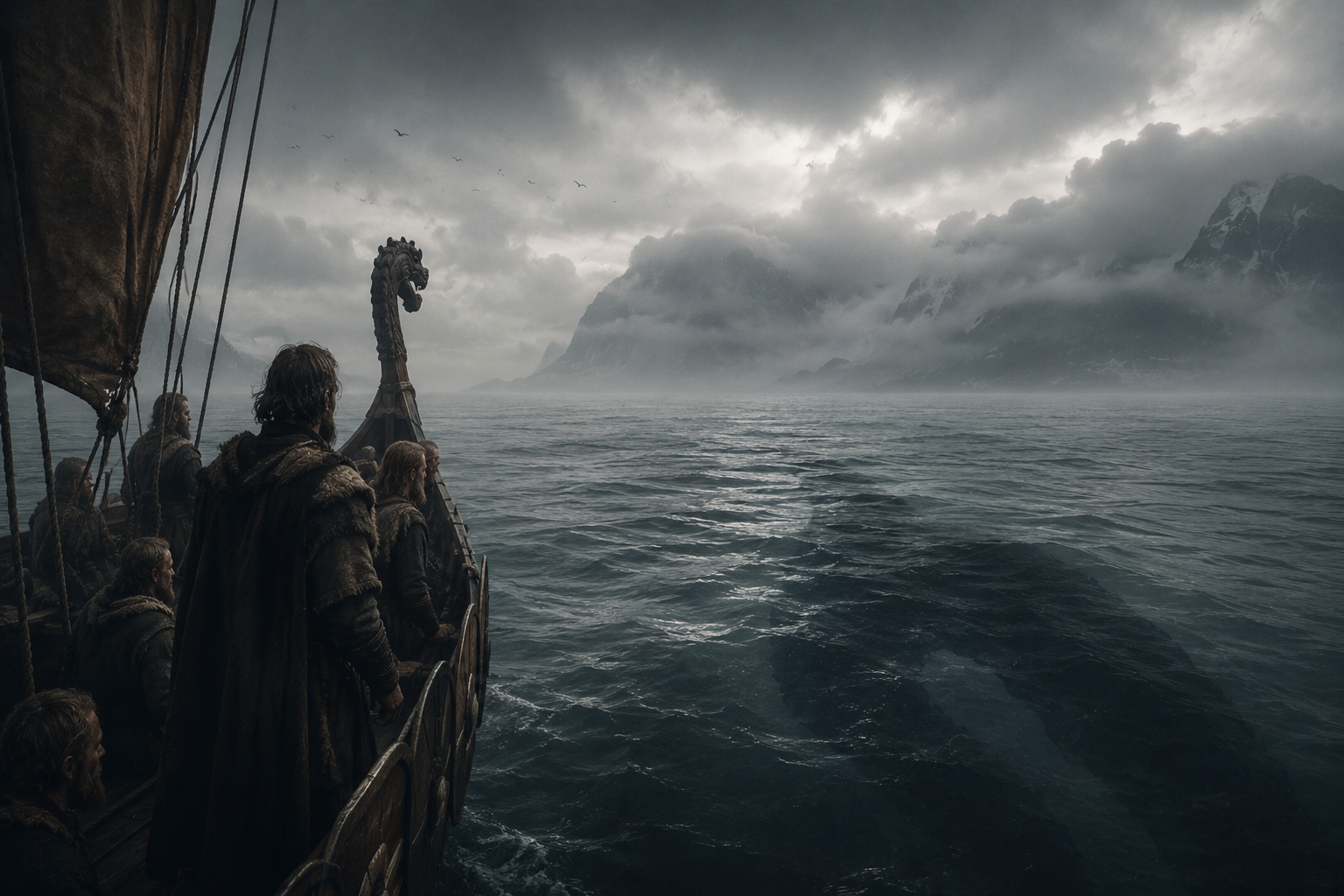
Stories about the creature circulated among fishermen and sailors who navigated the cold waters of the North Atlantic, particularly between the sixteenth and eighteenth centuries.
At a time when much of the ocean remained unexplored, any unusual phenomenon could become an extraordinary tale.
Sudden storms, whirlpools, large shoals of fish, or sightings of unfamiliar sea creatures fueled maritime legends for centuries.
The Kraken was commonly said to inhabit:
- The coast of Norway, especially the Lofoten Islands and the Nordland region
- Waters surrounding Iceland
- The North Atlantic Ocean
The Earliest References
Norwegian Origins: Hafgufa
One of the oldest predecessors of the Kraken is often linked to Hafgufa, a gigantic sea creature described in the Konungs skuggsjá (The King's Mirror), a Norwegian work from the thirteenth century.
Although it is not called the Kraken, many scholars believe it helped shape the later legend.
Olaus Magnus (1490–1557)
Olaus Magnus was a Swedish clergyman and writer.
In 1555, he published Historia de gentibus septentrionalibus (History of the Northern Peoples), in which he described enormous sea creatures inhabiting the northern seas and attacking ships.
The Birth of the Kraken
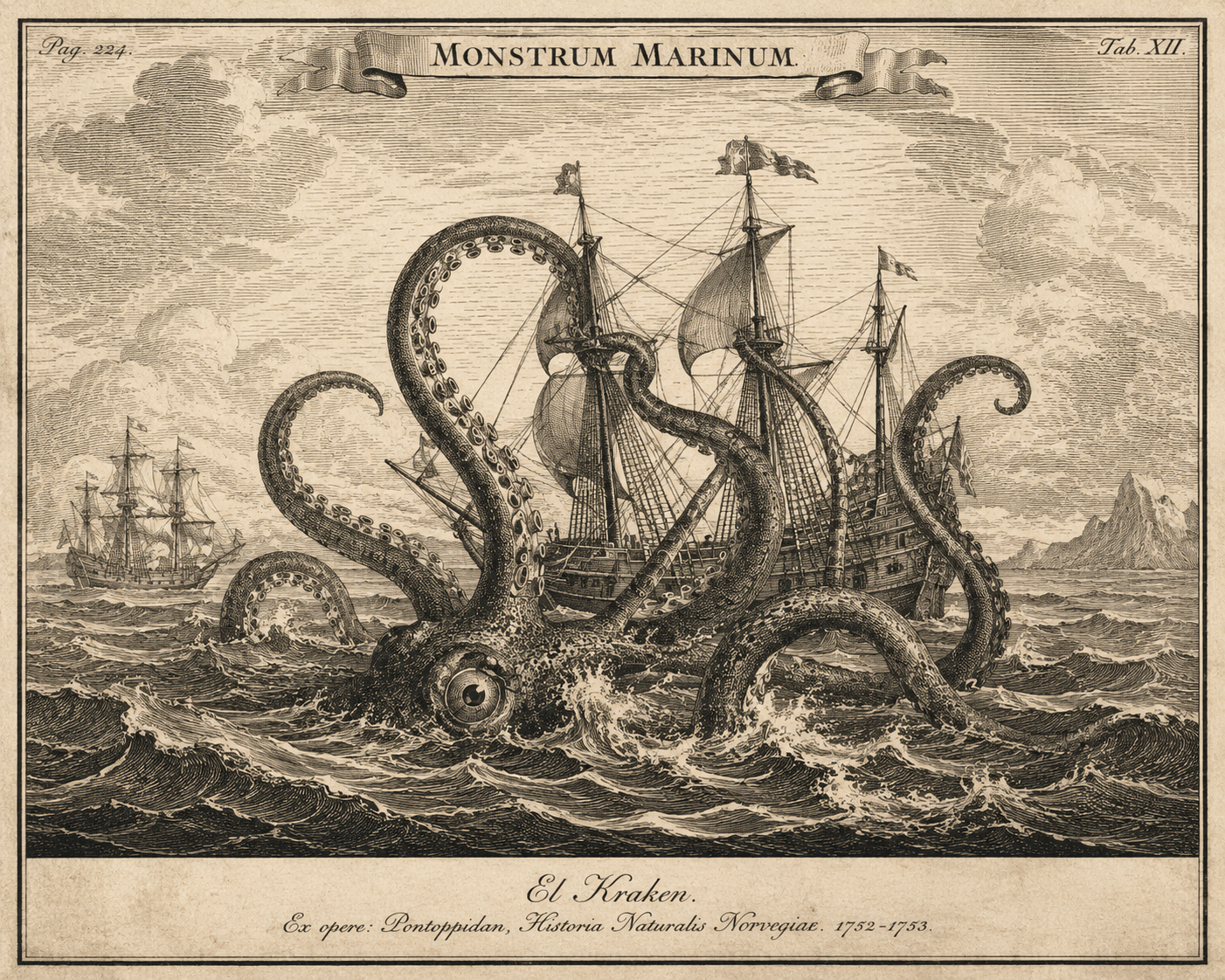
The legend gained its greatest momentum thanks to Erik Pontoppidan (1698–1764), a Danish bishop and naturalist.
In his work The Natural History of Norway published between 1752 and 1753, he described a creature that was:
- enormous
- larger than any ship
- island-like
- capable of creating whirlpools
- able to sink vessels
It is in this work that the name Kraken first appears associated with the sea monster.
Pontoppidan collected testimonies and traditions from Norwegian fishermen and sailors, playing a decisive role in popularizing the creature throughout Enlightenment Europe.
According to these accounts:
- it rose from the depths
- attracted enormous schools of fish
- fishermen approached confidently
- the monster submerged once again
- a gigantic whirlpool formed
- ships disappeared
Some versions even claimed it could drag entire vessels beneath the waves.
A Monster of Maps and Tales
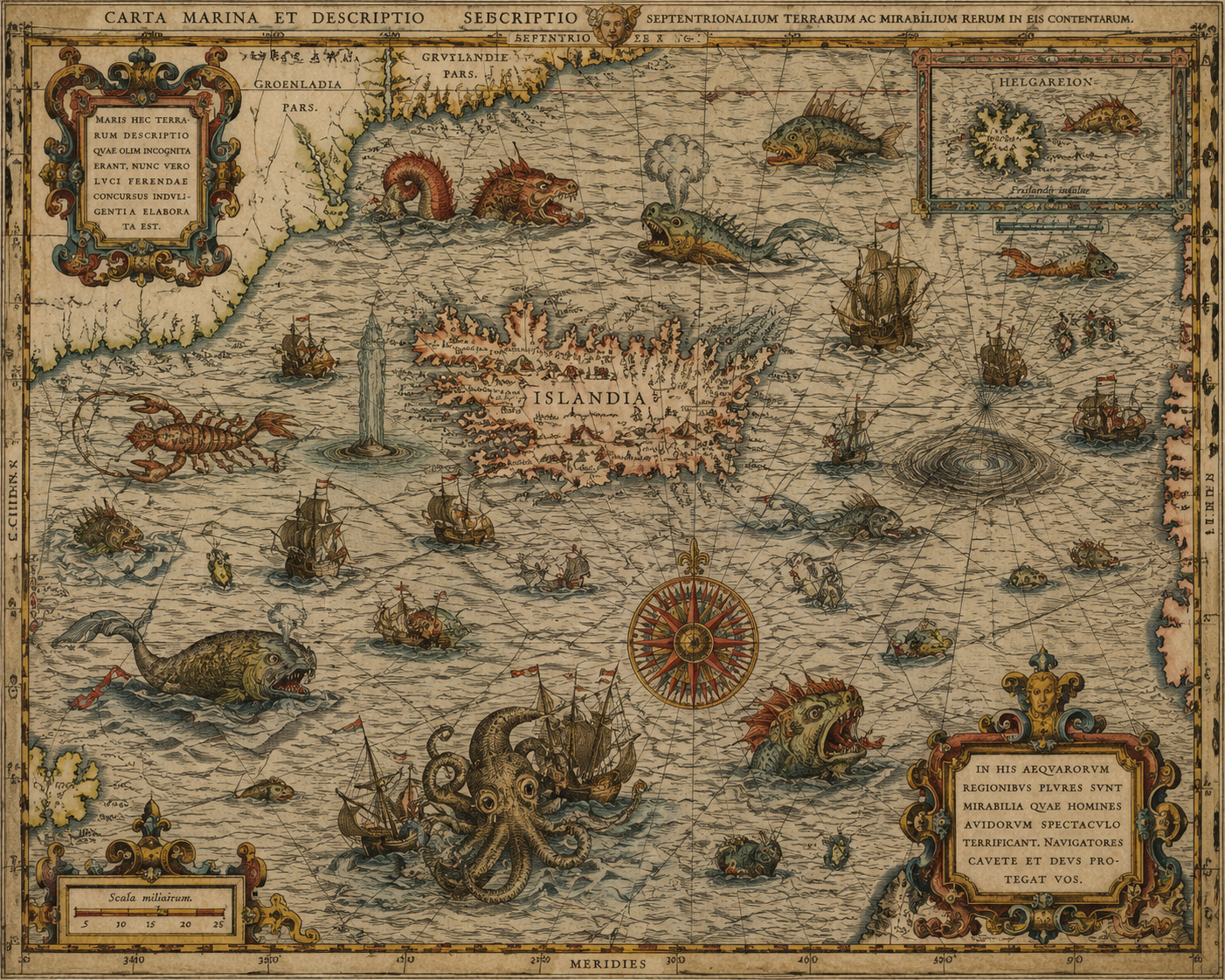
During the Middle Ages and the Renaissance, it was common to depict sea monsters in little-explored regions of maps.
Although the famous phrase "Here be monsters" has become widely known, illustrations of fantastic creatures were actually far more common than that specific inscription.
These images served several purposes:
- warning
- decoration
- imagination
They symbolized the dangers of the sea and the limits of human knowledge.
Although the Kraken was not always identified by name, many of these illustrations resemble the gigantic creature described in Norse legends.
Large sea monsters appear most frequently on maps between the fifteenth and seventeenth centuries. As navigation improved and geographical knowledge expanded, these creatures gradually disappeared from cartography.
Did It Really Exist?
There is no evidence that a creature matching the legendary descriptions ever existed.
However, the existence of giant and colossal squids proves that the oceans are home to animals capable of inspiring extraordinary stories.
For sailors of past centuries, finding the remains of such creatures or seeing enormous tentacles emerging from the deep would have been more than enough to inspire tales passed down from generation to generation.
Myth / Reality
Many researchers believe the myth may have been inspired by encounters with a real animal: the giant squid.
For centuries, sailors discovered:
- enormous tentacles floating at sea
- strange carcasses washed ashore
- cephalopod remains on beaches
- circular sucker marks on sperm whales
Especially in regions such as:
- Norway
- Iceland
- Newfoundland
These animals are real and can reach astonishing sizes. For centuries, little was known about them because they inhabit great depths and rarely reach the surface.
By the late nineteenth century, the first scientific evidence confirming the existence of giant squids had begun to accumulate.
For a medieval sailor, encountering one of these animals must have been an unforgettable experience.
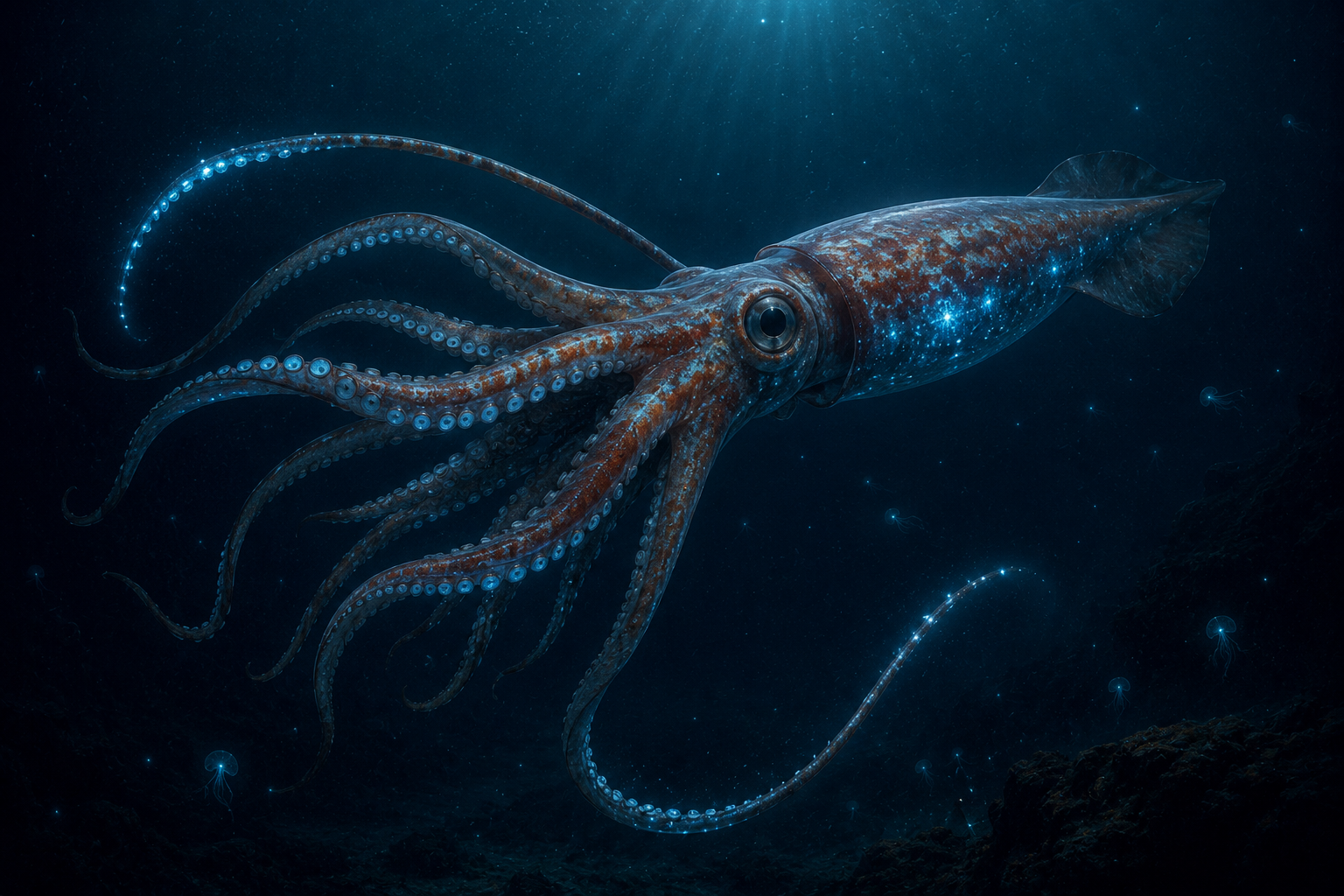
Even so, the legendary Kraken was far larger than any known real creature.
The Kraken and Sperm Whales
Sperm whales are the primary predators of giant squids.
Many individuals bear circular scars caused by the enormous suckers of these cephalopods during battles fought in the deep ocean.
For centuries, these marks helped fuel stories of gigantic sea monsters fighting beneath the waves, far beyond human sight.
From Folklore to Popular Culture
Over time, the Kraken left sailors' legends behind and became a universal figure.
It was especially during the eighteenth and nineteenth centuries that it began appearing regularly in tales of exploration and maritime adventure.
Unknown seas, mysterious islands, and ocean monsters fascinated readers around the world.
Jules Verne & Howard Phillips Lovecraft
Jules Verne (1828–1905)
In 1870, Jules Verne published Twenty Thousand Leagues Under the Seas..
In one of the novel's most famous scenes, the Nautilus battles a gigantic squid.
Although Verne never explicitly identifies it as the Kraken, the influence of the ancient northern sea legends and the recent discoveries of giant cephalopods is unmistakable.
H. P. Lovecraft (1890–1937)
In his work In The Call of Cthulhu (1928), Lovecraft described a creature that resembles the Kraken in several respects.
Although Cthulhu is not a giant squid, it shares many characteristics:
- it dwells in the depths
- it possesses colossal size
- it inspires terror
- it belongs to an unknown world
- it occasionally rises from the sea
Lovecraft transformed the ocean into one of the central settings of his universe of cosmic horror.
Curiosities
It Is Connected to the Giant Squid
Many specialists believe that sightings of large cephalopods may have inspired part of the legend.
One of the World's Most Famous Sea Monsters
Few legendary creatures have made the transition from local folklore to global popular culture as successfully as the Kraken.
The Terror Beneath the Waves
For ancient sailors, the ocean was a place filled with mysteries. Beyond familiar routes lay storms, monsters, and unknown lands.
Over the centuries, the Kraken and the giant squid gradually drew closer together until they merged in the collective imagination.
The Kraken was born from humanity's ancient fear of the deep. A creature that embodied everything people could neither control nor understand.
And perhaps that is why it continues to fascinate us centuries later.
Follow the Footprints
Visit It Today...
The Natural History of Norway
Erik Pontoppidan's work remains one of the most important historical sources for understanding the evolution of the Kraken legend.
Today, copies and digitized editions can be consulted at institutions such as:
- The Royal Danish Library
- The National Library of Norway
- British Library
- Universities and specialized libraries
NTNU University Museum of Natural History and Archaeology (Trondheim, Norway)
This museum preserves important historical records and specimens of giant squids found along the Norwegian coast, including some of the country's most famous documented examples.
It is one of the best places to discover the connection between the legend of the Kraken and real marine biology.