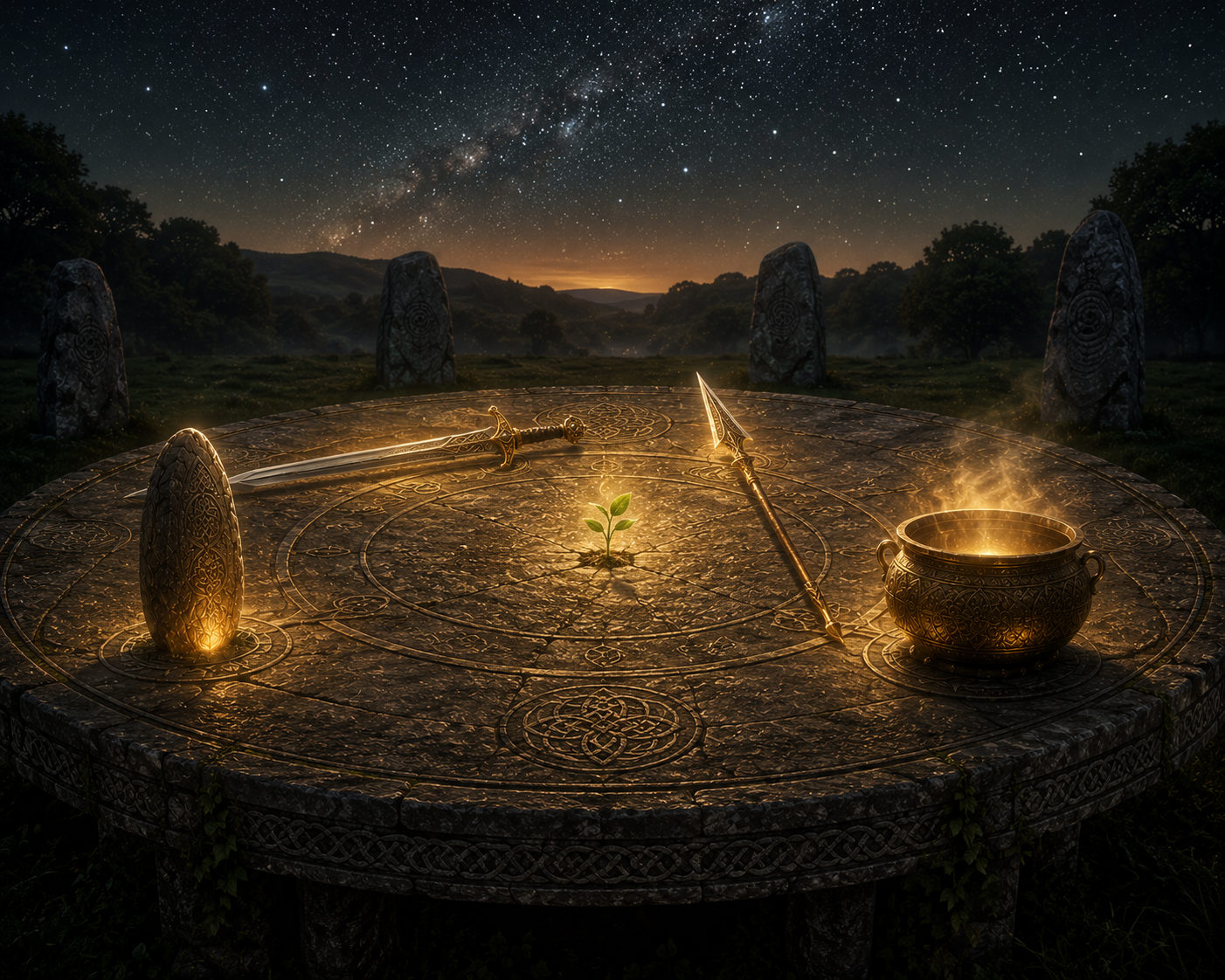
Before arriving in Ireland, the Tuatha Dé Danann received four extraordinary objects that would become some of the most important symbols in all of Celtic mythology.
They were not merely weapons or relics. Each represented an essential quality of kingship: sovereignty, strength, justice, and abundance.
Tradition tells that these treasures were given by the wise men of the four cities of the north before the Tuatha embarked on their journey to Ireland.
Over the centuries, their stories would inspire some of the most famous legends in Europe.
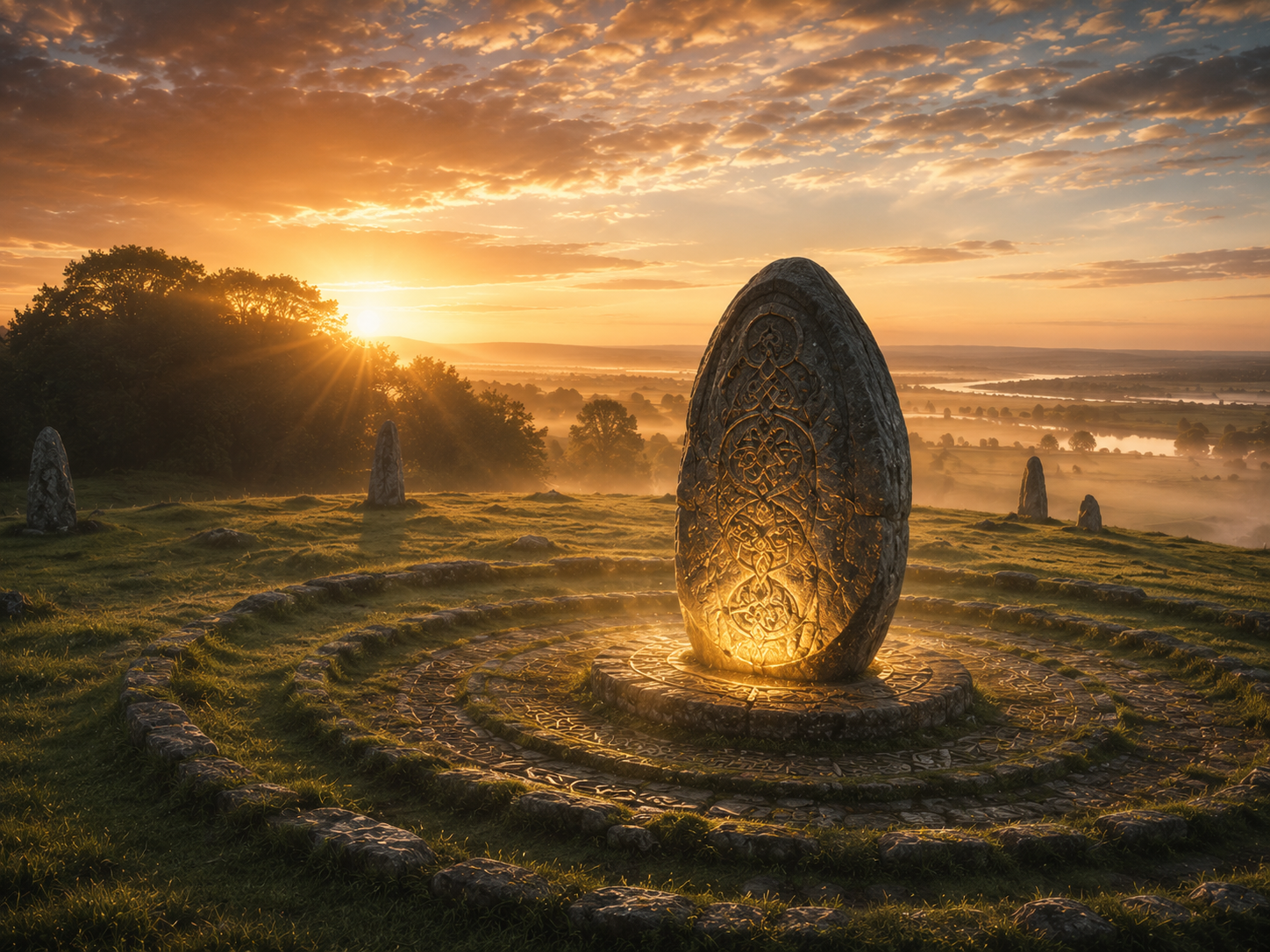
The Stone of Fal (Lia Fáil): The Stone of Sovereignty
Originating from Falias, the Lia Fáil was known as the Stone of Destiny.
It is the only one of the Four Treasures that never truly belonged to an individual. The stone belonged to Ireland itself and symbolised the island's sovereignty.
According to tradition, it roared whenever the rightful High King of Ireland placed his feet upon it during the coronation ceremony. Some versions also claim that it shone with its own light, granted prosperity as long as the king ruled justly, and served as a sacred bond between the land and Ireland's sovereignty.
It became the supreme symbol of the legitimate right to rule.
Cuando los Tuatha Dé Danann derrotaron a los Fir Bolg en la Primera Batalla de Mag Tuired, la tradición sitúa sobre ella la proclamación de Nuada Airgetlám (Nuada of the Silver Hand) upon the Lia Fáil as he was proclaimed king.
Over time, it was said that the stone ceased to roar. Several explanations exist, though the best known maintains that it recognised only truly rightful kings and that, over the centuries, this sacred connection was gradually lost.
Nuada's Sword
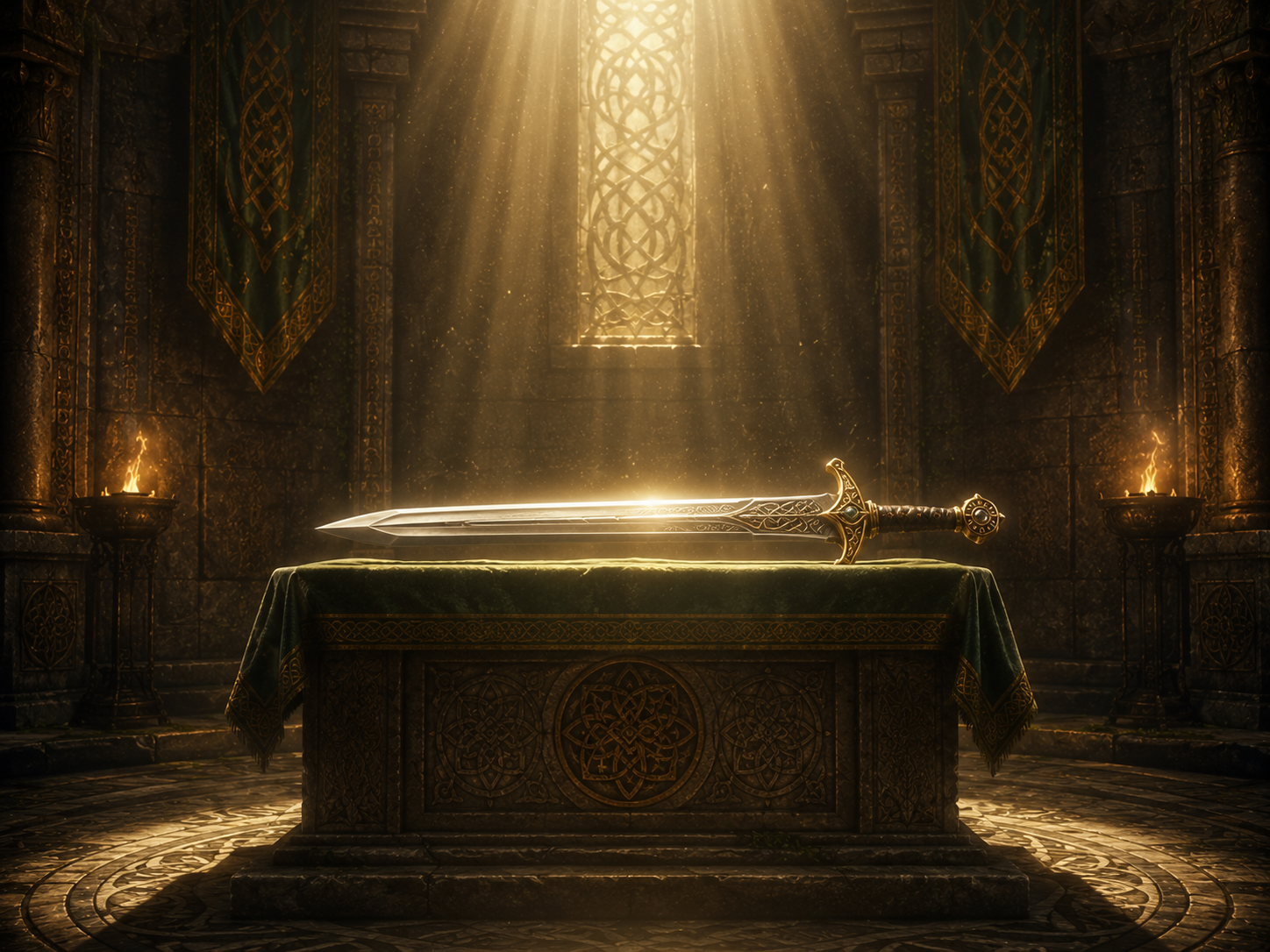
This treasure came from Findias. Legend held that once it was drawn from its sheath, no one could escape it.
It never failed. It was never defeated.
It represented:
- justice
- authority
- legitimate power
It eventually became associated with Nuada, the first king of the Tuatha Dé Danann.
According to the sources, Nuada lost an arm during the First Battle of Mag Tuired and, although he ceased to reign for a time, he kept the sword.
After the Tuatha Dé Danann withdrew from the visible world, the sources no longer mention this treasure. Some scholars believe that its disappearance symbolises the end of the Tuatha Dé Danann's sovereignty over Ireland.
Lugh's Spear
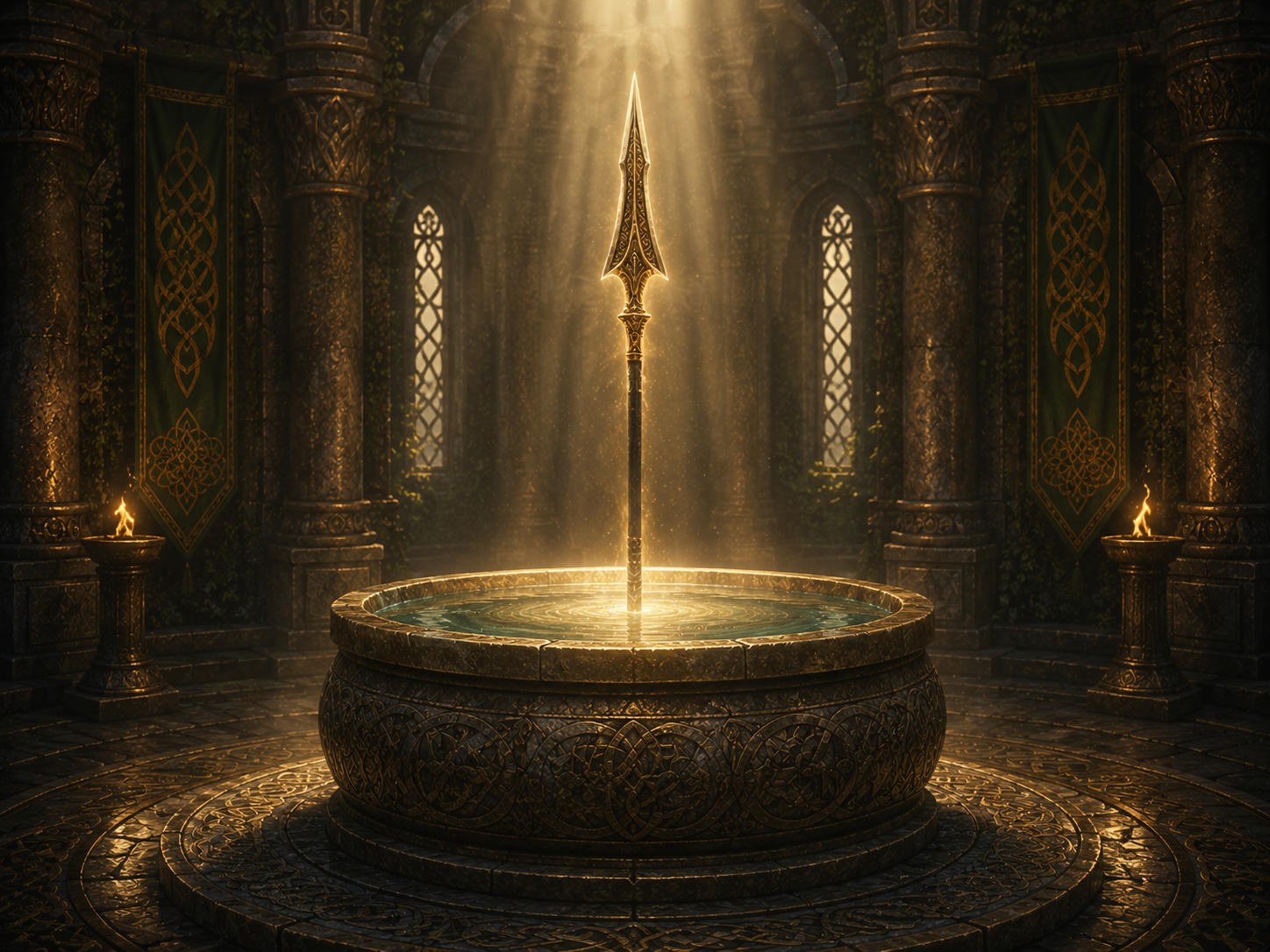
This treasure came from Gorias. It was an irresistible weapon.
The spear eventually came into the hands of Lugh, the god of many skills, known as Samildánach, "the Many-Gifted."
It symbolised inevitable victory.
The traditions state that once thrown, it always found its target. Some versions even claim that the spear possessed such immense power and such an insatiable thirst for battle that it had to be kept submerged whenever it was not in use, lest its fiery nature set the world ablaze.
The various sources preserve different traditions. Some speak of a vessel filled with water, others of a great cauldron, while others describe poppy leaves used to calm its power.
During the Segunda batalla de Mag Tuired, Lugh utilizó esta lanza contra Balor del Ojo Maligno. Sin embargo, las fuentes no coinciden en el arma exacta con la que fue derrotado: algunas tradiciones hablan de la lanza, mientras que otras describen que Lugh empleó una honda y una piedra para atravesar el ojo de Balor. Ambas versiones conviven dentro de la tradición.
The Dagda's Cauldron
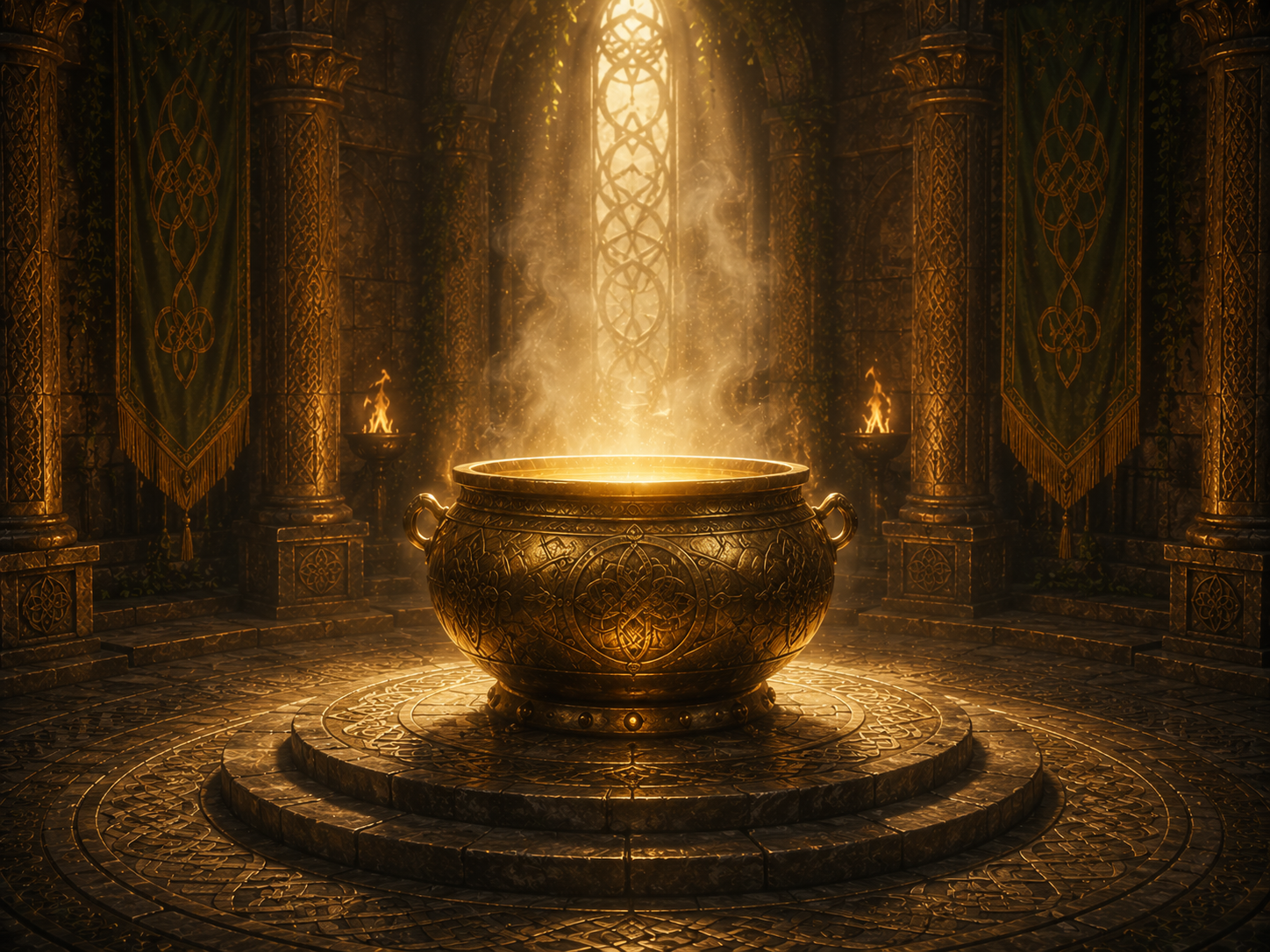
This treasure came from Murias. It was not a weapon. It was a cauldron.
Yet no warrior ever left its feast without being completely satisfied.
It never ran empty. Food was never lacking.
It represented:
- abundance
- hospitality
- prosperity
It eventually became associated with the the Dagda, famous for his enormous appetite. In one story, his enemies attempt to humiliate him by preparing an enormous cauldron of food that they believe no one could possibly finish. The Dagda consumes every last morsel, reinforcing his image as the god of abundance and fertility.
More Than Simple Objects
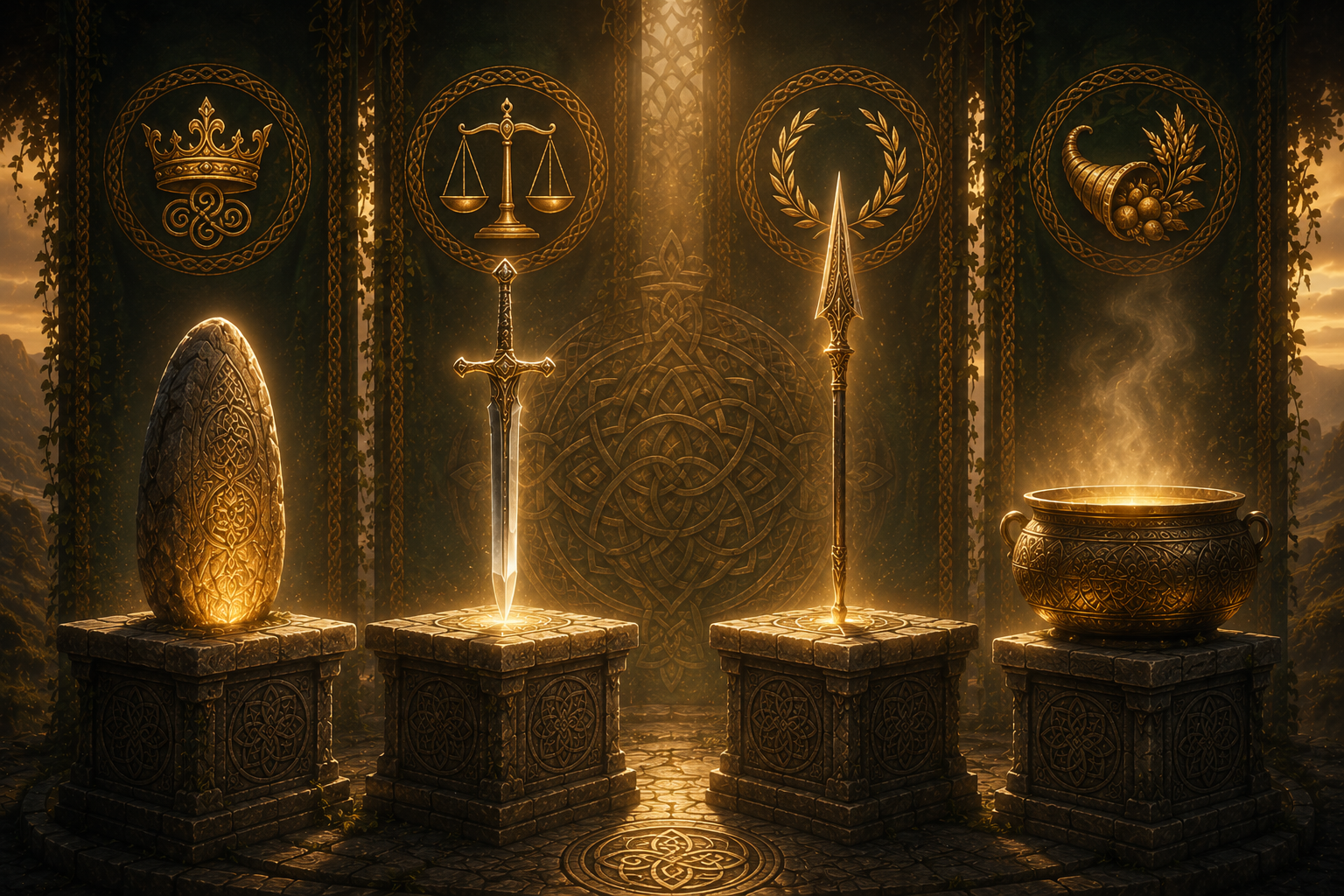
The Four Treasures were far more than magical objects. Together, they formed a symbolic whole.
Each represented one of the great pillars of kingship:
- The Stone → legitimacy
- The Sword → justice
- The Spear → strength and defence
- The Cauldron → abundance
Together they symbolised the ideal form of rule that the Tuatha Dé Danann brought with them to Ireland. They embodied the qualities that a perfect king should possess.
Their Legacy
Although the Tuatha Dé Danann disappeared from the world of men after the arrival of the Milesians, their Four Treasures continued to occupy a privileged place in Celtic tradition.
To this day, the Lia Fáil remains associated with the Hill of Tara, while the Dagda's Cauldron, Nuada's Sword, and Lugh's Spear continue to inspire novels, films, and scholarly studies of Irish mythology.
The Four Treasures represent something that no army can preserve forever:
- legitimacy (Lia Fáil)
- justice (Nuada's Sword)
- courage and victory (Lugh's Spear)
- prosperity (the Dagda's Cauldron)
When the Tuatha Dé Danann leave Ireland, tradition suggests that these qualities return with them to the Otherworld, becoming a lost ideal remembered only through legend.
Other Cauldrons in Celtic Tradition
The Dagda's Cauldron was not the only magical vessel in Celtic tradition. Other stories, particularly those from Wales, speak of the famous Cauldron of Annwn and the Cauldron of Bran the Blessed..
Although they belong to different mythological cycles, they all share profound symbolism connected with abundance, regeneration, and transformation.
For the Celtic peoples, the cauldron was a sacred symbol representing:
- transformation;
- rebirth
- abundance
- knowledge
- inspiration
- immortality
Among the best known are:
- The Cauldron of Annwnappears in the Welsh poem Preiddeu Annwfn (The Spoils of Annwn) and was later connected with Arthurian legend.
- The Cauldron of Bran the Blessed: possessed the power to restore the dead to life, although without restoring their ability to speak.
Possible Influences on Medieval Literature
Most of the following connections are scholarly hypotheses rather than historically proven relationships.
Lugh's Spear
Many medievalists believe that Lugh's Spear may have influenced later legends surrounding the Holy Spear, eventually known as the Spear of Longinus.
This does not mean they are the same object, but rather that both belong to the ancient literary motif of the invincible weapon linked to the destiny of a king.
The Dagda's Cauldron
Many specialists believe that the Dagda's Cauldron may have influenced the medieval legends of the Holy Grail.
Both share several symbolic features:
- they provide nourishment
- they restore those who approach them
- they symbolise abundance
- they are associated with a worthy king
- they form part of quests
However, no direct historical connection has been demonstrated; only possible literary influences.
Nuada's Sword
Various scholars have identified possible parallels between Nuada's Sword and Excalibur.
Although there is no evidence demonstrating a direct relationship, these similarities illustrate how ancient Celtic motifs may have influenced Arthurian literature.
Follow the Footprints
Visit It Today...
Hill of Tara (County Meath)
Tradition identifies this site with the Lia Fáil, the Stone of Destiny, one of the Four Great Treasures of the Tuatha Dé Danann.
The stone can still be seen today atop the hill, one of the most iconic locations in both the history and mythology of Ireland.