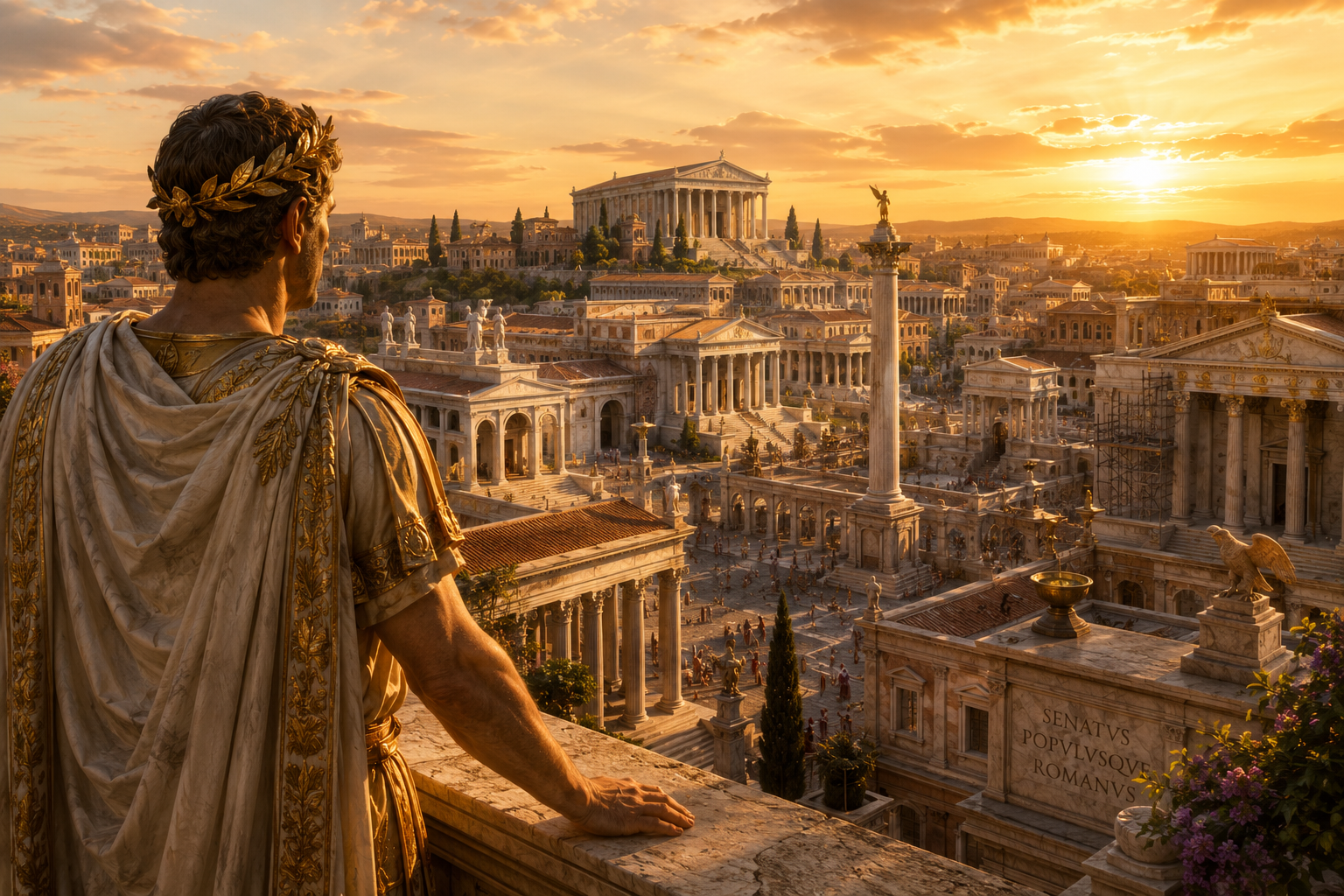
Few figures have left such a profound mark on history as Gaius Julius Caesar Augustus.
His name still lives on in our calendar. His political model changed Rome forever, and the empire he helped build would shape the destiny of Europe, the Mediterranean, and much of the known world for centuries.
He was born on 23 September 63 BC as Gaius Octavius (Gaius Octavius, into a distinguished family, though far removed from the absolute power he would later achieve.
Augustus was not simply the first emperor of Rome. He was the man who designed a new Rome.
"I found Rome a city of brick and left it a city of marble."
— Quote attributed to Augustus by Suetonius in The Twelve Caesars.
Origins: Augustus and His Divine Ancestry
Augustus himself promoted the idea that his family descended from Aeneas, the Trojan hero. According to tradition, Aeneas was the son of the goddess Venus (Aphrodite in Greek mythology).
His family, the Julian gens (gens Julia), claimed direct descent from Iulus (Ascanius), the son of Aeneas.
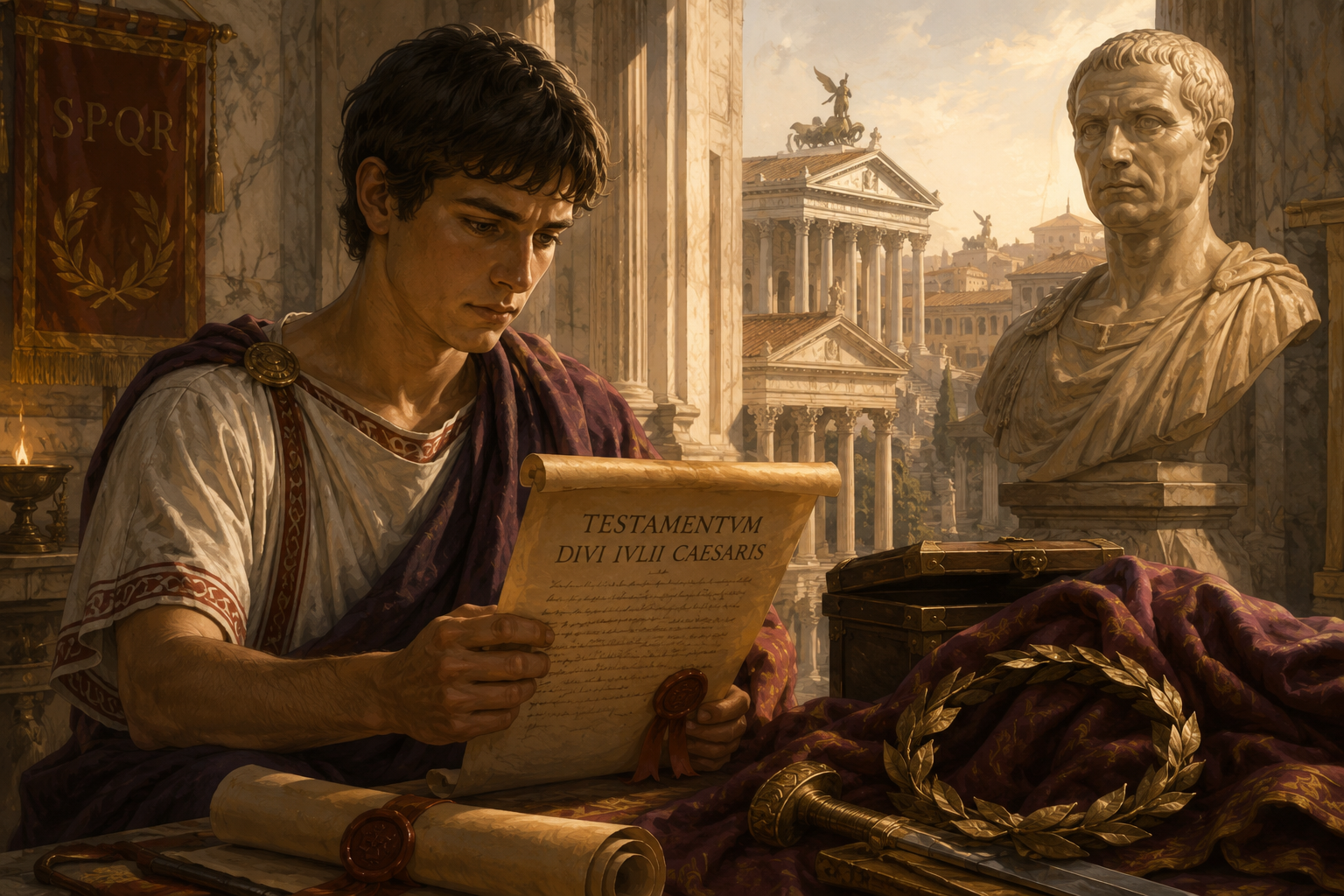
The Heir of Julius Caesar
He was the great-nephew of Julius Caesar, who officially adopted him in his will. His life changed forever.
After Caesar's assassination in 44 BC, Octavian inherited:
- his name
- his fortune
- part of his political influence
From that moment onward, his rise to power—and the struggle for Rome's future—began.
The War for Power
After Caesar's death, Rome descended into another period of civil war.
Octavian formed a political alliance with:
- Mark Antony
- Marcus Aemilius Lepidus
This shared government became known as the Second Triumvirate.
Over time, however, the alliance collapsed, and Octavian eventually turned against Mark Antony.
Their rivalry culminated in one of the most decisive moments in Roman history: the Battle of Actium (31 BC).
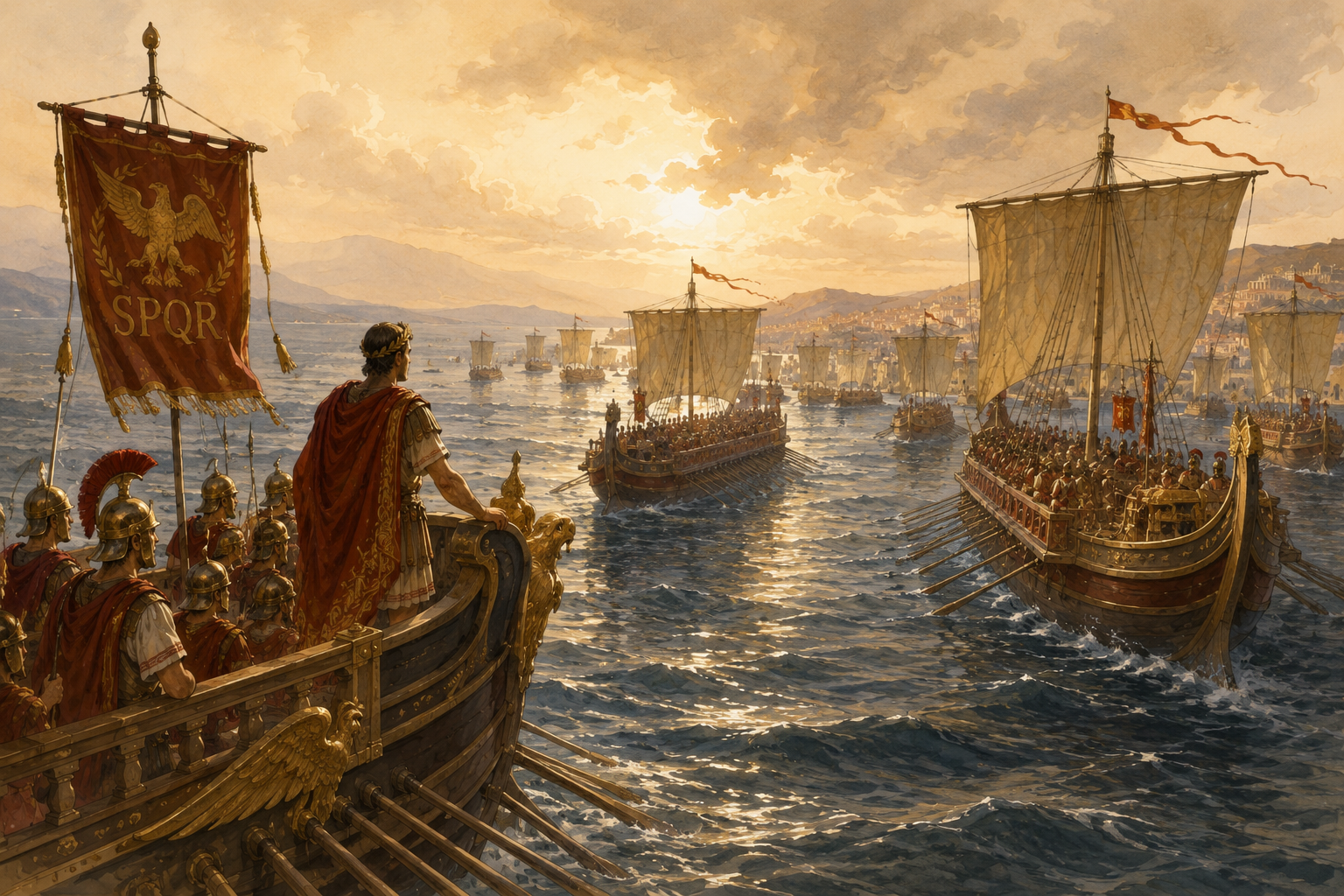
Octavian's victory over Mark Antony and Cleopatra permanently changed Rome's destiny, making him the undisputed master of Roman power.
The Birth of the Empire
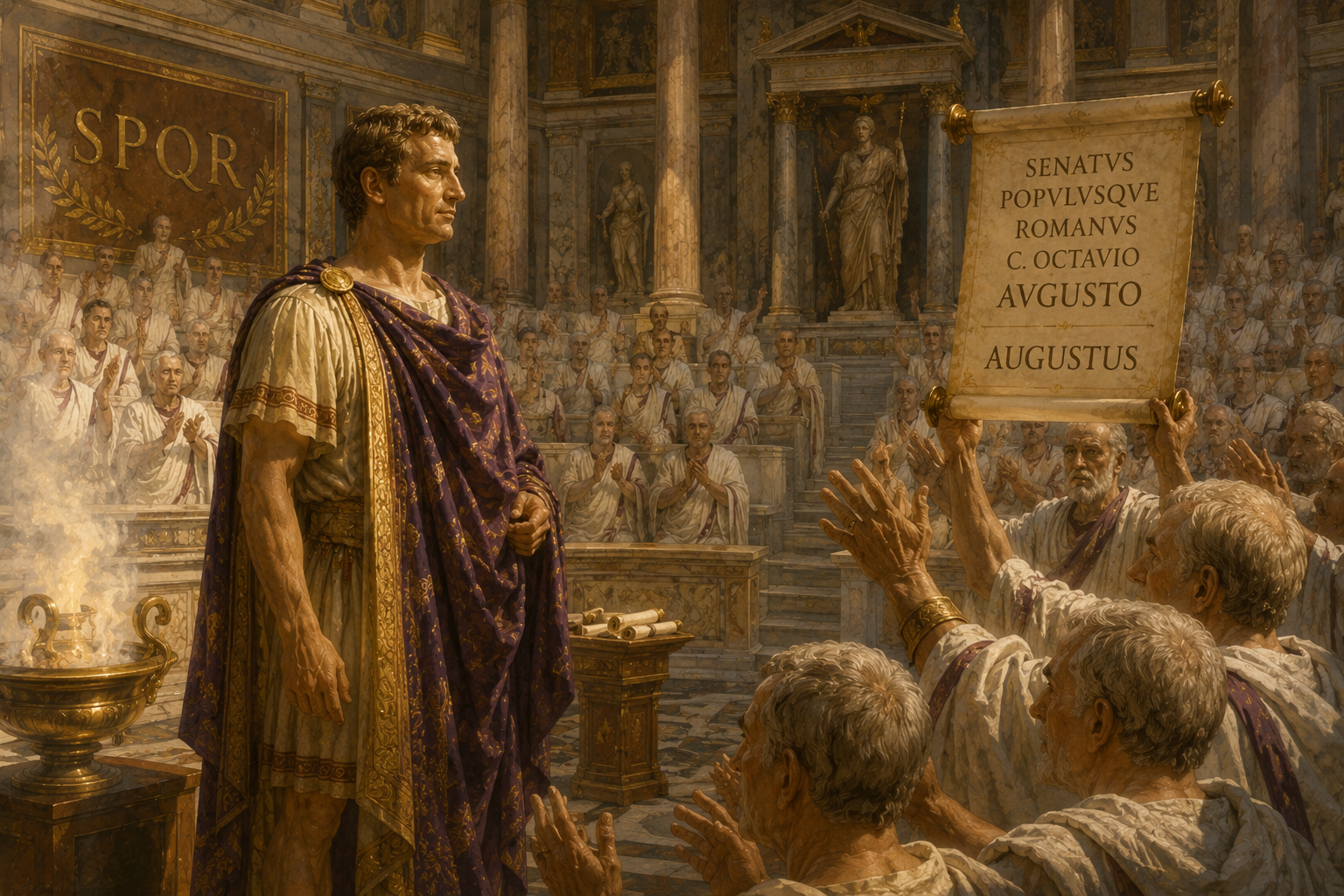
In 27 BC, the Senate granted him the title Augustus ("the revered" or "the sacred"). This moment officially marks the beginning of the Roman Empire.
Although many Republican institutions remained in place, real power became concentrated in his hands.
Augustus never presented himself as a king or dictator. Instead, he preferred the titles princeps ("first citizen") and Imperator ("military commander"). In practice, however, he controlled:
- the army
- politics
- religion
- the provinces
Behind this carefully maintained appearance emerged a new political system known as the Principate..
The Pax Romana
Augustus ruled for more than forty years, from 27 BC to AD 14. During his reign began one of the greatest periods of stability in the ancient world. The Pax Romana encouraged:
- economic expansion
- the construction of major infrastructure
- urban development
- trade
- the administrative consolidation of the Empire
Rome left behind decades of civil war to become the political heart of the Mediterranean.
The Transformation of Rome
Augustus launched an ambitious programme to reshape the city.
During his reign, temples, monuments, forums, and public buildings transformed the appearance of the capital. Among his many reforms were:
- the Cursus Publicus, the Empire's official state courier system
- the reorganisation of the provinces, including Hispania, where colonies were founded for military veterans
- monetary reforms
- the restoration and expansion of the Roman road network
- administrative reorganisation
- the reorganisation of urban services
- improvements to the grain supply (Cura Annonae)
His architectural programme also became a powerful political tool.
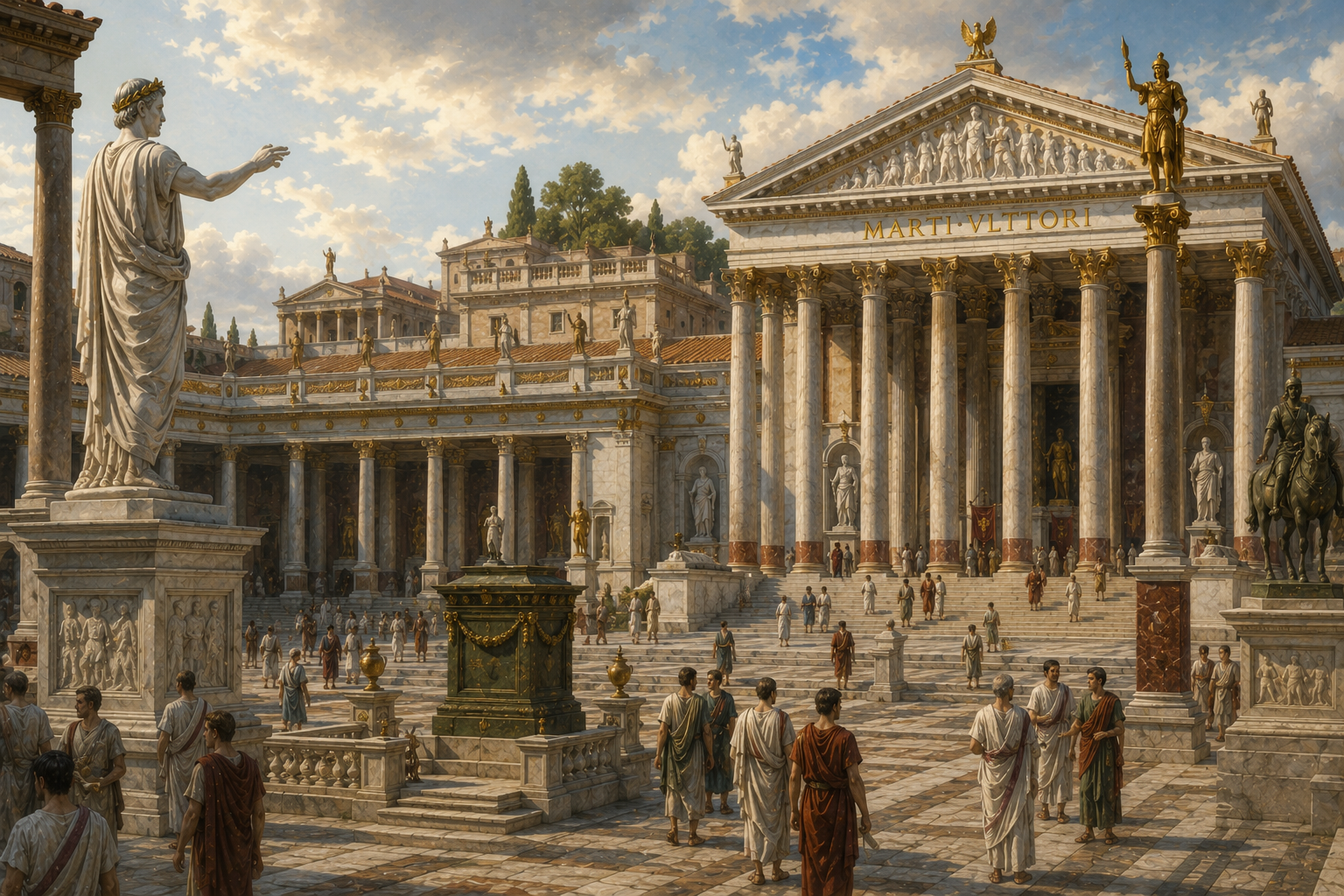
“On land that was my own, I built the Temple of Mars Ultor and the Forum of Augustus with the spoils of war."
— Res Gestae Divi Augusti.
The Golden Milestone
Today, many cities have their own "kilometre zero."
More than two thousand years ago, Augustus erected the Miliarium Aureum (Golden Milestone) in the Roman Forum. This monumental column symbolically marked the point from which all the roads of the Empire began.
Many historians have linked the Golden Milestone with the famous saying "All roads lead to Rome," although there is no evidence that the phrase originated at this time.
The Horologium Augusti
Among Augustus' many building projects was the the Horologium Augusti, also known as the Solarium AugustiConstructed around 10 BC in the Campus Martius, it was a monumental solar clock—or solar calendar—that used a massive Egyptian obelisk as its gnomon, casting a shadow to measure the passing of the seasons.
The First Urban Fire Brigade of Antiquity
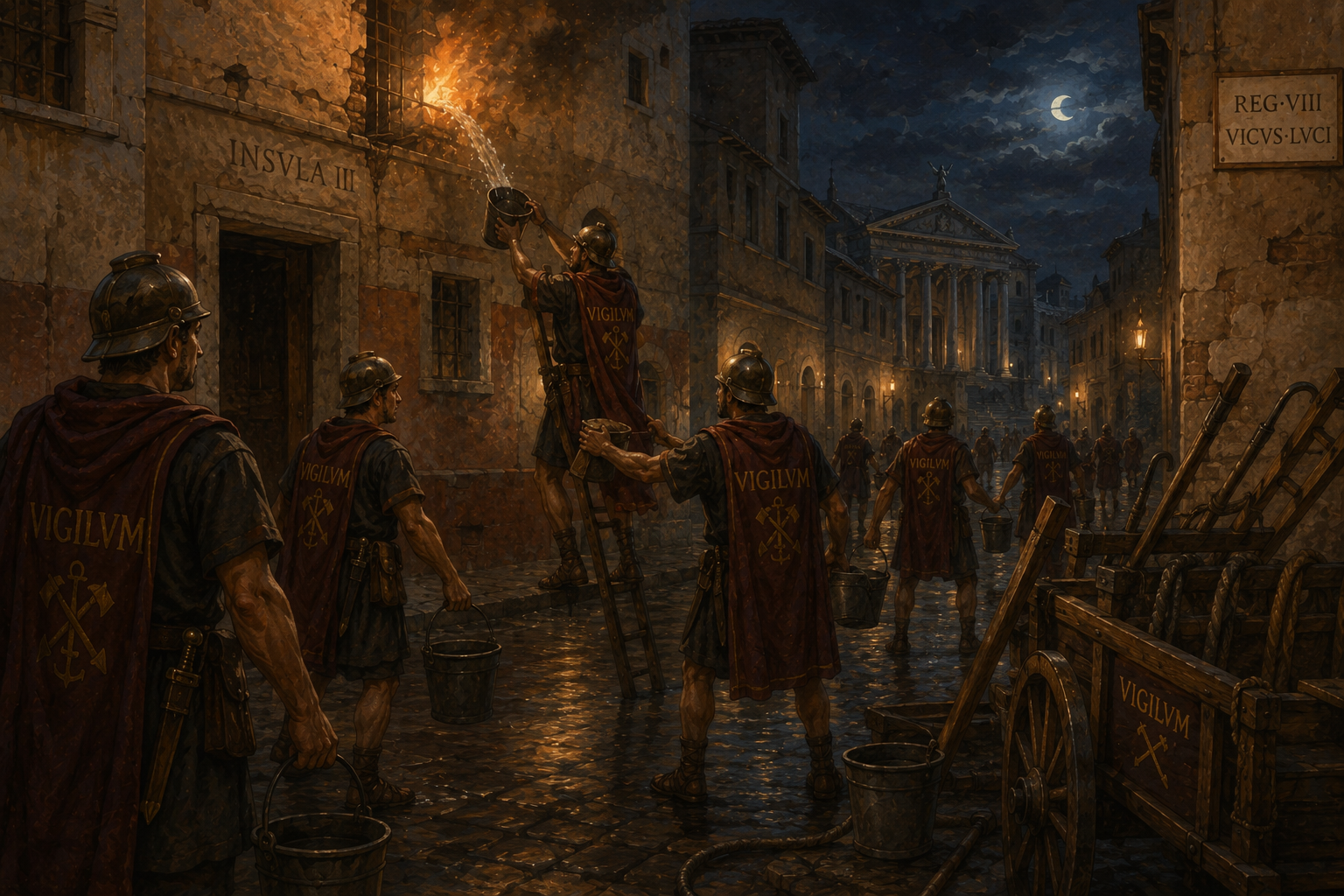
In AD 6, Augustus created the Cohortes Vigilum, a uniformed civil corps responsible for public safety.
It consisted of seven cohorts, each numbering approximately 1,000 men. Every cohort was responsible for protecting two of Rome's fourteen administrative regions.
Their duties included:
- inspecting fire hazards
- fighting fires
- patrolling the city at night
- maintaining public order
- guarding the streets
- pursuing criminals
The corps was composed mainly of freedmen (former slaves who had gained their freedom).
Their equipment included buckets, hand-operated pumps, axes, hooks, and ladders.
Many historians consider them the first organised urban fire brigade of the ancient world.
A Professional Army
Augustus established a permanent professional army. A Roman soldier now had:
- a stipendium (salary)
- a fixed term of service
- retirement benefits
Military service normally lasted twenty years, although additional years could be added under certain circumstances, and in some cases service could extend to twenty-five years.
Upon completing their service, veterans received rewards such as:
- money
- lands
To finance these benefits, Augustus established the Aerarium Militarein AD 6, a military treasury dedicated to rewarding retired soldiers.
The Emperor's Personal Guard
The Praetorian Guard served as the emperor's personal bodyguard. Its members were carefully selected elite soldiers.
Augustus organised nine cohorts, each consisting of approximately 500 men, although the exact figures remain debated.
Their responsibilities included protecting:
- the emperor
- important public buildings
- strategic locations
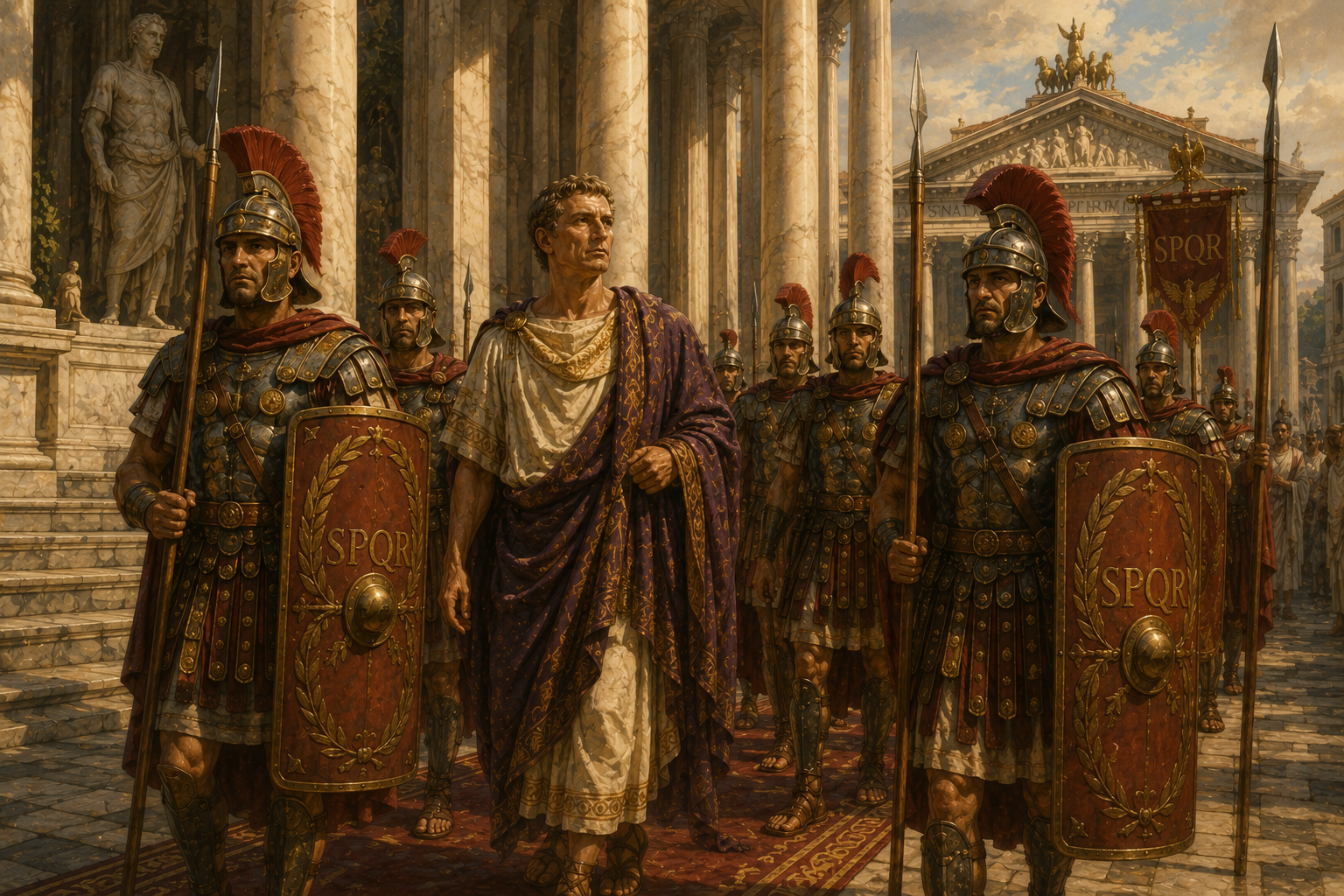
Over the centuries, the Praetorian Guard accumulated extraordinary political power, becoming one of the most influential—and feared—institutions of the Empire. At times, they even determined the fate of emperors themselves.
The Great Reorganisation of Rome
One of Augustus' greatest achievements was the administrative reorganisation of the city. He divided Rome into fourteen administrative regions (Regiones XIV), each of which was further divided into numerous vici (neighbourhoods, local districts, or streets). By the fourth century, Rome contained approximately 265 vici.
He also established:
- local administration
- officials responsible for each vicus
- an organised system of urban management
Although each region had its official number, every one also possessed its own name:
- Regio I Porta Capena
- Regio II Caelimontium
- Regio III Isis et Serapis
- Regio IV Templum Pacis
- Regio V Esquiliae
- Regio VI Alta Semita
- Regio VII Via Lata
- Regio VIII Forum Romanum
- Regio IX Circus Flaminius
- Regio X Palatium
- Regio XI Circus Maximus
- Regio XII Piscina Publica
- Regio XIII Aventinus
- Regio XIV Transtiberim
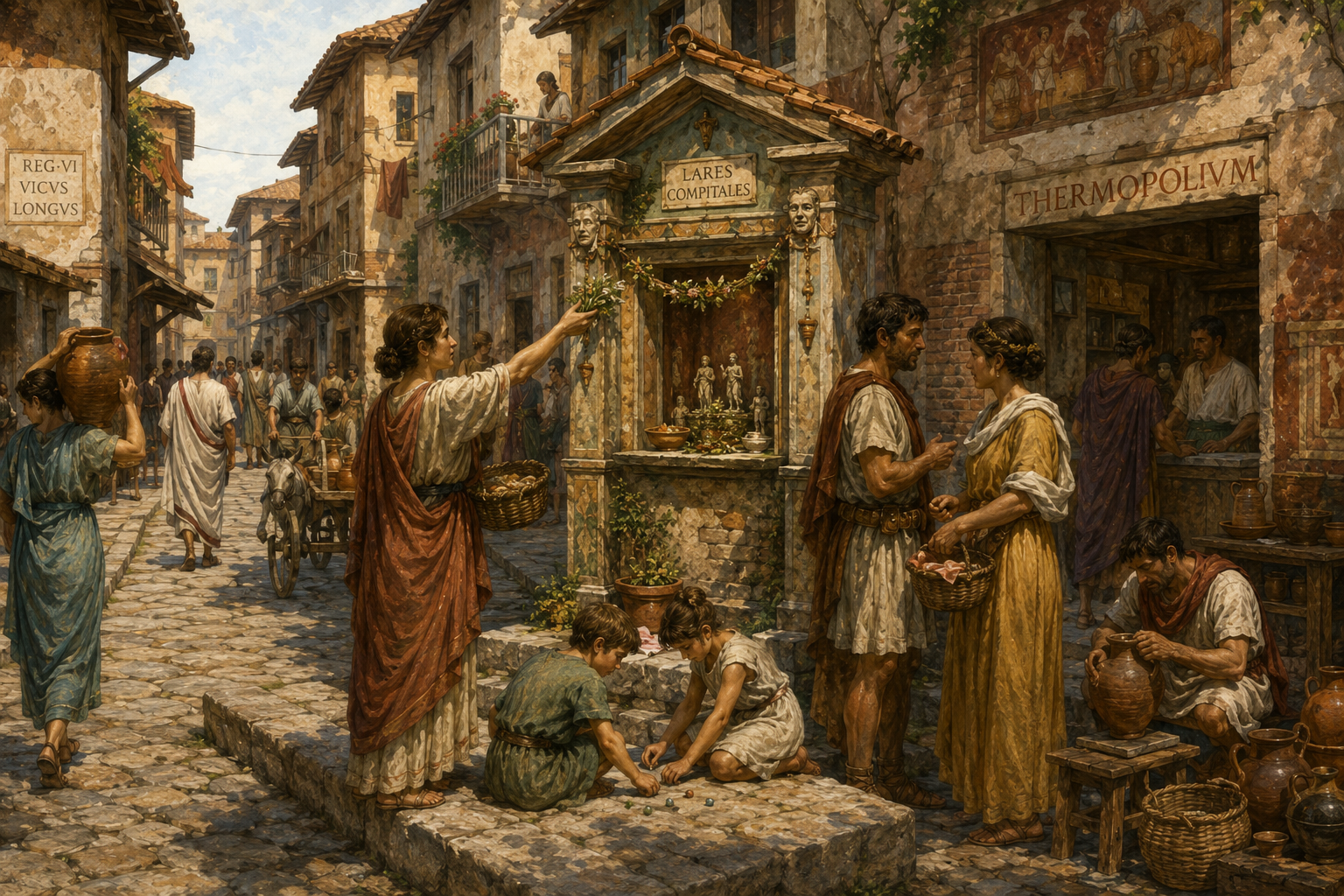
Each region was divided into numerous vici, small urban communities with their own officials. Every vicus had its own magistri vici (local administrators) and ministri (assistants). Normally, four magistri were elected by the residents of each vicus.
Their responsibilities included: organising festivals, overseeing local religious cults, coordinating neighbourhood affairs and arranging public celebrations.
Many neighbourhoods also had their own altar dedicated to the Lares Compitales, protective deities of crossroads and local communities.
Although ancient writers, inscriptions, monuments, and archaeological discoveries confirm Augustus' administrative reforms, the complete list of the approximately 265 vici has not survived.
Some neighbourhoods already existed and were incorporated into the new system, while others appear to have been created—or substantially reorganised—during the Augustan reforms. Among the best-known examples are:
- Vicus Tuscus (Etruscan Street)
- Vicus Patricius
- Vicus Longus
- Vicus lugarius
- Vicus Sandaliarius
One documented example associated with Augustus' reorganisation is the:
- Vicus Cornicularius, established around 5–6 BC in Regio III (Isis et Serapis), on the southern slope of the Oppian Hill.
Although its original layout has disappeared, archaeologists believe it occupied an area close to today's Colosseum Archaeological Park and the slopes of the Caelian Hill.
Augustus' Legacy Across the Empire
In 25 BC, Augustus founded Augusta Praetoria (modern-day Aosta) following his campaigns against the Alpine tribes. Much of its ancient walls still survive today.
His reforms reached virtually every corner of the Empire. He founded and reorganised cities, established new colonies for military veterans, developed communication networks, and promoted the administrative integration of numerous territories.
His legacy can still be traced today in places as diverse as Spain, France, Switzerland, Greece, and North Africa, where several cities preserved the memory of his name for centuries.
This vast territorial reorganisation helped consolidate the Roman Empire and left a visible legacy that can still be followed throughout Europe and the Mediterranean.
Augustus and Propaganda
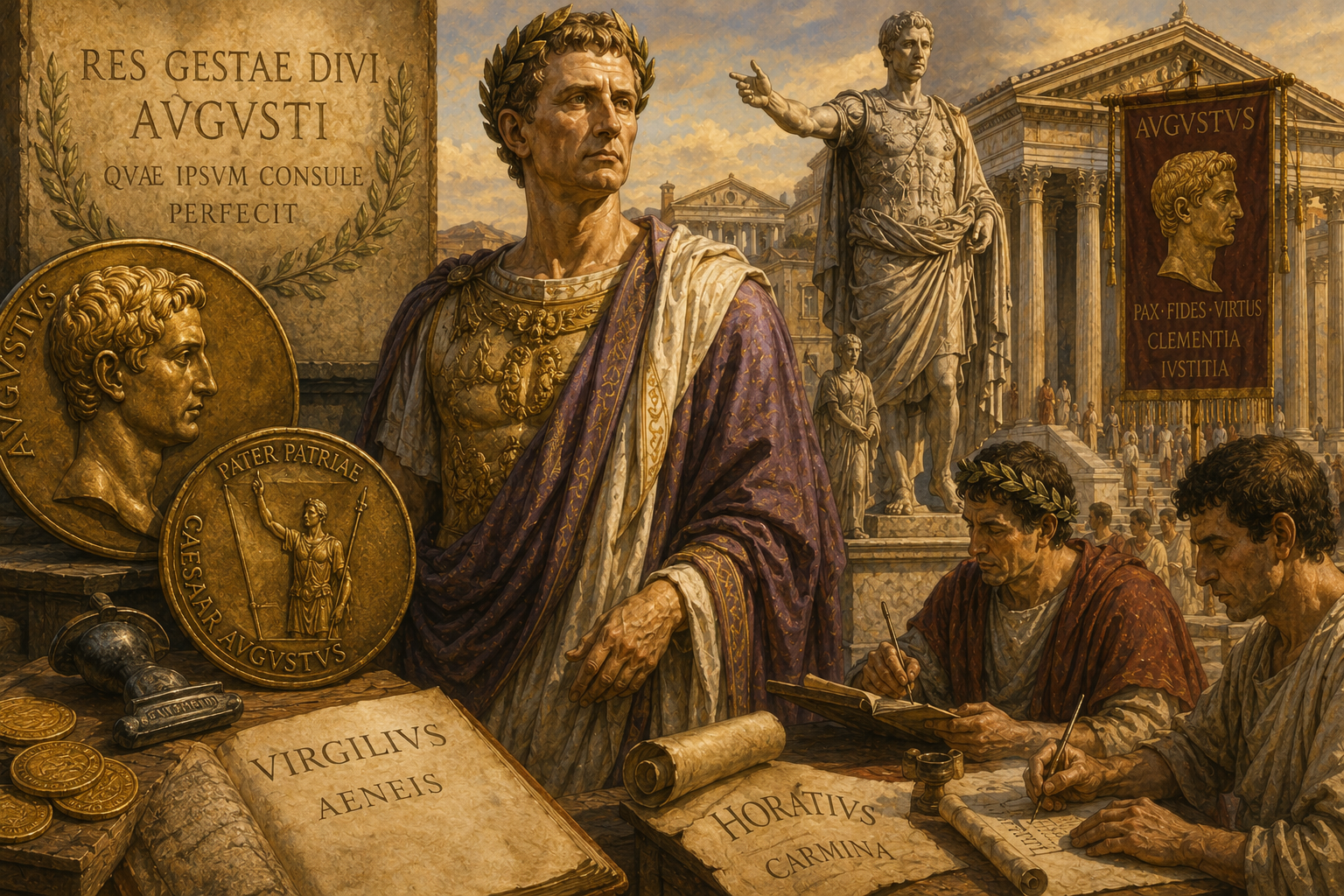
Few people understood the power of image and public perception as well as Augustus. He used:
- coins
- sculptures
- monuments
- literature
- religion
Everything contributed to building the image of a ruler destined to restore peace and order to Rome.
Poets such as Virgil and Horace took part in this extraordinary cultural flourishing that would define an entire era.
«Quintili Vare, legiones redde!»
«"Quinctilius Varus, give me back my legions!"«
— Phrase attributed to Augustus by Suetonius after learning of the destruction of three Roman legions in the Battle of the Teutoburg Forest (AD 9), one of the greatest military disasters in Roman history.
A Man Who Became a God
After his death in AD 14, the Senate granted him the posthumous title Divus Augustus (the Divine Augustus).
Public games were organised in his honour, largely financed by his heir and successor, Tiberius.
These included:
- chariot races
- theatrical performances
- gladiatorial contests
His imperial cult spread throughout many provinces of the Empire.
For centuries, cities across the Roman world erected temples and statues in his honour. His name and inscriptions appeared far beyond Rome itself, reflecting the immense prestige of the man who had ushered in a new era.
Curiosities
El mes de Augusto: Augustus (August)
Unlike Julius Caesar, whose tribute came after his death, Augustus was honoured with a month bearing his name while he was still alive.
In 8 BC, the Senate renamed the month Sextilis as Augustus because many of the most important events of his career had taken place during Sextilis.
It was also the month in which he died. On 19 August AD 14, Augustus died in Nola, near Naples. His body was carried to Rome in a grand funeral procession. He was cremated in the Campus Martius, and his ashes were later placed inside the Mausoleum of Augustus.
“Acta est fabula, plaudite!”
"The play is over. Applaud!"
— Phrase attributed to Augustus by the historian Suetonius.
Father of the Fatherland
In 2 BC, Augustus received the title Pater Patriae (Father of the Fatherland), also expressed as Augustus Pater (Father Augustus), one of the highest honours Rome could bestow.
The title appeared on coins, inscriptions, and monuments, reflecting the prestige of the ruler regarded as the father and protector of the Empire.
The Origin of the Word "Minister"
The Latin word minister originally meant "servant," "assistant," or "helper." It derives from minus ("less" or "smaller"), in contrast with magister, which comes from magis ("more" or "greater").
While magister referred to a master or someone in authority, minister designated a person who served or assisted others.
From this Latin root come modern words such as minister, ministry, and to minister.
Follow the Footprints
Augustus' legacy can still be traced today across countless sites throughout the former Roman world.
His memory also endures in former imperial territories scattered across Europe and the Mediterranean, reminding us just how far his influence extended beyond the city of Rome itself.
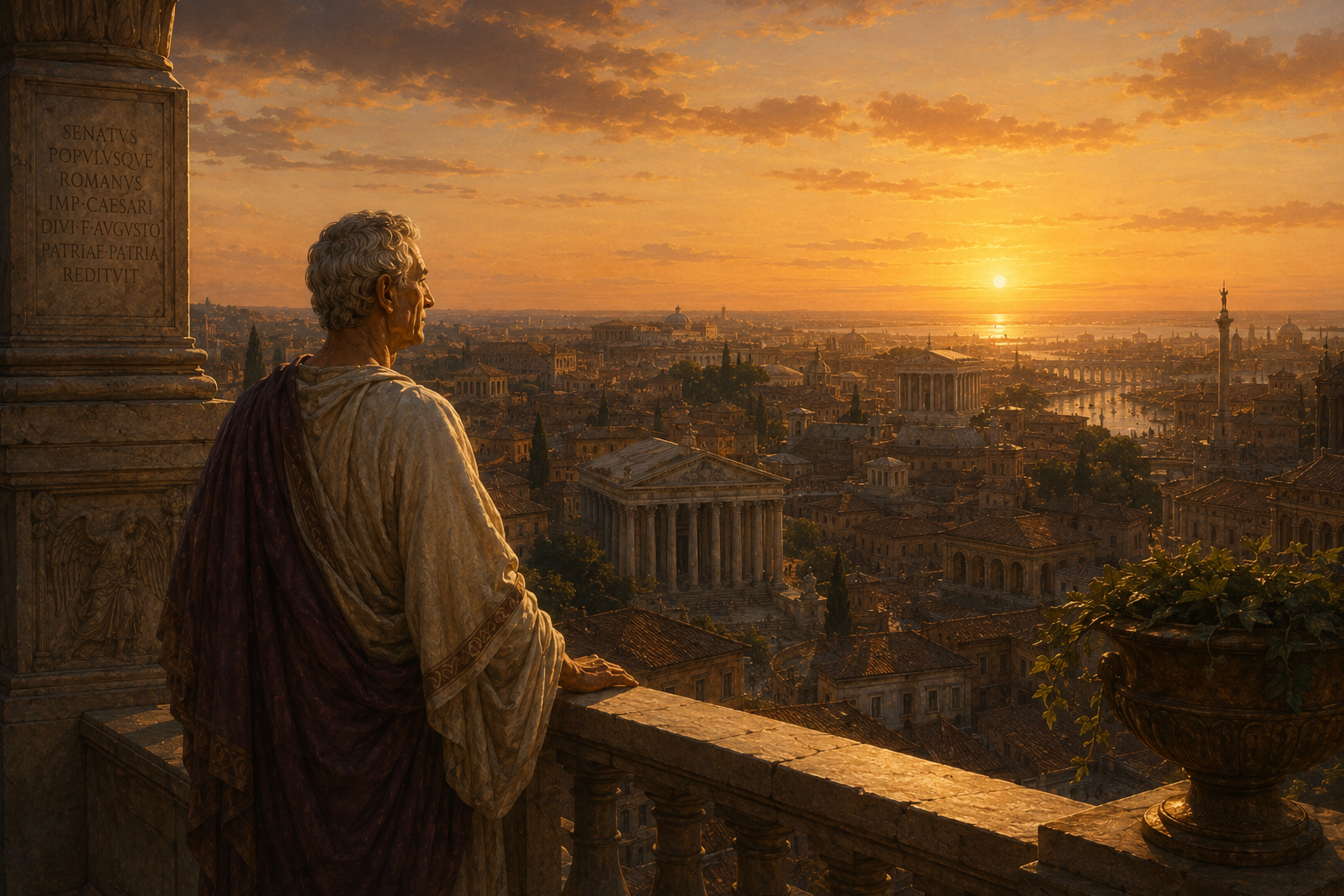
"When I wrote these memoirs, I was seventy-six years old."
— Res Gestae Divi Augusti.
Visit It Today... The Augustus Route
Rome
To follow in Augustus' footsteps today, the Digital Augustan Rome project offers an interactive way to explore the principal buildings and reforms carried out during his reign.
For official historical and archaeological information about many of these monuments, the Museo dell'Ara Pacis provides extensive resources, including:.
- The Mausoleum of Augustus
- Ara Pacis
- the Forum of Augustus
- the Temple of Mars Ultor
- the House of Augustus on the Palatine Hill
- the remains of the Temple of the Divine Augustus
- the Baths of Agrippa
- the site of the original Pantheon
- the Horologium Augusti
The Domus Augusti (House of Augustus) was the emperor's private residence, located on Palatine Hill.
A Legacy That Lives On
Few people can claim that millions of people speak their name every year.
Yet that is exactly what happens with Augustus.
The ancient Roman month of Sextilis was renamed Augustus in his honour. Over the centuries, the name evolved into the modern month of August.
More than two thousand years later, his name still marks one of the twelve months of the year. It also survives—transformed by time—in the names of cities that continue to thrive today. His words remain carved in stone, and his monuments continue to welcome visitors from around the world.
"After this time I surpassed all others in authority, although I possessed no greater official power than those who were my colleagues in office."
— Res Gestae Divi Augusti.