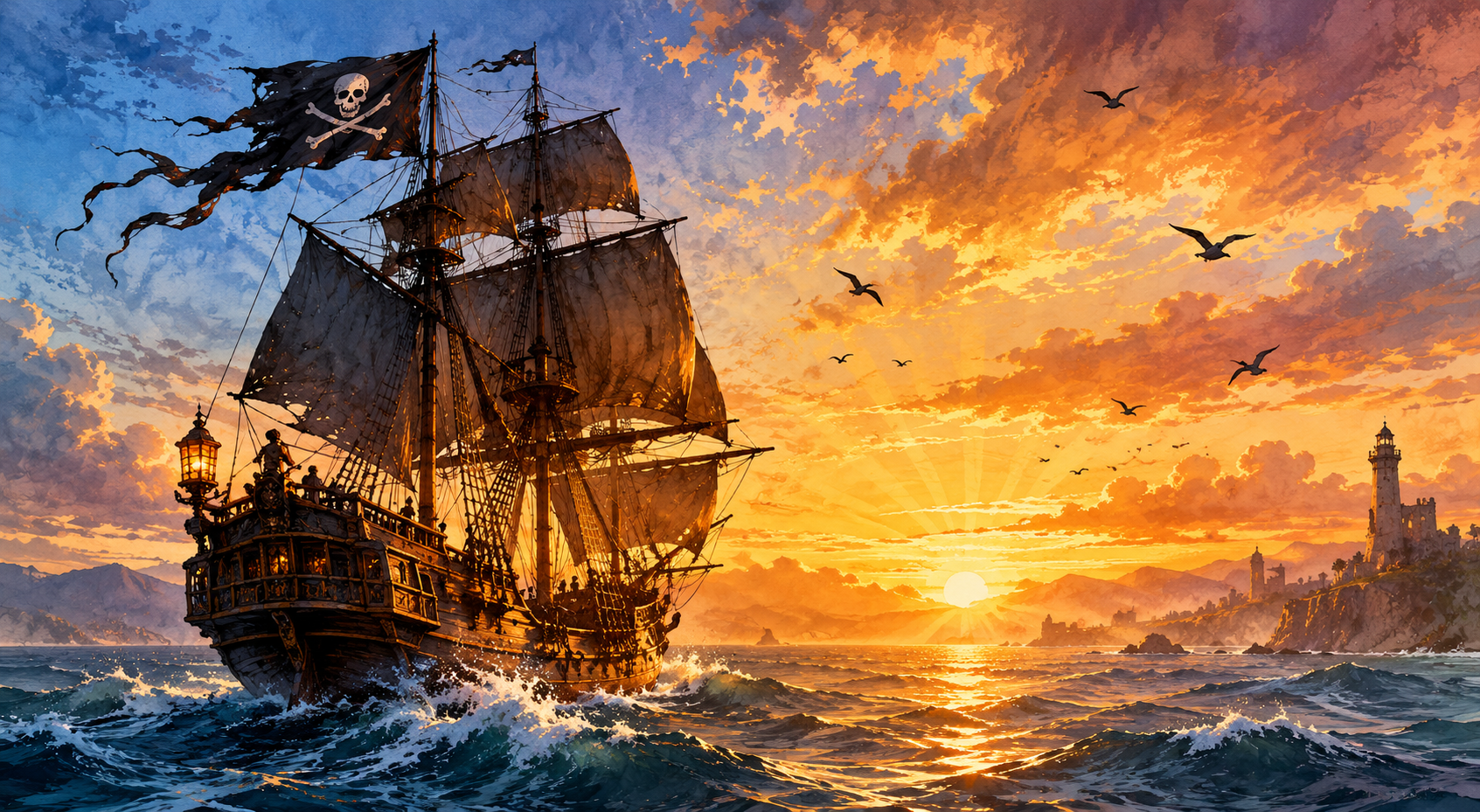
Ever since human beings first took to the sea, it ceased to be merely a route from one place to another… and became a place of danger as well.
Where there are trade routes, there is wealth. And where there is wealth… there are always those willing to seize it.
That is how pirates came into being.
Not as a legend. But as a constant throughout history.
The First Pirates: The Ancient World
Piracy did not begin in the Caribbean.
Long before that, the waters of the Mediterranean were already the scene of attacks on merchant ships and coastal settlements.
Among the earliest known examples are:
- The so-called Sea Peoples (Bronze Age)
- Greek and Cilician pirates
During the Roman Republic, piracy became such a serious problem that it threatened Rome's own food supply.
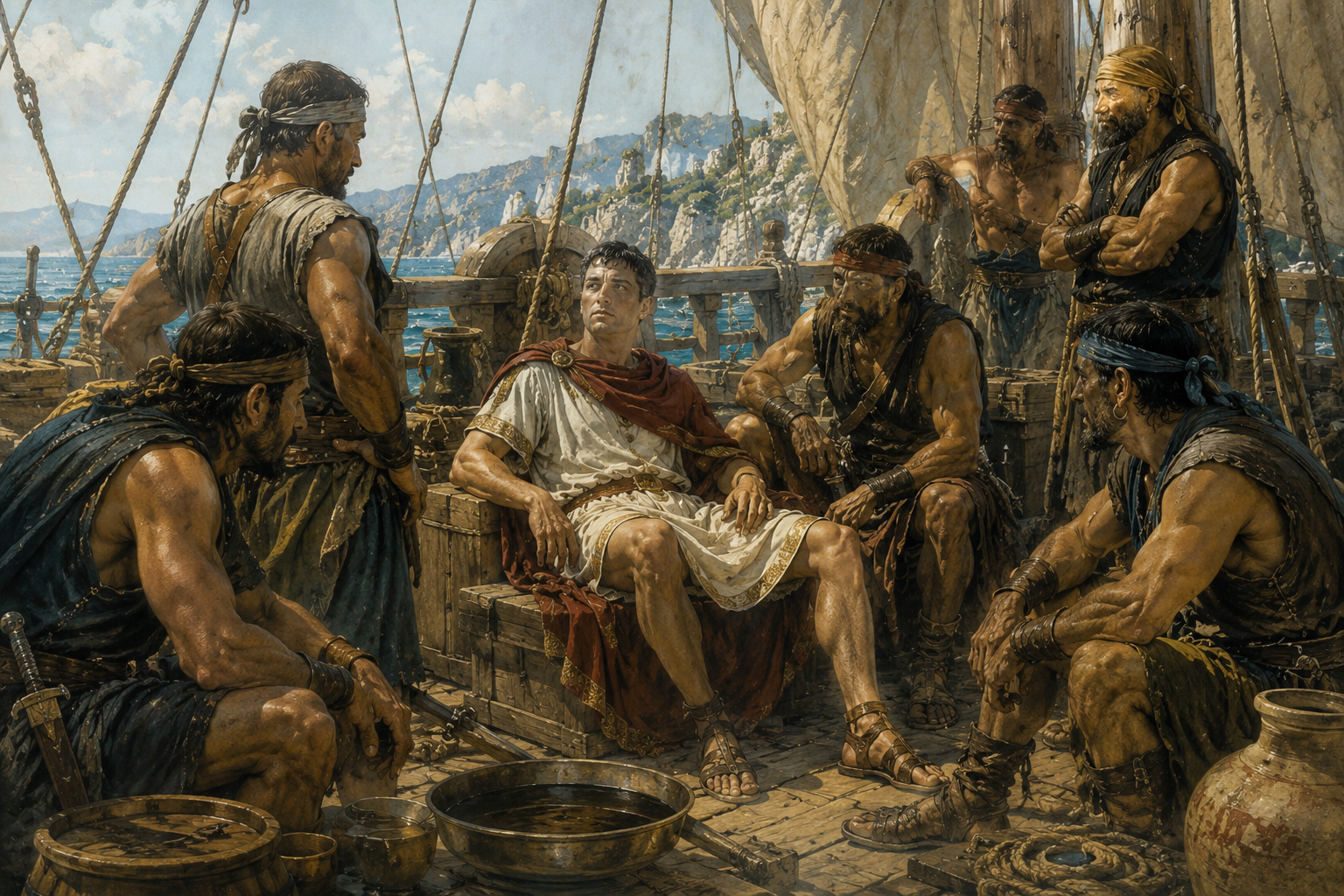
It was in this context that one of the most famous stories of the ancient world took place: the capture of Julius Caesar by Cilician pirates.
Far from showing fear, Caesar lived among them during his captivity and is even said to have joked about the ransom demanded for his release. Once he was free, he gathered a fleet, returned to capture them, and ordered their execution.
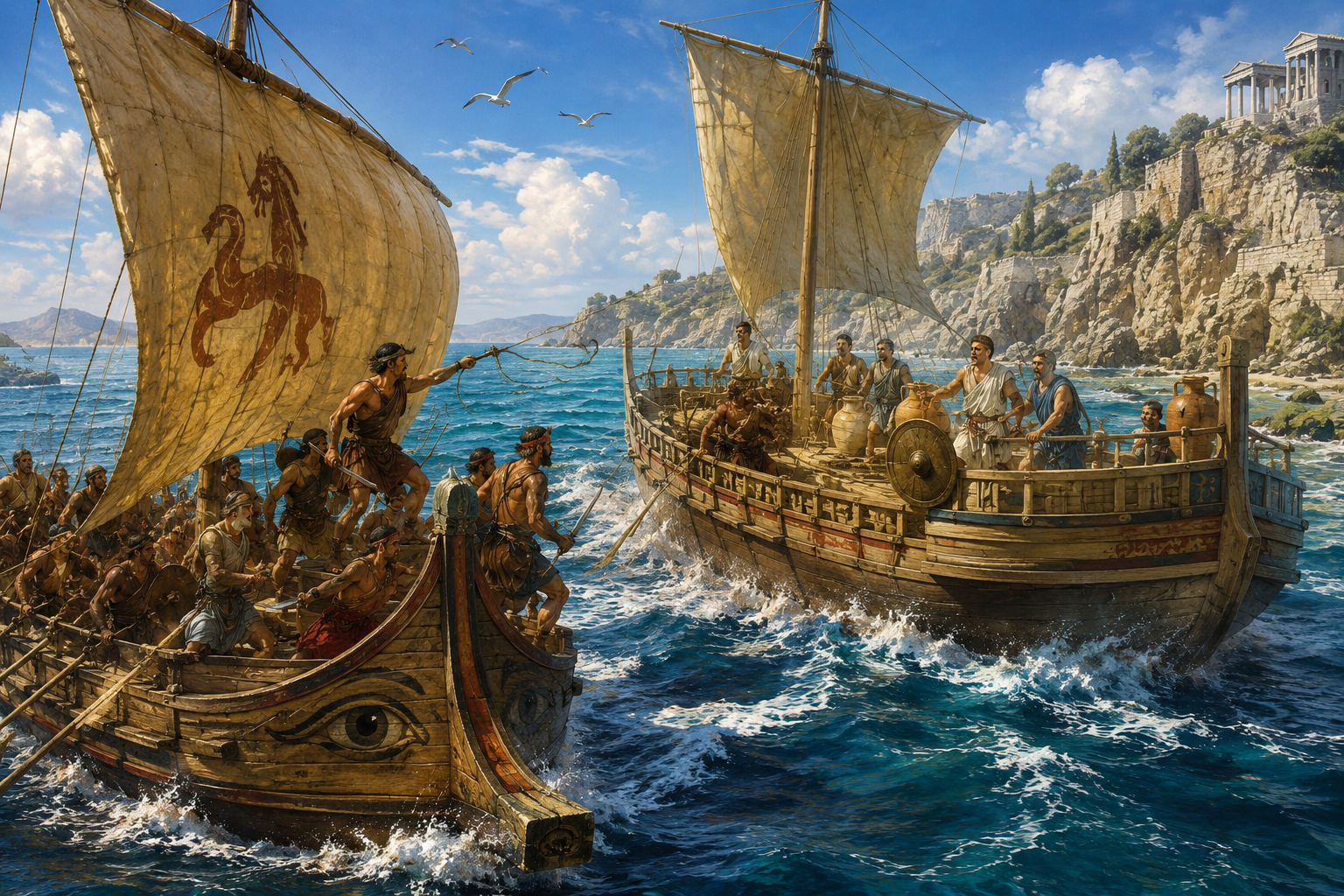
From its very beginnings, piracy was not about adventure. It was about power, violence, and opportunity.
The Middle Ages: Between Trade and Plunder
After the fall of Rome, piracy did not disappear. It simply changed its form.
In northern Europe, the Vikings combined trade, exploration, and maritime raiding. Across the Mediterranean, attacks on trade routes, ports, and ships continued as rival powers competed for control of the sea.
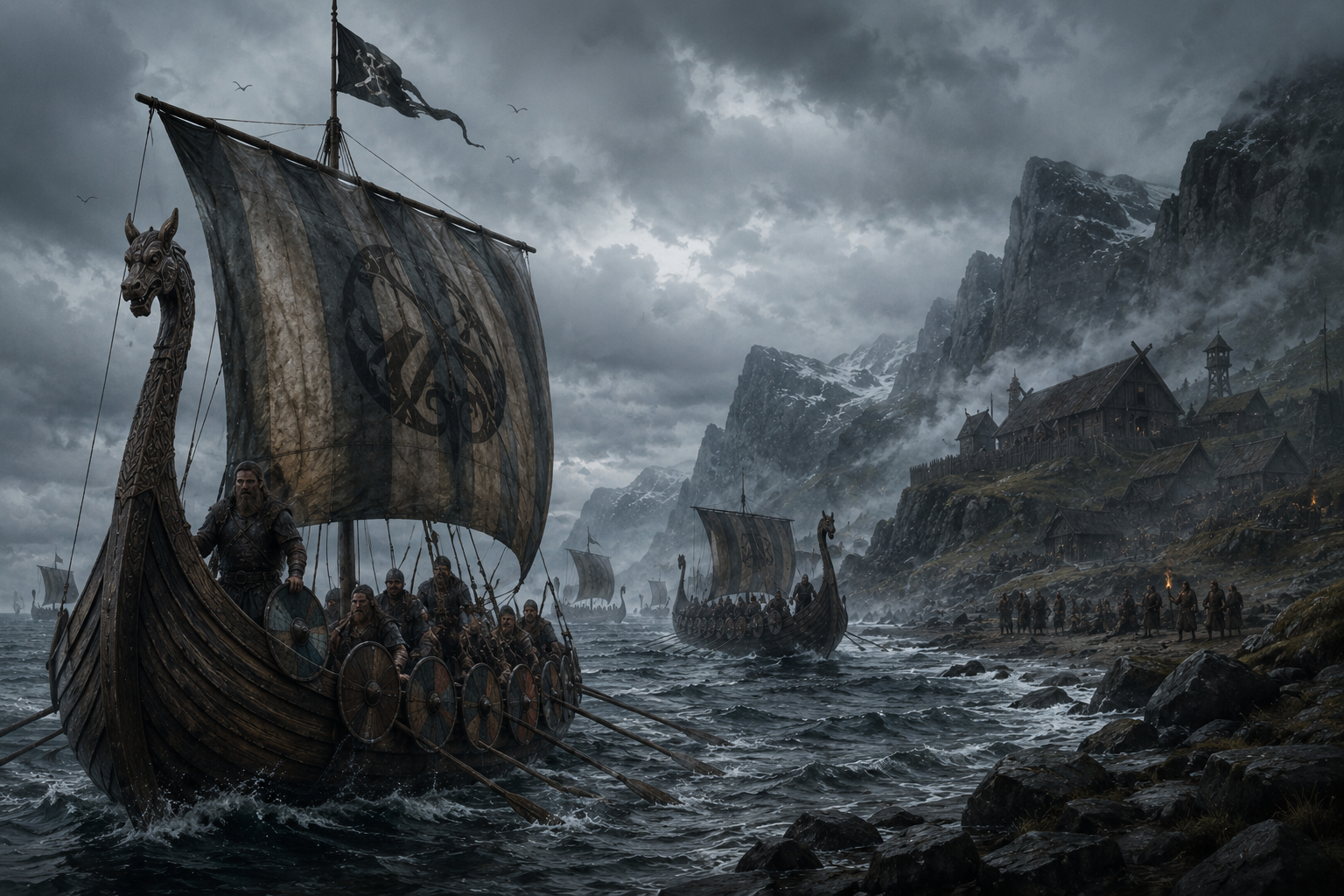
The romantic image of the pirate did not yet exist, but the phenomenon itself remained very much alive.
The Golden Age of Piracy
Between the 17th and 18th centuries, piracy reached its most famous era.
The stage had changed:
- The Caribbean
- Colonial trade routes
- Commerce between Europe, Africa, and the Americas
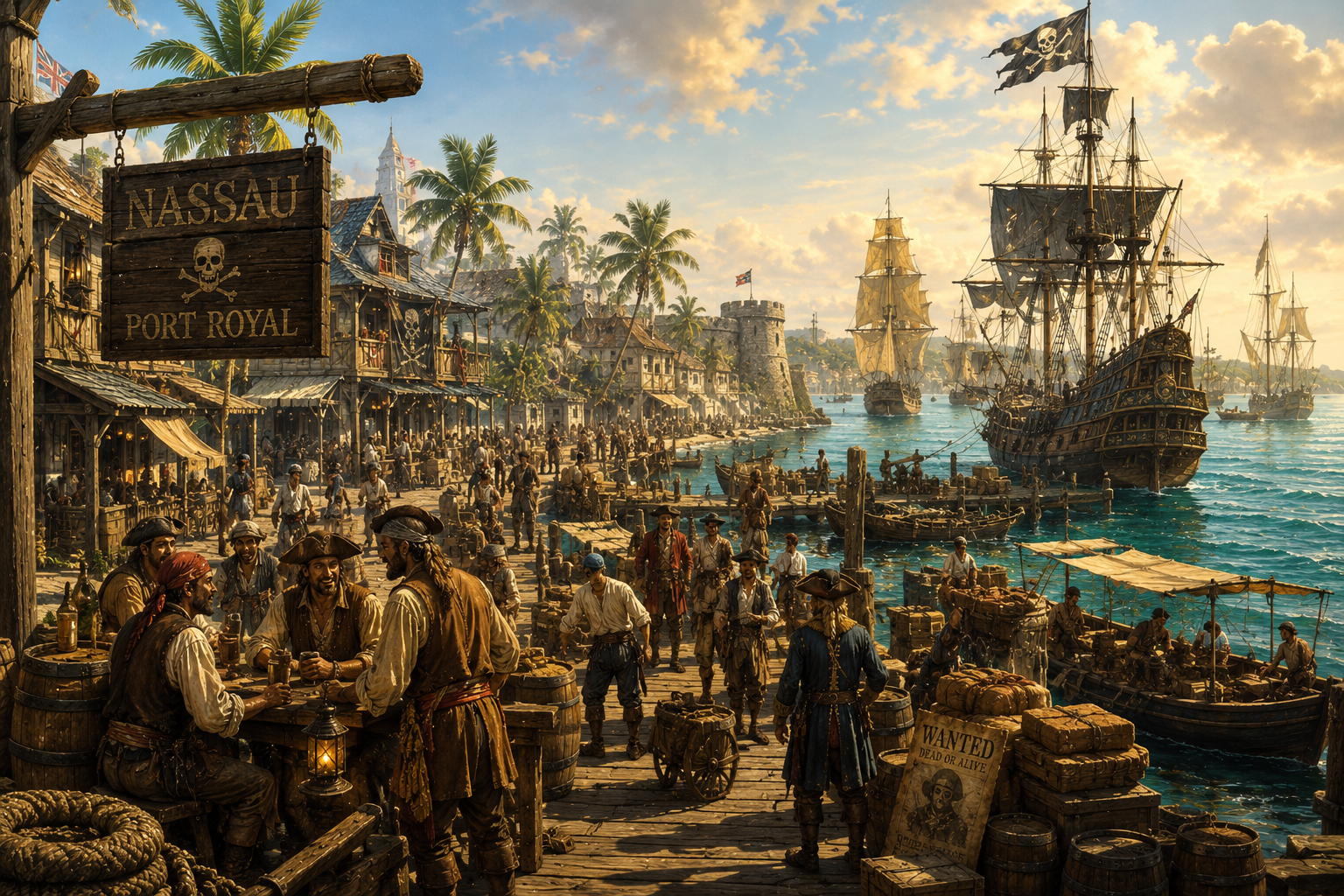
It was during this period that some of history's most legendary figures emerged:
- Blackbeard (Edward Teach)
- Anne Bonny
- Mary Read
- Henry Morgan
Sin embargo, no todos eran iguales.
Not all of them, however, were the same. Many operated as privateers, sailors officially authorized by a crown to attack enemy ships during times of war. Others were simply independent pirates who operated entirely outside the law.
Life at Sea: Rules and Survival
Life aboard a pirate ship was far from the complete chaos often portrayed in films.
Many crews operated under clearly established rules, including:
- The division of plunder
- Compensation for injuries
- Codes of conduct
- Strict discipline
In some respects, these communities were even more egalitarian than the official navies of their time.
Captains could be elected by their crews, and profits were often distributed relatively fairly. But they were also harsh places. Punishment could be swift, and survival was never guarante
Treasures, Maps, and Legend
As time passed, reality gradually gave way to myth. Maps marked with an X. Remote islands. Chests overflowing with gold buried on deserted beaches.
Although some pirates did hide part of their loot, most spent their riches quickly on food, supplies, gambling, or alcohol.
The image of the great hidden pirate treasure belongs far more to popular imagination than to documented history.
The Hidden Pirate Treasure
Surprisingly, the image of a pirate burying treasure on a deserted island does have a historical basis.
The most famous example is that of William Kidd, a 17th-century Scottish privateer who eventually found himself accused of piracy.
In 1698, Kidd captured a ship called the Quedagh Merchant, a wealthy trading vessel carrying valuable cargo. The legality of the capture was hotly disputed and ultimately became one of the main reasons he was charged with piracy.
In June 1699, fearing arrest, he concealed part of his wealth on Gardiners Island, near New York, hoping to use it later to prove his innocence or negotiate a pardon.
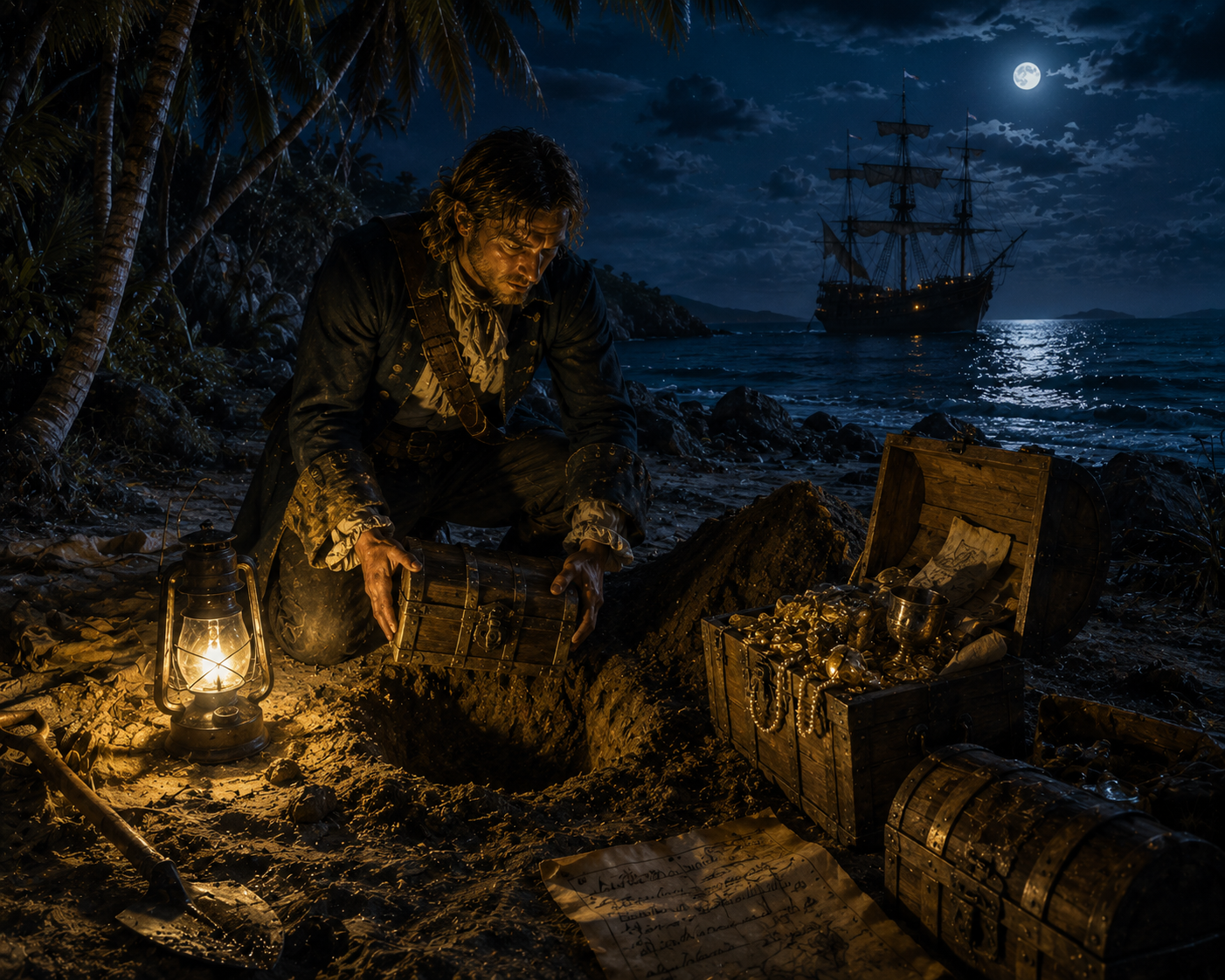
The authorities recovered the treasure shortly afterward, and it was used as evidence during his trial.
The historical importance of the discovery only grew over time. Records of the recovery still survive today, making Kidd one of the best-documented pirates in history.
Among these records are:
- inventories
- court documents
- witness testimonies
- detailed lists of the recovered objects
Thanks to this documentation, much of the treasure's contents are known.
Among the recovered items were:
- Spanish gold coins
- more than 200 silver bars
- gold dust
- gold ingots
- rubies
- diamonds
- rings
- enamelled silver caskets
- valuable Eastern textiles
- silver candlesticks
- goods from the Indian Ocean trade
- luxury containers and objects from the East
Some contemporary estimates valued the treasure at around £30,000 in late 17th-century currency—an extraordinary fortune for its time.
Over the years, the treasure recovered from Gardiners Island became dispersed, although the documentation relating to it has been preserved.
Even today, suspicions remain that the authorities did not recover all of Kidd's treasure, or that he may have hidden wealth elsewhere. For centuries, treasure hunters have searched for possible lost caches connected with the famous privateer.
William Kidd was convicted and executed in London on May 23, 1701.
His trial and the discovery of his treasure attracted enormous public attention. Pamphlets, newspapers, and even popular songs helped turn him into a widely known figure throughout England.
The story of William Kidd gave rise to a legend that would endure for centuries: that of the captain who buries a treasure, hoping one day to return and reclaim it.
X Marks the Spot
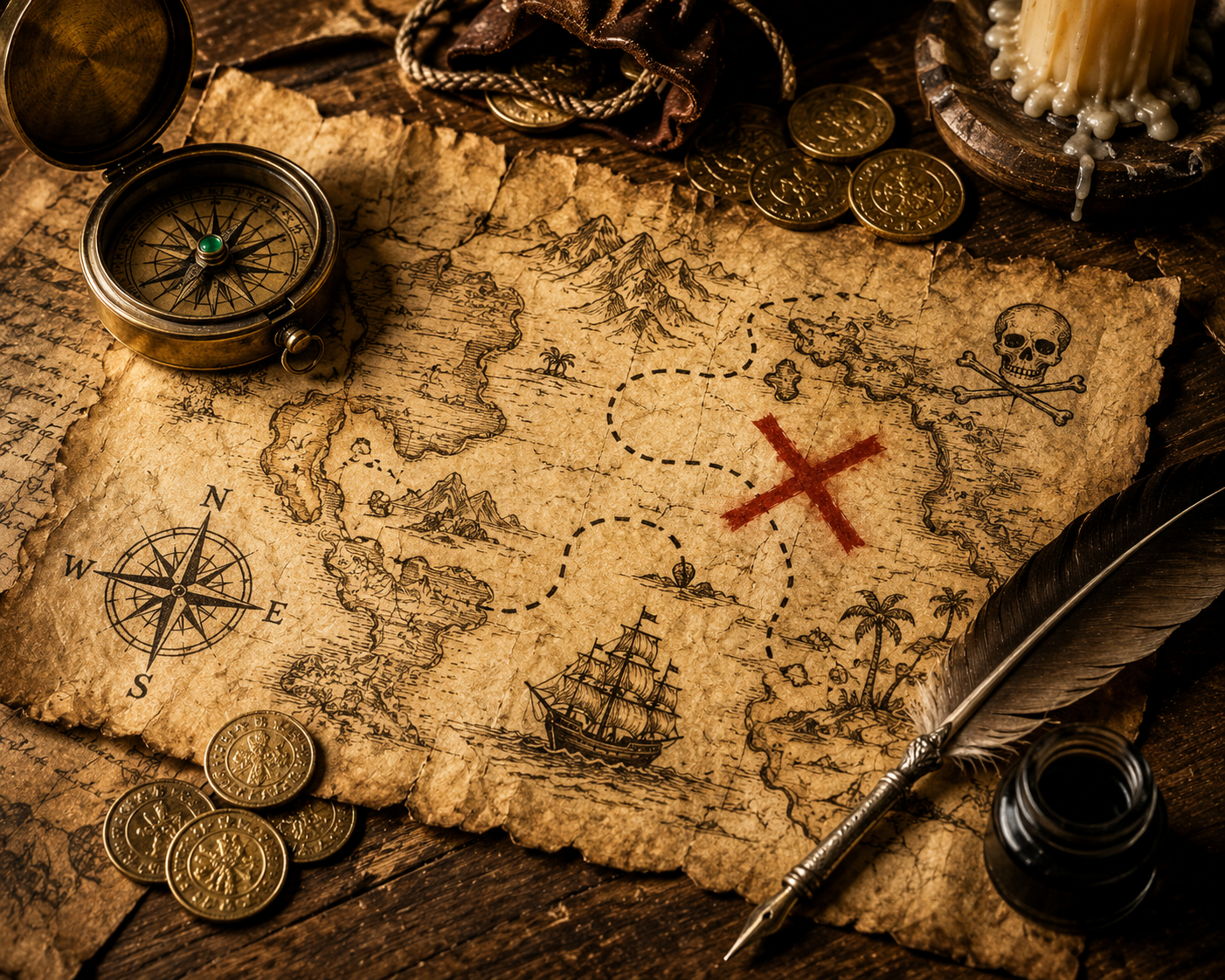
If buried treasure has a historical foundation, the famous map marked with an X belongs largely to the world of literature.
The image we all recognize today—an old map, a mysterious island, and a large X marking the location of hidden treasure—was popularized by the Scottish writer Robert Louis Stevenson in his novel Treasure Island published in 1883.
The story follows a young boy named Jim Hawkins, who discovers a map revealing the location of a treasure hidden by the feared pirate Captain Flint. From that moment begins an adventure filled with mutiny, unknown islands, danger, and the search for lost riches.
Although the novel drew inspiration in part from maritime tales and the history of real pirates, many of the elements we now associate with piracy were popularized by Stevenson.
Among the most famous are:Among the most notable are:
- the treasure map marked with an X
- the search for buried treasure on a remote island
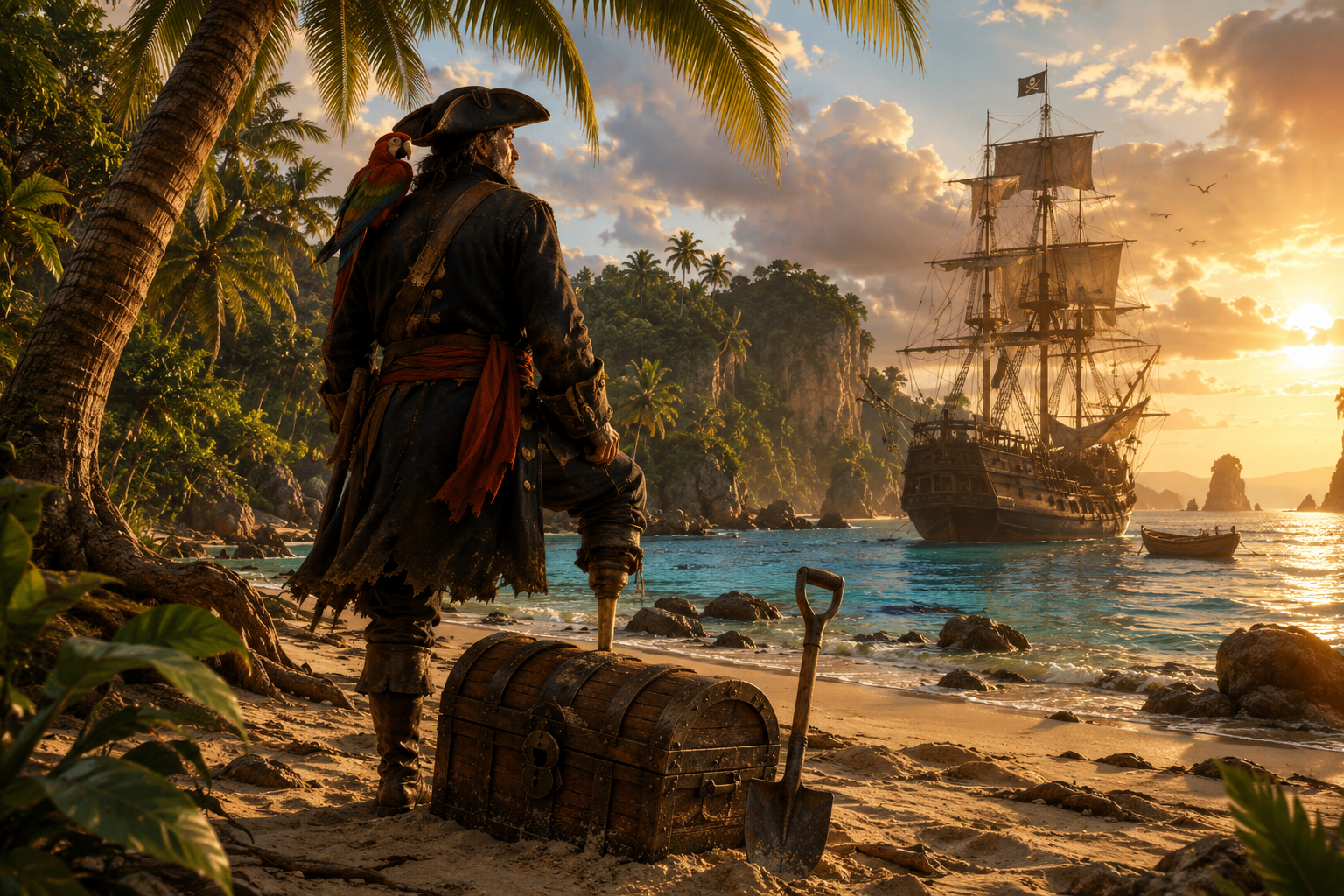
- the pirate with a wooden leg
- mutinies aboard ships
- parrots perched on pirates' shoulder
- the pirate language and visual imagery later adopted by novels, films, and television series
Over time, Treasure Island became one of the most influential adventure novels ever written. Its success was so great that it shaped the popular image of pirates far more than the historical facts themselves.
Whenever we imagine an old yellowed map with a great X marking the location of buried treasure, we are in fact looking at the legacy of one of the most famous literary works ever written.
The legend of the buried pirate treasure may have been inspired by real cases such as that of William Kidd—but it was Stevenson who transformed it into one of the most enduring symbols of popular culture.
Between Myth and the Sea: The Pirate Imagination
Over time, the figure of the pirate grew far beyond the historical facts.
As the centuries passed, new elements emerged that have become inseparable from popular culture:
- Davy Jones, lord of the ocean depths
- Mermaids associated with danger and temptation
- Sea creatures and ocean legends
The pirate ceased to be merely a criminal pursued by the law. Instead, he became a symbol of freedom, adventure, and rebellion.
The End of Classical Piracy
At the beginning of the 18th century, the great powers began to combat piracy in a systematic way.
Among the measures they adopted were:
- Constant naval patrols
- Control of trade routes
- Public trials and executions
Gradually, the so-called Golden Age of Piracy came to an end.
Piracy did not disappear entirely from the world, but the era that has most captured our imagination was over.
Curiosities
William Kidd / Captain Kidd
After William Kidd's execution, his body was covered in tar and displayed in an iron cage above the River Thames in London.
It remained there for several years as a public warning to sailors, privateers, and pirates alike. This punishment, known as gibbeting, was used by the English authorities to discourage future acts of piracy.
The sight of a pirate's body hanging above the river left a powerful impression on the public and contributed to many of the legends surrounding the fate of captured pirates.
His fame did not end with his death. Soon after his execution, pamphlets, popular tales, and songs inspired by his story began to circulate. One of the best known was Captain Kidd’s Farewell to the Sea , published in 1701.
Paradoxically, the man who was condemned for piracy would become one of the most famous pirates in history.
A Pirate More Famous After Death
The story of William Kidd is one of the earliest examples of reality transforming into legend.
His trial, the discovery of his hidden treasure, and the enormous public attention surrounding his case ensured that his name would survive for centuries.
While many pirates disappeared from the historical record, Kidd continued to appear in books, songs, newspapers, novels, and popular tales.
In a way, the treasure that truly achieved immortality was not the one he buried on Gardiners Island…It was his own story.
Between History and Legend
Pirates were not heroes…But neither were they merely fairy-tale villains.
They were products of their time:
- the expansion of global trade
- conflicts between empires
- a sea that offered both wealth and danger
As the centuries passed, history became intertwined with legend. And so, somewhere between reality and myth, the image that still fascinates us today was born.
Because pirates were not born from myth…
Myth was born from them.
Follow the Footprints
Gardiners Islandstill exists off the coast of Long Island, New York. Purchased by Lion Gardiner in 1639, it has remained in the hands of the same family ever since. Today, it cannot be freely visited, as it remains a privately owned island—the very place where William Kidd hid what would become the most famous pirate treasure in history in 1699.
Visit It Today...
Among the many museums around the world dedicated to the history of piracy, some of the most notable include:
- The Pirate & Treasure Museumin St. Augustine, Florida (United States), considered one of the world's largest pirate archives, housing nearly a thousand historical artifacts and recovered gold bars, along with interactive exhibits.
- Real Pirates Salem Museumin Massachusetts (United States), dedicated to the Golden Age of Piracy and famous for displaying artifacts recovered from the wreck of the pirate ship Whydah Gally.
- Pirates of Nassau Museumin Nassau, Bahamas, located in one of the former pirate capitals of the Caribbean. It features a full-scale replica of a pirate ship and exhibitions on some of history's most famous privateers and pirates.
- Pirate Treasure Museumin St. Thomas (U.S. Virgin Islands), showcasing treasures and artifacts recovered from historic shipwrecks.
Its Legacy Lives On...
- The Gasparilla Pirate Festival in Tampa, Florida (United States), celebrated annually since 1904. Inspired by the legend of the pirate José Gaspar, it features parades, floats, and the famous "pirate invasion," during which symbolic corsairs ceremonially take over the city.
- Pirates Week Festival in the Cayman Islands, one of the Caribbean's best-known themed festivals, featuring historical reenactments, parades, and activities inspired by the age of piracy.