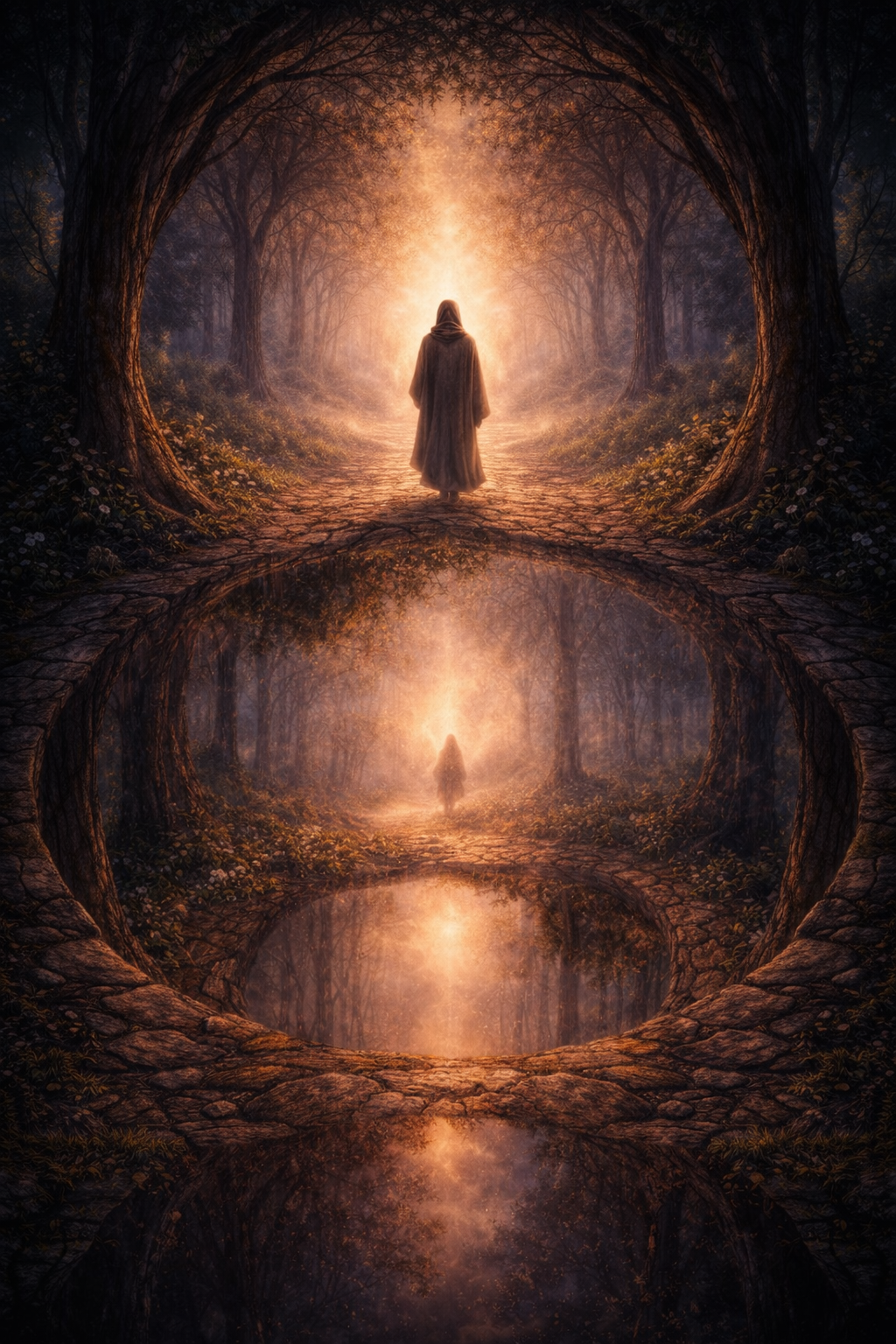
The cyclical nature of time in Celtic mythology is one of the keys to understanding their worldview. It's not just about seasons, but a different way of experiencing reality.
But it is not just a different way of measuring the passing of seasons.
It is, above all, a different way of experiencing reality.
For the Celtic peoples, time did not organize the world.
It transformed it.
Time as experience
In Celtic tradition, time is not a fixed structure. It is not a line that moves forward steadily.
It is something that is perceived, felt, and can be altered.
A single moment can contain more than one reality.
An instant can expand… or disappear.
Time is not the same for everyone.
Nor in every place.
When time becomes unstable
This way of understanding time has a direct consequence: Reality itself becomes unstable.
If time is not fixed, neither is the world.
In Celtic narratives, this appears in subtle ways:
- journeys that seem to last hours… yet years have passed
- encounters that do not fully belong to the human world
- places that change depending on who crosses them
These are not exceptions. They are part of how that universe works.
Time and the Otherworld
The Otherworld is not separated by physical distance. It is separated by a difference in the perception of time.
There, time does not flow as it does in the human world.
It may stop.
It may accelerate.
It may not exist at all.
That is why those who enter the Otherworld rarely return unchanged.
Not because the place transforms them, but because time there is not the same.
Time and the cycles of nature
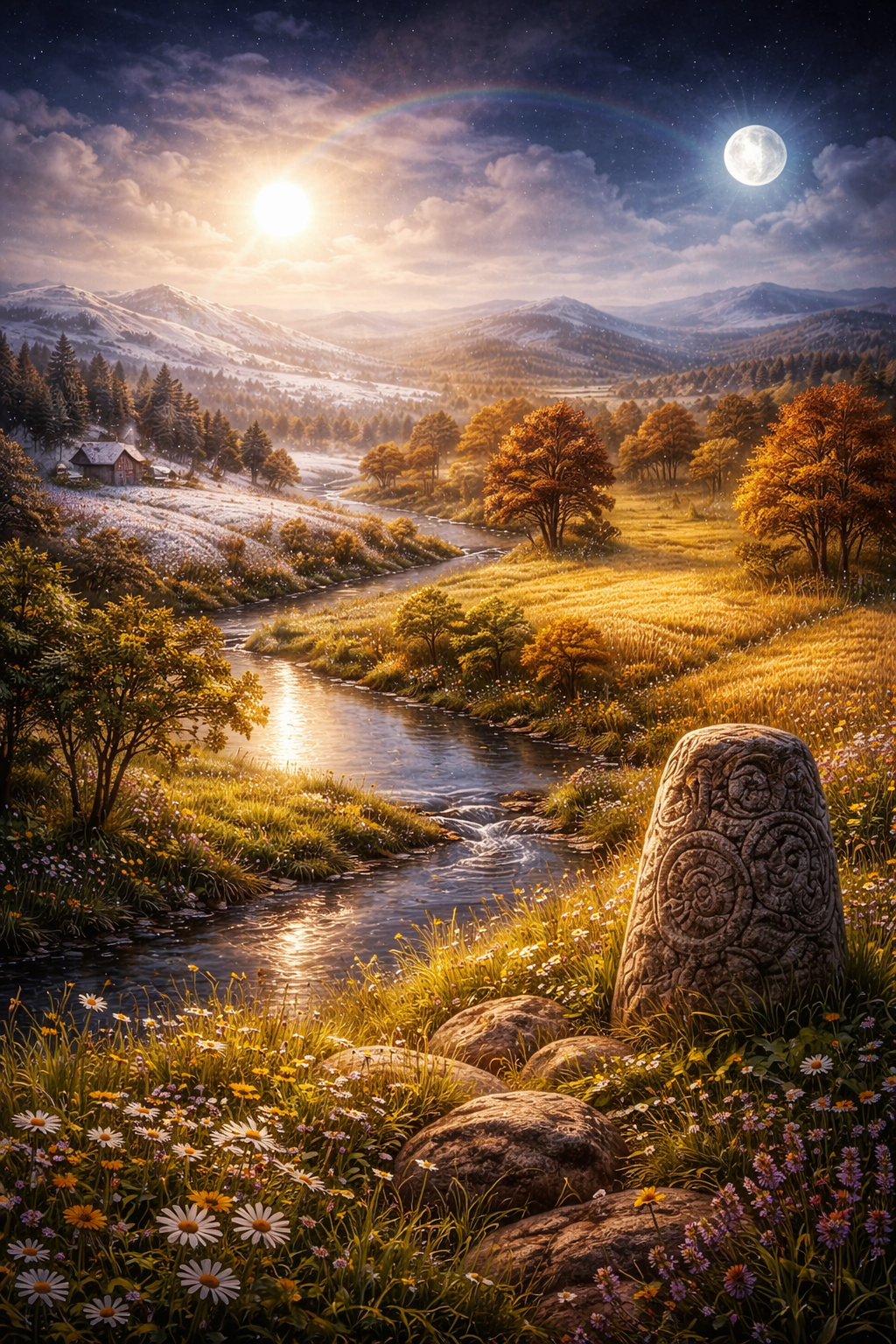
For the Celtic peoples, time was not only perceived… it was observed in nature.
It did not begin at a fixed point, nor was it organized into months as we understand them today, but into living cycles shaped by the land and the moon.
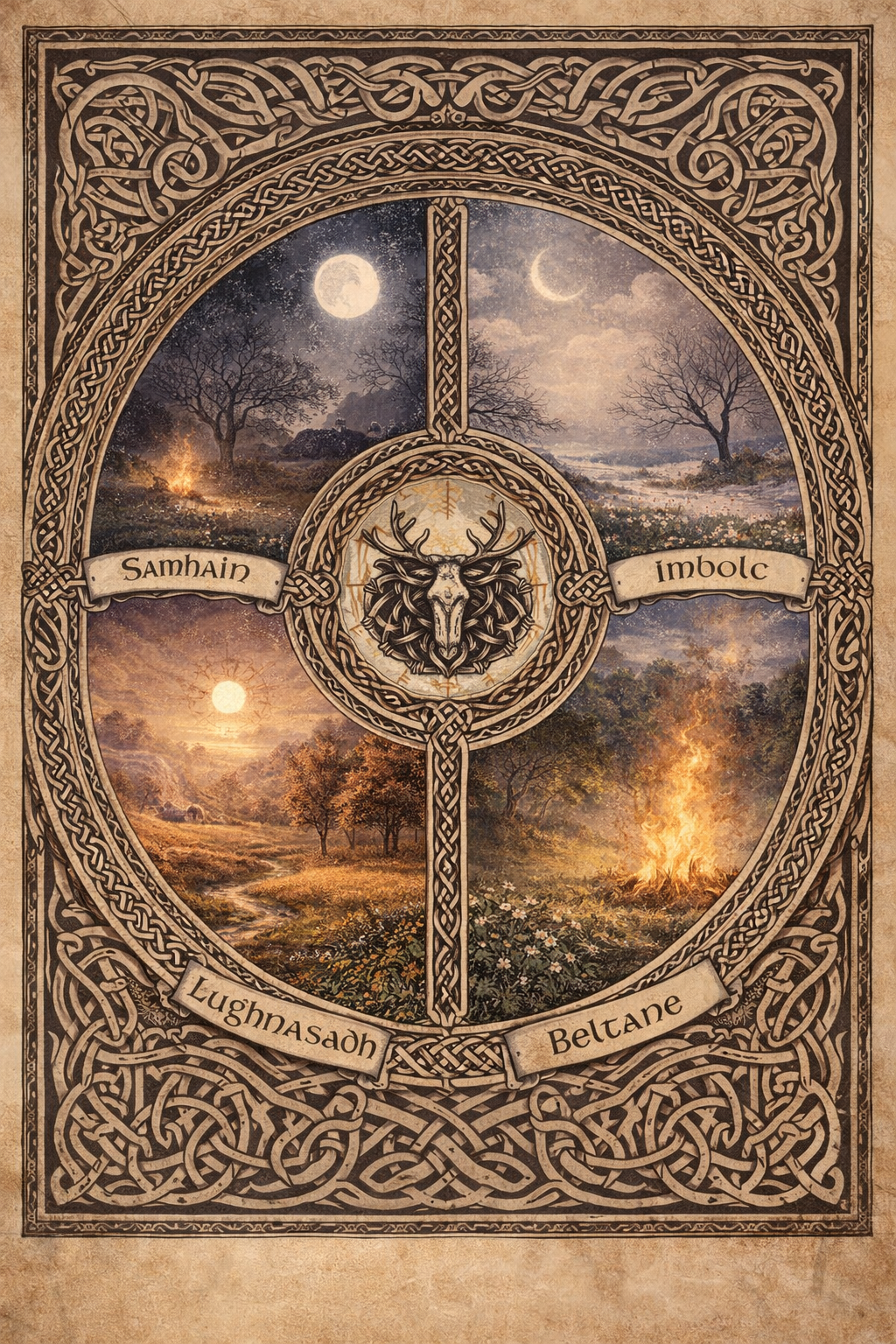
The year was divided into two great halves:
- a dark half
- a light half
And it revolved around four key moments:
- Samhain, the beginning of the year and the dark half
- Imbolc, the awakening after winter.
- Beltane, the beginning of the light half
- Lughnasadh, tiempo de cosechas
More than dates, these were transitions. Moments when the world shifted from one state to another
A day that began in darkness
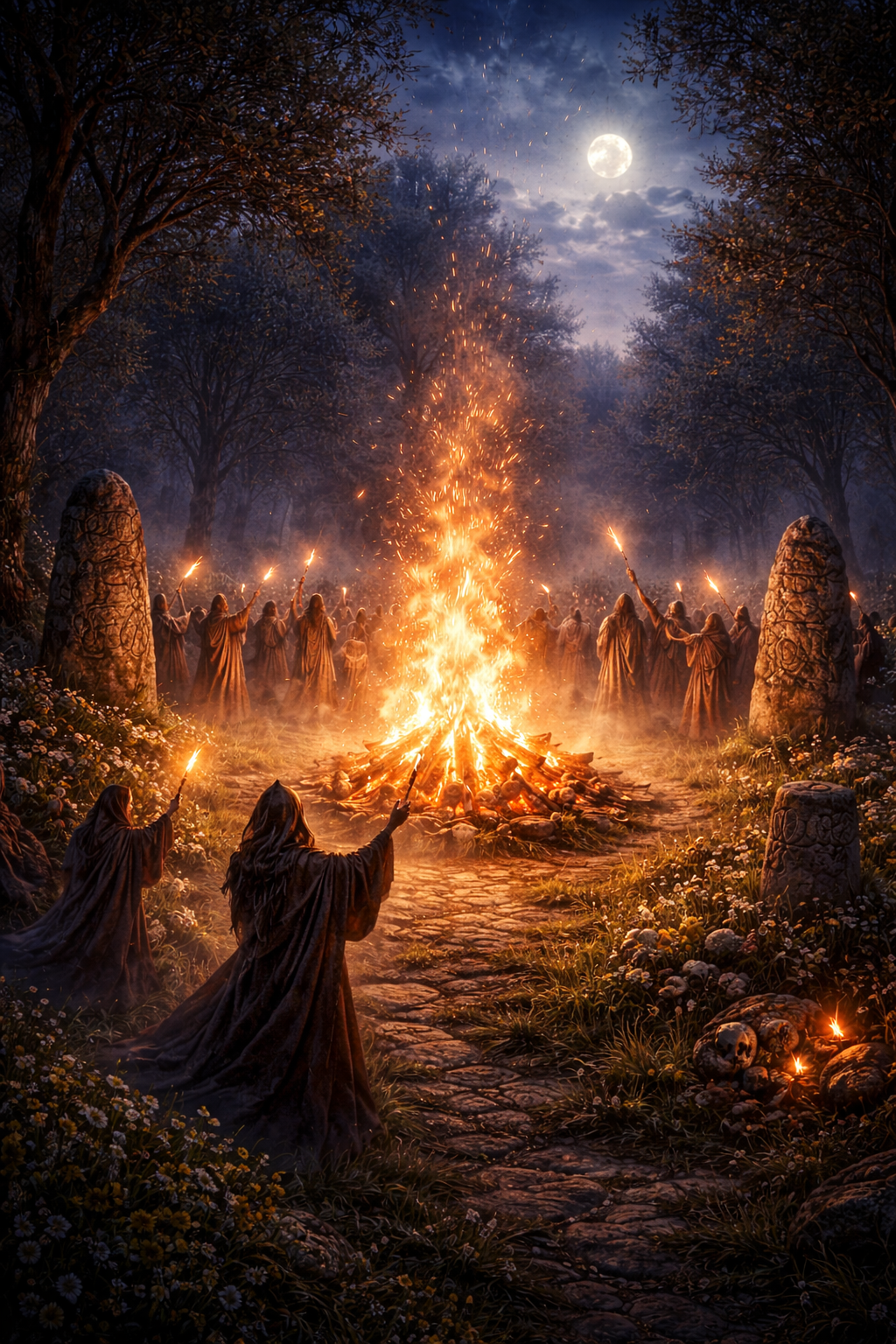
This way of understanding time was also reflected in something essential: the beginning of the day.
For the Celts, the day did not begin with light, but with night.
Este detalle, mencionado por Julius Caesar in De Bello Gallico, reveals a profoundly different mindset.
A calendar between the moon and the sun
Celtic time was neither purely solar nor purely lunar. It was lunisolar.
The cycles of the moon marked the closest, most immediate rhythm. Each month followed its phases, alternating periods of darkness and light.
At the same time, the movement of the sun — the seasons — defined the great changes of the year.
Thus, time was built as a layering of cycles: moon, sun, and nature.
One of the clearest examples of this system is the Coligny Calendar (Gaul, 2nd century AD), which shows:
- lunar months
- adjustment to the solar cycle
- years of 12 or 13 months
A time that does not fix… but transforms
The sun marked the great rhythms. The moon, the closest ones.
Each lunar cycle divided time into phases of darkness and light, reflecting the same pattern the Celts saw in all existence.
Thus, time was not a rigid structure.
It was a fabric of overlapping cycles.
Solar. Lunar. Natural.
A system in which everything was connected.
The “Wheel of the Year”: a later interpretation
Today, it is common to encounter the so-called “Wheel of the Year”, formed by eight festivals including solstices and equinoxes.
However, this structure does not belong to the original ancient Celtic tradition.
It is a modern reconstruction, developed mainly in the 20th century, combining Celtic elements with other European traditions. Among them:
- Germanic celebrations.
- Norse traditions
- modern reinterpretations
More than a historical system, it is a contemporary way of organizing and understanding these cycles.
Crossing without realizing it
In many stories, the passage between worlds does not happen consciously.
There is no clear moment in which someone “enters” the Otherworld.
It simply happens.
A path becomes different.
A landscape shifts.
A feeling appears.
And when one returns… something no longer fully fits.
A shifting reality
For the Celts, reality was not something fixed.
It was not made of immovable elements.
It moved.
It adapted.
It transformed.
What is visible today may not be tomorrow.
And what cannot be seen… may be more present than it seems.
Living in a changing world
This vision of time also implies a different way of inhabiting the world.
It is not about controlling reality.
Nor about fixing it in place.
It is about understanding that everything is in process.
That everything changes.
And that stability… is only a temporary illusion.
Understanding the invisible
Cyclical time does not only explain the passage of life.
It explains why the invisible can become present.
Why there are thresholds.
Why worlds overlap.
Time does not separate realities.
It connects them.
Beyond the calendar
In Celtic mythology, time is not a measure.
It is a force.
A force that transforms perception, alters experience, and blurs boundaries.
That is why reality is never fully defined.
Porque, cuando el tiempo deja de ser lineal…el mundo deja de ser fijo.
And the invisible… may be closer than it seems.