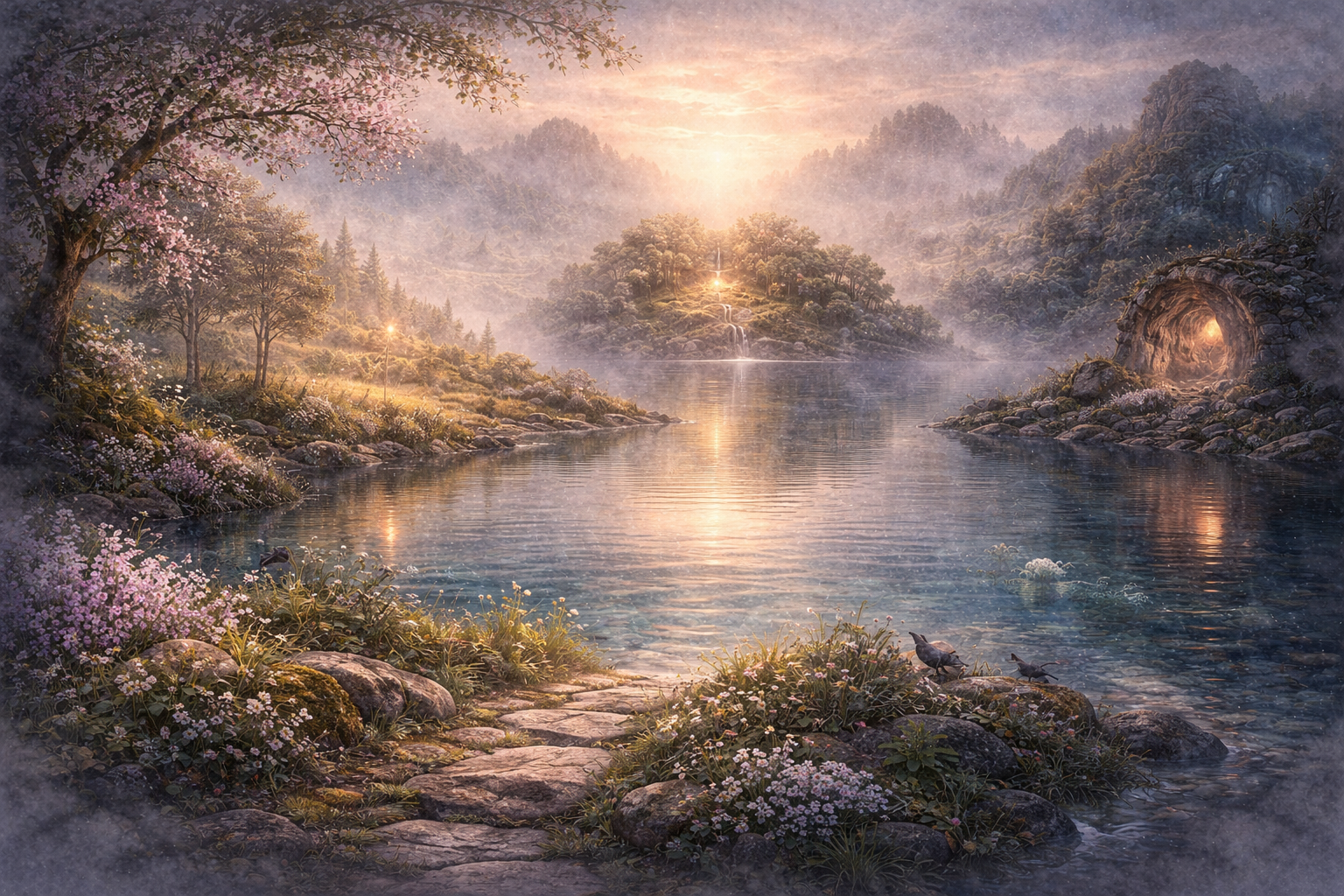
Unlike other mythologies, the Otherworld is not presented as a single defined place.
There is no single realm, nor a clear map that marks its boundaries.
Instead, ancient stories speak of different names, landscapes, and regions that seem to refer to the same reality: an invisible world capable of taking many forms.
The Celtic Otherworld is not described as a fixed territory, but as a shifting reality that may appear as an island, a plain, an underwater realm, an invisible land… or as a place reached only by crossing a threshold.
More than a territory, it is a presence.
A world with many forms
In Irish and Welsh traditions, the Otherworld is described in multiple ways. Not as separate worlds, but as different manifestations of a single invisible plane.
Each of these regions reflects a distinct idea:
- eternal youth
- abundance
- knowledge
- death
- the unknown
The Celtic Otherworld is not divided into different worlds.
It reveals itself.
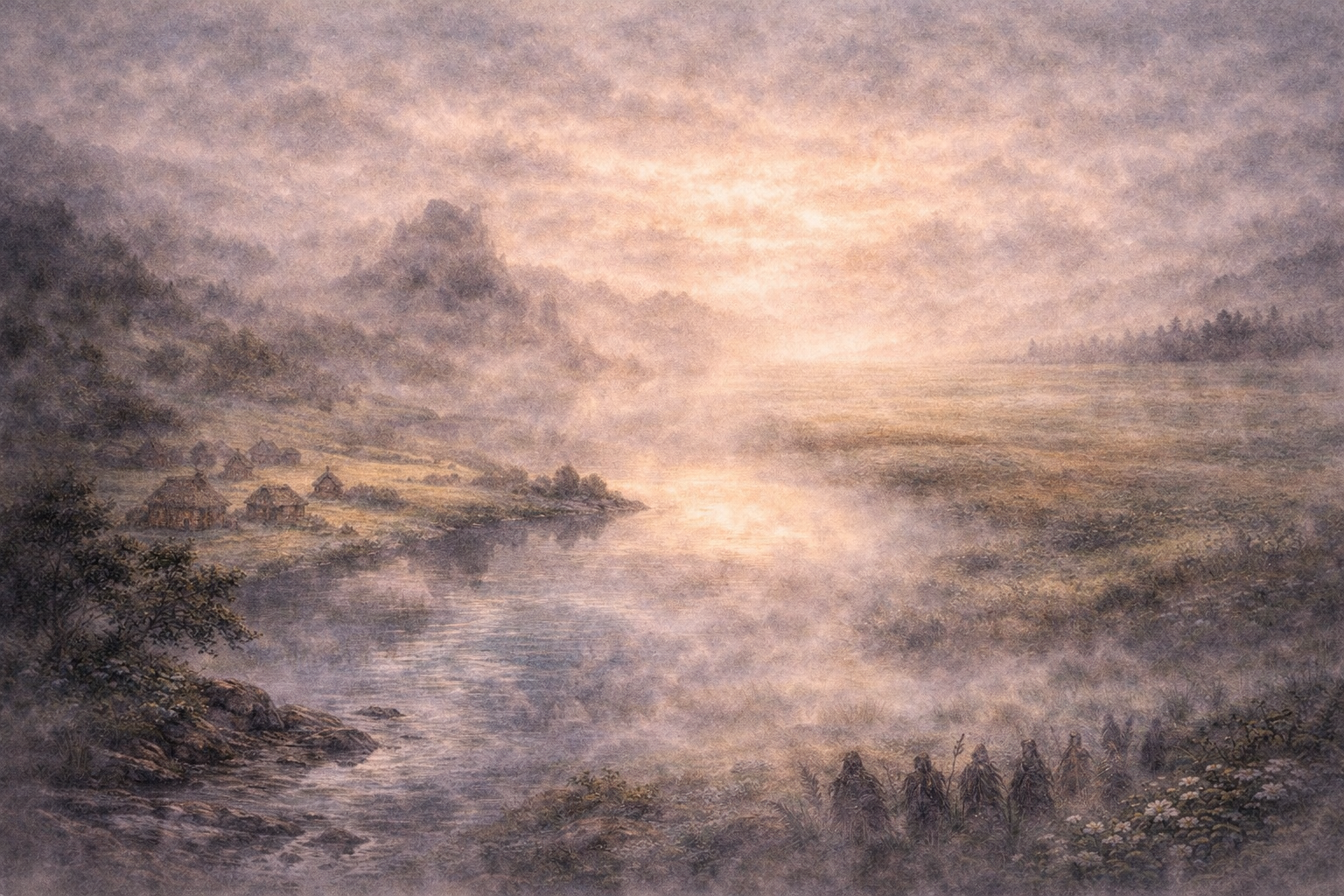
Main regions of the Otherworld
Among the most well-known names are:
Tír na nÓg — the land of youth
One of the most famous places in Irish tradition.
Tír na nÓg literally means “land of the young,” and is described as a place where:
- aging does not exist
- there is no illness
- time does not pass as it does in the human world
In many ways, it is the closest image to a paradise within the Celtic imagination.
Mag Mell — the plain of delight
Mag Mell, “the plain of joy,” appears as a realm of:
- abundance
- music
- feasting
- eternal happiness
It is often described as a place reached by heroes after their journeys.
Emain Ablach — the island of apples
A place associated with abundance and knowledge.
In Celtic tradition, the apple symbolizes the sacred, the hidden, and the immortal.
This place is closely connected to one of the most famous islands in European mythology.
Avalon — the island between worlds
Over time, Celtic traditions became intertwined with medieval narratives.
From this fusion emerges Avalon, an island shrouded in mist where:
- time seems to stand still
- healing is possible
- and heroes do not die… but rest
It is the place where, according to legend, King Arthur was taken.
Tech Duinn — the house of the dead
Not all manifestations of the Otherworld were luminous.
Tech Duinn, “the house of Donn,” is associated with death.
According to tradition, it was the destination of souls after death. A darker place, but not an evil one — part of the natural balance.
Annwn — the hidden realm
In Welsh tradition, the Otherworld is known as Annwn.
Ruled by Arawn, it is described as a mysterious, deep, and difficult-to-understand realm.
Not a place of punishment, but a different space with its own rules.
Tír fo Thuinn — the land beneath the waves
A realm connected to the sea.
It is associated with magical beings and submerged or invisible territories that coexist with the human world.
Not a dark place, but a distant and enchanted one.
Tír Tairngire — the land of promise
A realm described as a paradise of abundance, eternal beauty, and happiness.
It is often identified with, or overlaps with, Tír na nÓg.
In some traditions, it is linked to the sea god Manannán mac Lir.
Mag Mór — the great plain
A vast expanse associated with:
- abundance
- fertility
- eternity
More abstract than other places, it conveys a sense of infinity.
Hy-Brasil — the phantom island
A mythical island shrouded in mist, visible only on rare occasions.
According to legend, it emerged from the sea once every seven years.
It was often depicted as a circular island, crossed by a river or channel.
Tír na mBeo — the land of the living
A place where immortal beings reside.
Another expression of a world where life does not fade.
One world, many faces
For the ancient Celts, these regions were not separate worlds, but different ways of perceiving the same reality.
The Otherworld was not separated from ours by physical distance, but by perception.
It could appear as an island…
as a plain…
as an invisible realm…
But it was always there.
Close.
Present.
Waiting to be crossed.
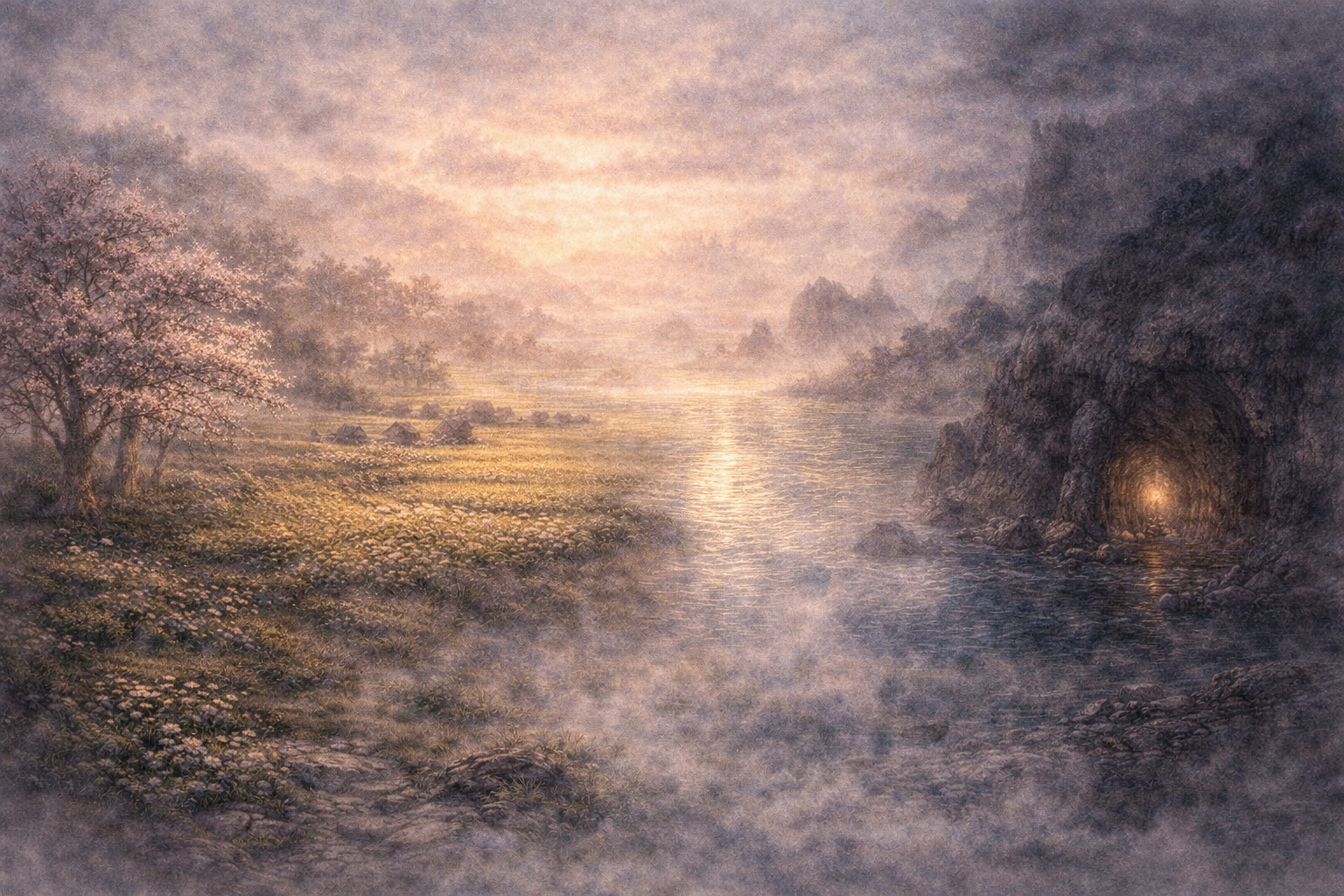
A reality that cannot be contained
Unlike other traditions, Celtic mythology does not seek to organize the universe into rigid structures.
There is no definitive map. No clear boundaries. Only stories that, from different places and times, attempt to describe something that cannot be seen… but can be felt.
Because for the Celts, the world did not end where sight could reach.
But where the invisible began.