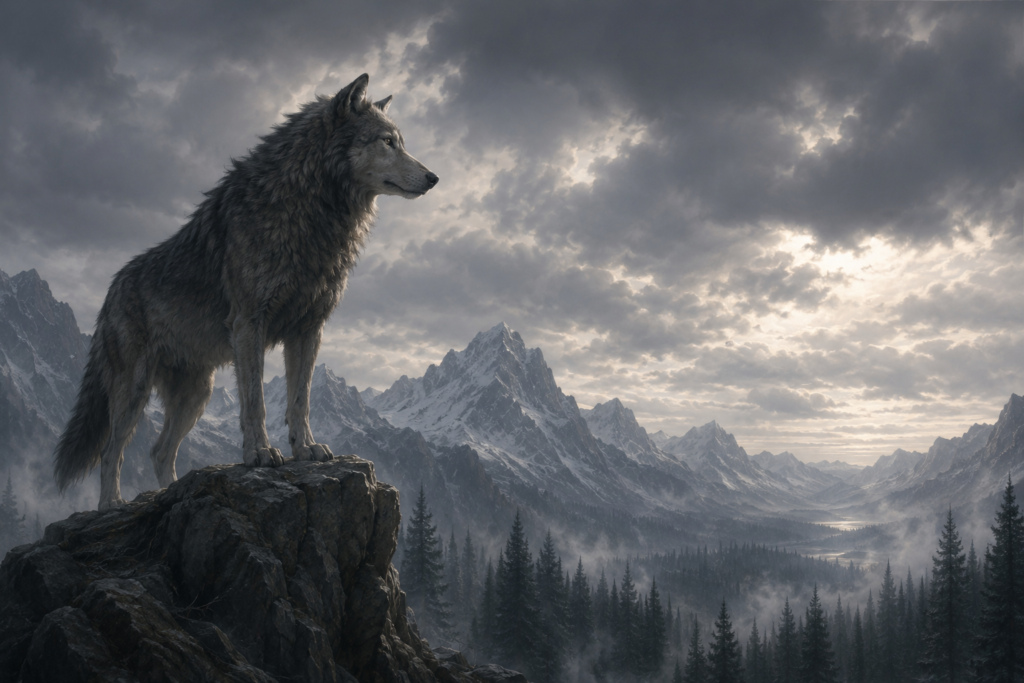
Fenrir is not simply a monstrous creature within Norse mythology. He is a living prophecy, a direct consequence of the gods’ fear, and one of the most tragic figures in the entire Scandinavian mythological tradition.
His story is not only about destruction, but also about destiny, betrayal, and the price of trying to control the inevitable.
Origin and lineage
Fenrir is the son of Loki, the god of trickery and change, and the giantess Angrboda, a figure associated with ominous prophecies and future sorrow. From this union were born three beings destined to play crucial roles in Ragnarök:
- Fenrir, the Wolf
- Jörmungandr, the World Serpent
- Hel, ruler of the realm of the dead
From the very beginning, the gods know the prophecy: Fenrir will grow up to devour Odin. This is his fate and the reason he inspires fear throughout Asgard.
Description and Characteristics
Although the Eddas do not provide a detailed physical description of Fenrir, they portray him as a wolf of unnatural growth.
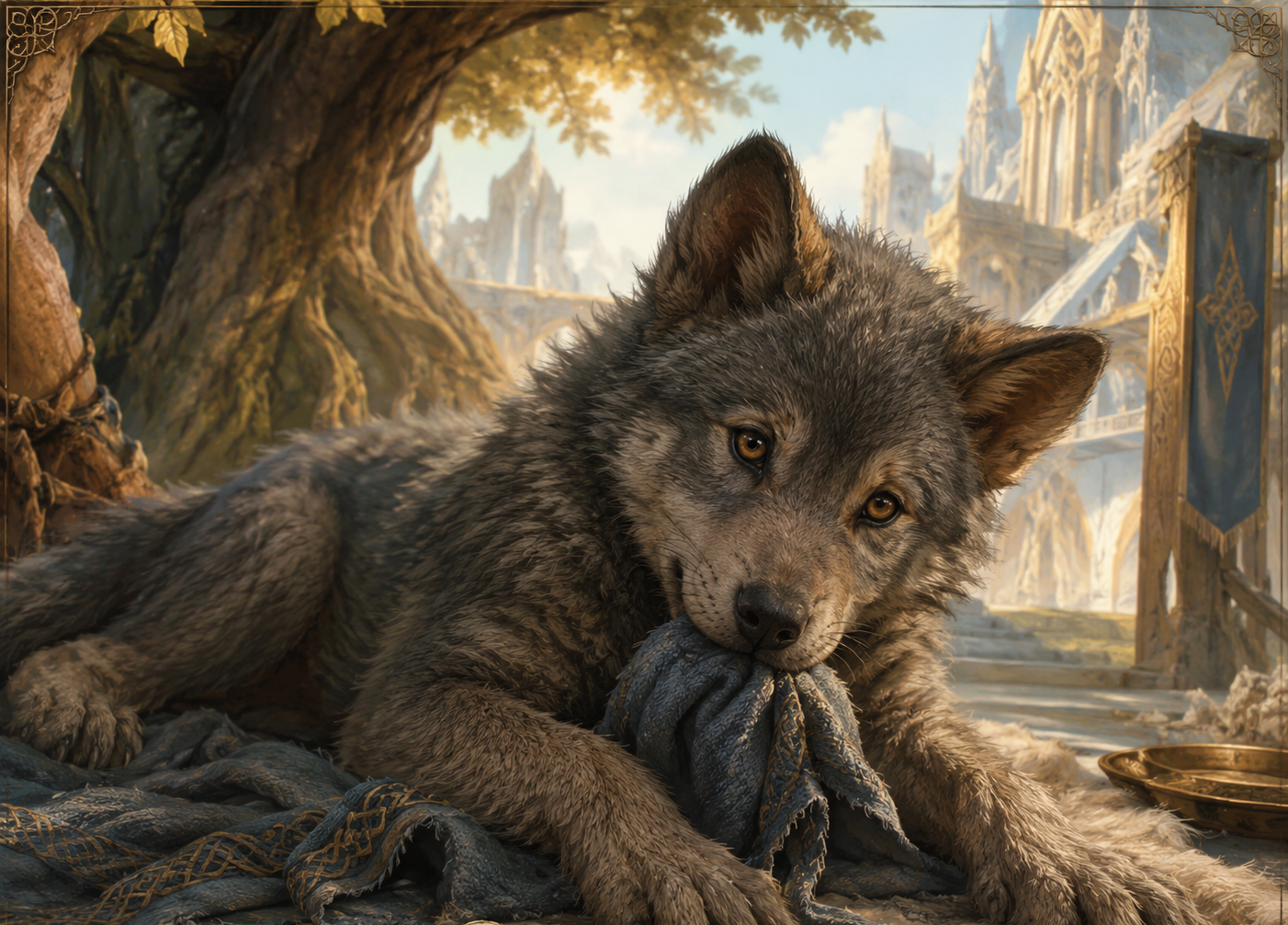
He begins as a cub raised in Asgard but grows until he reaches such an enormous size that even the gods begin to fear him.
He is associated with an unsettling presence marked by:
- restrained ferocity
- silent danger
- latent violence
- a constant sense of threat
Fenrir is not a theatrical monster. He is an inevitable one.
Fenrir’s Upbringing in Asgard
Unlike other creatures considered dangerous, Fenrir is not destroyed at birth. Instead, the gods decide to bring him to Asgard and keep a close watch on him.
At first, he shows no particularly aggressive nature. However, his rapid and unstoppable growth constantly reminds the gods of the prophecy hanging over him. Over time, fear begins to outweigh compassion.
Fenrir and Tyr
Tyr, the god of law, justice, and oaths, is the only deity who dares approach the wolf without hesitation.
- He feeds him.
- He cares for him.
- He does not fear him.
To Fenrir, Tyr becomes the only bond of trust within Asgard.
For this very reason, Tyr’s sacrifice will take on special significance when the moment of betrayal arrives.
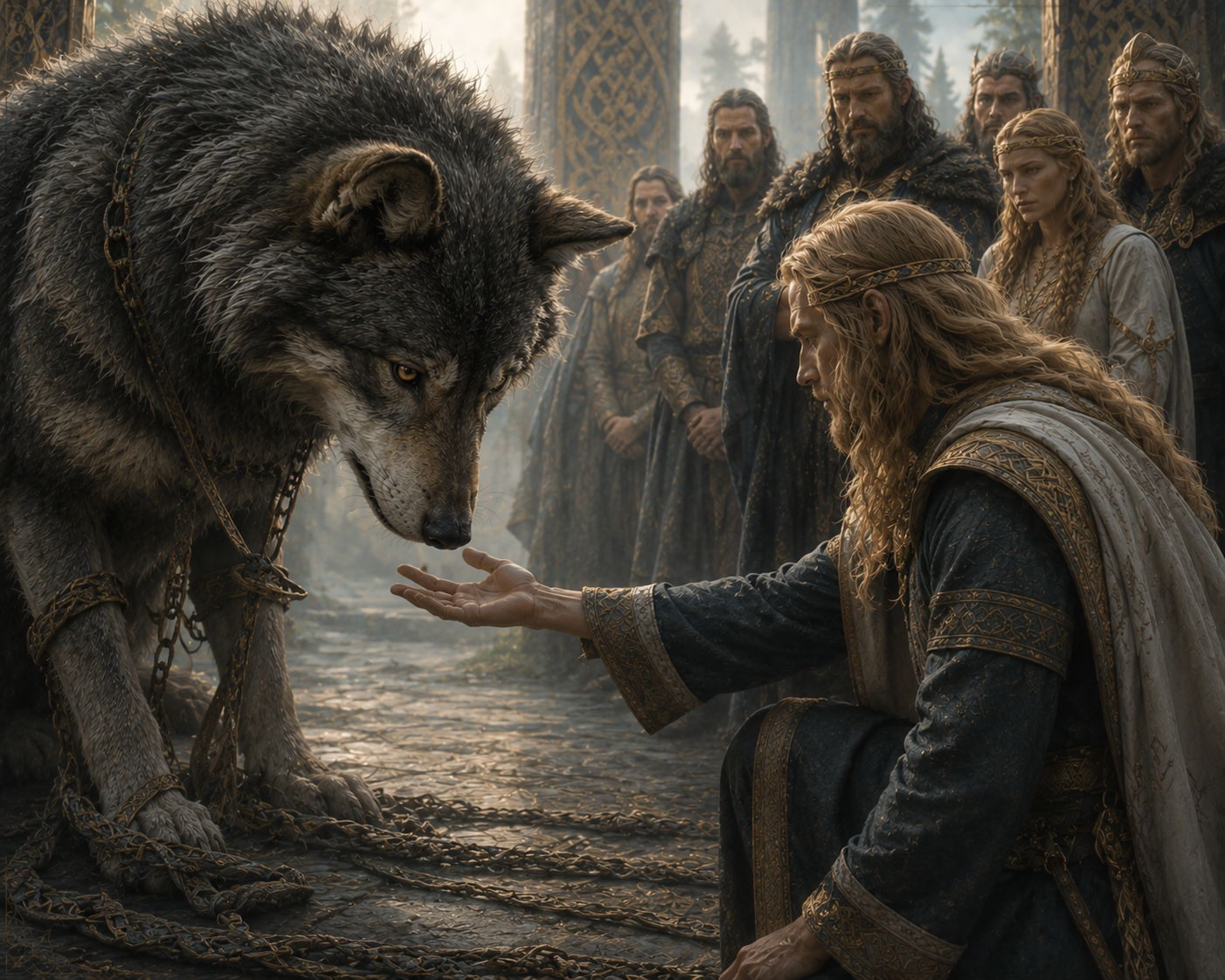
The Binding: From Game to Deception
Cuando el temor de los dioses supera a la vigilancia, deciden encadenar a Fenrir. No intentan hacerlo mediante la fuerza, sino presentándolo como un juego y una demostración de poder.
Throughout the story, three different restraints are used in an attempt to contain the wolf.
The Three Bindings: From the Physical to the Impossible
Læðingr: The First Chain
The first restraint, called Læðingr, is a massive chain forged by the gods themselves.
Heavy and strong, it seemed capable of holding any creature.
Fenrir breaks it without difficulty.
Drómi: The Second Chain
After the failure of Læðingr, the gods forge a second chain, even stronger than the first: Drómi.
Created to withstand monstrous strength, it appears impossible to break.
Fenrir escapes once again.
These trials strengthen the wolf’s confidence in his own power and in the apparent honesty of the gods.
Gleipnir: The Final Binding
When they realize that no physical chain can hold him, the gods turn to the dwarves, the most skilled craftsmen of the Nine Worlds.
They commission a third binding: Gleipnir.
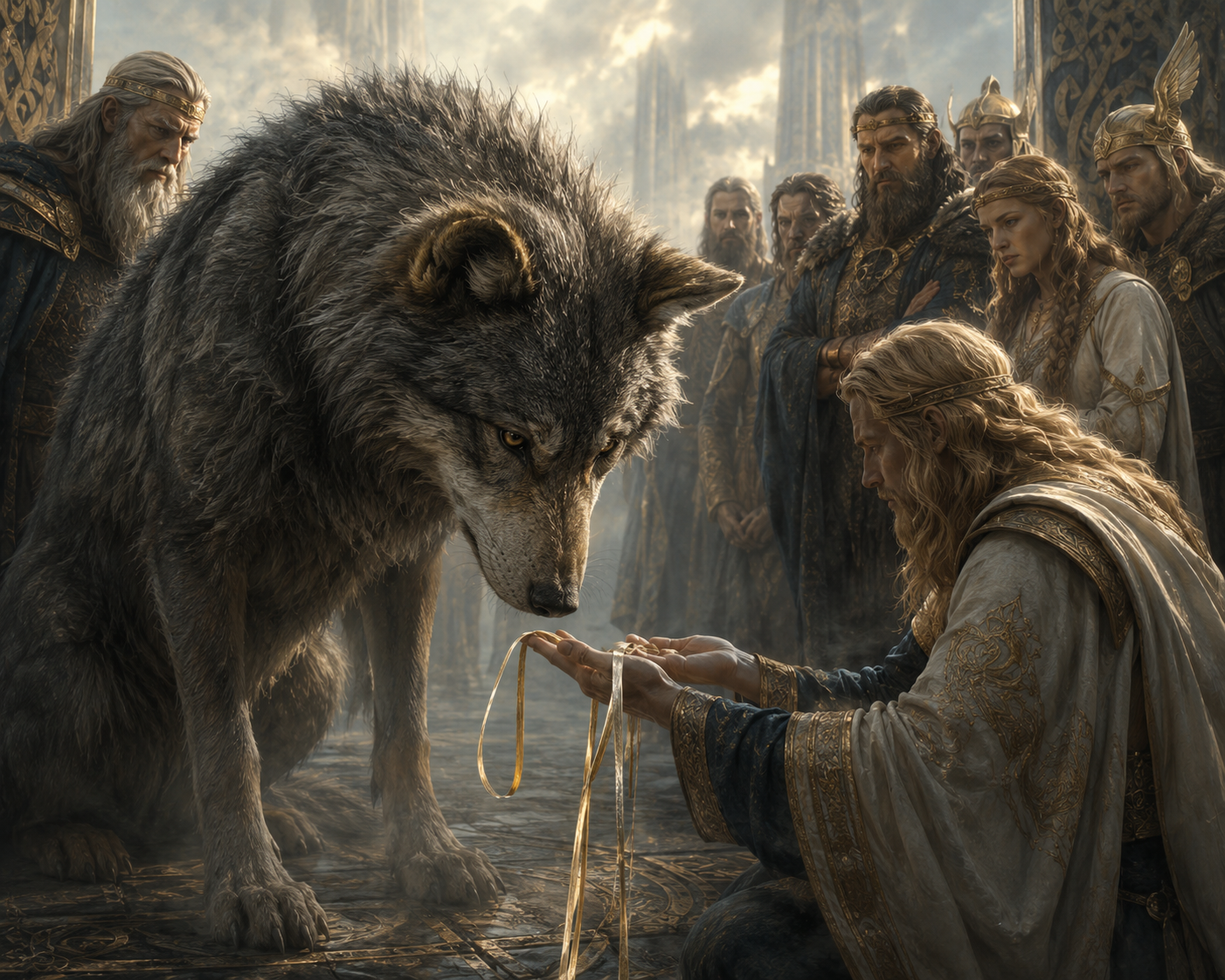
Gleipnir: The Soft Ribbon Made of Impossible Things
Unlike the previous chains, Gleipnir does not resemble a prison at all.
It is a thin, soft, and light ribbon crafted from impossible elements:
- the sound of a cat’s footsteps
- a woman’s beard
- the roots of a mountain
- the sinews of a bear
- the breath of a fish
- the saliva of a bird
When the gods ask Fenrir to test his strength against this new binding, the wolf becomes suspicious.
After breaking two mighty chains, the delicate ribbon appears to be a trick. Nevertheless, he agrees on one condition. He demands that one of the gods place a hand inside his jaws as a guarantee of good faith.
If he succeeds in freeing himself, the hand will be returned unharmed. If he has been deceived, the hand will be lost.
None of the gods dares to accept. None except Tyr.
When Fenrir realizes that he cannot break Gleipnir and understands that he has been betrayed, he snaps his jaws shut and tears off the god’s hand.
Thus, Tyr loses a hand, and Fenrir loses the little trust he still had in the gods.
The Fate of the Bound Wolf
After being restrained, Fenrir is taken far from Asgard.
The gods bind him in a remote place where he remains imprisoned by Gleipnir.
To prevent him from fully closing his mouth, they place a sword between his jaws. From the saliva that drips from his mouth flows the river Ván.
There he remains:
- isolated
- motionless
- conscious
- waiting
The prophecy is not yet fulfilled.
Fenrir in Ragnarök
When Ragnarökarrives, Gleipnir finally breaks and Fenrir regains his freedom.
The sources describe his size as immense:
- his upper jaw reaches the sky
- his lower jaw scrapes the earth
Fenrir advances alongside the forces of chaos and fulfills the destiny foretold from his birth.
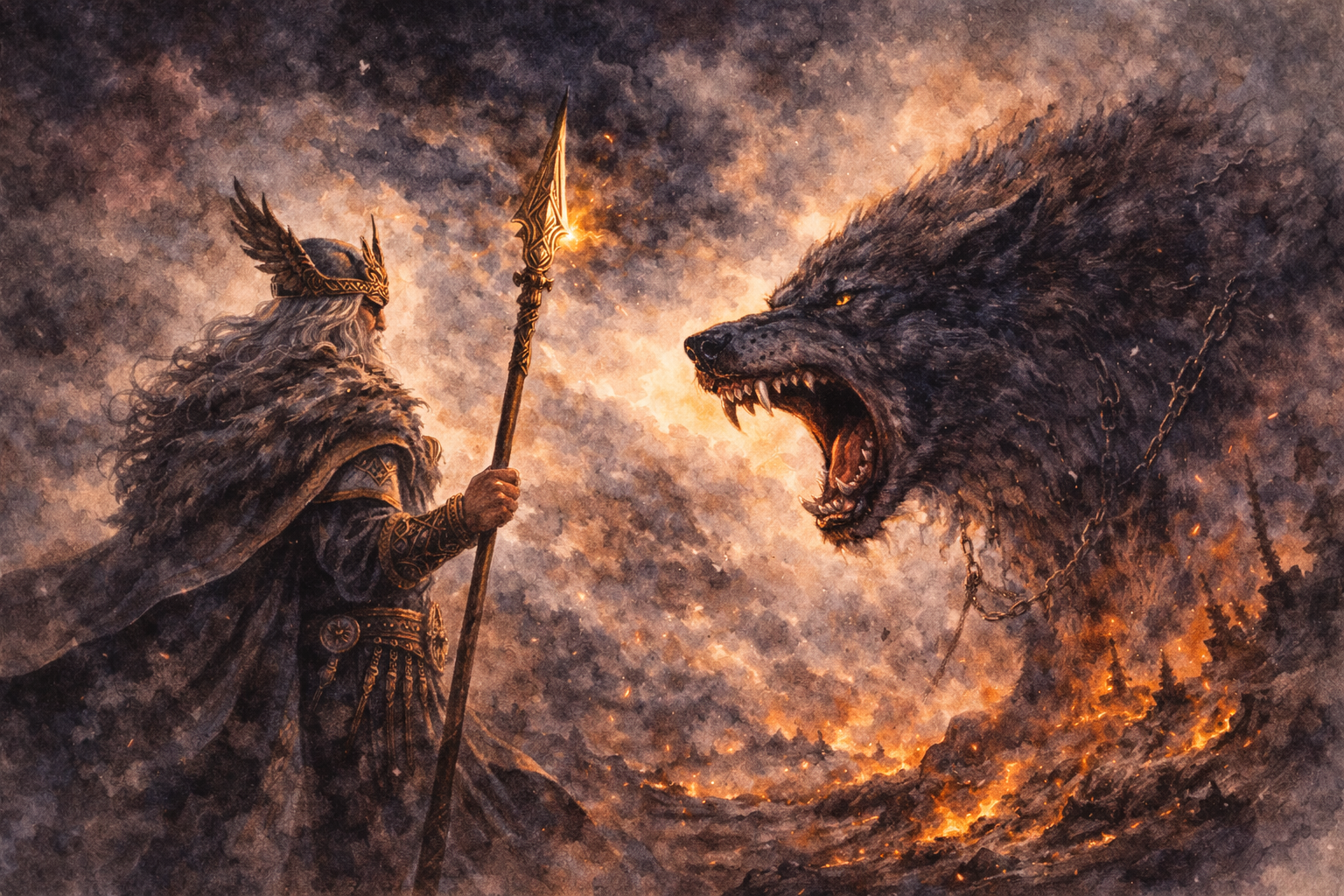
He devours Odin, bringing the prophecy to completion.
He does not merely destroy a god. He destroys the order the gods had struggled to preserve.
Víðarr, Odin’s son, then confronts the wolf and kills him, avenging his father's death.
A Monster or a Victim of Destiny?
Fenrir is often remembered as one of the most terrifying creatures in Norse mythology.
Yet his story can also be viewed from another perspective.
He never chose the prophecy that condemned him. He was feared from birth. He was watched, deceived, and chained for something he had not yet done.
Por ello, Fenrir representa una de las preguntas más profundas de la tradición nórdica: ¿Fue realmente un monstruo…o se convirtió en aquello que los dioses temían porque nunca le permitieron ser otra cosa?