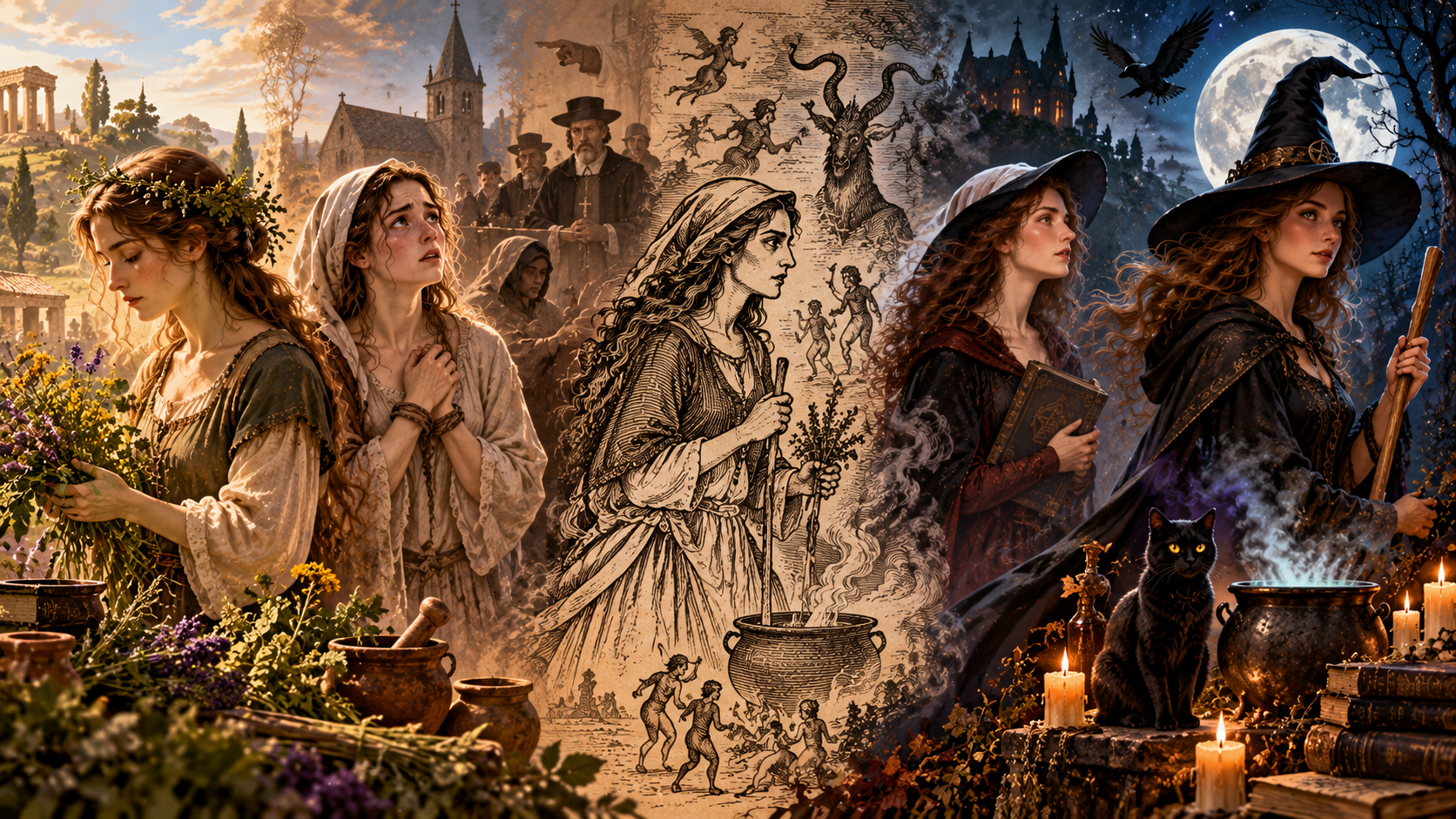
Everyone recognizes a witch when they see one: a pointed hat, a broomstick, a black cat, a cauldron, and a cottage in the forest. But almost none of these elements belonged to the first women who were described as sorceresses, magicians, or practitioners of dark arts.
The image we know today as “the witch” emerged slowly over the centuries, blending religion, superstition, folklore, fear, literature, and popular imagery.
““There were no witches or bewitched people until people began to speak and write about them.”
Alonso de Salazar y Frías, summary of his reports to the Inquisition, 1612.
The Origin of the Word
The word we translate today as “witch” does not have a single origin. Each European language developed its own terms and, with them, different nuances.
Witch — England
It derives from Old English wicce, feminine, and wicca, masculine, terms used for people associated with magic, divination, or occult practices. The deeper etymology of witch remains debated. wicce, femenino, y wicca, masculino, términos utilizados para personas relacionadas con la magia, la adivinación o las prácticas ocultas. La etimología más profunda de witch continúa siendo discutida.
Hexe — Germany
The German Hexe derives from Old High German hagazussa and Middle High German hecse. Its exact etymology has not been completely established, although the first element is probably related to hag, a term associated with an enclosure, hedge, or boundary. This has led to interpretations connecting the word with a being associated with the boundaries between inhabited spaces and the outside world.
The familiar translation “one who jumps over fences” is well known, but it is better understood as an etymological interpretation rather than an established literal meaning.
Strega — Italy
It derives from the Latin striga, related to strix, a nocturnal bird. In ancient and medieval traditions, these figures gradually became associated with supernatural female beings and harmful magic.
Sorcière — France
It derives from Late Latin sortiarius, meaning “one who divines through lots,” from sors, sortis, associated with fortune and divination.
During the Middle Ages, there was not yet a single European category equivalent to our modern word “witch.” Documents could use Latin terms such as malefica, striga, sortilega or sortiarius, depending on the context and the practice being described.
In the Pyrenean region, forms such as bruxa, bruxo and bruixa appear in medieval documentation. Their etymological origin remains uncertain. Linguistic studies have not established a definitive explanation, and even a pre-Roman origin has been proposed.
Magic and Female Figures in Antiquity
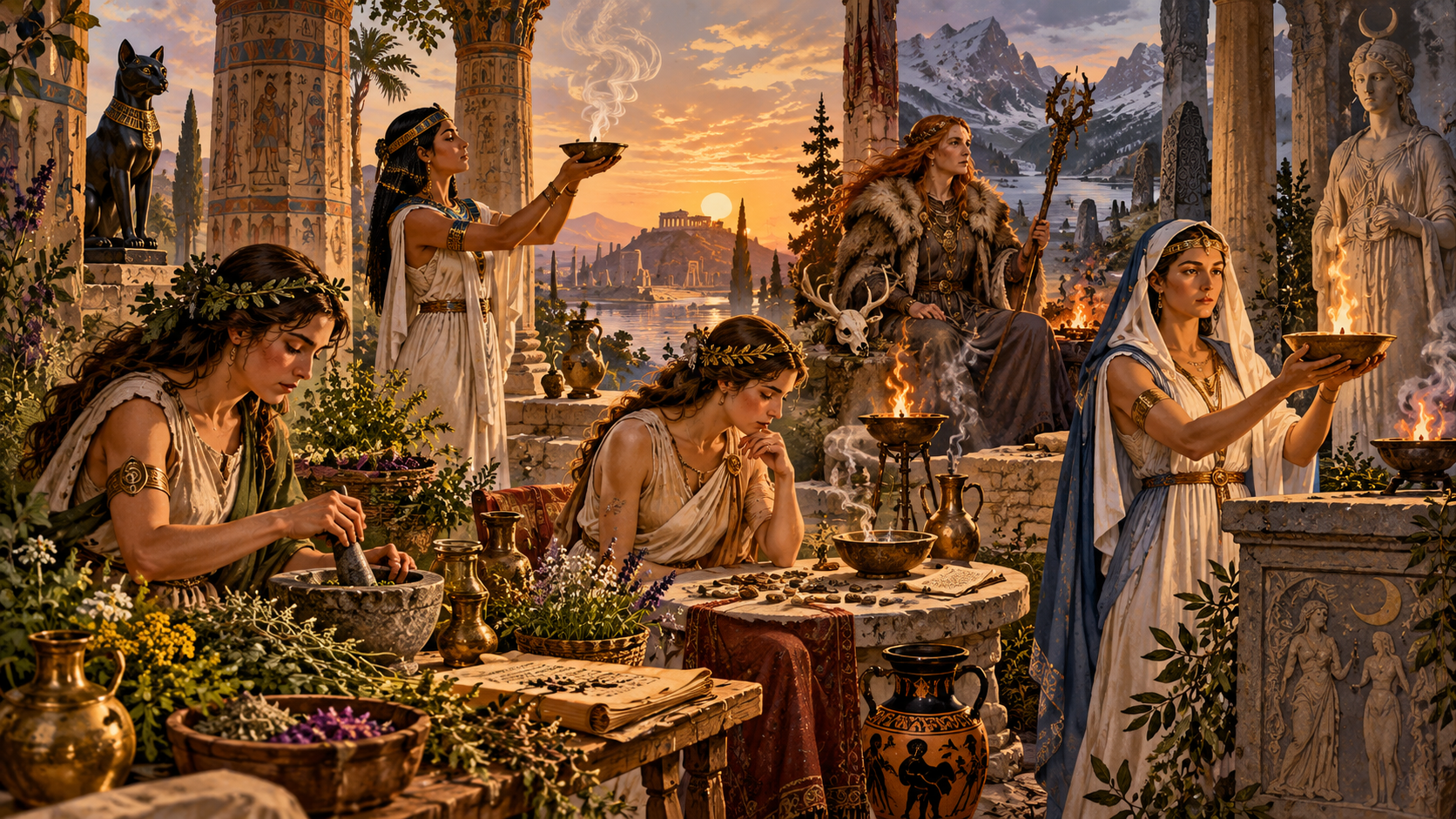
Ancient societies provide numerous examples of women associated with magic, divination, or supernatural practices. In Greece, Rome, Egypt, Mesopotamia, and other ancient societies, we find different figures connected with the supernatural:
- Sorceresses, associated with spells, potions, or magical rituals.
- Diviners, who interpreted signs, dreams, oracles, and other phenomena in order to discover the will of the gods.
- Völvas, en la tradición nórdica, mujeres vinculadas a prácticas seiðr magic., in the Norse tradition, women associated with seiðr, a form of magic connected with divination and knowledge of destiny.
- Healers, who knew about plants, medicinal preparations, wound care, and other remedies. Some people who practiced these kinds of activities would be accused of witchcraft many centuries later.
- Women involved in religious and ritual practices, whose knowledge could include ceremonies, formulas, plants, or forms of divination.
- Priestesses., who performed recognized religious functions within their own societies, such as priestesses of particular Egyptian and Greek cults or the Roman Vestal Virgins.
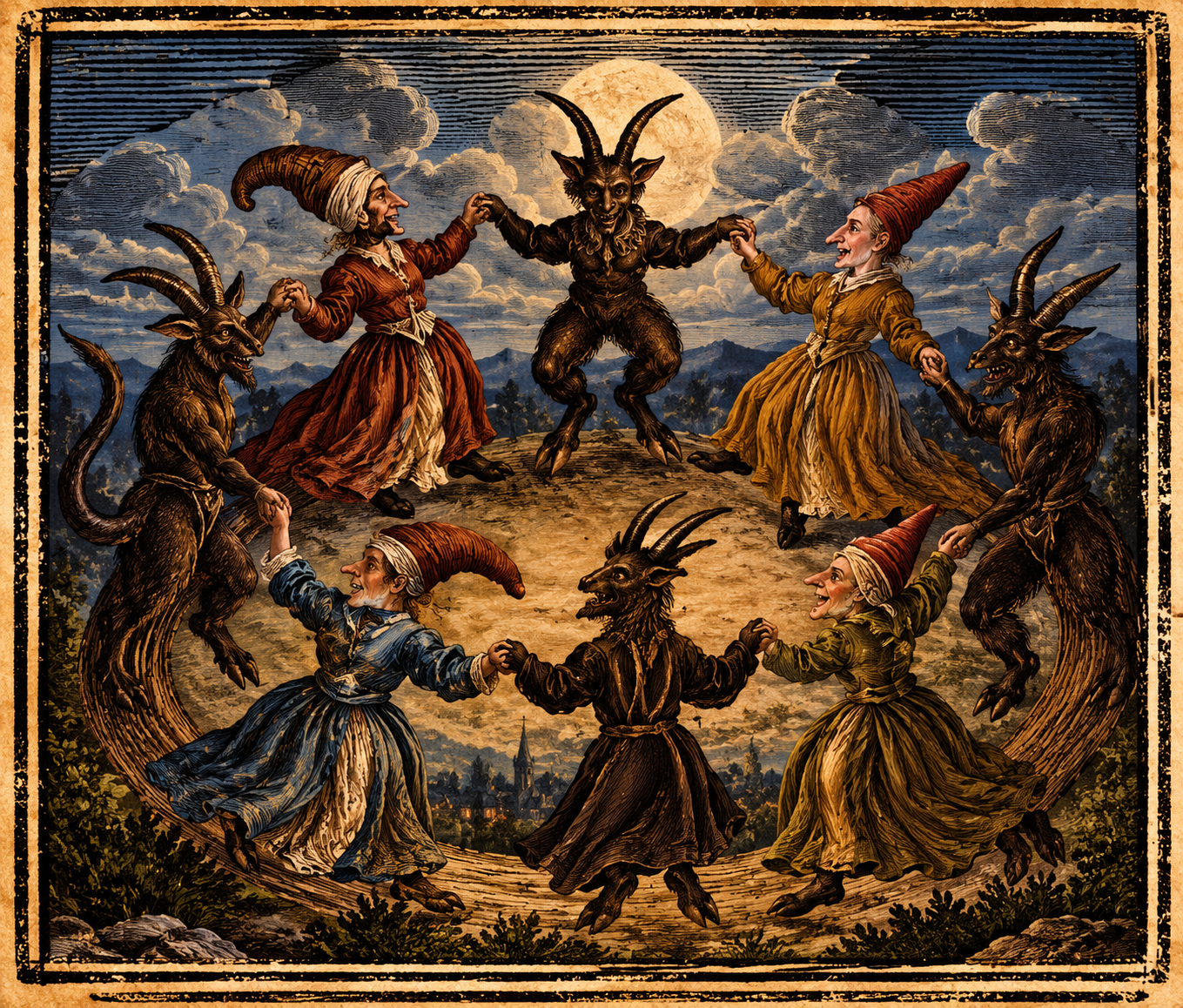
Different traditions also contain female figures associated with spirits, supernatural beings, nocturnal journeys, or extraordinary gatherings.
The history of European witchcraft would emerge precisely from the gradual combination of different beliefs: harmful magic, divination, popular superstition, demonology, stories about spirits, and particular folkloric traditions.
“It must not be omitted that certain wicked women, devoted to Satan, seduced by the illusions and phantoms of demons, believe and profess that they ride at night upon beasts with Diana, goddess of the pagans… and that in the silent hours of the night they fly across vast lands…”
— Regino of Prüm, Canon Episcopi, 10th century Canon Episcopi, siglo X.
Magic Before Christianity
For centuries, magic and witchcraft were not necessarily synonymous. In many ancient and medieval societies, amulets, oracles, rituals, formulas, healing practices, and different forms of magic existed that could be considered acceptable depending on the context.
The boundary between religion, medicine, superstition, and magic was also not the same as the one established by Christian authors in later centuries. Even during the Middle Ages, attitudes toward magic were far more complex than popular culture usually suggests. There were religious condemnations, but there were also traditions of natural magic, astrology, ritual practices, and intellectual studies of the supernatural world within medieval culture.
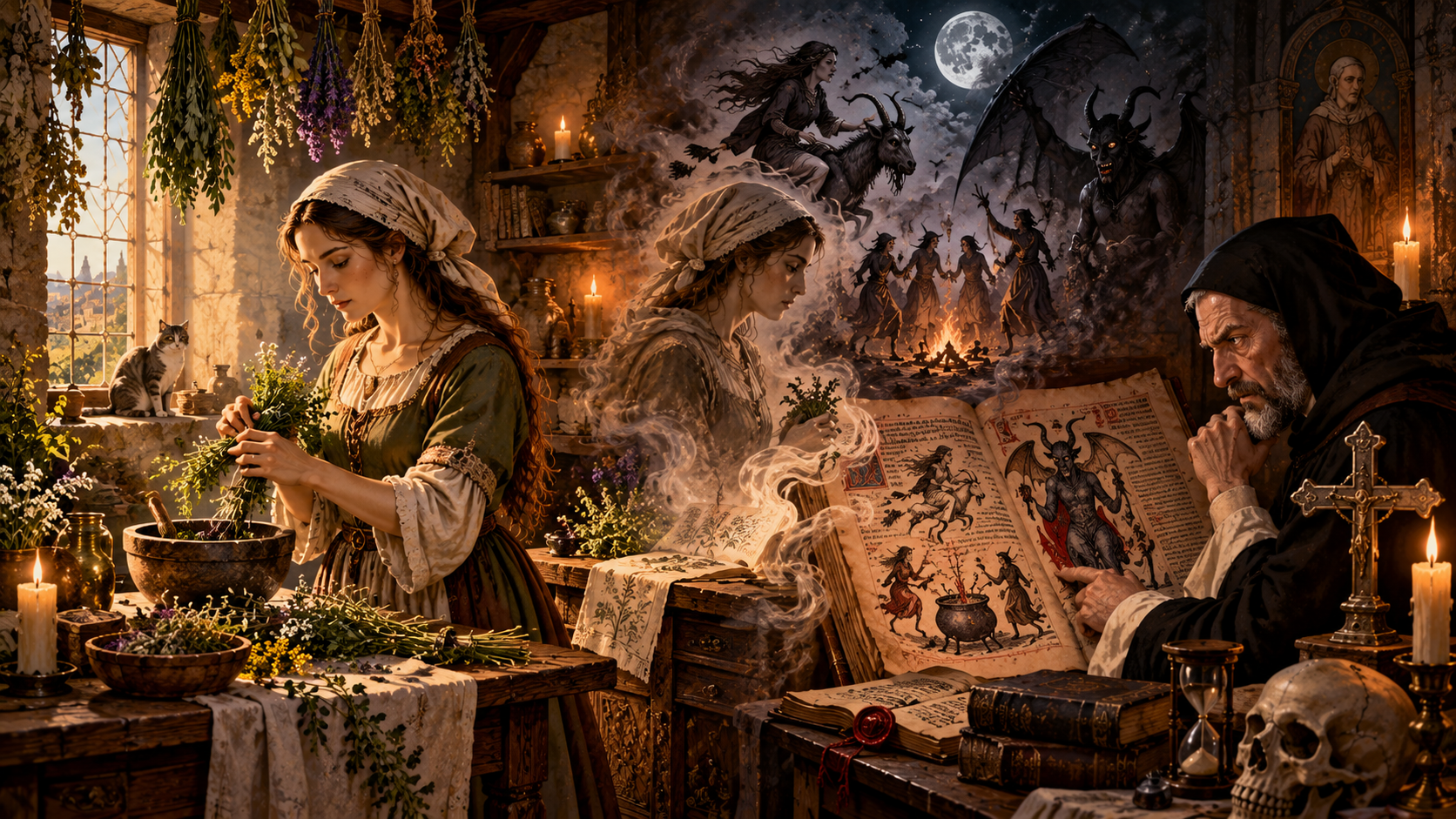
From the 12th and 13th centuries onward, certain theologians and jurists began to classify and associate some magical practices with demonic activity. Medieval demonology gradually developed an increasingly systematic explanation of the relationship between human beings, magic, heresy, and demonic powers.
The image of the witch that would emerge during the great trials of the 15th to 17th centuries would be the result of an accumulation of ideas that eventually merged together.
The Medieval Transformation
Centuries before the great persecutions of the early modern period, stories were already circulating in Europe about women who supposedly traveled at night accompanied by supernatural figures. By the end of the Middle Ages, a new way of understanding certain magical practices began to take shape.
Between the 15th and 16th centuries, increasingly elaborate stories appeared in different parts of Europe about people who supposedly not only practiced harmful magic, but also took part in nocturnal gatherings, made pacts with demons, and belonged to organized communities serving evil. Europe was also undergoing profound social, religious, and economic transformations. The Black Death, agricultural crises, wars, religious tensions, and later the Reformation and Counter-Reformation contributed to the creation of societies marked by uncertainty and conflict.
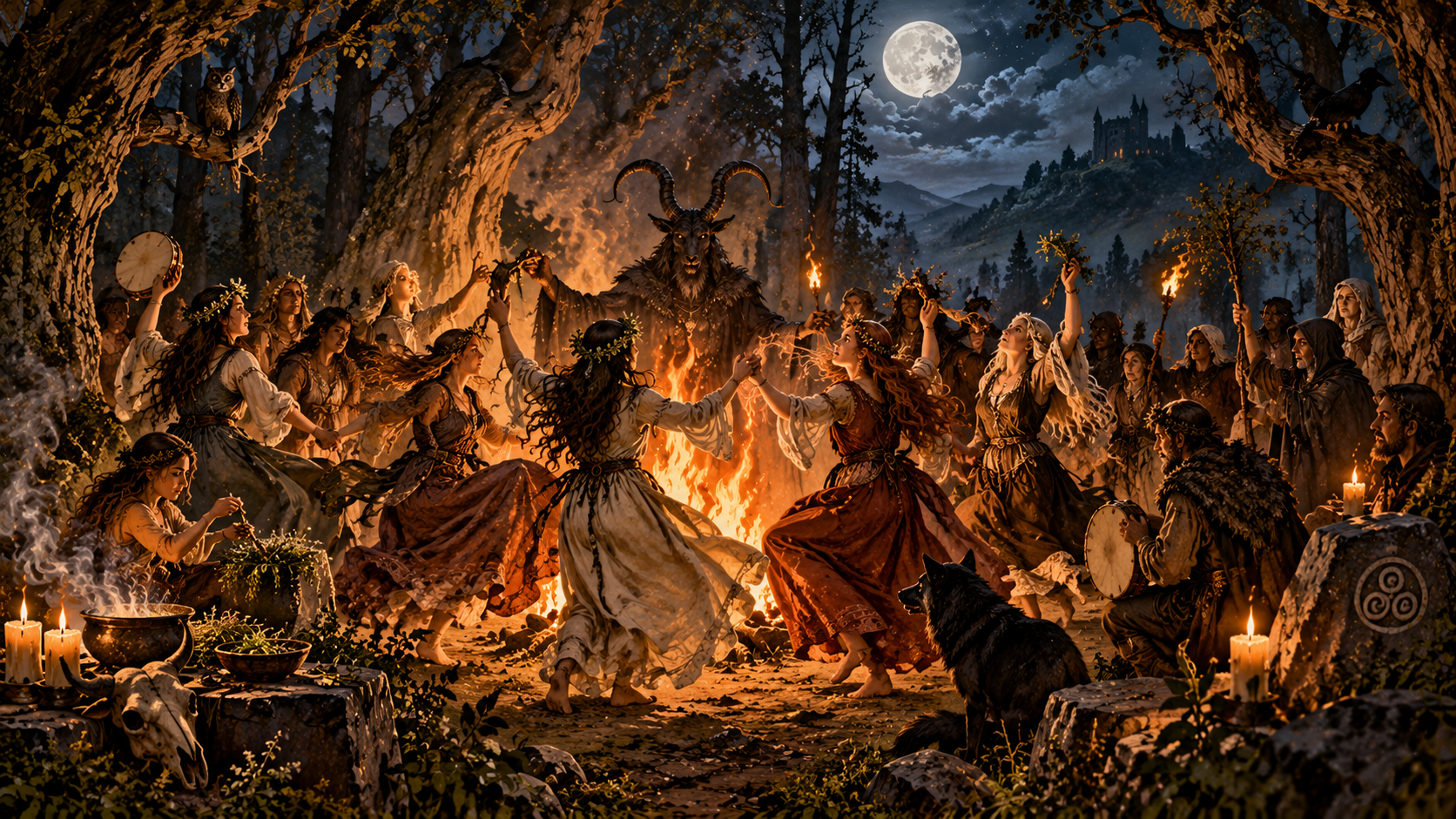
The idea of the so-called witches’ sabbath began to take shape during the 15th century, allowing witchcraft to be imagined as a genuine organized conspiracy.
The image of a person who:
- practiced harmful magic;
- maintained contact with demons;
- renounced the Christian faith;
- participated in nocturnal gatherings;
- traveled supernaturally;
- and belonged to a secret community that threatened Christian society as a whole began to take shape.
The ancient sorceress, the woman associated with magic, and the stories of nocturnal gatherings were beginning to merge into a new figure: the witch.
In 1484, Pope Innocent VIII issued a papal bull describing accusations of demonic practices and harmful acts attributed to people in certain regions of the German territories and authorizing specific inquisitors to investigate them.
“…by virtue of Our Apostolic authority, we decree and command that the aforementioned Inquisitors… be authorized to proceed with the correction, imprisonment, and punishment of such persons.”
Papal Bull Summis desiderantes affectibus , Innocent VIII, 1484.
Religious Interpretations
During the Late Middle Ages, a new way of interpreting certain magical practices began to develop.
Ancient accusations of maleficium —that is, the use of magical practices to cause harm—were gradually joined by new ideas: pacts with demons, nocturnal gatherings, supernatural flight, and the supposed existence of a secret organization dedicated to fighting Christianity.
The idea of a conspiracy of people serving the Devil did not appear suddenly. It was gradually constructed through religious treatises, demonological texts, sermons, and judicial proceedings. Authors, theologians, judges, and preachers incorporated new elements into this image until it became an increasingly comprehensive explanation of witchcraft.
The new conception imagined people who obtained their powers from the Devil and belonged to a secret community dedicated to causing harm. This transformation of the idea of sorcery into demonic witchcraft became one of the fundamental elements of the great witch hunts of the early modern period.
“…finally, all these impossibilities, and many more, are affirmed as true by various people.”
Regional Scot The Discoverie of Witchcraft, 1584.
The First Persecutions
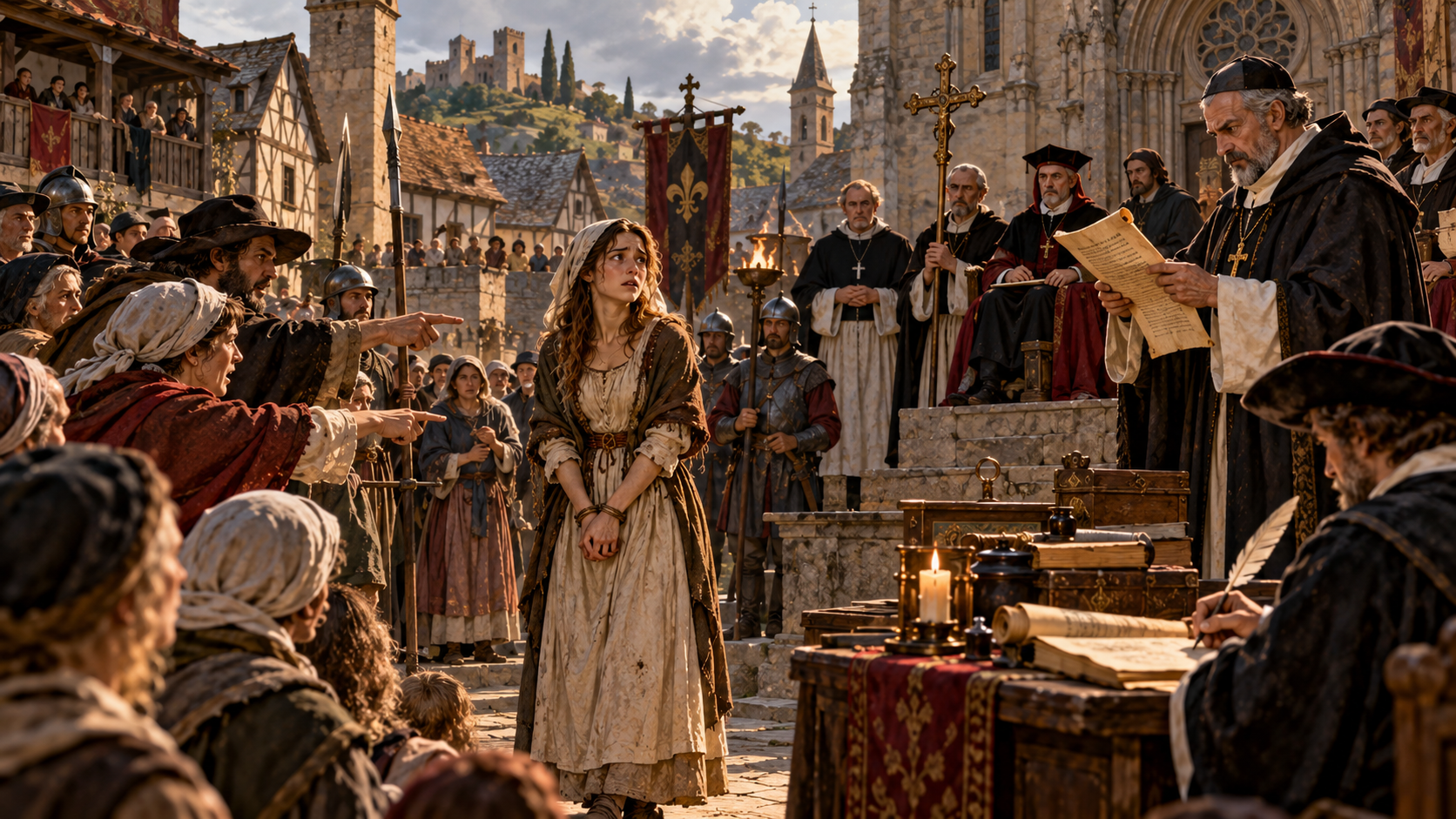
Trials already appear during the Late Middle Ages, and they increased progressively from the 14th and 15th centuries onward. However, it was approximately between 1450 and 1750, and particularly during the 16th and 17th centuries, that the persecutions reached their greatest intensity.
The people accused could come from very different backgrounds. Many were women, although in certain regions men were also accused. Accusations could arise from conflicts between neighbors, illness, deaths, problems involving animals or crops, personal disputes, or the suspicion that someone had caused harm through magic.
In Europe, approximately 80% of those accused were women, although the percentage varied considerably from one region to another. In some places, the proportion of men was much higher, while in others women constituted an overwhelming majority.
“Superstition is found above all in women, the weaker sex, because women are more credulous, more prone to wickedness, and naturally deceitful.”
(The Hammer of Witches), 1487, by the inquisitors Heinrich Kramer and Jacob Sprenger.
The Great Witch Trials
During the major European witch trials, approximately eight out of every ten people accused were women, although the proportions varied depending on the territory.
The accusations could include:
- ruining crops;
- causing storms or hail;
- making animals sick or killing them;
- causing illness;
- causing the death of people, including children;
- using magic to harm neighbors;
- making pacts or having relationships with demons.
These accusations did not always arise from an unexplained misfortune. They were often connected to specific conflicts within communities: disputes between neighbors, personal enmities, suspicions, and accusations that someone had magically caused a particular misfortune.
Some of the Tests Used in Witch Trials
The procedures used to investigate accusations varied enormously depending on the place and period.
The Water Test
The so-called water test or swimming test , or swimming test, involved placing the accused person in water to determine whether she would float or sink. The accused was tied by the hands and feet and, usually with a rope attached so that she could be pulled back out, thrown into the water. If she floated, the water was believed to have rejected her, and she was therefore considered guilty. If she sank, she was considered innocent.
Water was regarded as a pure element associated with baptism.
Spectral Evidence
Another particularly controversial form of evidence was spectral evidence. In this case, a person claimed to have been attacked by the spirit or apparition of another individual. No physical evidence of the alleged attack was necessary.
The best-known example occurred during the Salem witch trials of 1692, in the English colonies of North America. The courts accepted testimony from people who claimed to have seen the specters of the accused attacking them.
The Devil’s Mark
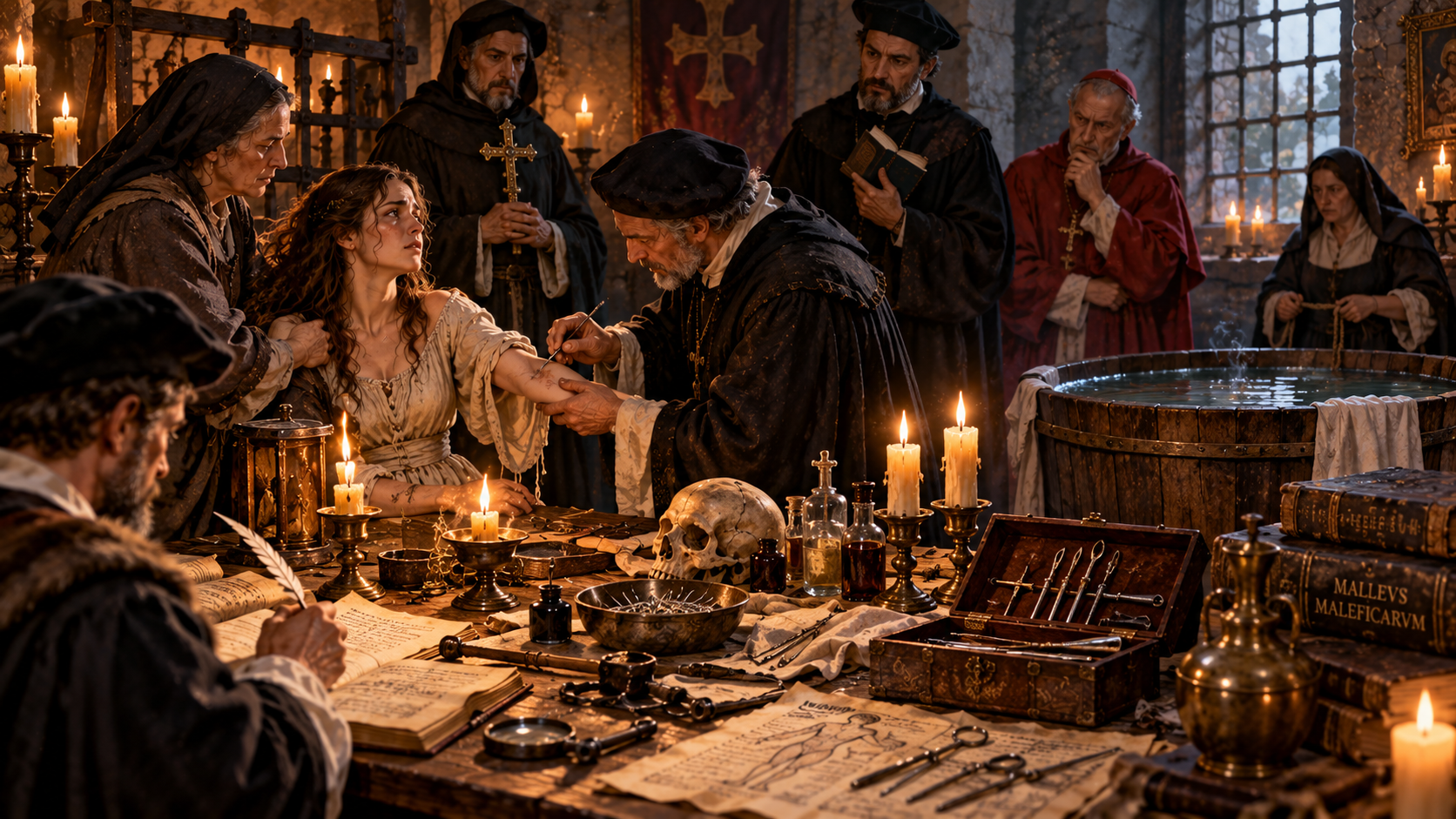
Investigators also searched the bodies of accused people for supposed marks of the Devil . According to certain demonological beliefs, the Devil could leave a physical mark on those who had entered into a pact with him.
In some trials, the accused person’s body was examined for areas supposedly insensitive to pain. Procedures could include shaving the body and using needles to determine whether a particular area bled or reacted to pain.
What we know today as the “witch’s mark” was a belief and investigative procedure employed by certain investigators and courts.
“How is it possible that the name of witches has become so famous, and how diverse are the opinions concerning them and their actions?”
Regional Scot The Discoverie of Witchcraft, 1584.
Decline
From the second half of the 17th century, the great persecutions began to decline progressively across much of Europe.
In some territories, the decline began earlier; in others, trials continued for decades and even extended into the 18th century. The decline was gradual and was connected with legal changes, new standards of evidence, a growing reluctance among certain courts to accept accusations, and changes in attitudes toward the very concept of witchcraft.
Estimates of the total number of trials and executions vary depending on the historians and the period considered. Current research generally places the number of people prosecuted for witchcraft in Europe in the tens of thousands, while the number of executions is usually estimated at several tens of thousands.
“If someone withstands the torture, they say that the devil helped them; if they confess, they execute them. There is no way out of the trap for the innocent.”
Friedrich Spee, Cautio Criminalis, 1631.
Timeline
10th century: The Canon Episcopi, associated with Regino of Prüm, records stories about women who believed they traveled at night with supernatural figures. The text interprets these experiences as illusions or demonic deception.
1233: Pope Gregory IX issues Vox in Rama, directed against a heresy known as Luciferianism in German territories. The text describes rituals attributed to the heretics, including the presence of a black cat.
1326: Pope John XXII promulgates Super illius specula, which contributes to expanding the classification of certain magical and demonic practices within the sphere of heresy and strengthens inquisitorial intervention against them.
1436-1438: Johannes Nider writes Formicarius. Its fifth book contains one of the earliest extensive treatments of witchcraft within this emerging demonological framework. The work was first printed in 1475.
1484: Innocent VIII promulgates the papal bull Summis desiderantes affectibus. The document describes accusations of demonic practices and authorizes inquisitors and those working with them to act against such practices in certain German territories. It also served as a preface to the inquisitorial manual (The Hammer of Witches).
1487: Malleus Maleficarum (The Hammer of Witches) is published. The work was traditionally attributed to the Dominican inquisitors Heinrich Kramer (Institoris) and Jacob Sprenger, although Sprenger’s involvement has been questioned by modern historians. The Library of Congress attributes the work primarily to Kramer. The book systematizes numerous ideas about witchcraft and proposes procedures for investigating and prosecuting it.
16th century: Persecutions intensify in different regions of Europe.
1580: Jean Bodin publishes De la démonomanie des sorciers De la démonomanie des sorciers (On the Demon-Mania of Witches), one of the most influential treatises of its time and a strong advocate of a severe interpretation of witchcraft.
Second half of the 17th century: Las grandes persecuciones comienzan a disminuir progresivamente en buena parte de Europa, aunque algunos procesos continúan durante el siglo XVIII.
The Voices of Reason
During the period of the great persecutions, not everyone accepted the reality of the accusations. There were also physicians, jurists, theologians, and writers who questioned the procedures used against people accused of witchcraft.
Johann Weyer
The Dutch physician Johann Weyer published De praestigiis daemonumin 1563, an important critique of the persecutions and of the demonological interpretation of certain cases. His criticism focused particularly on the interpretation of certain people accused of witchcraft and the way in which they were persecuted.
He believed that many accused women might be suffering from illness, melancholy, or delusions of the imagination, and advocated more lenient treatment.
Reginald Scot
In 1584, the English writer Regional Scot published The Discovery of Witchcraft. His work questioned claims about the powers attributed to witches and denounced the mechanisms through which certain stories and confessions could become supposed evidence. Scot attempted to demonstrate how tricks, deception, and beliefs could be mistaken for genuine witchcraft.
Friedrich Spee
The German Friedrich Spee anonymously published Cautio Criminalisin 1631. Spee argued that the use of torture could produce confessions and accusations that, far from proving a person’s guilt, could instead generate a chain of further accusations.
In his analysis, he describes situations in which a person subjected to torture would eventually provide the names of supposed accomplices simply to put an end to the suffering. His strongest argument lies precisely in the impossibility of obtaining reliable evidence through procedures capable of producing the very confession they were intended to prove.
Alonso de Salazar y Frías
The Spanish inquisitor Alonso de Salazar y Frías Alonso de Salazar y Frías took part in the investigation of the Zugarramurdi trials in the 17th century and was particularly critical of the lack of evidence he encountered.
His investigations contributed to the Spanish Inquisition adopting a much more skeptical position toward certain accusations of witchcraft.
“They confess things that are simply fables, lies, and fabrications that neither exist nor will ever exist, nor could exist according to the laws of nature.”
Johann Weyer, excerpt from De lamiis liber, 1577.
Symbols of Witches
The image of the witch that we all recognize today did not originate from a single book or a single artist. It was the result of centuries of stories, engravings, treatises, and illustrations that gradually added the elements we now associate with witches.
None of these symbols appeared at the same time. And some of their origins remain highly uncertain.
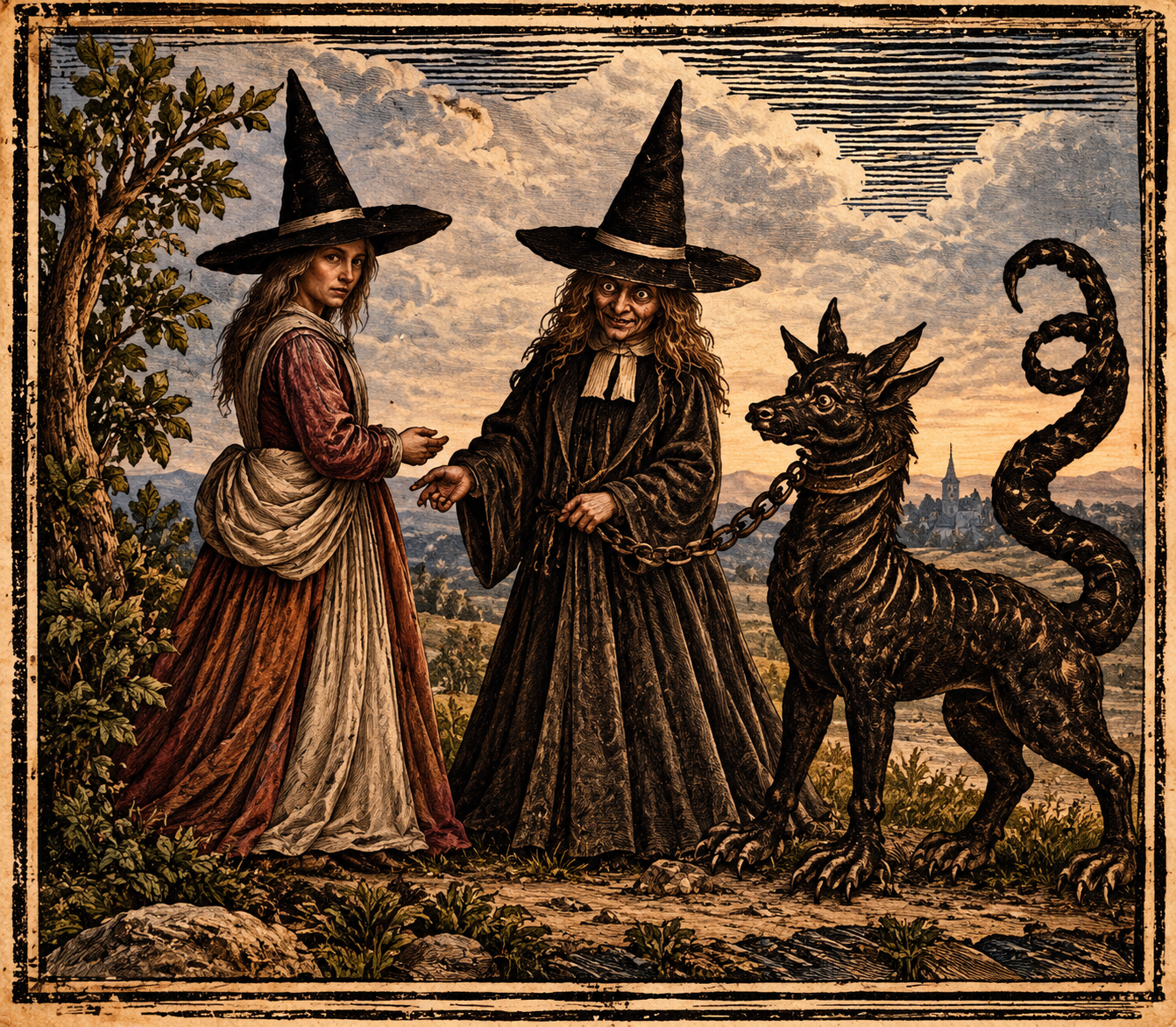
The Pointed Hat
The pointed hat is probably one of the elements whose origins are most difficult to establish with certainty.
Throughout the Middle Ages and the early modern period, different types of tall or pointed headwear existed. Some were part of fashion, while others were associated with particular social or religious groups.
Different theories have been proposed to explain their later association with witches. These include hats worn by certain religious communities, medieval headdresses, and, in later periods, garments associated with social groups that experienced discrimination.
Artistic representations subsequently helped establish an increasingly recognizable appearance. One example appears in 1720, in The History of Witches and Wizards, a work published in London that included illustrations of witches, demons, and flights on broomsticks.
The Broomstick
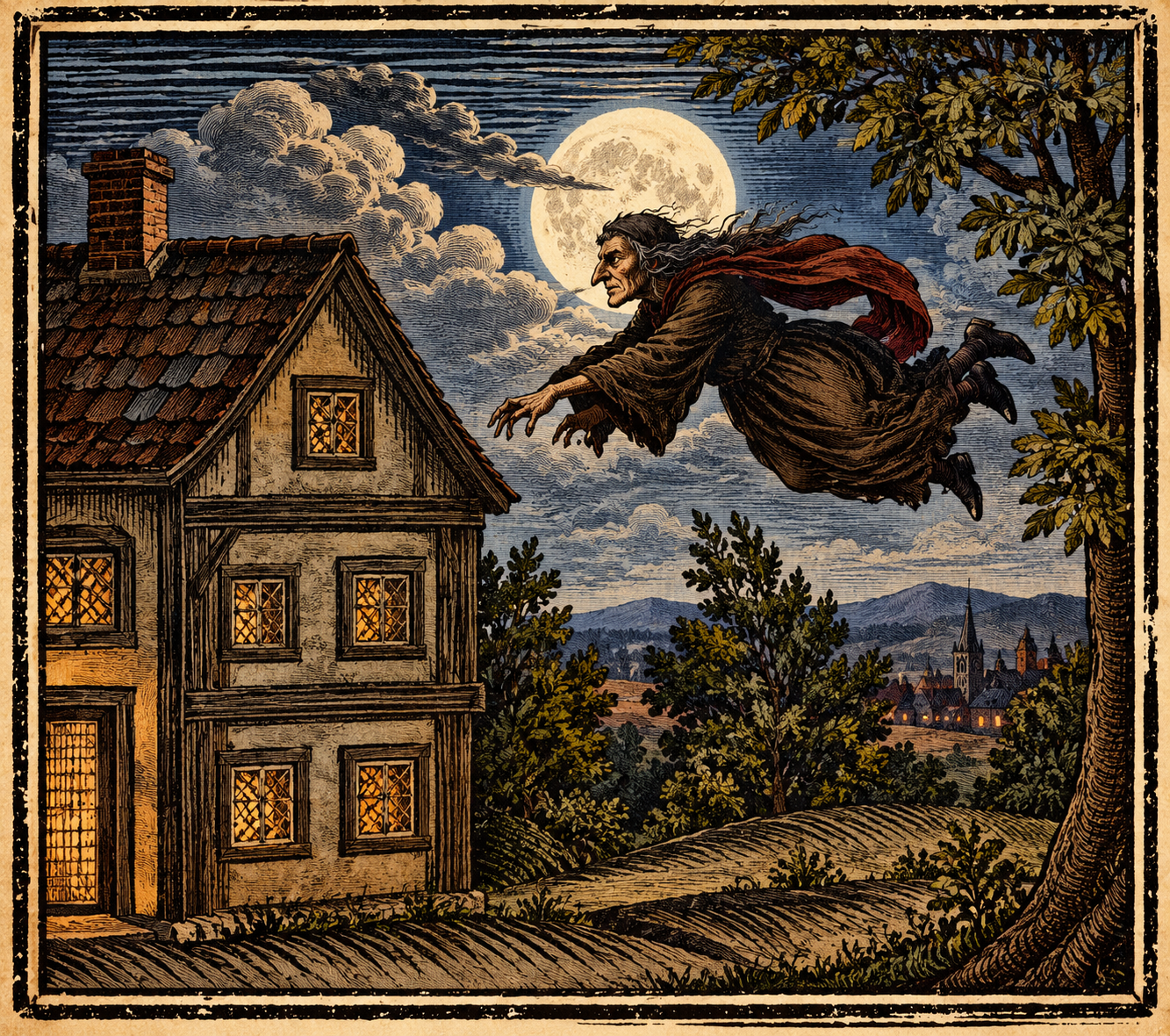
The broom was an everyday object associated with domestic work and, in European societies, particularly with the female sphere.
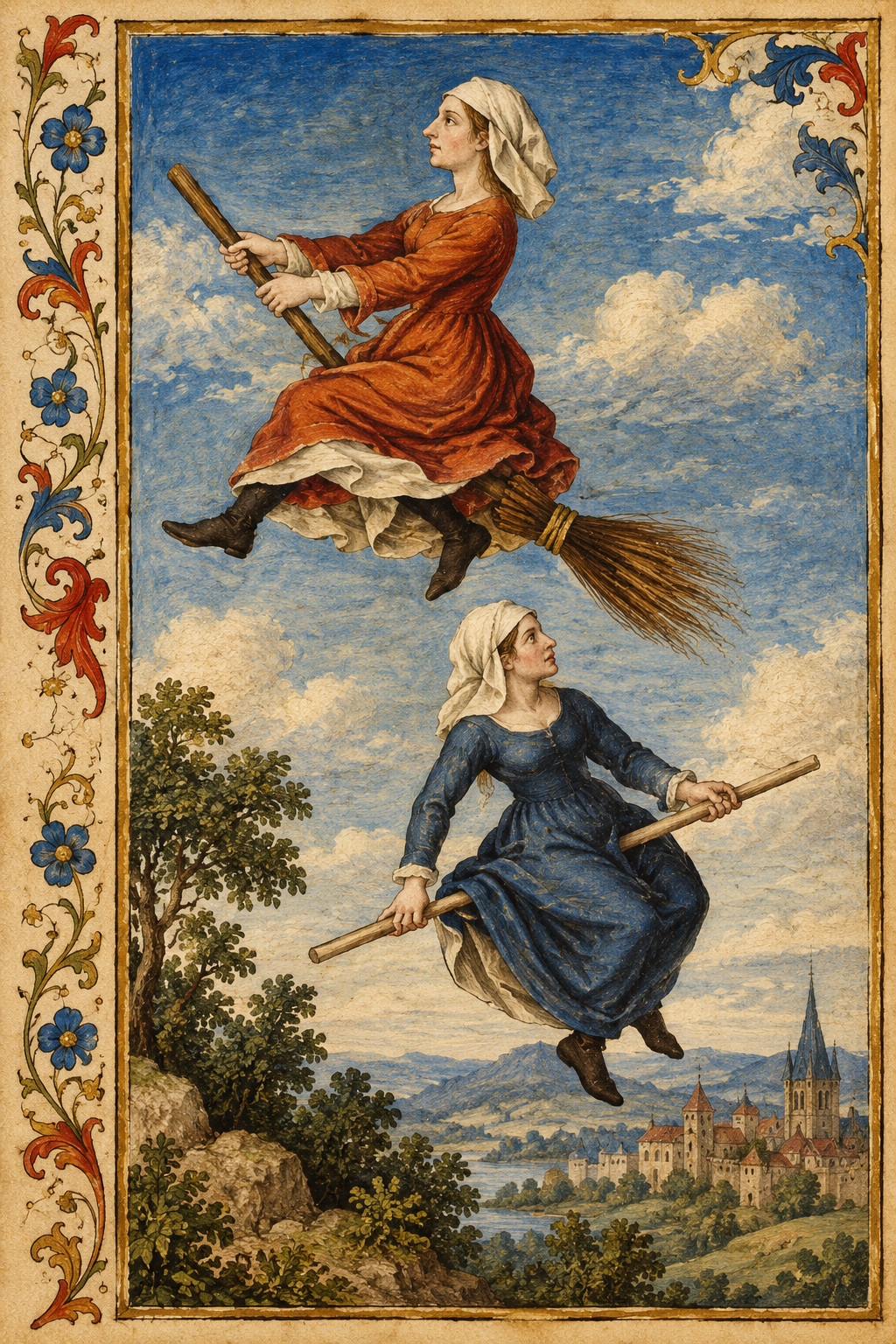
In 1451, an illustrated manuscript of the French poem Le Champion des Dames, written by Martin Le Franc, contains a small marginal illustration showing two women flying: one on a broomstick and another on a staff. The image is accompanied by the inscription Des Vaudoises and depicts women identified with the Waldensians, a religious group considered heretical. It is the earliest known dated representation of a woman flying on a broomstick.
The reasons why the broom eventually became associated with the flight of witches have not been established with certainty.
The Cauldron
Large cooking vessels had been part of European domestic life long before they became associated with witches. They were used for cooking, boiling water, preparing food, and making various preparations. They could also be used to prepare remedies, plants, and other substances.
As the image of demonic witchcraft developed, this everyday object began appearing in representations of magic and sorcery.
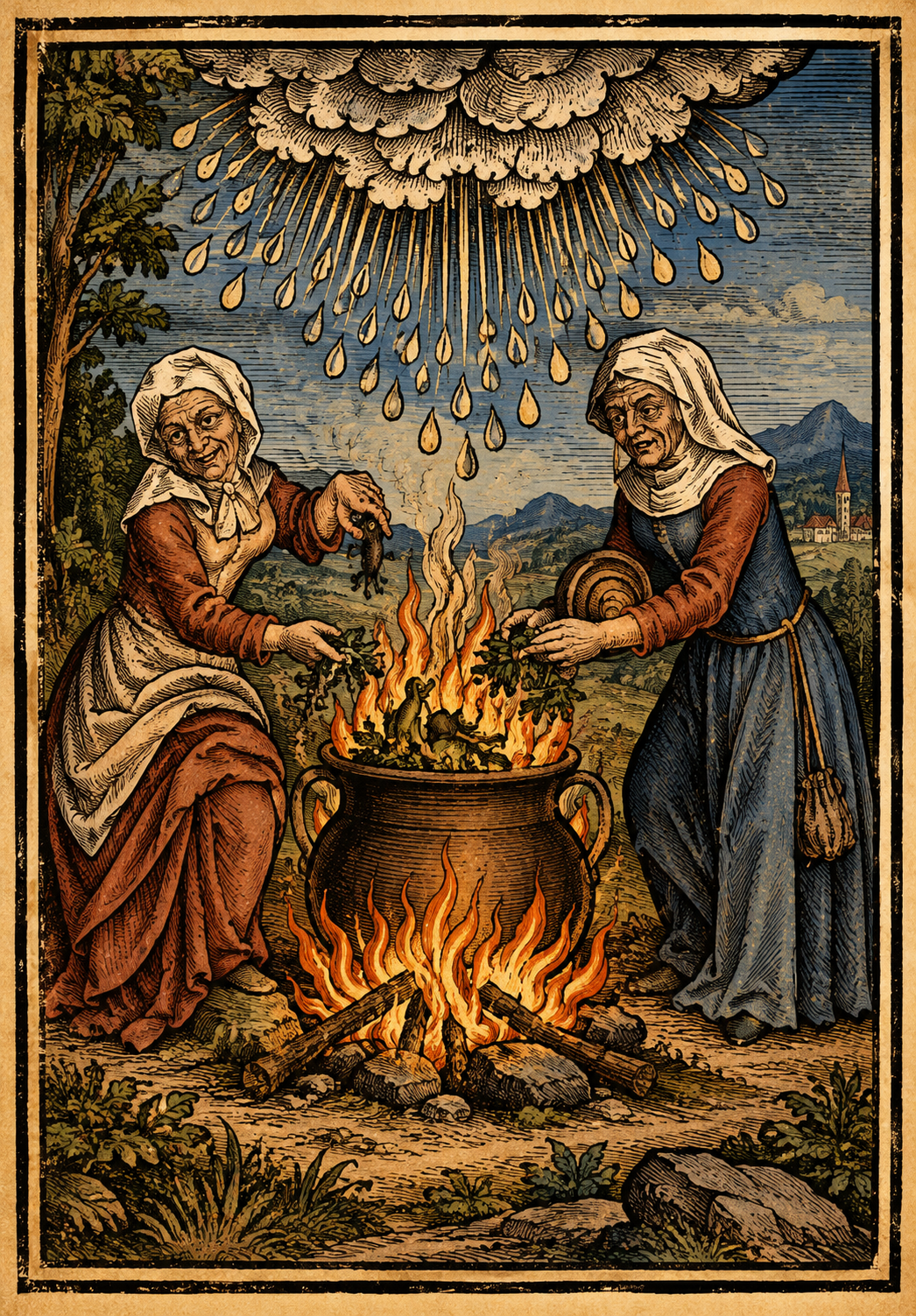
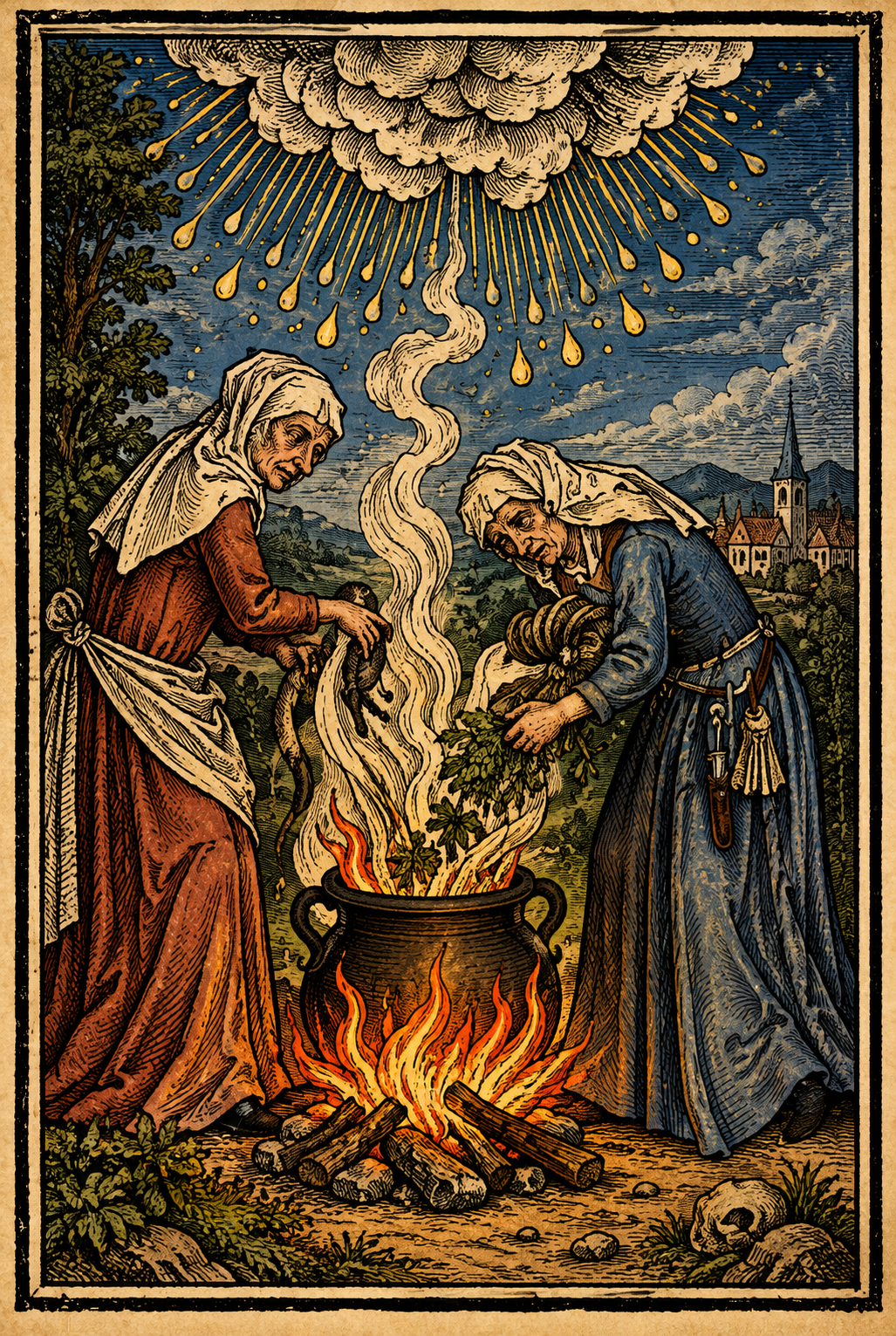
One of the most important examples appears in the work of Ulrich Molitor, De lamiis et phithonicis mulieribus, published in 1489/1490.
The work is considered one of the earliest illustrated treatises on witchcraft and contains the earliest known printed depiction of witches using a cauldron.
The Black Cat
Cats were not originally animals associated exclusively with witchcraft. In Ancient Egypt, certain cats were connected with deities and religious cults, while in Norse mythology they were associated with Freyja, whose chariot is described in the sources as being drawn by cats.
The medieval association between cats, magic, and witchcraft emerged in certain contexts. Cats—particularly black cats—could acquire negative connotations associated with night, the unknown, or the supernatural.
During the early modern period, the idea of the familiar also developed: an animal supposedly assisting a person accused of witchcraft. Such familiars could appear in the form of cats, dogs, toads, ravens, or other animals. familiar, un animal que supuestamente ayudaba a una persona acusada de brujería y que podía aparecer representado como gato, perro, sapo, cuervo u otros animales.
In 1233, the papal bull Vox in Rama, promulgated by Gregory IX against an alleged heresy, described a ritual in which a black cat appeared. Although this was not yet the “familiar” of witches as it would later appear in witch trials, the episode contributed to the medieval association between certain animals and practices considered demonic.
Europe Under the Shadow of Witchcraft
Persecutions took place in numerous European regions, but they were not the same in intensity, duration, or number of victims. Among the territories most affected were:
Holy Roman Empire
The territories of the Holy Roman Empire were among the principal settings of the great witch hunts. One of the most extreme episodes took place in the Prince-Bishopric of Bamberg.
During the persecutions of the 1620s and 1630s, around one thousand people fell victim to witchcraft trials in the territory, making it one of the most intense episodes of persecution within the Holy Roman Empire.
Scotland
Scotland was one of the regions of Europe where witch persecutions reached particularly high levels in relation to its population.
France
Large witch trials also took place in France. Many of these cases were judged by secular courts rather than exclusively by ecclesiastical tribunals.
Between approximately 1550 and 1700, around 2,000 witchcraft trials were recorded.
Iceland
The Icelandic trials were far fewer in number than those in the great continental regions, but they present one exceptional characteristic: most of the people executed were men. This constituted a notable exception within the wider European context.
Switzerland
The territories of present-day Switzerland also experienced significant witch persecutions, particularly during the 16th and 17th centuries. Their intensity and characteristics varied considerably between cantons and jurisdictions. In many persecutions, women constituted the majority of those accused, although men were also among the victims.
“I have often thought that the only reason we are not all declared witches is because we have not all been tortured.”
Friedrich Spee, Cautio Criminalis, 1631.
Witches Today
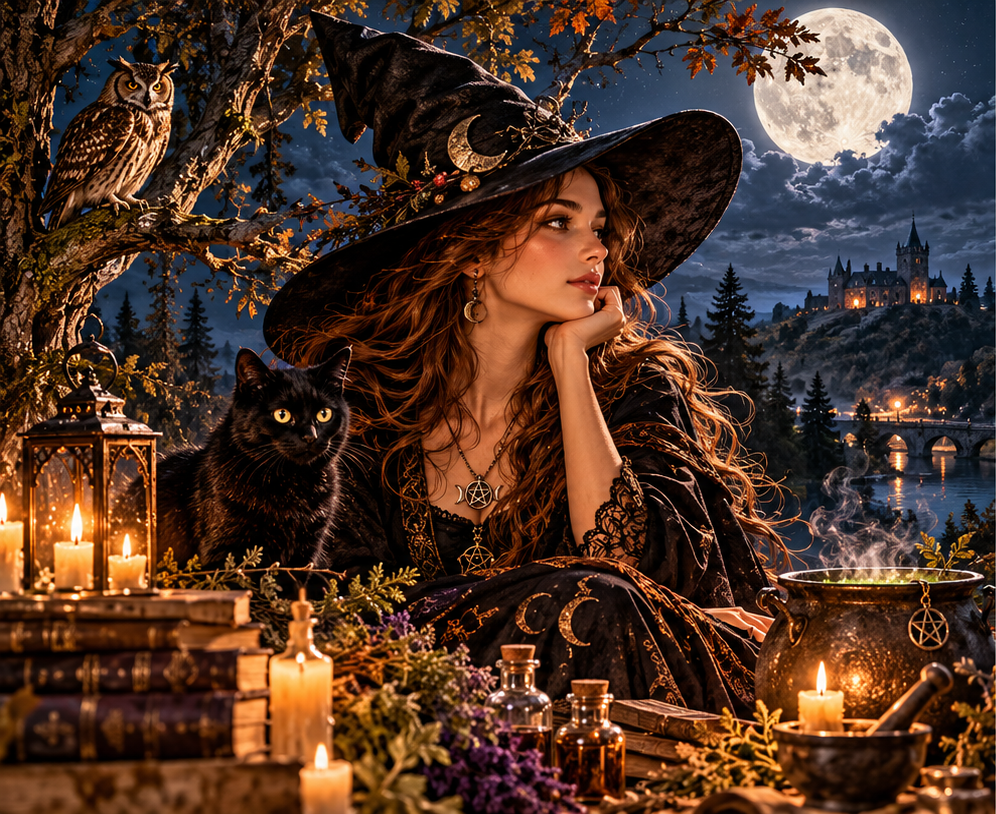
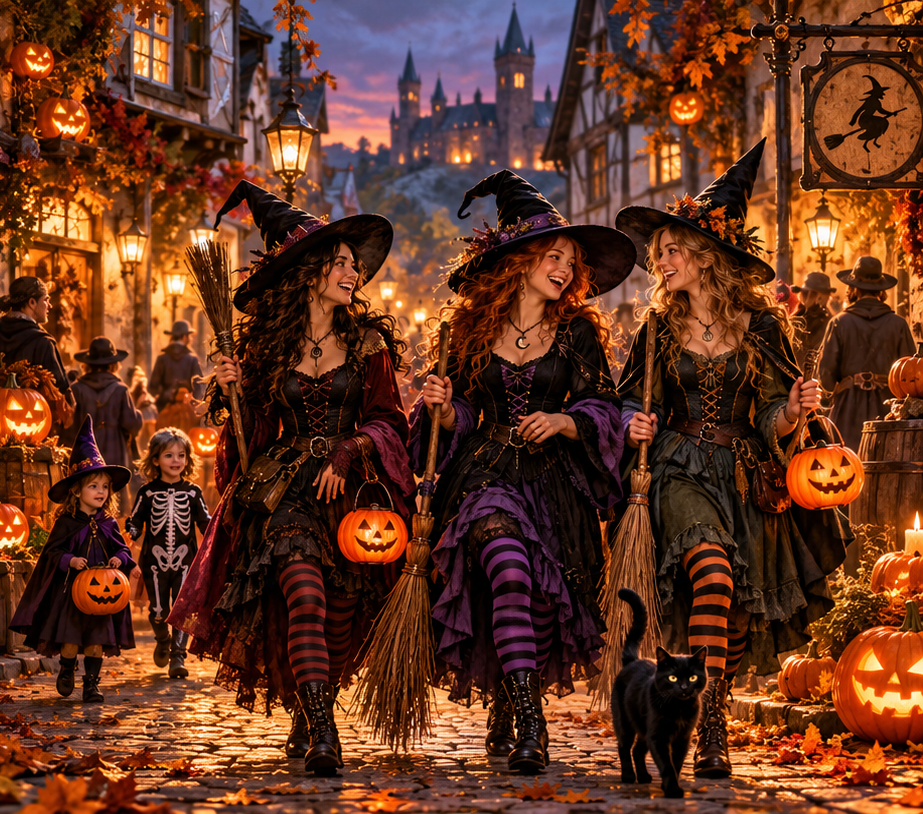
The figure of the witch has changed completely. The word witch no longer has a single meaning. In popular culture, it may represent mystery, magic, independence, or a connection with nature. In certain spiritual and Neopagan movements, it may also acquire a religious or identity-based meaning.
The Wicca, which emerged as a contemporary religious movement during the 20th century, developed new ways of understanding magic, nature, and ritual practices.
At the same time, the witch became one of the most recognizable figures of Halloween, fantasy literature, cinema, television, and popular culture.
The contemporary image is therefore very different from the demonized figure that appears in the treatises and trials of the 15th through 17th centuries. The witch ceased to be merely an accusation and also became a cultural, religious, and symbolic figure.
Curiosities
The Cat Sathan
In 16th-century England, numerous accounts appeared concerning animals believed to be familiars belonging to people accused of witchcraft. Among the animals mentioned were cats, dogs, toads, ferrets, and others.
One of the best-known cases is that of Agnes Waterhouse, who was tried in Chelmsford in 1566. During her trial, Waterhouse confessed to using witchcraft and described a cat named Sathan as her familiar.
According to her testimony, the animal had been associated with Elizabeth Francis, another woman accused of witchcraft, and had later passed to Agnes Waterhouse. Agnes was accused of using magic to cause illness and death and was eventually executed in Chelmsford on July 29, 1566.
The Water Test Was Much Older
The water test did not originate with the witch hunts. The so-called cold-water ordeal was a much older judicial practice, documented in Europe since the Middle Ages.
Although it had been prohibited as a judicial procedure in Western Europe in 1215, forms of the practice later reappeared in certain trials during the early modern period, including some connected with witchcraft.
The famous test we now associate with witches was therefore not created to persecute them. It was a much older practice that eventually came to be used in some witchcraft trials.
When History Gave Them Back Their Names
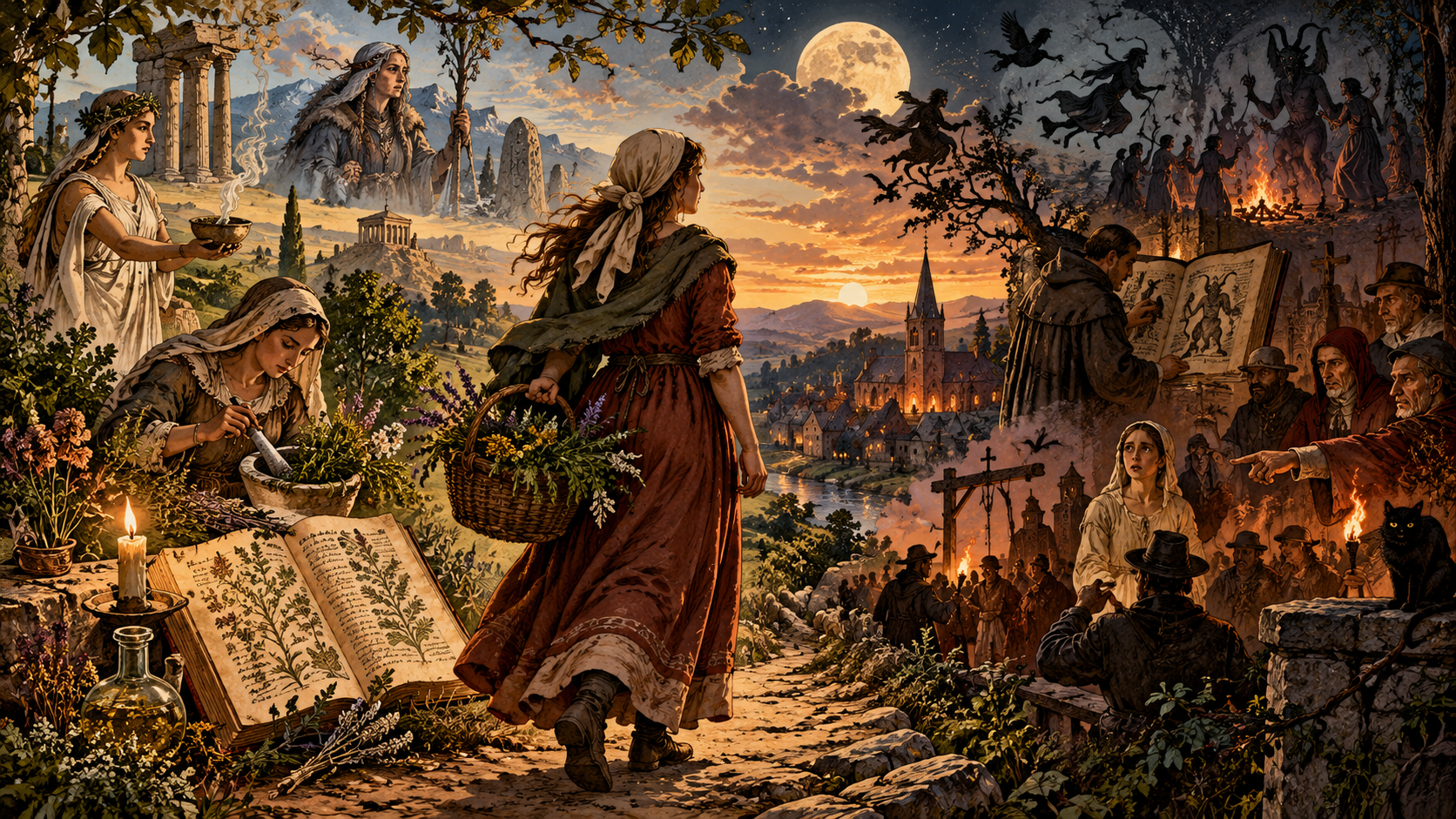
Many of the people executed during the witch persecutions disappeared from collective memory for centuries. Their names remained buried in court records, parish registers, municipal documents, and archives that were barely consulted for generations.
They could never have known that their stories would eventually appear in books, museums, memorials, and historical-memory projects. Nor could they have known that, over time, many of those accusations would be revisited and questioned.
In some places, communities have sought to symbolically recover the memory of these people and acknowledge the injustices committed during the persecutions. Because behind the word witch there were real people. People with names, families, occupations, homes, neighbors, and lives that were ultimately reduced to an accusation.
“The evils attributed to witches occur where there are no witches, and even continue when they have been hanged and burned. Why, then, attribute such an effect to a cause which, even when eliminated, continues to occur?”
Reginald Scot, excerpt from The Discoverie of Witchcraft, 1584.
Follow the Footprints
Although many of the people persecuted and executed for witchcraft were forgotten for centuries, in recent decades different countries and communities have begun to recover their memory.
There are not only museums and exhibitions dedicated to the history of witchcraft. There are also memorials, plaques, monuments, research projects, and initiatives intended to remember those who became victims of these persecutions.
Its Legacy Lives On...
Salem, United States
The Salem trials took place in 1692. Shortly after the trials, signs of remorse began to appear. In 1697, several members of the jury publicly acknowledged their mistakes and asked for forgiveness. Massachusetts also began exonerating some of those convicted from 1703 onward, although the process of legal recognition continued for centuries.
In 1992, coinciding with the 300th anniversary of the trials, the Salem Witch Trials Memorialwas inaugurated in Salem, dedicated to the people who were executed during those proceedings.
Germany
The territories of the Holy Roman Empire were among the principal settings of the witch persecutions. Today, numerous cities and communities have created memorials, plaques, exhibitions, and research projects dedicated to recovering the memory of those who were persecuted.
However, there is currently no collective rehabilitation of all the victims by the German state.
Scotland
There is currently a movement to recover the memory of the victims through commemorative plaques, monuments, historical trails, exhibitions, and educational projects. In March 2022, then-First Minister Nicola Sturgeon, on behalf of the Scottish Government, offered a formal posthumous apology to people who had been accused, convicted, vilified, or executed under the Witchcraft Act of 1563.
A pardon for those convicted was also proposed, but the bill subsequently introduced for this purpose was withdrawn in 2023.
France
In France, there are historical investigations, remembrance initiatives, and local projects related to the history of witchcraft, but there is currently no nationwide collective rehabilitation of people convicted of witchcraft.
Iceland
In Iceland, the memory of the witchcraft trials is preserved primarily through historical research, archives, and local projects, but there has been no formal pardon.
Norway
In Vardø, in northern Norway, stands the Steilneset Memorial, built to commemorate the 91 people convicted and executed for witchcraft in Finnmark during the 17th century.
Switzerland
Anna Göldi was executed in 1782 and is commonly regarded as the last woman executed for witchcraft in Europe. In 2008, 226 years after her death, the Canton of Glarus officially rehabilitated her and recognized that she had been the victim of an unjust judicial process.
Göldi's rehabilitation subsequently inspired other remembrance initiatives in Switzerland.
Visit It Today...
HEX! Museum of Witch Hunt — Ribe, Denmark
This museum is located in Ribe, one of the principal historical settings of witchcraft trials in Denmark.
Its exhibition explains how fear of witchcraft spread throughout Denmark and Europe during the 16th and 17th centuries, how the trials operated, and why people came to be accused and convicted. The museum also preserves historical objects and reconstructions related to the beliefs and practices of the period.
Museum of Witchcraft — Bruges, Belgium
Located at Wollestraat 29, Bruges, this museum presents the historical development of beliefs surrounding witchcraft and preserves various objects associated with these practices and with the persecutions.
Among its exhibits is an original 1638 witch scale and a so-called “ducking stool,” a seat used to submerge people suspected of witchcraft under water.
The museum shares its location with the Museum of Torture.