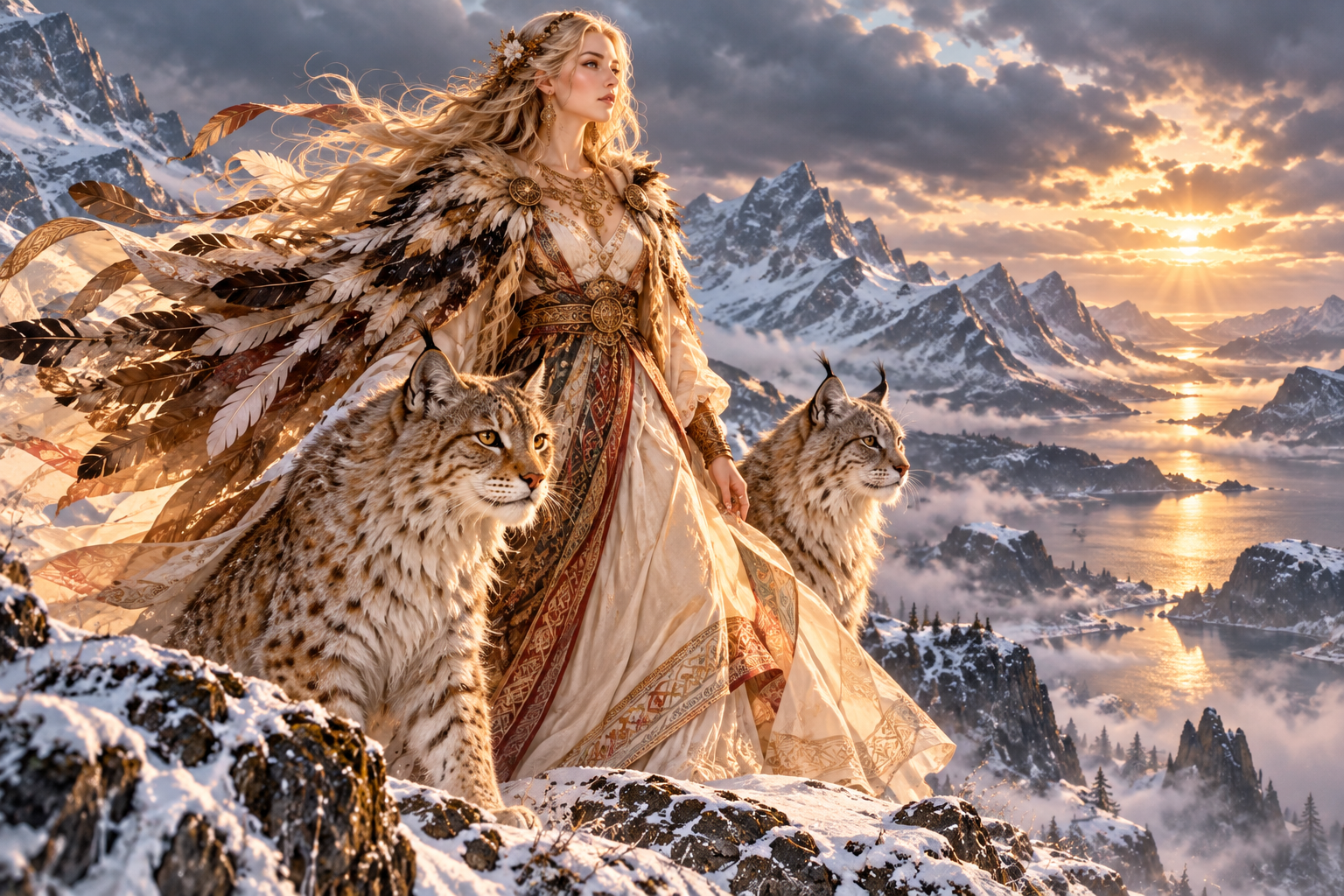
Some gods seem to embody a single defining idea: Thor is usually associated with strength, Týr with honor, and Baldr with light. Freyja, by contrast, brings together many different aspects.
She is a goddess of love, beauty, fertility, and wealth, but also of magic, war, and death. She mastered the powerful art of seiðr magic., welcomed half of the warriors who died in battle, and possessed one of the most famous treasures in Norse mythology: the necklace Brísingamen.
According to medieval traditions, when Freyja wept for her absent husband, her tears turned into gold upon falling to the earth and into amber when they reached the sea.
She is one of the most complex and fascinating figures in the entire Scandinavian tradition. Freyja does not represent a single force, but the union of qualities that might at first seem contradictory: desire and war, fertility and death, beauty and power.
The Goddess of the Vanir
Freyja belongs to the The Vanir, one of the two great families of gods in Norse mythology.
Medieval sources present the Æsir and the The Vanir as two divine clans with different characteristics, although their roles are not always clearly separated.
The Æsir are associated with figures such as Odin, Thor, Týr, and Frigg, while the Vanir are generally linked to fertility, wealth, prosperity, nature, and abundance.
According to Norse tradition, the two groups fought a great war. In the end, they made peace and exchanged hostages.
It was then that Njörðr, his son Freyr , and his daughter Freyja came to dwell among the Æsir. From that moment onward, Freyja became part of the divine world of Asgard and one of the most important female deities in Norse mythology.
The Meaning of Her Name
Freyja does not appear to have originally been a personal name.
In Old Norse, freyja simply means “lady.” Its masculine counterpart is Freyr Freyr, usually translated as “lord.”
For this reason, many scholars believe that both words originally functioned as titles or honorific forms of address. Over time, they became the names by which these two deities are known today.
Other Names of Freyja
In Norse tradition, the gods could be known by different poetic names or titles. In the Skáldskaparmál section of Snorri Sturluson’s Prose Edda , poets are said to refer to Freyja by various heiti. —poetic names that describe her attributes, origin, or divine roles.
Medieval sources preserve several of these names:
- Gefn: usually interpreted as “the Generous One” or “the Giver.”
- Mardöll: its meaning remains uncertain, though it has been linked to the shining or illumination of the sea.
- Vanadís: “Goddess of the Vanir.”
- Valfreyja: often interpreted as “Lady of the Slain” or “Freyja of the Fallen Warriors.”
- Sýr: meaning “sow” or “female pig.” This title may be connected with fertility, abundance, and the symbolic importance of the boar in Germanic traditions.
Not all of these names have completely certain interpretations, and their exact meanings continue to be debated.
A Goddess of Many Faces
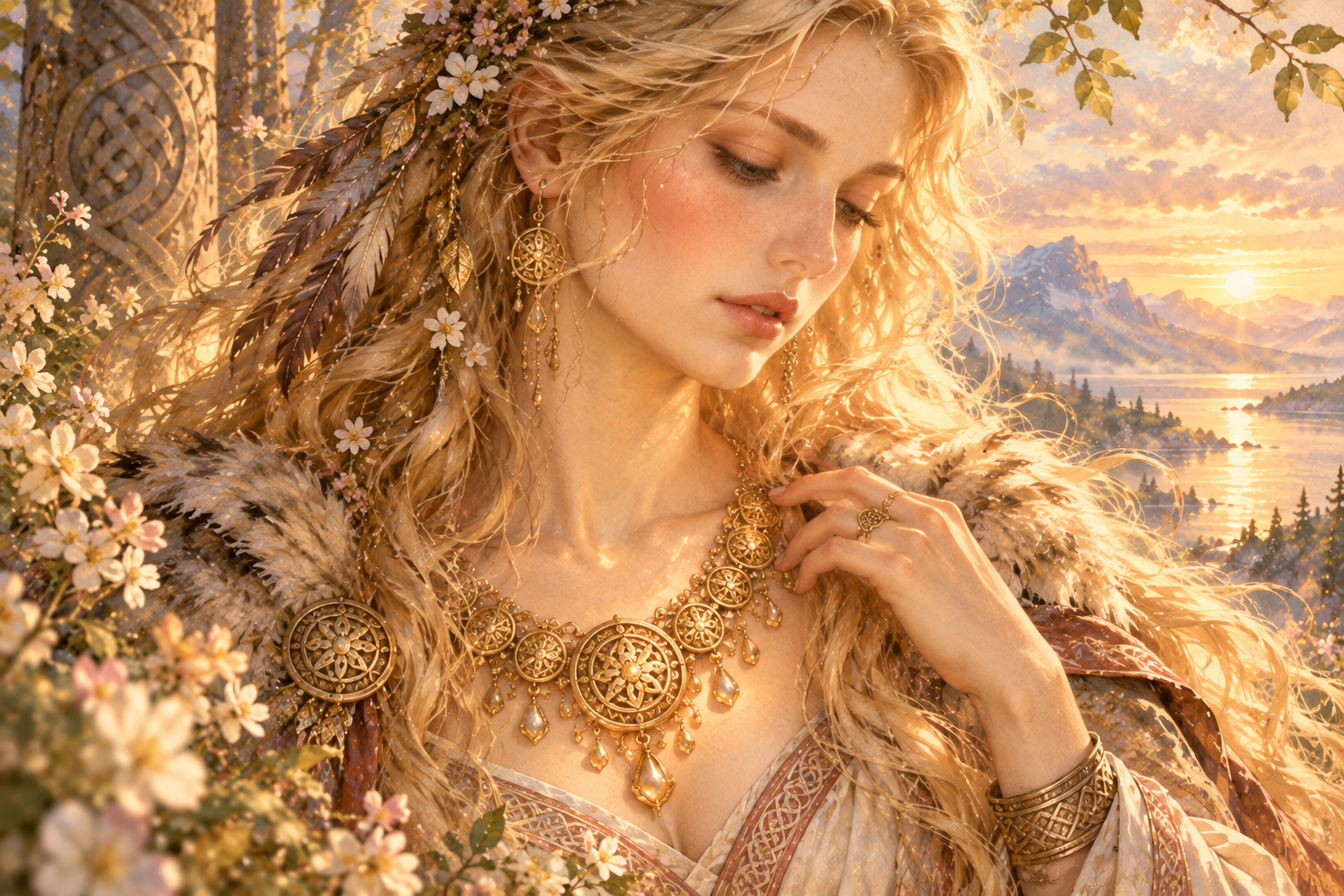
Medieval sources portray Freyja as a goddess associated with many areas of life:
- love and beauty;
- fertility and sexuality;
- wealth and prosperity;
- magic and divination;
- war and death;
- desire and independence.
This remarkable range of functions makes her one of the most complex figures in the Norse pantheon.
Freyja is far more than a goddess of love. She is also a powerful woman, a keeper of magical knowledge, and a deity closely connected with the destiny of fallen warriors.
The Mistress of Seiðr
One of Freyja’s most distinctive qualities is her connection to seiðr magic., a form of magic associated with divination, destiny, and the manipulation of unseen forces.
The medieval sources do not provide a single complete definition of seiðr, but they associate it with practices such as:
- divination;
- perceiving future events;
- influencing fate;
- communicating with spirits;
- transformation;
- altering the will or the course of circumstances.
In Norse mythology, Freyja is one of the greatest masters of this art. According to Snorri Sturluson, it was she who taught seiðr to the Æsir, including Snorri Sturluson’s Prose Edda, fue ella quien enseñó el seiðr a los Æsir, incluido Odin, Some traditions regarded this practice as inappropriate for men, and for that reason Odin’s use of seiðr could become a source of criticism or mockery.
Freyja’s relationship with seiðr also shows that her power did not rely solely on beauty or attraction. She was a goddess of knowledge, magic, and forces that even the gods approached with caution.
Freyja and War
Freyja is also closely connected with war and the fate of those who die in battle.
According to Grímnismál, one of the poems of the Poetic Edda, Freyja receives half of the fallen warriors, while the other half go to Odin. This makes Freyja a figure closely linked to heroic death and the destiny of warriors. However, the sources do not explain in detail how the choice was made between the warriors received by Freyja and those who went to Valhalla.
Her relationship to battle is not identical to Odin's; rather, it appears to be connected to death and destiny, as well as magic and the selection of the fallen.
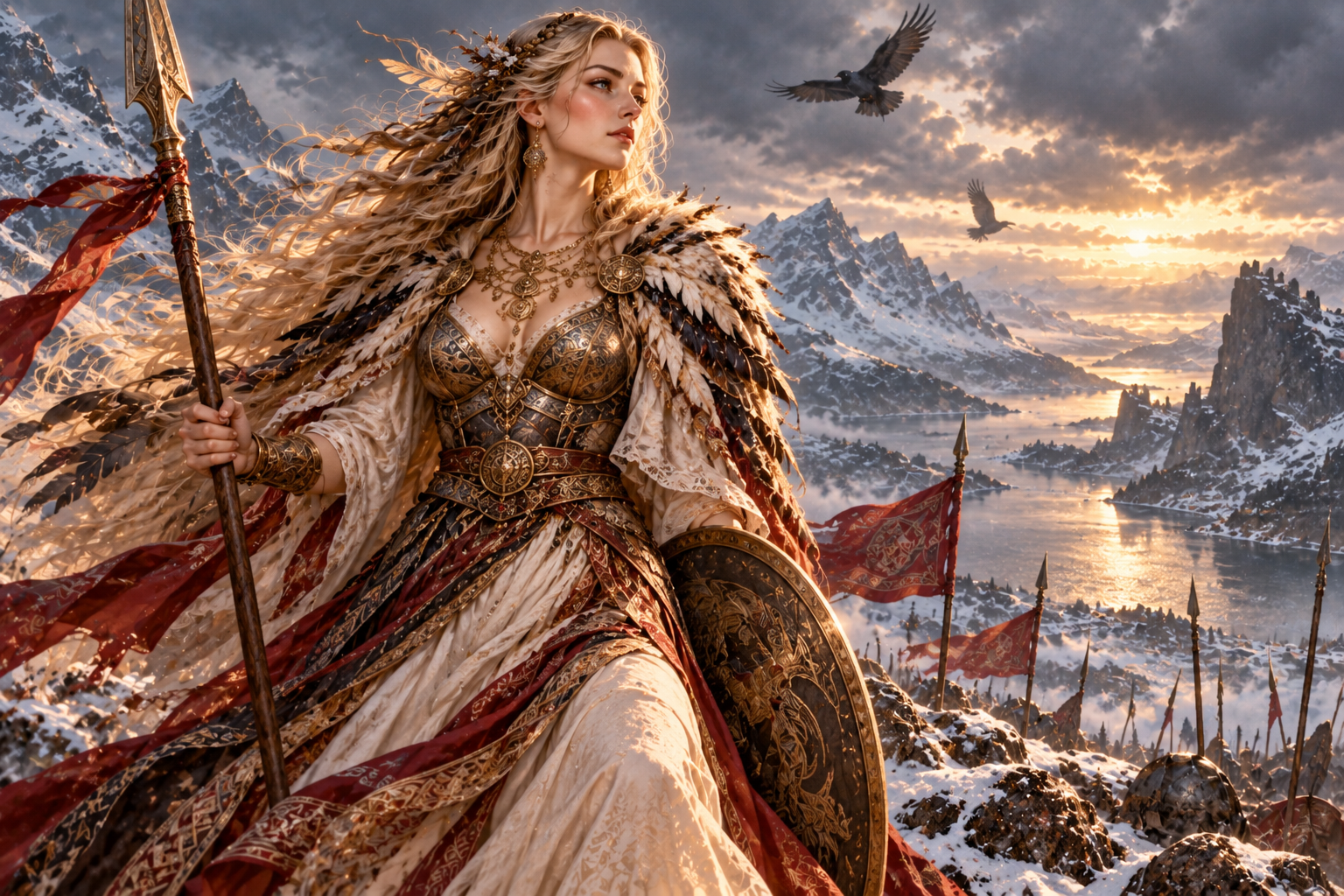
“Fólkvangr is the ninth; there Freyja decides who shall have seats in the hall. Each day she chooses half of the slain; the other half belongs to Odin.”
— Grímnismál, stanza 14l, estrofa 14.
Fólkvangr and Sessrúmnir
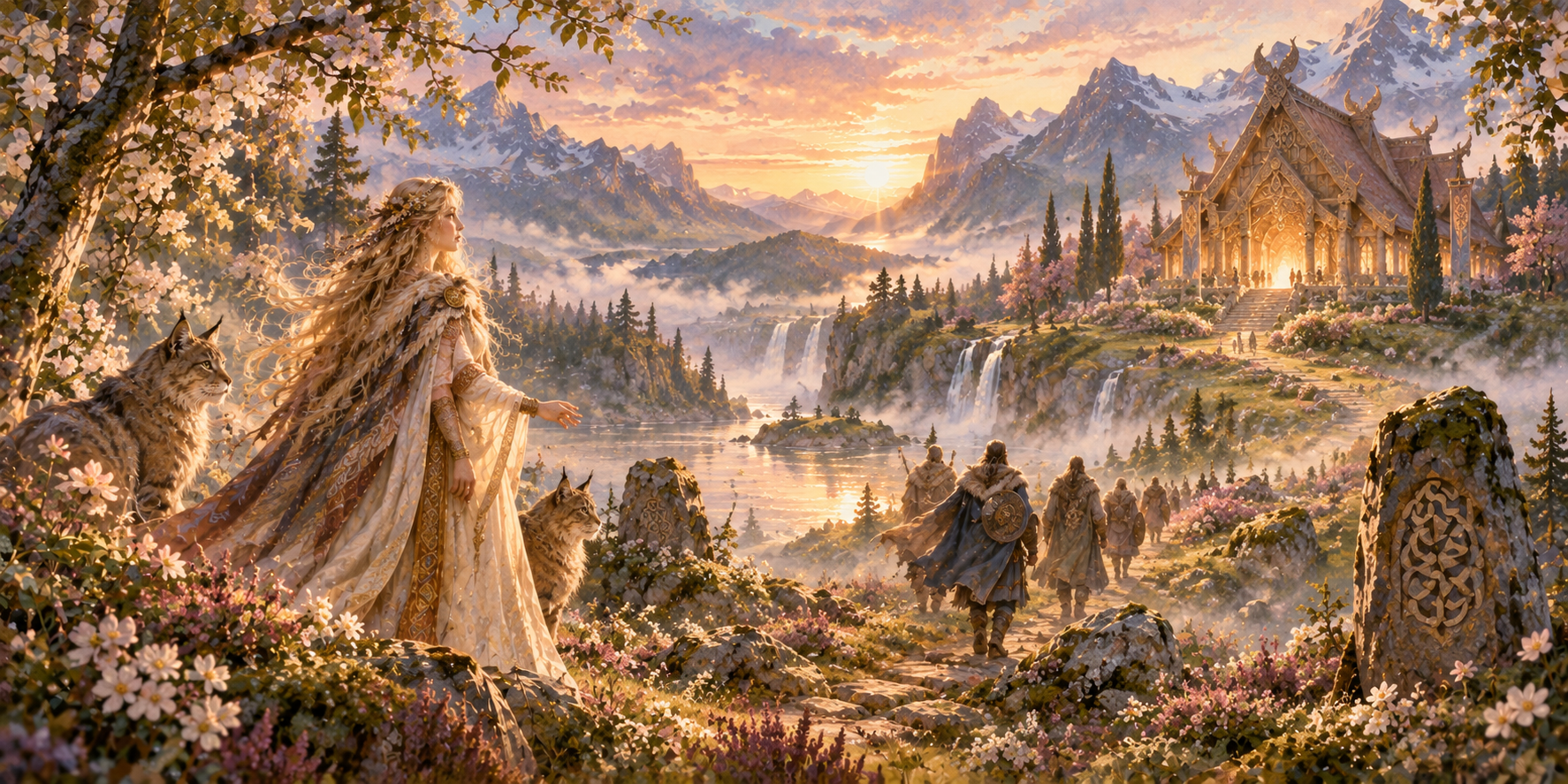
Freyja’s realm is called Fólkvangr.
Within Fólkvangr stands her great hall, Sessrúmnir. , a name usually understood to mean a spacious hall with many seats. According to tradition, it is here that Freyja welcomes half of the warriors who have fallen in battle.
Although Odin’s Valhalla is far better known in popular culture, Fólkvangr occupies an equally important place in Norse cosmology. The existence of both realms shows that the fate of fallen warriors was not reserved exclusively for Odin.
The Treasures and Companions of Freyja
Brísingamen
One of the most famous objects associated with Freyja is the necklace Brísingamen.
The sources describe it as an extraordinary piece of jewelry associated with the goddess’s beauty, prestige, and power. However, the accounts of its origin and how it came into her possession vary.
The best-known version appears in Sörla þáttr, a late Icelandic tale preserved in a medieval text from the Christian period.
According to this story, Freyja discovered a magnificent necklace crafted by four dwarfs:
- Álfrigg;
- Dvalinn;
- Berlingr;
- Grérr.
The dwarfs refused to sell her the jewel. Instead, they demanded that she spend one night with each of them in exchange for the necklace. Freyja accepted and thus obtained Brísingamen.
The necklace became a symbol of:
- beauty;
- wealth;
- prestige;
- power;
- desire;
- authority.
In another tradition, Loki manages to steal Brísingamenfrom her, leading to a confrontation with Heimdall.
The Feather Cloak
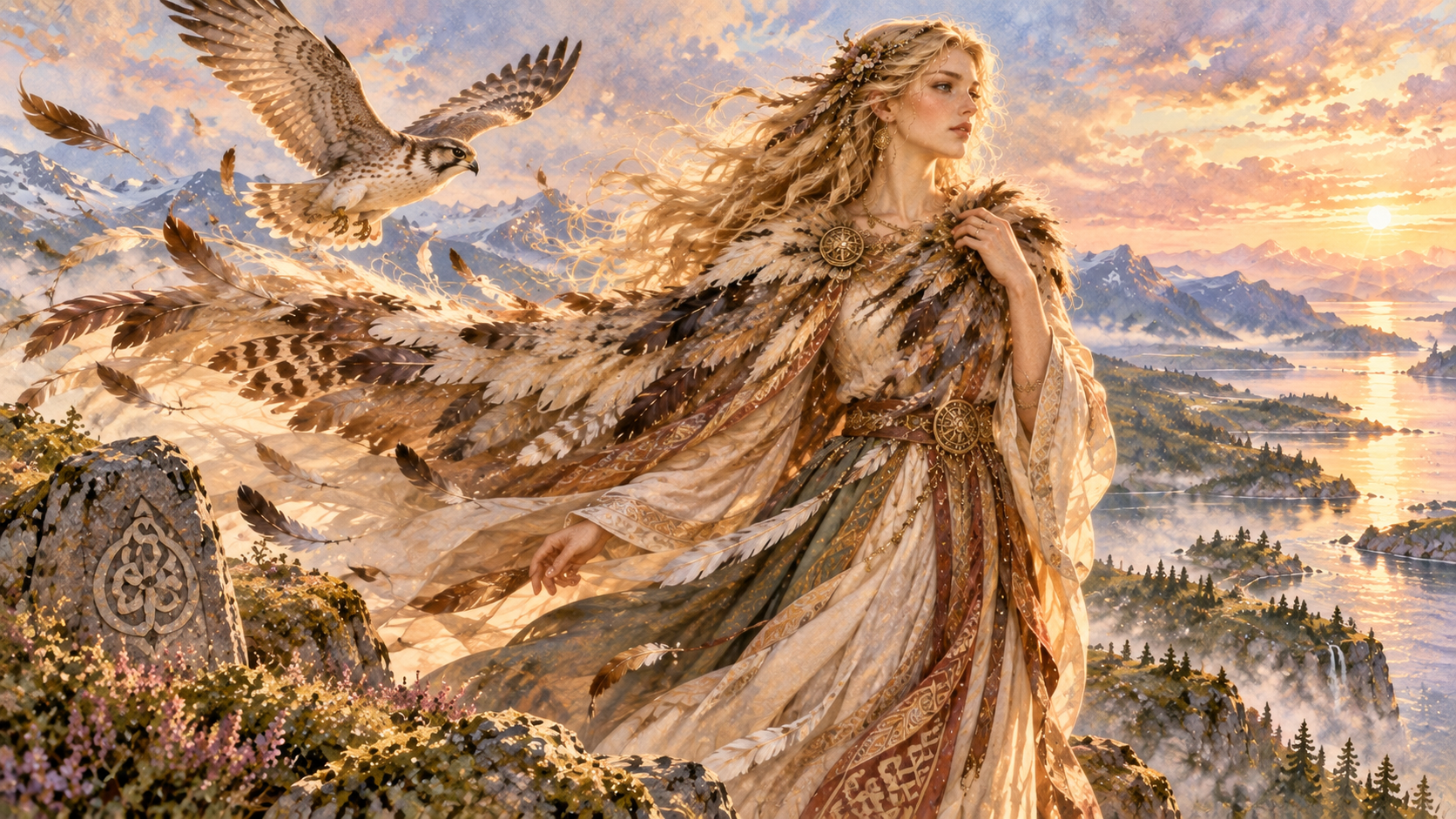
Freyja also possessed a magical garment called Valshamr, whose name is usually translated as “hawk cloak” or “hawk garment.”
Whoever wore it could take the form of a hawk and travel through the air. The sources associate the cloak with Freyja, although in some stories it is used by other characters. On several occasions, Loki manages to persuade the goddess to lend it to him so that he can travel or carry out particular missions.
The Cat-Drawn Chariot
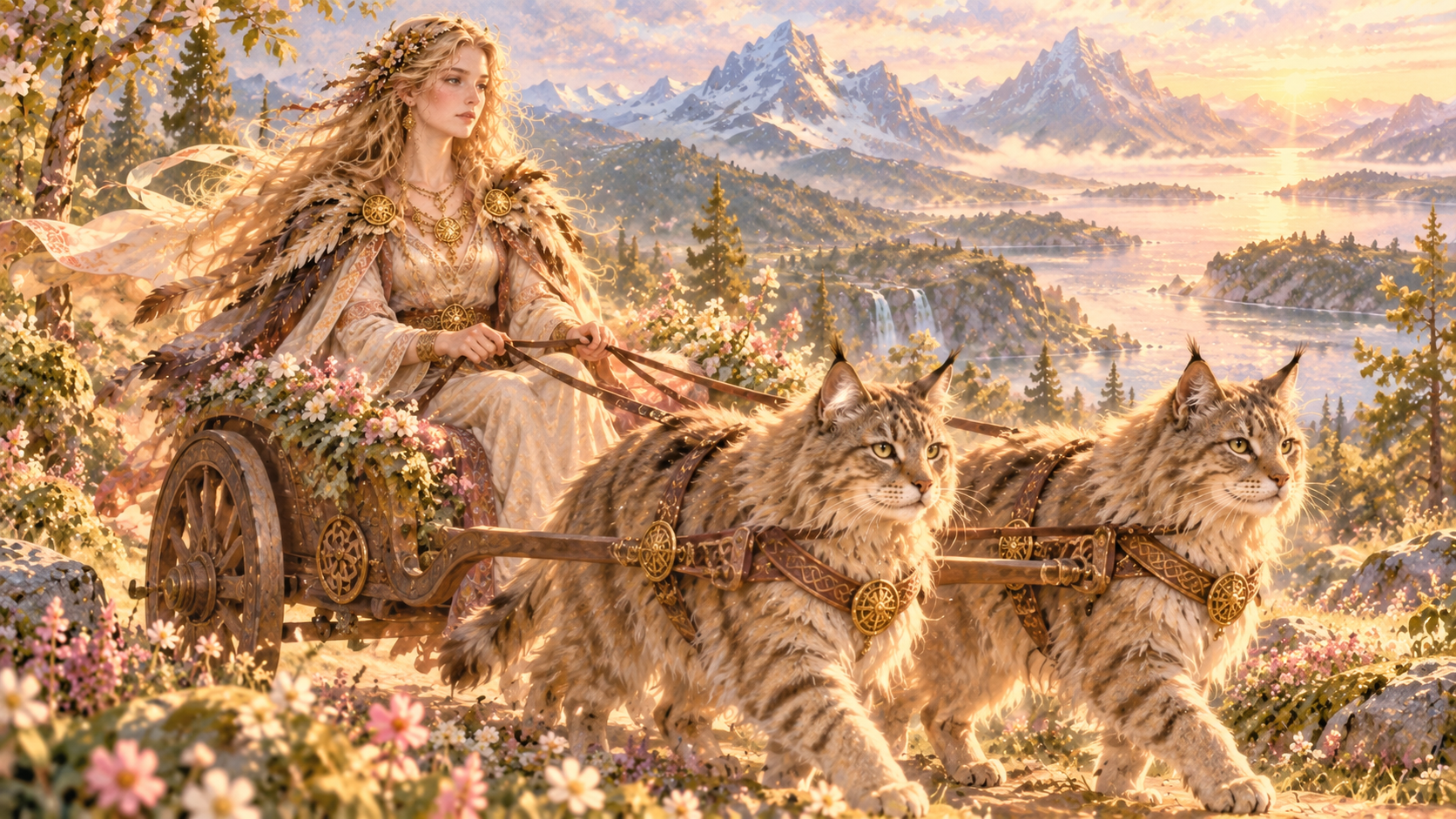
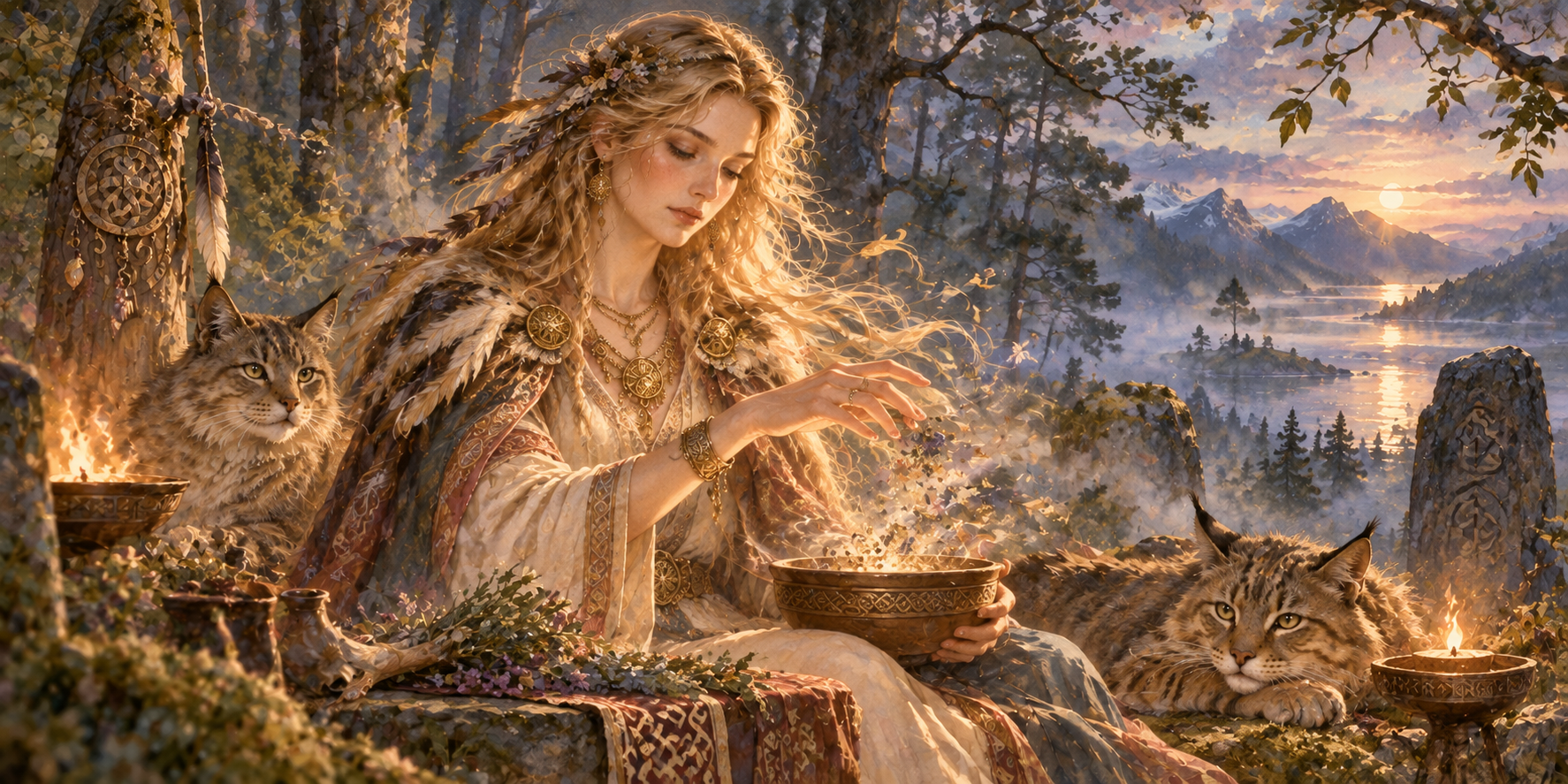
One of Freyja’s best-known symbols is her chariot, drawn by two large cats. The sources do not preserve their names or provide many details about their appearance. Even so, the image of the goddess traveling in a chariot pulled by felines became one of the most popular representations of Freyja.
Cats were later associated with the goddess, particularly through their symbolic connections with:
- fertility;
- sensuality;
- independence;
- abundance
- domestic and agricultural life.
Some of these interpretations, however, belong to modern reconstructions of Freyja’s symbolism rather than being explicitly established by the medieval sources.
Hildisvíni
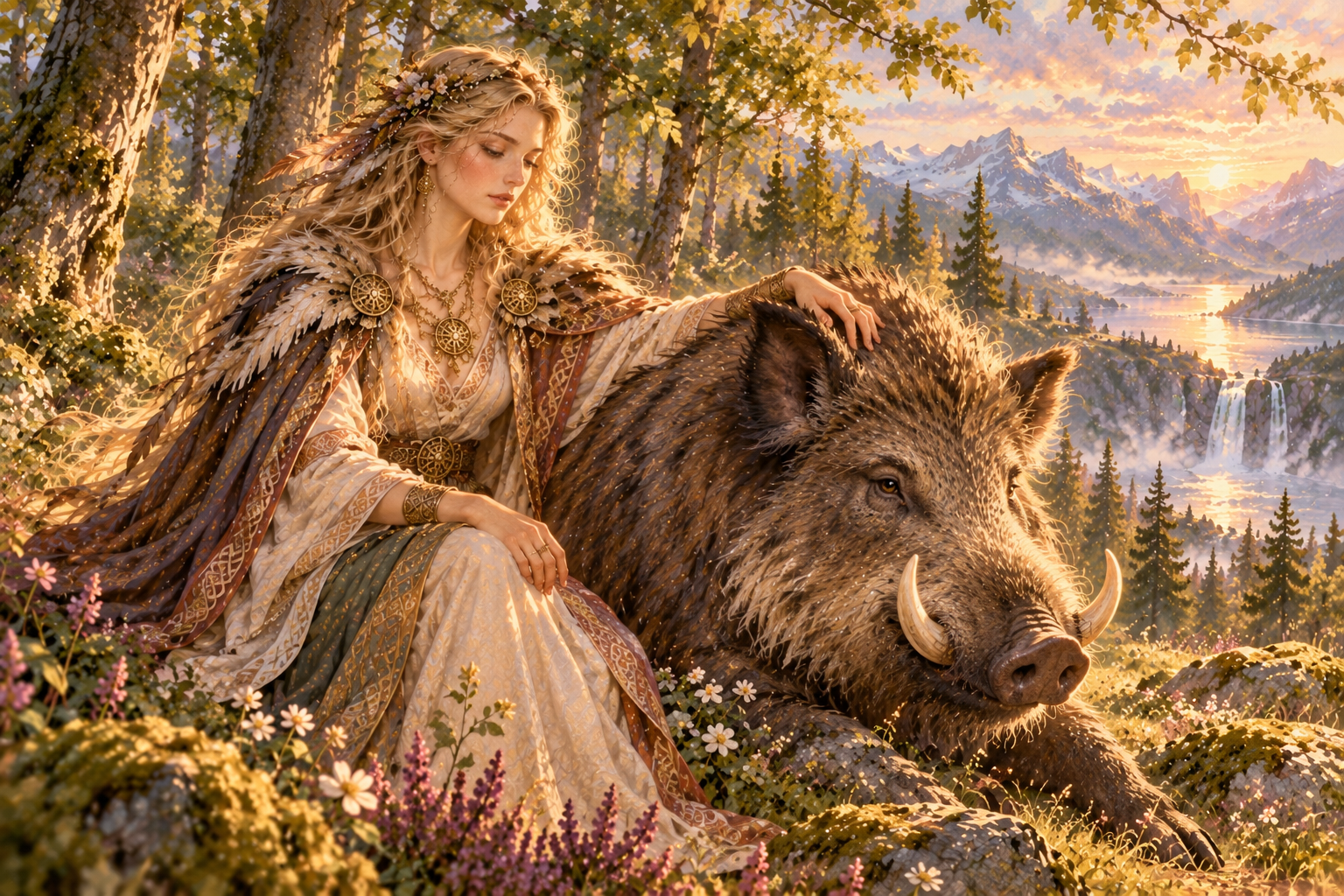
Another creature associated with Freyja is the boar Hildisvíni, whose name can be interpreted as “battle boar.”
In the poem Hyndluljóð, Freyja is depicted traveling upon a boar. The animal is connected with Óttar, a man under the goddess’s protection.
The poem presents Óttar as a devotee of Freyja who needs to know and prove his lineage. To help him, the goddess accompanies him to the dwelling of the giantess Hyndla, a woman who possesses knowledge of numerous genealogies.
The boar held great importance in Germanic and Norse cultures. It was associated with strength, fertility, protection, and prosperity.
The Family of Freyja
Óðr: Her Absent Husband
The sources identify Óðr as Freyja’s husband, although he is a relatively undeveloped figure.
Óðr is usually described as someone who undertook long journeys and remained away for extended periods. Freyja traveled throughout the world searching for him and wept for his absence.
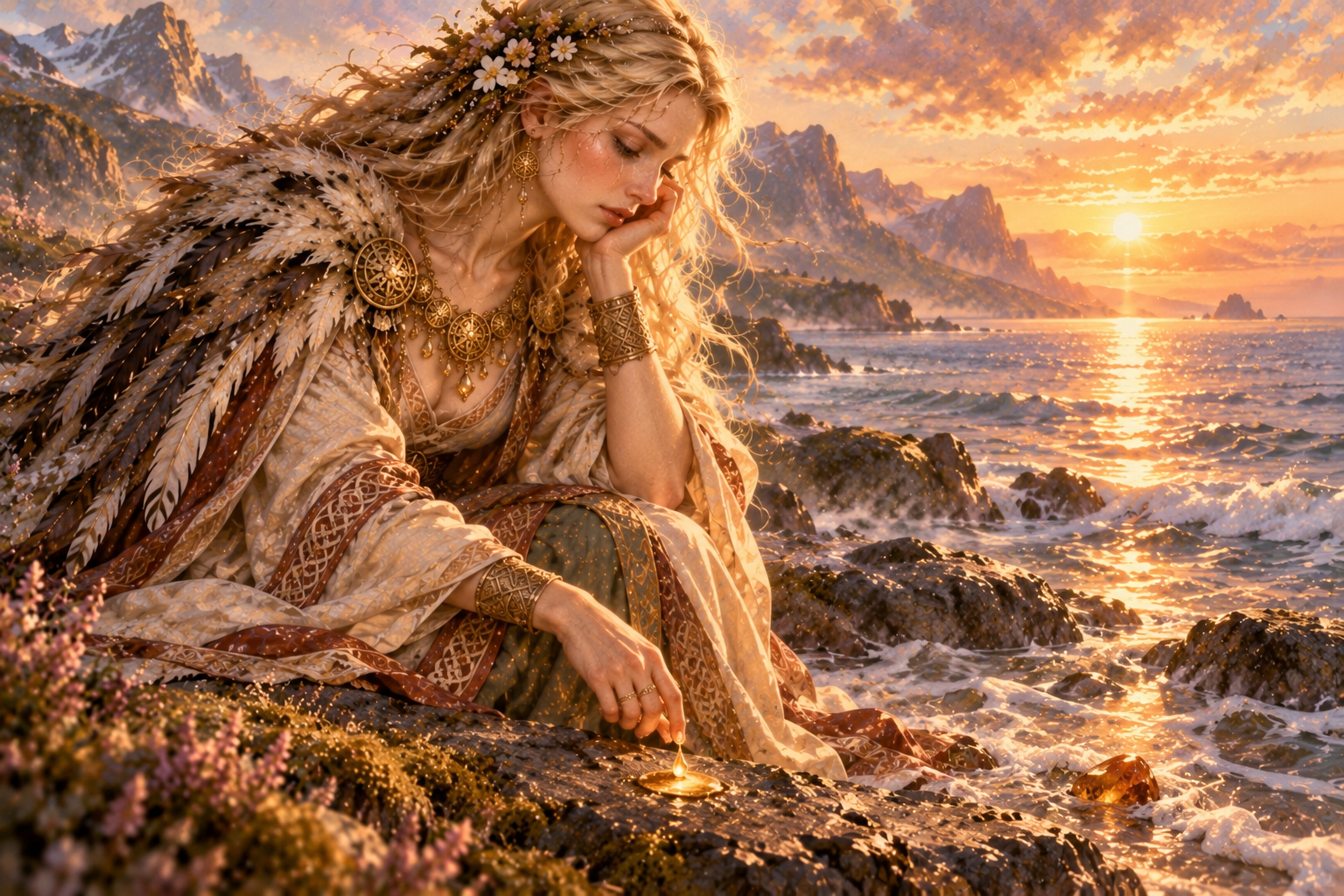
According to tradition, her tears turned into gold when they fell upon the earth and into amber when they reached the sea.
The name Óðr is associated with ideas such as inspiration, passion, fury, or ecstatic emotion. Because of certain similarities between his name and some of Odin’s attributes, several scholars have proposed that the two figures may derive from an older divine figure.
The Golden Tears
One of the best-known legends about Freyja tells how she wept inconsolably while searching for her absent husband.
Her tears became gold when they fell upon the earth and amber when they reached the sea. The story connects Freyja with wealth and precious metals, while also helping explain why gold and amber became symbolically associated with her in some later interpretations.
Her Children
According to tradition, Freyja and Óðr had two daughters:
- Hnoss;
- Gersemi.
Their names are associated with precious objects. Hnoss is generally interpreted as “jewel” or “treasure,” while Gersemi is likewise connected with the idea of something precious or valuable.
Both are mentioned primarily in genealogical and mythographical sources, and very little is known about them beyond these references.
The Great Tales of Freyja
The Theft of Brísingamen
The most detailed account of the theft of Brísingamen appears in Sörla þáttr, a late Icelandic tale.
According to this version, Loki discovers Freyja asleep while wearing her famous necklace. To steal it, he uses magic and takes the form of a tiny creature. Some modern retellings describe him as becoming a fly or a flea.
Loki manages to shift Freyja’s body slightly and take the jewel. When the goddess awakens, she discovers that Brísingamen has disappeared.
Freyja asks Heimdall, guardian of the Bifröst, for help. Heimdall pursues Loki, and the two eventually confront each other during the chase.
In some versions, both take the form of seals and fight in the sea. In the end, Heimdall defeats Loki, retrieves the necklace, and returns it to Freyja.
The Giant Þrym and the Marriage Proposal
One of the funniest stories in Norse mythology appears in the poem Þrymskviða.
One day, Thor discovers that his hammer, Mjölnir, has disappeared. Loki investigates and discovers that the culprit is the giant Þrym, who has hidden it.
Þrym refuses to return the hammer unless Freyja agrees to marry him.
When the gods deliver the proposal to Freyja, the goddess becomes so furious that, according to the poem, Brísingamen trembles upon her breast and the entire hall of the Æsir resounds.
Since Freyja absolutely refuses to marry the giant, the gods devise a plan.
Thor disguises himself as a bride, while Loki accompanies him dressed as his maidservant. The two travel to Jötunheim to attend the supposed wedding.
During the feast, Þrym begins to suspect something is wrong because the “bride” eats and drinks extraordinary amounts. Thor devours an entire ox, several salmon, all the sweets, and drinks enormous quantities of mead.
Loki manages to explain his behavior by claiming that the bride has not eaten for several days because of her excitement over the wedding.
Finally, Þrym places Mjölnir upon the supposed bride’s knees as part of the ceremony. At that moment, Thor grabs his hammer, throws off his disguise, and attacks Þrym and the other giants.
The story ends with Thor recovering his weapon and escaping with Loki.
“Then Freyja became furious. Brísingamen trembled upon her breast, and the entire hall of the Æsir resounded.”
— Þrymskviða Þrymskviða.
The Story of Óttar
The story of Óttar appears in the poem Hyndluljóð.
Óttar was a man deeply devoted to Freyja. He had raised altars in her honor and offered her sacrifices. Grateful for his devotion, the goddess decided to help him.
Óttar needed to prove his true lineage, but he did not know the names of his ancestors for certain.
Freyja therefore took him to Hyndla, a giantess who knew numerous genealogies of gods, kings, and heroes.
In the poem, Freyja is accompanied by a boar associated with Óttar. The goddess asks Hyndla to reveal the man’s lineage, and the giantess begins to enumerate his ancestors, families, and heroes connected to his bloodline.
Freyja and Ragnarök
The medieval sources do not clearly describe Freyja’s fate during Ragnarök.
Unlike Odin, Thor, or Freyr, whose deaths are described more explicitly, Freyja has no clearly recorded death in the surviving texts. Nor do we have a detailed account of her role in the final battle.
Her fate remains one of the great mysteries of Norse mythology.
Curiosities
Freyja and the Name Friday
The English name Friday, meaning “Friday,” and similar names in the Germanic languages have traditionally been associated with the names of female deities.
For a long time, it was thought that the word might derive from Freyja, although a connection with Frigg, Odin’s wife, has also been proposed.
The similarities between the names Freyja and Frigg, together with the linguistic evolution of the Germanic languages, mean that the origin of the name remains a subject of scholarly debate.
The Temple of Ölvusvatn, Iceland
A late Icelandic saga, the Droplaugarsona saga (The Saga of the Sons of Droplaug), mentions a place associated with a temple and images of deities.
Some modern interpretations have connected this passage with a temple in the region containing statues of the goddesses Freyja and Frigg, positioned opposite figures of Thor and Freyr.
No surviving temple can currently be identified with certainty at the site.
Place Names
Some researchers have proposed that certain Scandinavian place names may preserve ancient references to Germanic deities.
Among the names studied are forms associated with Freyja, although in many cases they could also be connected with Freyr. The similarity between the two names makes it difficult to determine with certainty which deity was originally being referred to at a particular site.
Norway: Frøihov
In Norway, there are places whose names contain elements that some scholars have associated with Freyja or Freyr.
One of them is Frøihov, a place name that has been interpreted as a possible combination of a divine name and hof, an Old Norse term associated with a temple or place of worship.One traditional interpretation gives the meaning“temple of Freyja.”.
Today, the site is associated with a farm located in the municipality of Hole.
Sweden: Frövi and Frölunda
Sweden has several ancient place names containing elements such as Fröja or Frøy.
Some researchers have connected these names with Freyja, while others consider that they could refer to Freyr or to a more general religious tradition.
Among the examples studied are:
Frövi
It has been proposed that Frövi may derive from an older form related to Freyjuvé, interpreted as “sanctuary of Freyja.”
Frölunda
It has likewise been suggested that Frölunda could be connected with an older form such as Freyjulundr, interpreted as “sacred grove of Freyja.”
A Symbol That Has Survived Through Time
Over the centuries, Freyja never disappeared completely.
Her figure continued to inspire legends, literature, art, and popular culture. Today, she remains one of the best-known deities of Norse mythology and a representation of beauty, knowledge, independence, and power.
But Freyja is much more than a goddess of love. She was a magician and protector. A warrior and a figure associated with death. A goddess of fertility, wealth, and desire. She mastered seiðr and received a share of the warriors who fell in battle.
Her story reminds us that, for the ancient Scandinavians, strength and beauty, life and death, war and love could coexist within a single deity.
Follow the Footprints
Visit It Today...
Swedish History Museum — Stockholm
The Swedish History Museum houses an important collection of objects from the Viking Age, including jewelry, amulets, burial objects, and artifacts connected with Scandinavian beliefs.
Some female amulets and representations discovered in Scandinavia have been associated with Freyja.
The Aska Pendant
Among the best-known pieces is a small gilded silver figure discovered at Aska, in the parish of Hagebyhöga, in the province of Östergötland.
The piece, dated approximately to the 10th century, depicts a richly dressed female figure. Some researchers have proposed identifying her with Freyja, particularly because of her clothing and the piece of jewelry around her neck, which has been symbolically associated with Brísingamen.
Ladby Viking Museum — Denmark
The museum is connected with the famous ship burial discovered on the Danish island of Funen.
Its collections preserve objects and representations connected with the Viking world. Some female figures discovered in Scandinavia have been interpreted by certain researchers as possible representations of Freyja or a Valkyrie.