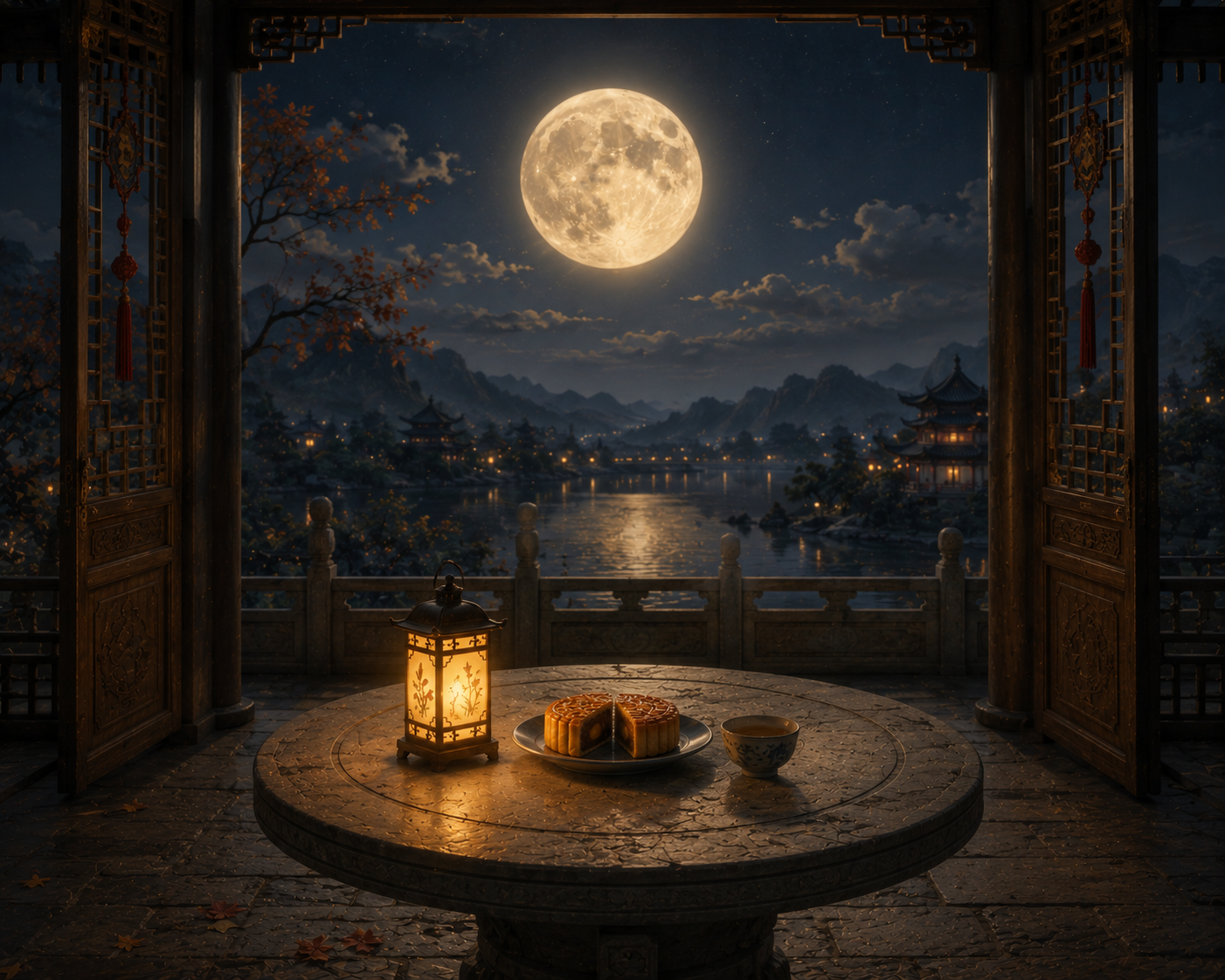
There are nights when the sky seems to bring entire generations together beneath the same light.
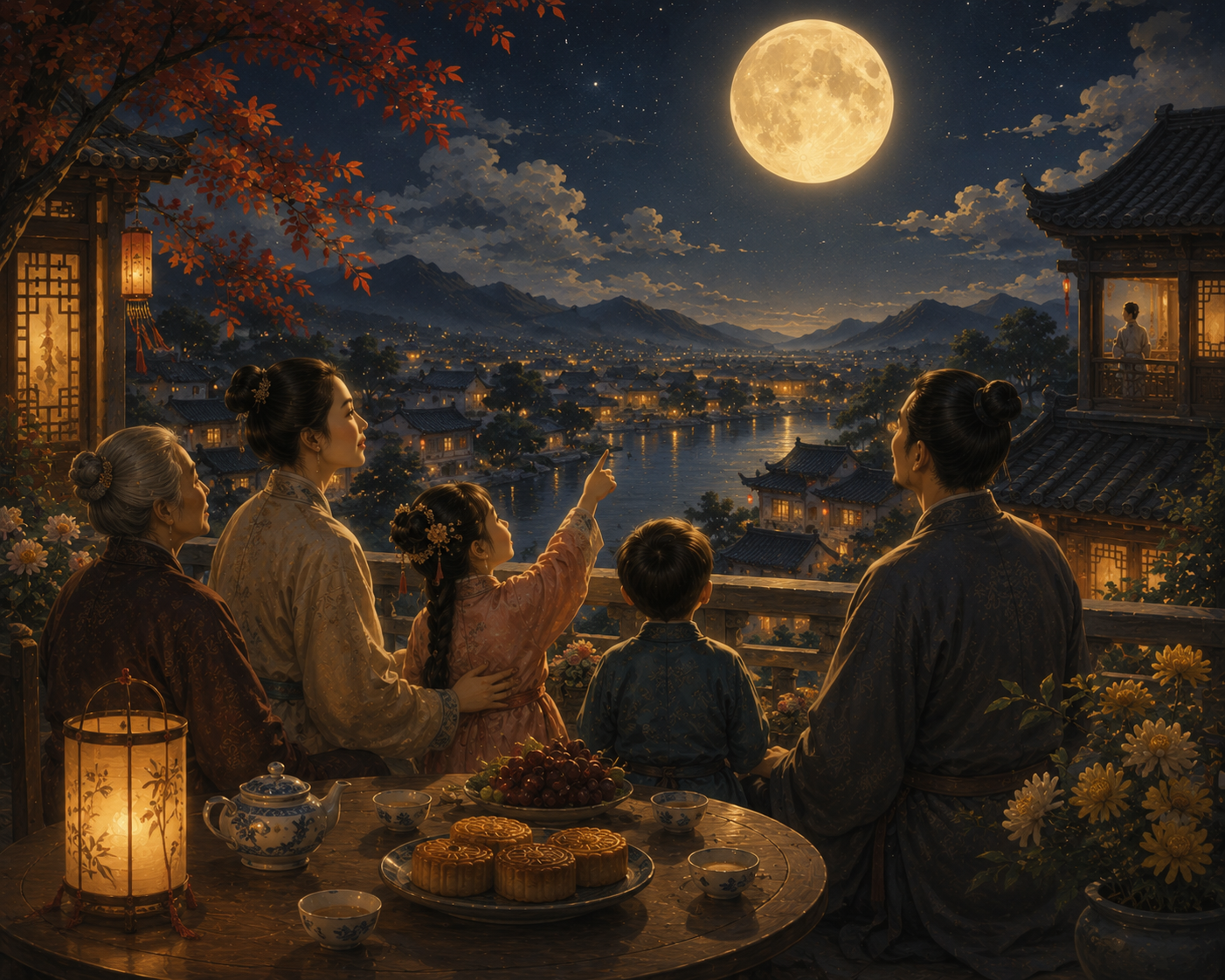
In China, one of them arrives every autumn, when the Moon reaches its full glory and millions of people gather to admire it, share traditional sweets, and light lanterns that illuminate the darkness.
It is the Mid-Autumn Festival, also known as the Moon Festival, one of the most important celebrations in Chinese culture and a tradition whose origins can be traced back to ancient times.
“Moonlight shines before my bed.
For a moment, I think it is frost upon the ground.
I raise my head and gaze at the bright Moon.
I lower it again and think of my homeland.”
Thoughts on a Quiet Night, Li Bai (Li Po). Pensamientos en una noche tranquila, Li Bai (Li Po).
A Festival with More Than Two Thousand Years of History
The origins of the Mid-Autumn Festival cannot be attributed to a single event. Its roots are connected to ancient agricultural ceremonies, harvest celebrations, and the veneration of the Moon.
As early as the Zhou dynasty, seasonal rituals associated with the observation and veneration of celestial bodies were already taking place. The term zhōngqiū, meaning “mid-autumn,” appears in ritual texts from this period, although the festival as we know it today developed much later.
Over the centuries, celebrations associated with the Moon gradually became more important. During the Tang dynasty (618–907), Moon-gazing and gatherings associated with this date became increasingly popular, and the festival began to take shape as a recognizable celebration.
During the Song dynasty (960–1279), it became firmly established as one of the great festivals of the Chinese calendar.
Thus, what began as a combination of ancient agricultural rituals, astronomical observation, and lunar veneration gradually incorporated new customs, legends, and popular traditions.
The Autumn Equinox and the Chinese Calendar
The Mid-Autumn Festival is celebrated on the fifteenth day of the eighth month of the Chinese lunisolar calendarifteenth day of the eighth month of the Chinese lunisolar calendar, a date that usually falls around the autumn equinox and coincides with the full Moon.
The connection between the festival and autumn is much older than the festival itself. Observing the cycles of the Sun and Moon allowed agricultural societies in China to organize the activities of the year and determine the appropriate times for sowing and harvesting.
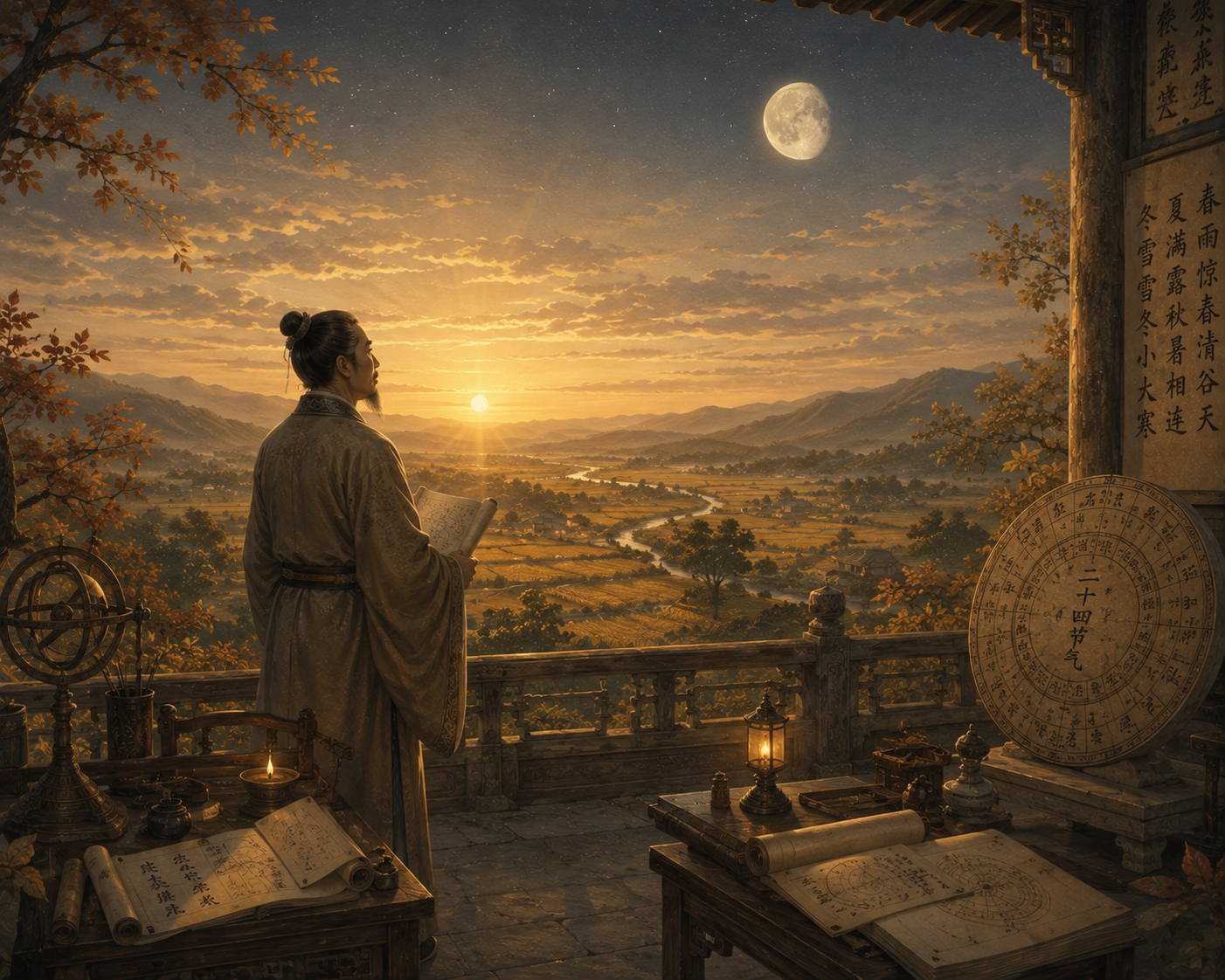
The 24 Solar Terms
The autumn equinox, known as Qiūfēn (秋分), is one of the Twenty-Four Solar Terms that divide the annual cycle according to seasonal and astronomical changes.
This system, developed in ancient China through the observation of the Sun's apparent movement, has more than two thousand years of history and was systematically established during antiquity. The Twenty-Four Solar Terms eventually became an essential tool for organizing agricultural activities and understanding the cycle of the seasons.
Autumn marks the moment when day and night are approximately equal in length and signals the beginning of the second half of the season.
The Equinox and the Harvest
The festival is deeply connected with autumn and abundance.
After the agricultural work of summer, the time came to gather the harvests and give thanks for the prosperity they had brought. The full Moon, round and luminous, became a powerful image associated with wholeness and balance.
Traditionally, it is associated with:
- wholeness
- harmony
- abundance
- family reunion
The Moon was not simply an astronomical phenomenon. It became a symbol filled with meaning.
Chang’e and the Legend of the Moon
The Mid-Autumn Festival is deeply connected to one of the most famous legends in Chinese mythology: the story of Chang’e, the woman who, according to tradition, ascended to the Moon after drinking an elixir of immortality.
Her story has inspired poems, paintings, works of art, and generations of storytellers. Over time, Chang’e became one of the most recognizable figures associated with the Moon in Chinese tradition.
However, there are several different versions of the legend.
In one of the best-known versions, Chang’e and her husband, Hou Yi, , lived in the heavens. One day, the Jade Emperor ordered Hou Yi to put an end to the disaster caused by his ten sons, who had appeared simultaneously in the sky and were scorching the Earth.
Hou Yi, famous for his skill as an archer, shot down nine of them, leaving only one to continue illuminating the world.
As a reward for his feat, he received an elixir of immortality from the Queen Mother of the West.
Hou Yi decided to keep it because he wished to remain with Chang’e. But while he was away, one of his disciples, Feng Meng, attempted to seize the elixir.
To prevent him from taking it, Chang’e drank it herself.
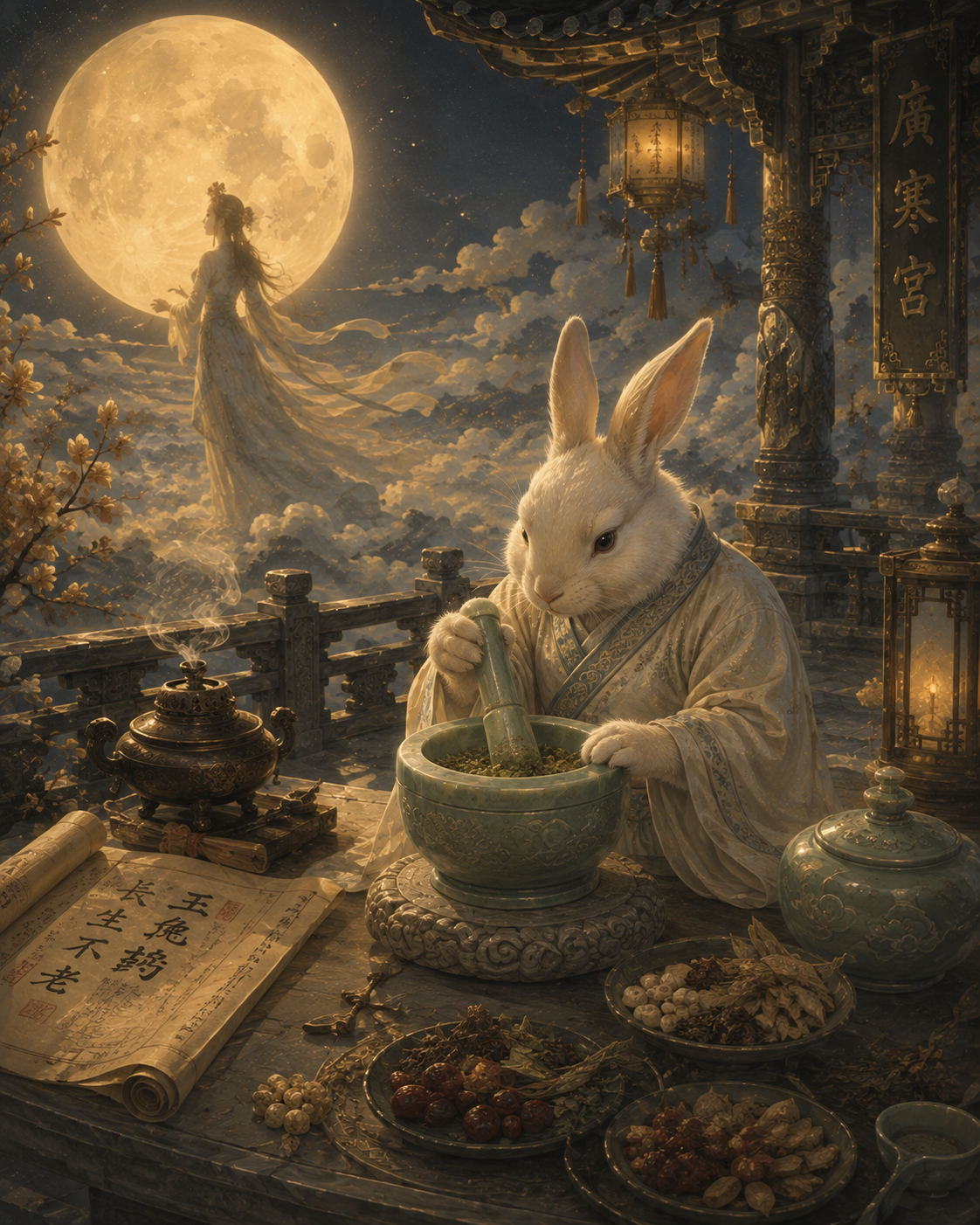
The effect was immediate. Her body became light and she began to ascend into the heavens until she reached the Moon, where she would remain forever in the Guanghan Lunar Palace, the Palace of Great Cold.
There, according to tradition, she would live alongside the Jade Rabbit.
When Hou Yi returned and discovered what had happened, he was devastated. He prepared offerings of some of Chang’e's favorite foods and placed them beneath the Moon while mourning her absence.
Over time, the tradition of gazing at the Moon and making offerings became associated with celebrations of the Mid-Autumn Festival.
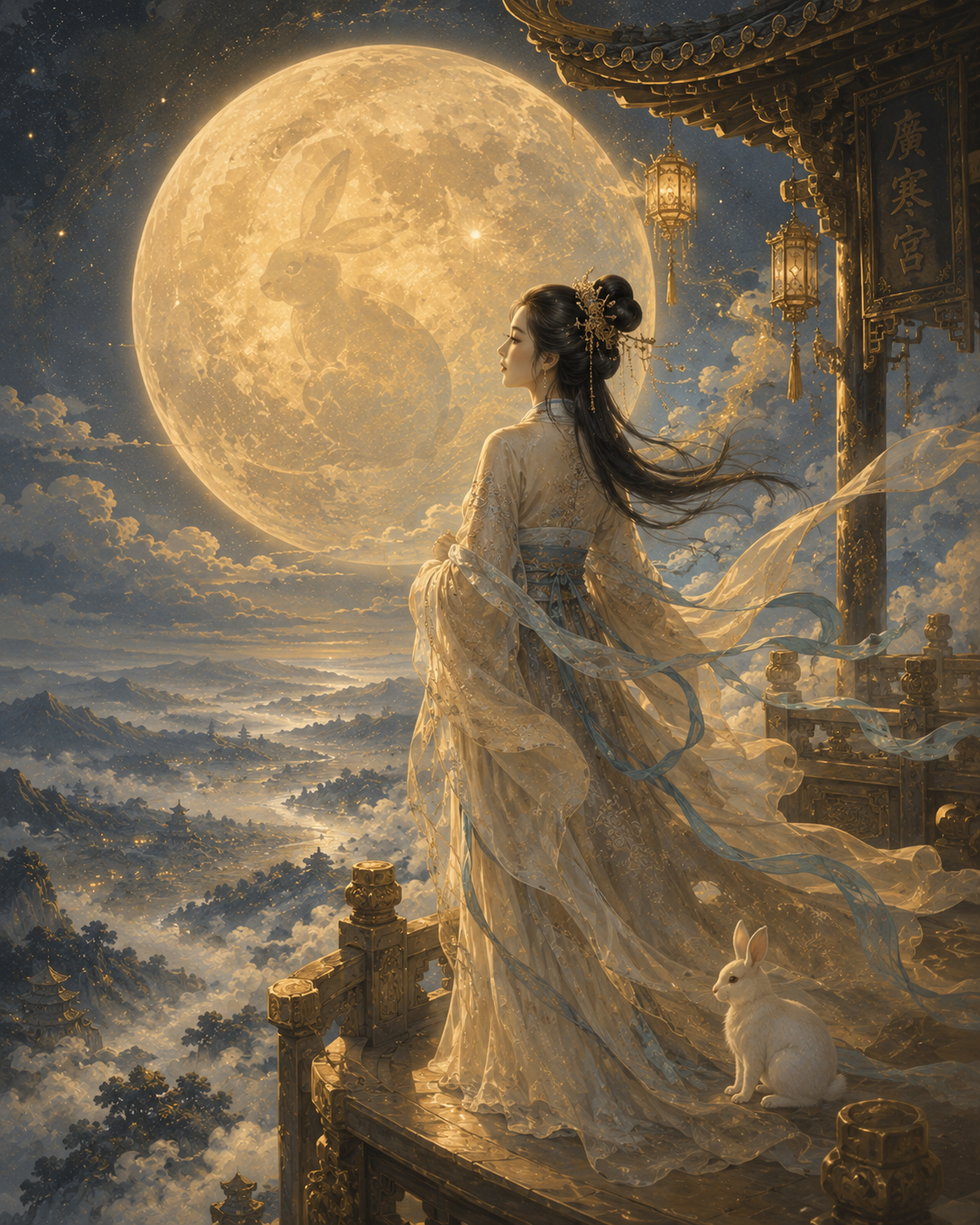
“The silver candlelight illuminates the painted screen, while a small moth flutters through the deep night. Frost covers the cold Jade Palace. As I gaze at the Moon, I wonder whether Chang’e regrets drinking the elixir of immortality.”
Chang’e, Li Shangyin.
The Symbolism of the Moon
In Chinese culture, the full Moon symbolizes much more than the passage of time or the changing of the seasons. Its perfectly round shape has long been associated with wholeness, harmony, and family reunion.
During the Mid-Autumn Festival, the full Moon thus becomes a symbol of:
- wholeness;
- harmony;
- unity;
- reunion;
- abundance;
- perfection.
For this reason, many people gaze at the same Moon while thinking of their loved ones, even when distance prevents them from sharing the same table. Beneath that same sky, the Moon becomes a symbol of connection that transcends both distance and time.
The importance of shapes is also deeply rooted in Chinese tradition. The circle, with neither beginning nor end, evokes the idea of wholeness and something that remains complete.
For this reason, during the Mid-Autumn Festival, a family gathered together can be symbolically compared to the full Moon: a complete whole.
This same idea appears in one of the festival's most characteristic elements: mooncakes, whose circular shape recalls the fullness of the Moon and the reunion of loved ones.
The Jade Rabbit and the Elixir of Immortality
According to tradition, Chang’e does not live alone on the Moon. Alongside her lives the Jade Rabbit (Yùtù), one of the most beloved figures in Chinese folklore.
One of the best-known legends tells that the Jade Emperor wanted to test the kindness of several animals. To do so, he descended to Earth disguised as an old, hungry beggar.
He encountered a monkey, a fox, and a rabbit.
The monkey gathered fruit.
The fox found food.
The rabbit, however, could only gather grass and realized that he had nothing to offer the old man.
Then he made an extraordinary decision. He asked the old man to light a fire and voluntarily threw himself into the flames, offering his own body as food.
The old man then revealed his true identity. Moved by the animal's sacrifice, the Jade Emperor saved the rabbit from the flames and took him to live on the Moon as a symbol of kindness, compassion, and selflessness.
From then on, the Jade Rabbit has accompanied Chang’e in the Lunar Palace. Tradition depicts him grinding medicinal herbs in a mortar, using them to prepare the elixir of immortality for the celestial beings.
In some traditions, another figure also lives on the Moon: Wu Gang, a man condemned by the Jade Emperor to eternally chop down an enormous osmanthus tree. Every time he is about to bring it down, the tree grows back, and his punishment begins all over again.
The Moon and the Family
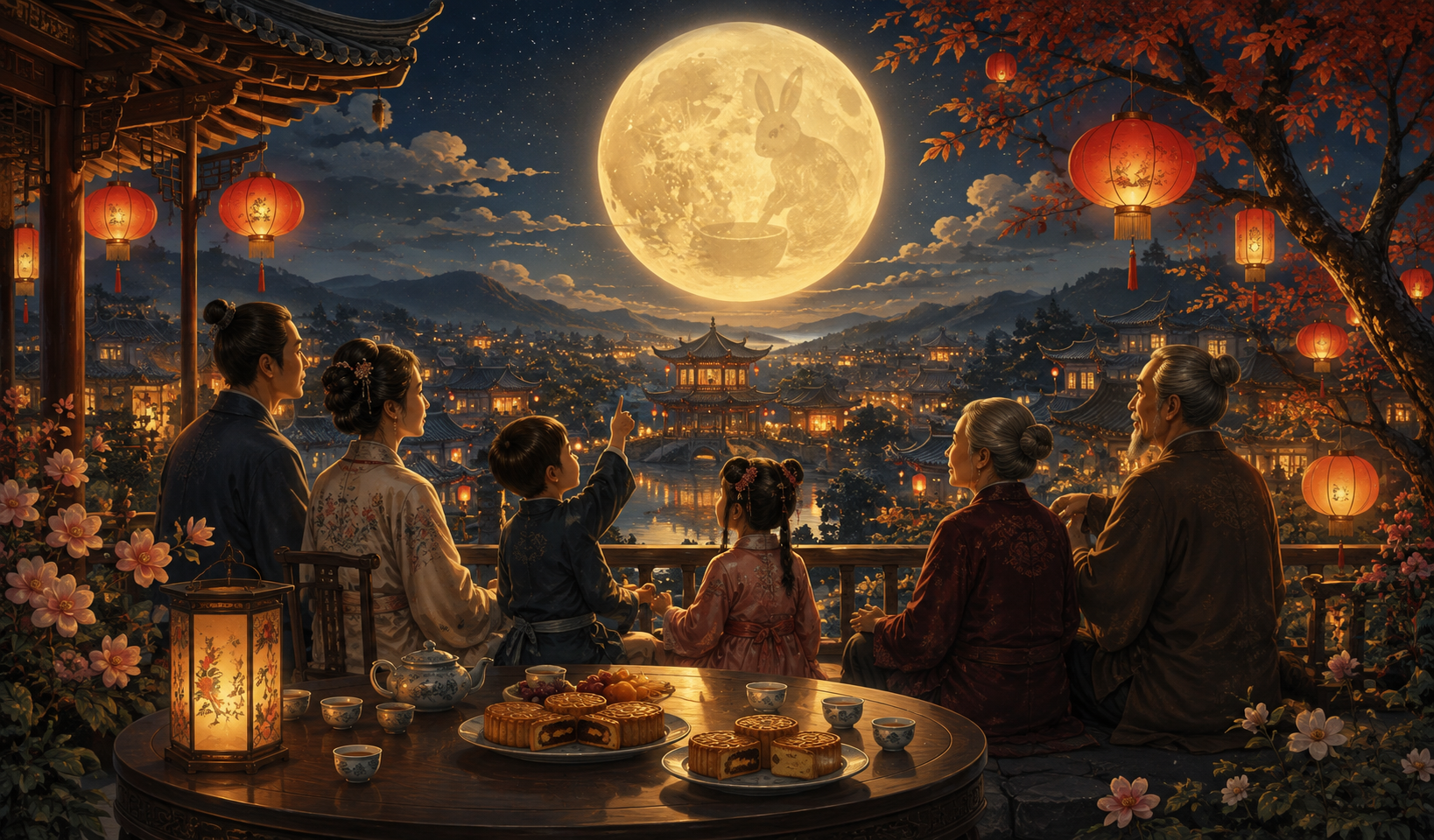
One of the most characteristic aspects of the Mid-Autumn Festival is its strong family dimension. Many people travel long distances to reunite with their loved ones and share a special meal.
The perfectly round full Moon traditionally represents union and reunion. For this reason, even those who live far away often look at the same sky while thinking of their families.
The Moon thus becomes a symbolic bond between those who are together and those separated by distance.
The Famous Mooncakes
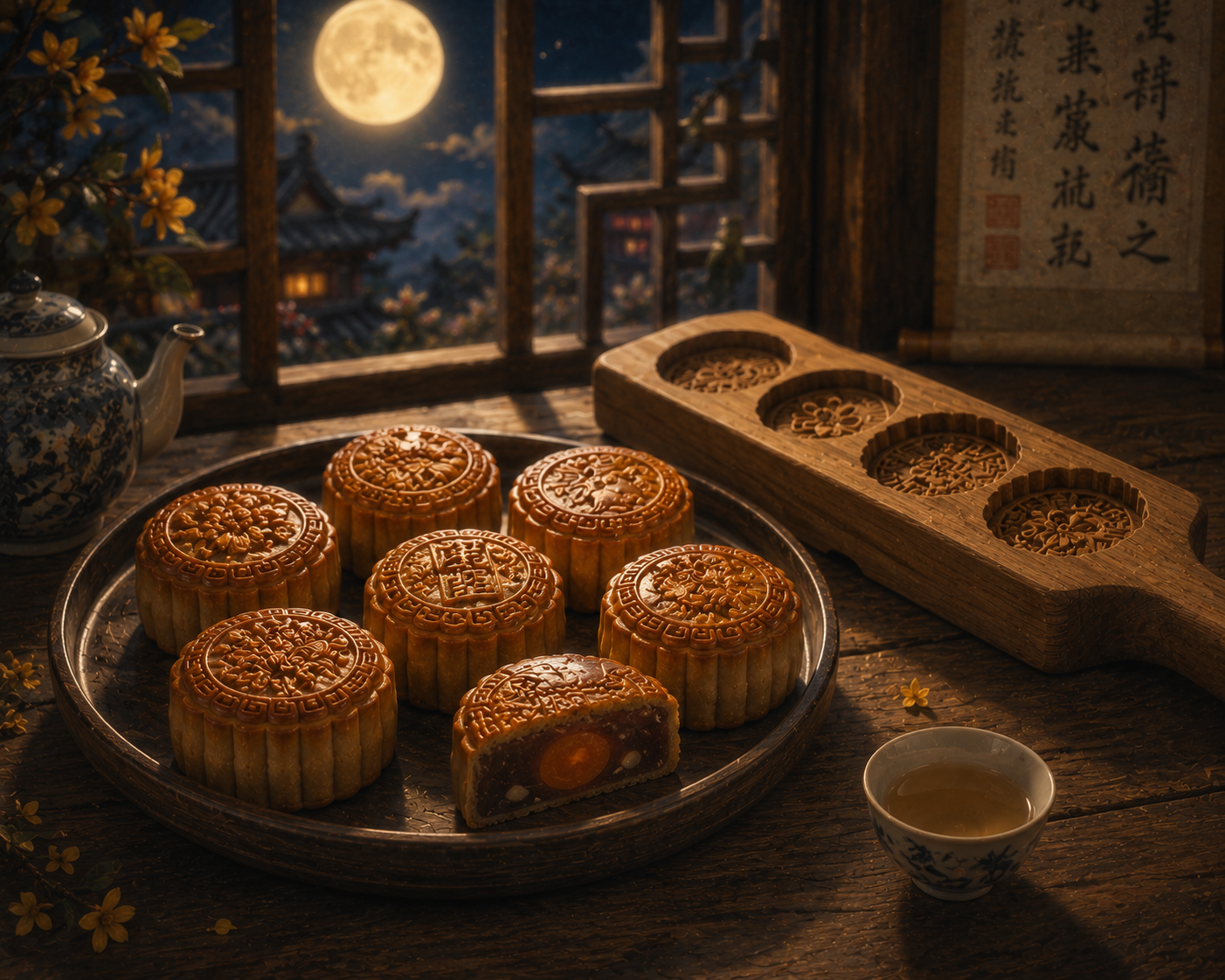
If there is one culinary symbol inseparable from this festival, it is the mooncake (yuèbǐng).
These small, round pastries have been part of the celebration for centuries and are now made in countless varieties.
Depending on the region, they may contain:
- lotus seed paste;
- sweet red bean paste;
- seeds and nuts;
- five-kernel filling;five-kernel);
- salted egg yolk;
- date paste;
- and other traditional or modern fillings.
Their round shape recalls the full Moon and traditionally symbolizes wholeness and family reunion.
Mooncakes are also exchanged as expressions of affection and good wishes during the festival.
The Origins of the Mooncake
The history of mooncakes is more complex than one of the most famous legends associated with them suggests.
Popular tradition holds that, during the Yuan dynasty, rebels used mooncakes to conceal secret messages and coordinate an uprising against Mongol rule.
According to this story, Zhu Yuanzhang, the future founder of the Ming dynasty, and his adviser Liu Bowen supposedly used this method to spread the message of rebellion and coordinate the attack during the Mid-Autumn Festival.
The story is famous, although there are earlier references to sweets and foods associated with autumn celebrations and offerings to the Moon.
For this reason, the story of the secret messages belongs more properly to the popular tradition surrounding the origins of the mooncake than to a historically proven origin.
From the Imperial Court to a Major Popular Celebration
During the Tang dynasty (618–907), celebrations associated with the Moon grew increasingly important, and the festival gained recognition within the imperial court.
During the following centuries, particularly under the Song dynasty, the Mid-Autumn Festival became firmly established as one of the great celebrations of the Chinese calendar, and many of the customs we associate with it today gradually took shape.
These included Moon-gazing, family reunions, offerings, and, over time, the exchange of mooncakes.
The Making of Mooncakes and Their Characteristic Designs
Traditional mooncakes usually have a thin, tender crust surrounding a sweet, dense filling. Depending on the region and the type of mooncake, other varieties are also prepared in different ways, although baked versions are particularly well known.
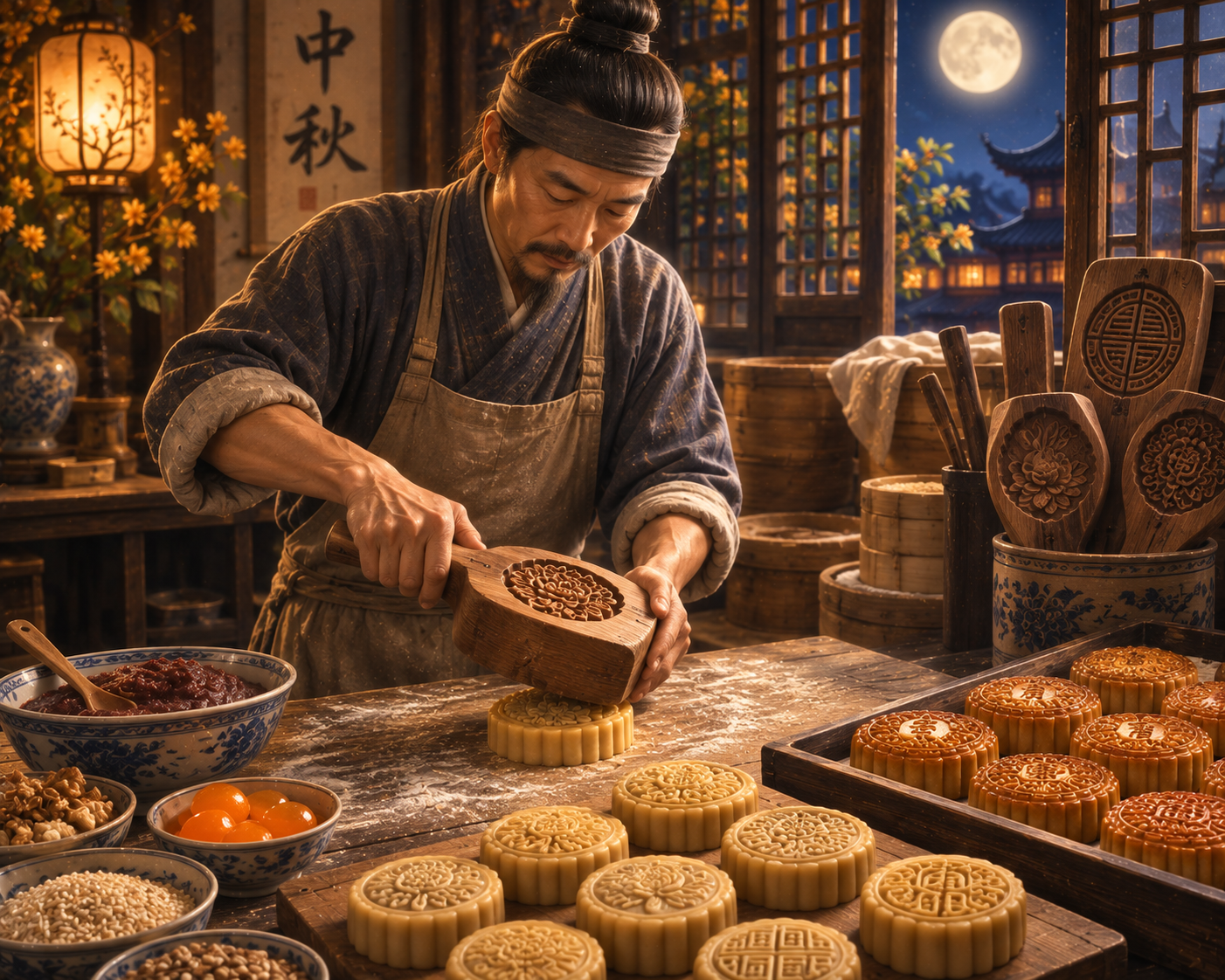
One of their most distinctive features is the decorative pattern stamped onto the surface. Traditionally, the molds could be carved by hand from wood, although other materials were also used depending on the period and region.
They were carved with a variety of motifs, including:
- characters associated with longevity or harmony;
- the Moon;
- flowers and plants;
- the Jade Rabbit;
- Chang’e;
- other auspicious symbols.
The molds were used to press the dough and imprint the design onto the surface before the mooncakes were placed in the oven.
Once prepared, they are usually cut into small portions and traditionally served with tea.
Lanterns Beneath the Moon
When night falls, the Moon is not the only thing illuminating the sky.
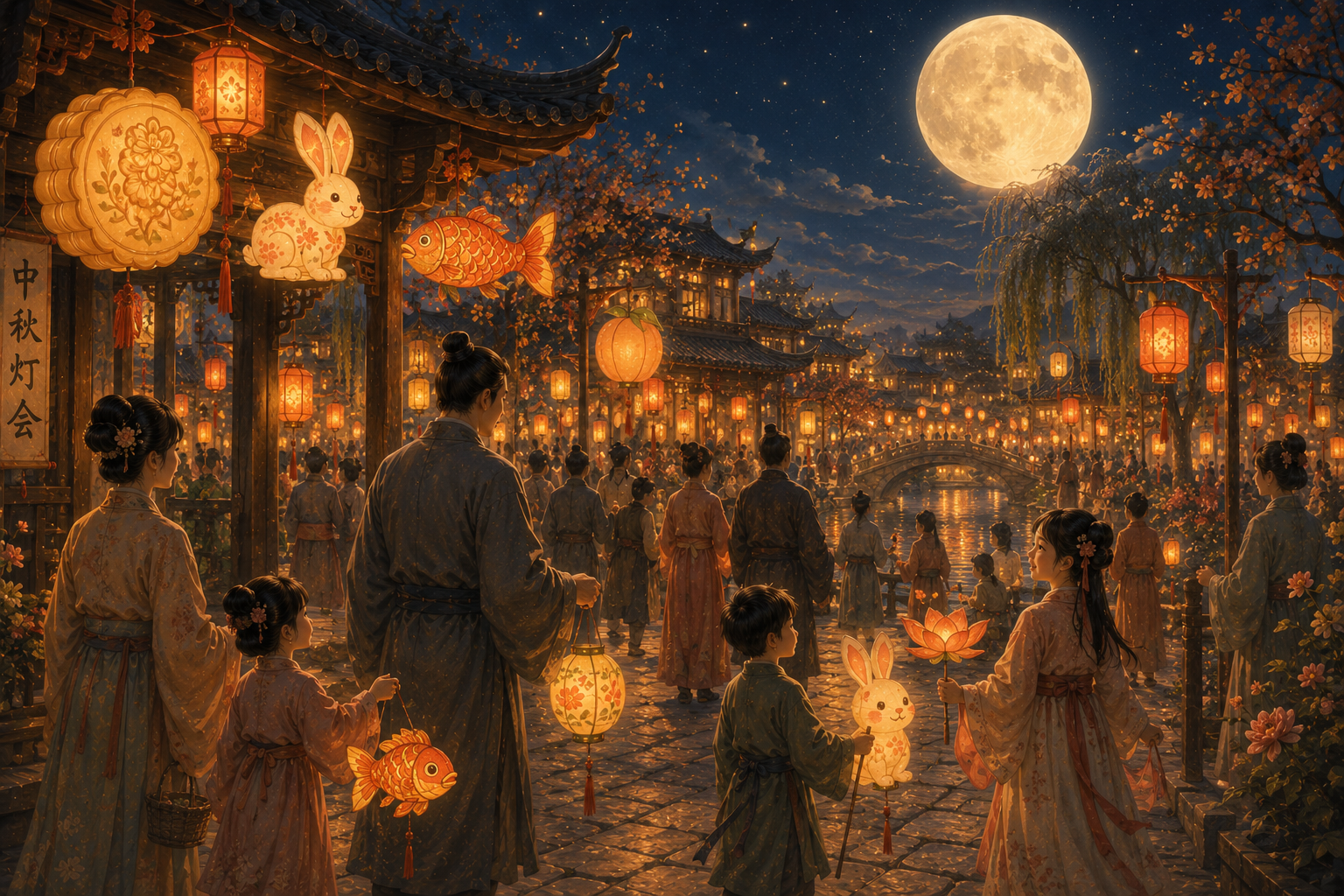
Thousands of lanterns can fill parks, streets, gardens, and courtyards during Mid-Autumn Festival celebrations. Some retain traditional shapes, while others depict animals, flowers, mythological figures, or scenes from Chinese legends.
Paper lanterns had existed in China long before becoming associated with particular festivals. Made from frames of wood, bamboo, or other materials and covered with paper or silk, they were originally used as sources of illumination and also appeared in various ritual and religious contexts.
Their connection with the Mid-Autumn Festival developed gradually. During the Tang and Song dynasties, nighttime gatherings to admire the Moon became extremely popular, and lanterns were progressively incorporated into these celebrations. During later centuries, their construction became increasingly sophisticated, and they evolved into genuine works of craftsmanship.
A Tradition That Evolved Over Centuries
Before the Tang dynasty
Silk and paper lanterns were already known in China and were used for illumination as well as in various ceremonies.
Tang dynasty (618–907)
Moon-related celebrations became enormously popular, particularly among the elite and at the imperial court. Nighttime gatherings to admire the Moon became increasingly common, and lanterns began appearing in different festive settings. The Mid-Autumn Festival also began to develop into a recognizable celebration.
Song dynasty (960–1279)
Mid-Autumn celebrations gained even greater importance, and there are references to lantern-related customs, including floating lanterns on water in some regions. Artisans continued refining their techniques, and designs became increasingly diverse.
Ming and Qing dynasties (1368–1912)
Lanterns continued to evolve and became increasingly elaborate decorative and handcrafted objects. Traditions varied considerably from one region to another, giving rise to different shapes, materials, and ways of using them.
Today
Lanterns remain part of Mid-Autumn Festival celebrations in different regions of China. They are made in countless sizes and shapes and appear at family gatherings, exhibitions, children's activities, and public celebrations.
Traditional Lanterns
There was never a single standard lantern design.
Their shape depended on the region, the available materials, and the occasion for which they were made. In some places, bamboo frames covered with paper were used, while other designs could be decorated with silk, painted Chinese characters, or auspicious motifs.
Traditional designs associated with the Mid-Autumn Festival include:
- birds;
- fish;
- fruit;
- flowers;
- animals;
- characters associated with the celebration;
- figures of the Jade Rabbit;
- Moon-inspired shapes.
In some regions, particularly in southern China, children and families made their own lanterns and hung them outside their homes or carried them during celebrations. In Guangdong and Hong Kong, for example, there are traditions of making bamboo lanterns shaped like birds, fish, fruit, and other forms.
In this way, lanterns ceased to be merely sources of light and became objects filled with symbolism and creativity.
A Tradition That Was Not Created by a Single Person
Unlike other traditions whose origins can be attributed to a particular individual, the lanterns associated with the Mid-Autumn Festival have no known inventor.
Their history is the result of a gradual evolution: ancient lanterns used to illuminate the night were incorporated into different celebrations, acquiring new forms and meanings over the centuries.
For this reason, the modern image of the Mid-Autumn lantern does not belong to a single period. It is the result of more than a thousand years of transformation.
And although today they can be found as magnificent works of craftsmanship, their simplest purpose remains unchanged: to illuminate the night while families gather beneath the same Moon.
The Moon That Brings Generations Together
As with many great traditions throughout history, the Mid-Autumn Festival did not emerge all at once. Over the centuries, it incorporated new customs, symbols, and stories until it became the celebration shared by millions of people today.
The full Moon, mooncakes, lanterns, and the legends of Chang’e and the Jade Rabbit are now all part of the same tradition, even though each of these elements has its own history.
For many people, the Moon of the Mid-Autumn Festival symbolizes family reunion and harmony.
For this reason, even those who are far from home continue the tradition of gazing at the Moon while thinking of their loved ones.
Curiosities
The Patterns of the Moon
Cultures around the world have found different figures in the dark markings on the lunar surface.
In some European traditions, the image of the Man in the Moon emerged. In China, by contrast, these shadows have traditionally been associated with the silhouette of a rabbit: the Jade Rabbit, preparing his elixir in a mortar.
A Variable Date
The Mid-Autumn Festival does not follow the Gregorian calendar. It is celebrated on the fifteenth day of the eighth month of the Chinese lunisolar calendarifteenth day of the eighth month of the Chinese lunisolar calendar, meaning that its date changes every year and usually falls between September and October.
The Jade Rabbit's Mortar
The image of the lunar rabbit with a mortar is very ancient.
Representations of the Jade Rabbit associated with the preparation of substances or elixirs appear in ancient Chinese art, including representations dating from the Han dynasty (206 BC–AD 220).
The figure of the Moon Rabbit would eventually become one of the most recognizable symbols associated with the Moon in Chinese tradition.
One Moon for Everyone
Today, the Mid-Autumn Festival continues to fill cities and villages with light.
Parks decorated with lanterns, family gatherings, cultural performances, traditional markets, and tables filled with mooncakes make this one of the most special nights of the Chinese calendar.
More than two thousand years after its earliest origins, the Moon continues to bring millions of people together beneath the same sky.
And perhaps that is the true magic of this ancient celebration: to remind us that, although centuries and borders may change, there is always a shared light capable of bringing together those who look toward it.
Follow the Footprints…
A Tradition That Remains Alive
Today, the Mid-Autumn Festival continues to be celebrated in many parts of the world.
In addition to mainland China, it remains deeply important culturally in:
- Taiwan;
- Hong Kong;
- Macao;
- Singapore;
- and numerous Chinese communities around the world.
Family gatherings, Moon-gazing, and lanterns remain part of a celebration that, after centuries of transformation, continues to bring people together beneath the same sky.
Visit It Today...
National Museum of China (Beijing)
The National Museum of China, located in Tiananmen Square, houses one of the world's great collections dedicated to the history and culture of China.
Its exhibitions include archaeological artifacts, bronzes, ceramics, porcelain, sculptures, and other objects that allow visitors to explore thousands of years of Chinese history.
Its permanent Ancient China exhibition traces the development of Chinese civilization from prehistoric times through the Ming and Qing dynasties, making it one of the most interesting places to explore the cultures and traditions that shaped the country.
Zigong (Sichuan)
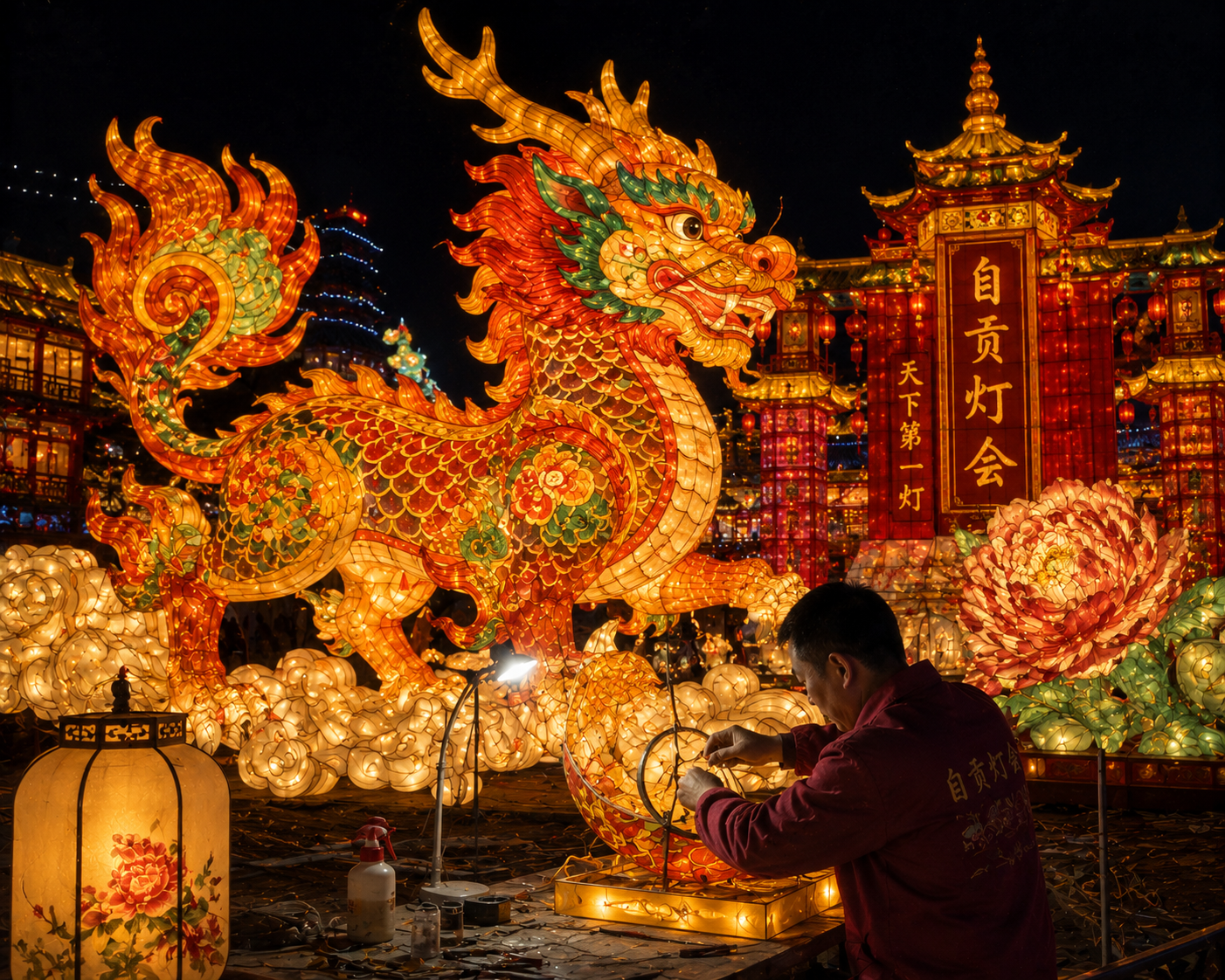
The city has one of China's most important lantern-making traditions.
Official sources from Sichuan trace Zigong's lantern tradition back several centuries and indicate that during the Tang and Song dynasties there were already festive customs involving lights in the region. Over time, this tradition evolved into a genuine craft specialty.
Today, Zigong is particularly famous for its large-scale lantern festivals, in which monumental structures made of metal, silk, and other materials depict animals, historical figures, mythological scenes, and elements of traditional Chinese culture.
The city is also home to the China Lantern Museum, a museum specializing in the history, production, and development of lantern culture. The city itself regards it as one of the main institutions dedicated to preserving and passing on this traditional craft.
Zigong's large lantern celebrations are particularly associated with Chinese Lunar New Year and the Lantern Festival, and the city is known as the “Lantern Capital of the World.”
“Though we may be separated by thousands of miles, may we share the beauty of this same Moon.”
Adapted from a translation of Shui Diao Ge Tou, Su Shi, 1076.