
In Norse mythology, Odin does not rule solely through strength or divine power. He rules through knowledge, sacrifice , and the mysterious authority of one who understands the threads of fate. Among all the symbols associated with him, one stands above the rest as the purest extension of his will: Gungnir, the legendary spear of the Allfather.
It is not merely a weapon. It is a sacred object, capable of securing victory, sealing oaths, and declaring the beginning of war.
In Odin's hands, Gungnir reminds us that, for the ancient Norse peoples, war and fate were inseparable.
The Characteristics of Gungnir
Gungnir is Odin's legendary spear, described as a flawless weapon.
The sources attribute several extraordinary qualities to it:
- it never misses its target;
- it always strikes its mark;
- it is inseparably linked to the authority of the sovereign god.
Its name is commonly interpreted as "the Swaying One" or "the Vibrating One,"evoking the image of a spear that seems almost alive, as though fate itself trembled at the tip of its blade.
Gungnir: The Masterpiece of the Dwarves
Gungnir was not forged by the gods. It was crafted by the Sons of Ivaldi, the legendary dwarf craftsmen of Svartalfheim, whose unmatched skill produced some of the greatest treasures in Norse mythology.
The creation of the spear is recounted in the Skáldskaparmál, a section of Snorri Sturluson's Prose Edda.
According to the story, Loki cut off Sif's hair as a mischievous prank. To repair the damage, he asked the Sons of Ivaldi to forge a new head of golden hair for the goddess. As part of the same commission, they also created two other legendary treasures, making the three masterpieces of the Sons of Ivaldi:
- Sif's golden hair;
- Gungnir;
- Skíðblaðnir, Freyr's magical ship, capable of being folded small enough to fit inside a pocket.
The sources never specify the exact material from which Gungnir was forged. Instead, they emphasize one of its most remarkable features: it is engraved with runes.
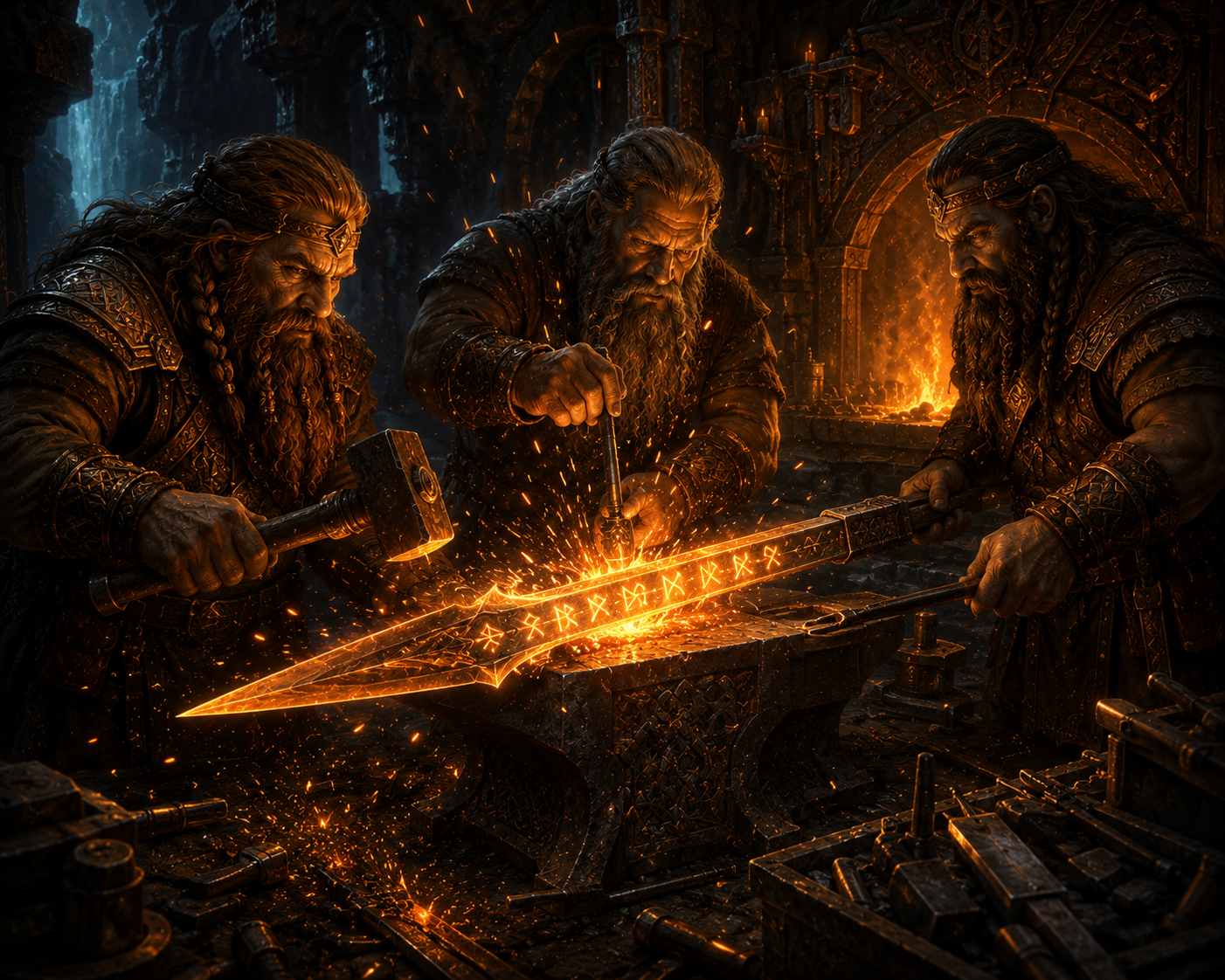
For the Norse peoples, runes were far more than letters. They were sacred symbols associated with:
- speech;
- fate;
- magic
- the order of the universe.
Gungnir is therefore much more than a spear of metal. It is a weapon whose very essence is infused with magic. un arma donde la magia forma parte de su esencia.
The Power of Gungnir
The legends attribute extraordinary qualities to Gungnir, making it an almost perfect weapon.
It Never Misses
Whenever Odin throws Gungnir, it always reaches its target.
Distance, darkness, or the chaos of battle make no difference. The spear inevitably finds the path marked by fate.
It Seals Oaths
Some traditions associate Gungnir with solemn oaths.
As the symbol of Odin's supreme authority, the spear represents the sacred power of a promise that cannot be broken.

Gungnir and the Beginning of War
One of the best-known episodes involving Gungnir occurs during the first great war of the gods: the conflict between the Æsir and the The Vanir.
Before the battle began, Odin cast his spear over the enemy army. He was not simply attacking. It was a ritual act.
In Norse tradition, throwing a spear over one's enemies meant dedicating the battle to Odin and formally declaring the beginning of war.
With that single throw, the conflict ceased to be a mere dispute and became an event woven into fate itself.
Odin, the Spear, and Sacrifice
Although Gungnir is usually associated with war, its meaning extends far beyond combat. It represents authority earned through knowledge and sacrifice.
It is no coincidence that it belongs to Odin, the god who sacrificed one of his eyes in exchange for wisdom and hung himself from the World Tree, Yggdrasil , for nine nights to discover the secrets of the runes.
In his hands, Gungnir symbolizes the rightful power of one who has paid a price for knowledge.
Curiosities
Ritual Spears in Sacred Bogs
Archaeology has demonstrated that spears held a sacred place in the religion of the Germanic peoples. Across Scandinavian lakes and bogs, hundreds of weapons have been discovered deliberately deposited as offerings to the gods.
Some specialists believe these rituals may be connected to the custom of consecrating a battle by throwing a spear, just as Odin does in the mythological sources.
One example is:
Boeslunde (Denmark)
One of Scandinavia's most important ritual sites. For decades, archaeologists have uncovered weapons, gold, spearheads, and ritual objects.
Among the discoveries are two gold-inlaid spearheads distinguished by their immense ritual significance rather than their military value.
Hjortspring (Island of Als)
In this bog on the island of Als, archaeologists discovered an entire boat together with hundreds of weapons, including: shields, spears, swords and military equipment.
The entire assemblage was deliberately deposited as an offering to the gods following a military victory.
Illerup Ådal (Denmark)
This bog served as a sacrificial site during the Roman Iron Age. Thousands of weapons—including spears, shields, swords, and pieces of armor—have been recovered there. Many had been deliberately bent or rendered unusable before being deposited, most likely as a final act of dedication to the gods.
Although none of these discoveries can be directly linked to Gungnir, they clearly demonstrate the enormous symbolic and religious importance that spears held among the Germanic peoples long before the Norse sagas were written.

Gungnir and the Holy Lance
Some researchers have pointed out symbolic parallels between Gungnir and the Lance of Longinus, later known in some medieval Christian traditions as the Holy Lanceor Spear of Destiny.
Other scholars have also drawn comparisons between the Lance of Longinus and Lugh's Spear in Celtic mythology.
All three appear as weapons associated with fate and sacred authority.
However, there is no historical evidence demonstrating a direct relationship between these traditions. These similarities remain scholarly comparisons rather than proven historical connections.
The Legacy of Gungnir
Unlike many legendary objects, Gungnir never disappears and never passes into the hands of another hero. It remains forever beside Odin.
As long as the Allfather exists, so too will his spear.
And as long as Gungnir remains in Odin's hand, war will never be merely a matter of strength.
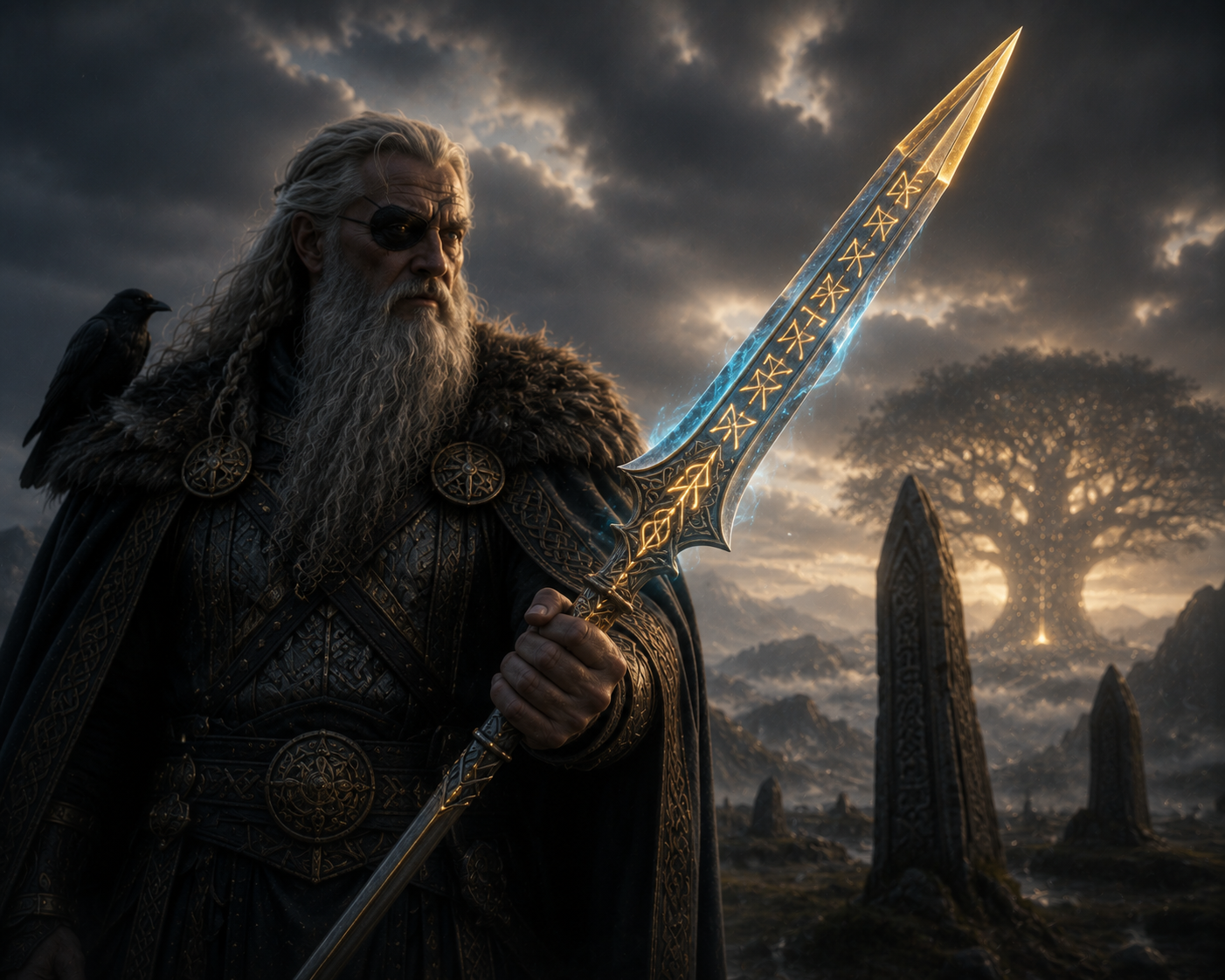
Above all...it will be a matter of fate.
Follow the Footprints
Visit It Today...
The famous Hjortspring Boat and much of the recovered weaponry are preserved at the National Museum of Denmark (Nationalmuseet) in Copenhagen.
Its collections include:
- the reconstructed boat;
- spears
- shields
- other votive offerings.
The archaeological site where these objects were discovered can still be visited, although the original artifacts were transferred to the museum for preservation.
The discoveries from Boeslunde are now distributed among several Danish museums, with many of the most significant finds housed at the National Museum. Excavations at Boeslunde have continued for many years, with new artifacts regularly being uncovered and added to museum collections.
In the Moesgaard Museum, near Aarhus, Denmark, thousands of weapons recovered from Illerup Ådal, are preserved and displayed, including:
- spears
- swords;
- shields
- arrowheads;
- military equipment.
This collection represents one of the best-preserved assemblages of Germanic weaponry in Europe and offers an exceptional insight into the religious rituals practiced by the ancient Scandinavian peoples.