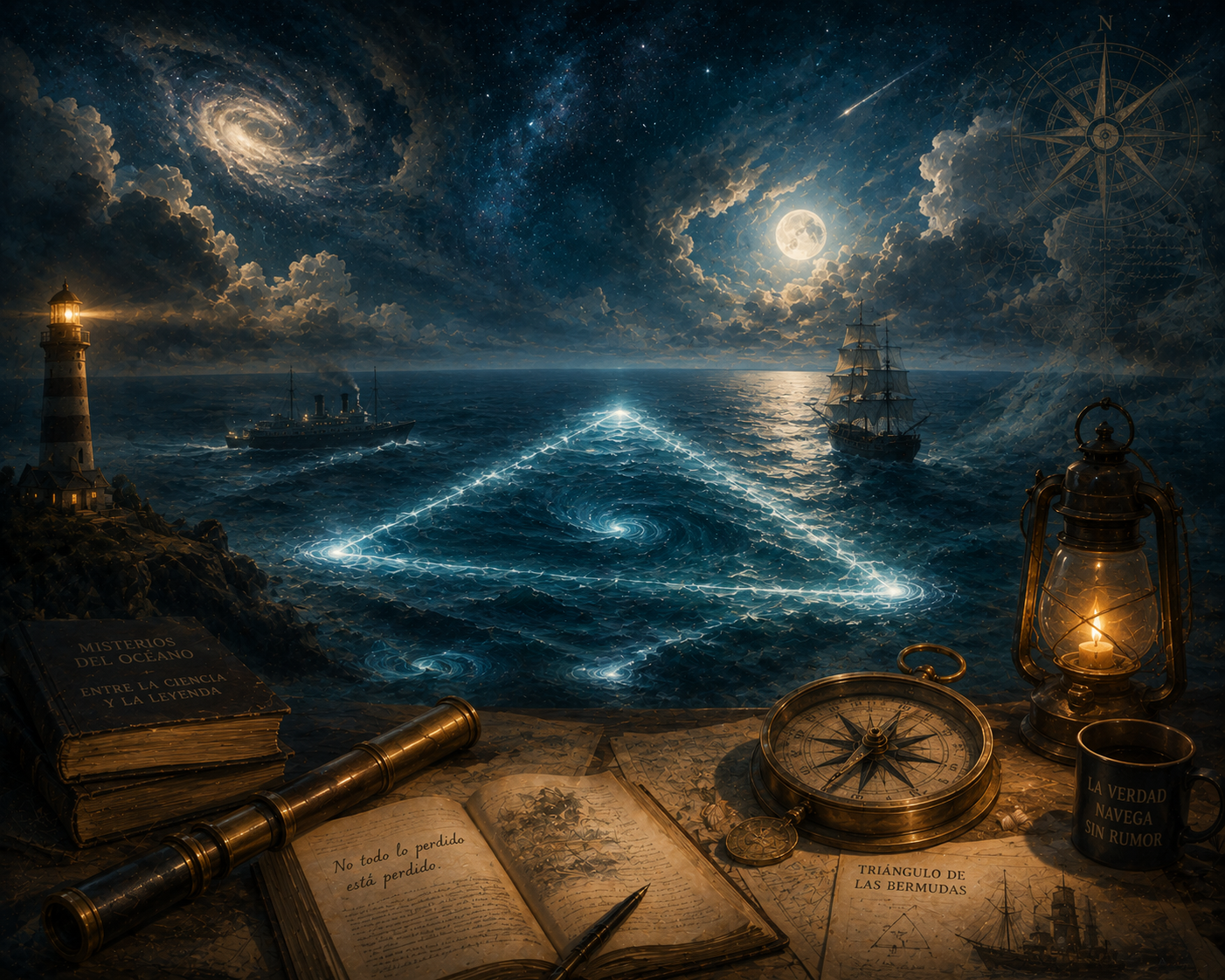
There was a time when the Bermuda Triangle did not exist. There were missing ships, lost aircraft, and unanswered questions... but the myth itself had not yet been born.
Before becoming one of the greatest popular mysteries of the twentieth century, the Bermuda Triangle did not even have a name. Its legend was built gradually until a group of journalists and writers gave shape to what would become one of the world's most famous modern myths. Although the name is now known worldwide, for much of history there was no region officially regarded as mysterious.
Perhaps the most remarkable thing about the Bermuda Triangle is that, for centuries, it simply did not exist.
"U.S. Navy, Air Force and Coast Guard investigators have admitted they are baffled. The few clues we have only add to the mystery."
Vincent Gaddis,
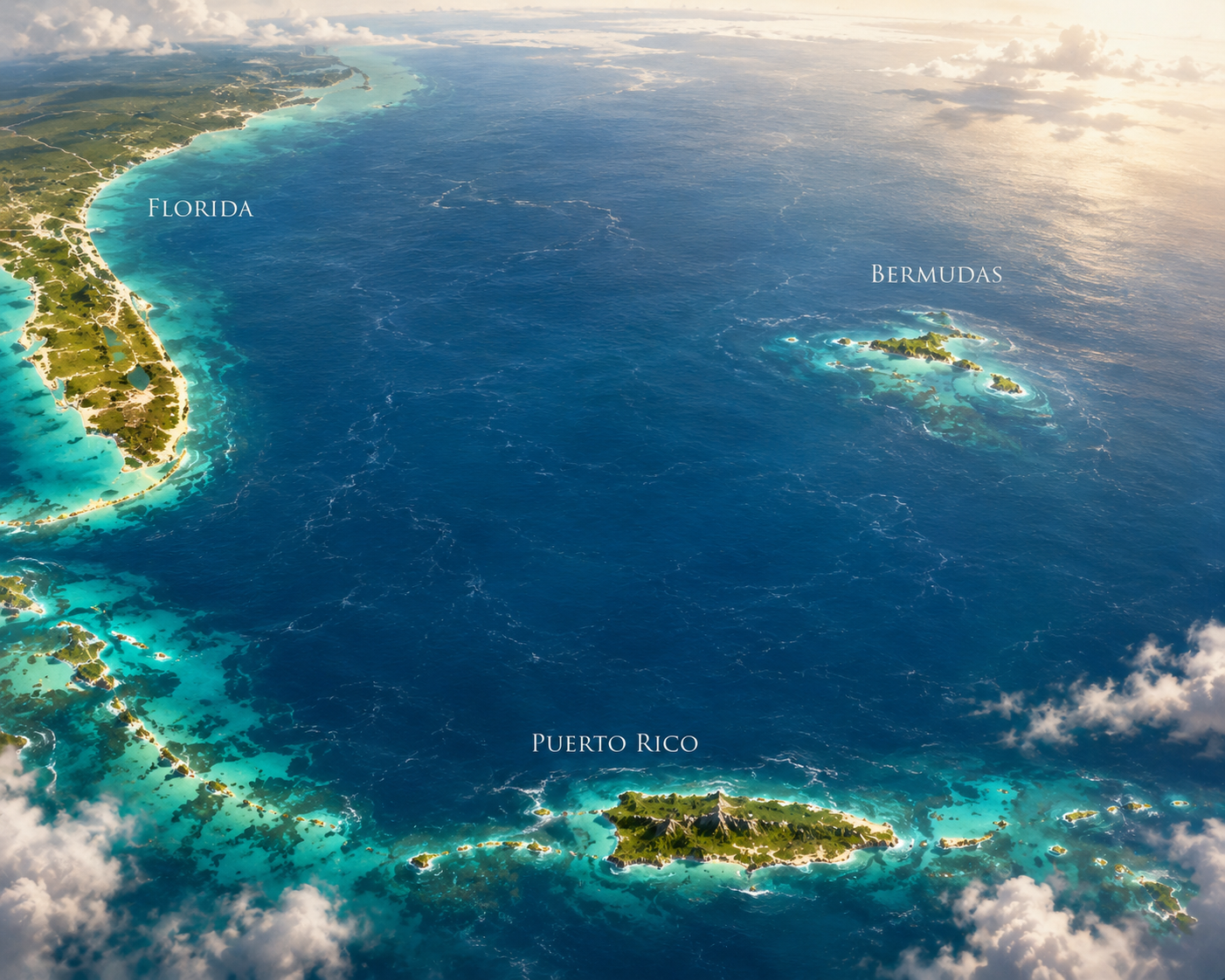
The Location of the Bermuda Triangle
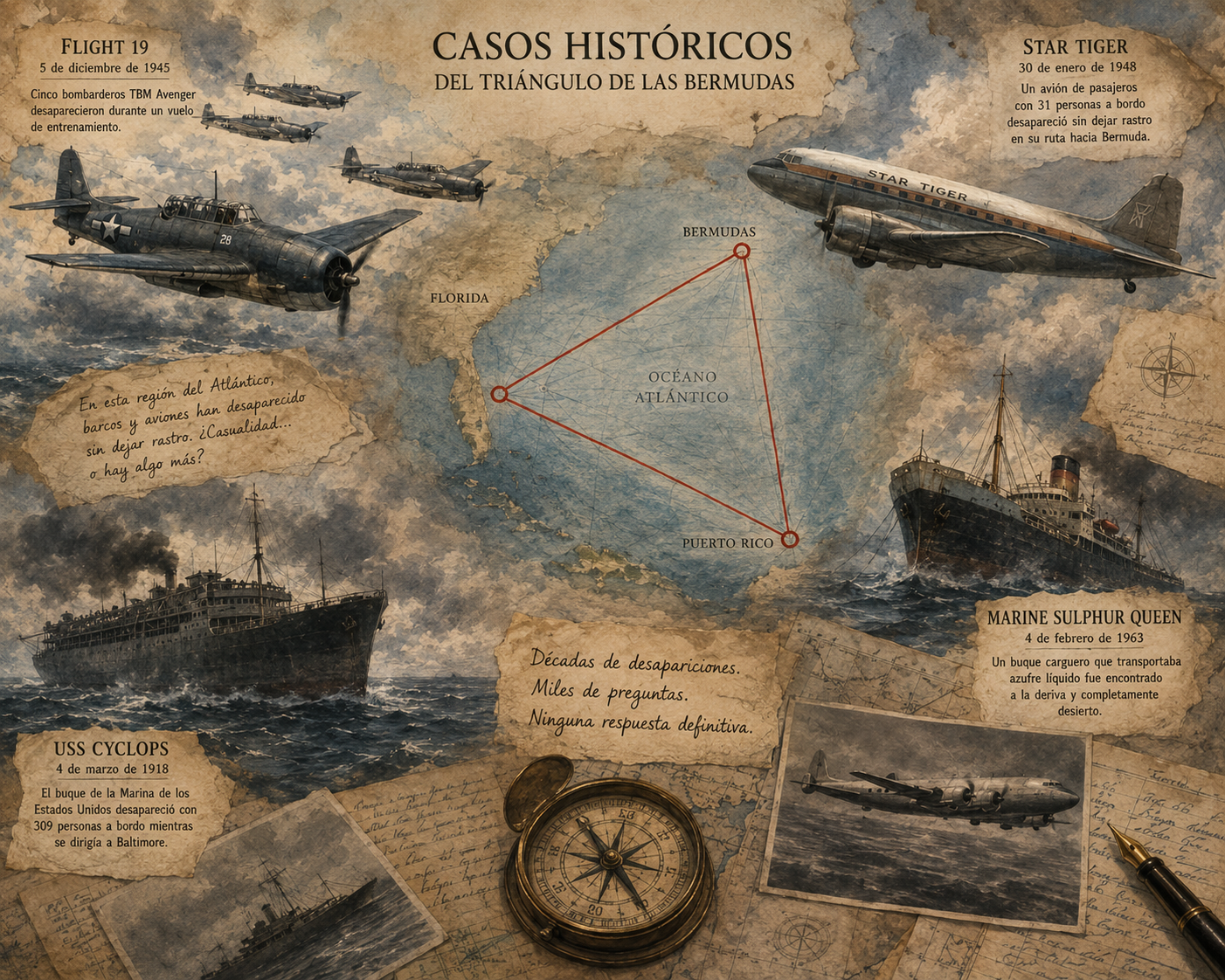
Traditionally, the Bermuda Triangle is located between three points in the western Atlantic:
- Miami (Florida)
- Bermuda
- San Juan (Puerto Rico)
However, there is no official boundary or internationally recognized geographical definition. Even its limits vary depending on the author or the map consulted.
Neither the International Hydrographic Organization nor the United States Board on Geographic Names officially recognizes the Bermuda Triangle as a geographical region.
"During the past two decades alone, this sea mystery at our back door has claimed almost 1,000 lives. But even this is only an inference. In this series of disasters, not one body has ever been recovered."
Vincent Gaddis,, The Deadly Bermuda Triangle
The Birth of a Mystery
Although earlier accounts exist, the worldwide fame of the Bermuda Triangle is relatively recent.
During the mid-twentieth century, articles began appearing about mysterious disappearances in the area. However, it was especially during the 1960s and 1970s that the phenomenon gained enormous popularity thanks to journalists and writers who brought together numerous cases under a single idea: somewhere in the Atlantic existed a place where extraordinary events occurred.
From that moment on, the Bermuda Triangle became part of popular culture and one of the greatest modern mysteries.
Edward Van Winkle Jones: The First Article to Gather Several Disappearances
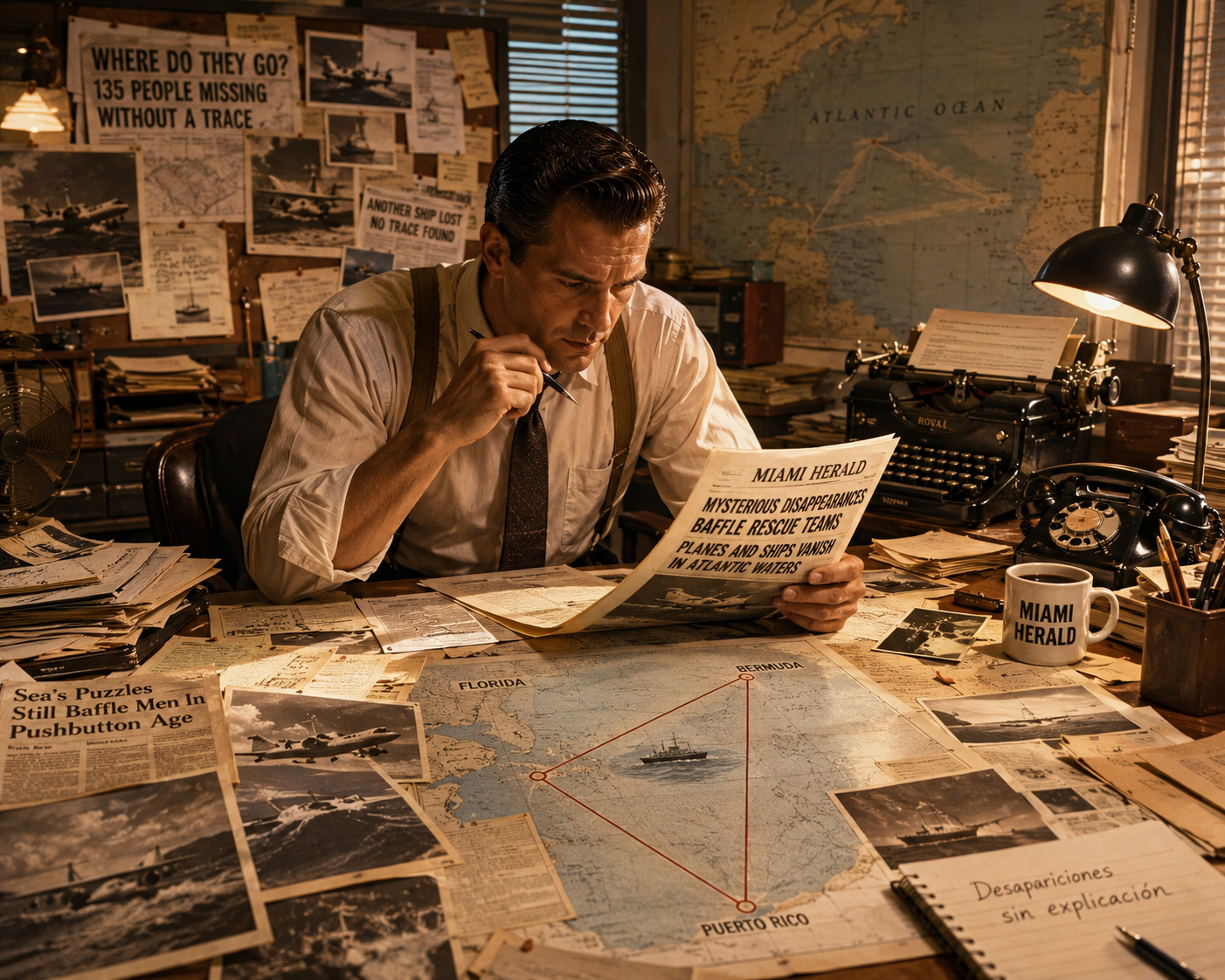
On 17 September 1950, journalist Edward Van Winkle Jones published an article in the Miami Herald entitled Sea’s Puzzles Still Baffle Men in Pushbutton Age, bringing together several disappearances that had occurred within the same region of the Atlantic.
Besides compiling these incidents, he estimated that approximately 135 people had already disappeared under mysterious circumstances. The article even included a map showing the principal cases.
"But it is the same big world the ancients knew, into which men and their machines and ships can disappear without a trace."
Edward Van Winkle Jones, Sea’s Puzzles Still Baffle Men in Pushbutton Age
George X. Sands: Beginning to Define the Area
In October 1952, George X. Sands published in Fate magazine Sea Mystery at Our Back Door, where he gathered some of the best-known cases up to that time.
He collected several well-known disappearances and was the first to present a roughly triangular region bounded by Florida, Bermuda, and Puerto Rico, giving the disappearances a common geographical framework.
"The area involved, a watery triangle bounded roughly by Florida, Bermuda and Puerto Rico... is less than a thousand miles on each side."
George X. Sands, Sea Mystery at Our Back Door
Vincent Gaddis: The Man Who Gave the Triangle Its Name
In February 1964, Vincent Gaddis, published in Argosy magazine The Deadly Bermuda TriangleHe was the first to use and popularize the expression “Bermuda Triangle”," which is why many researchers consider this article to mark the true birth of the modern myth.
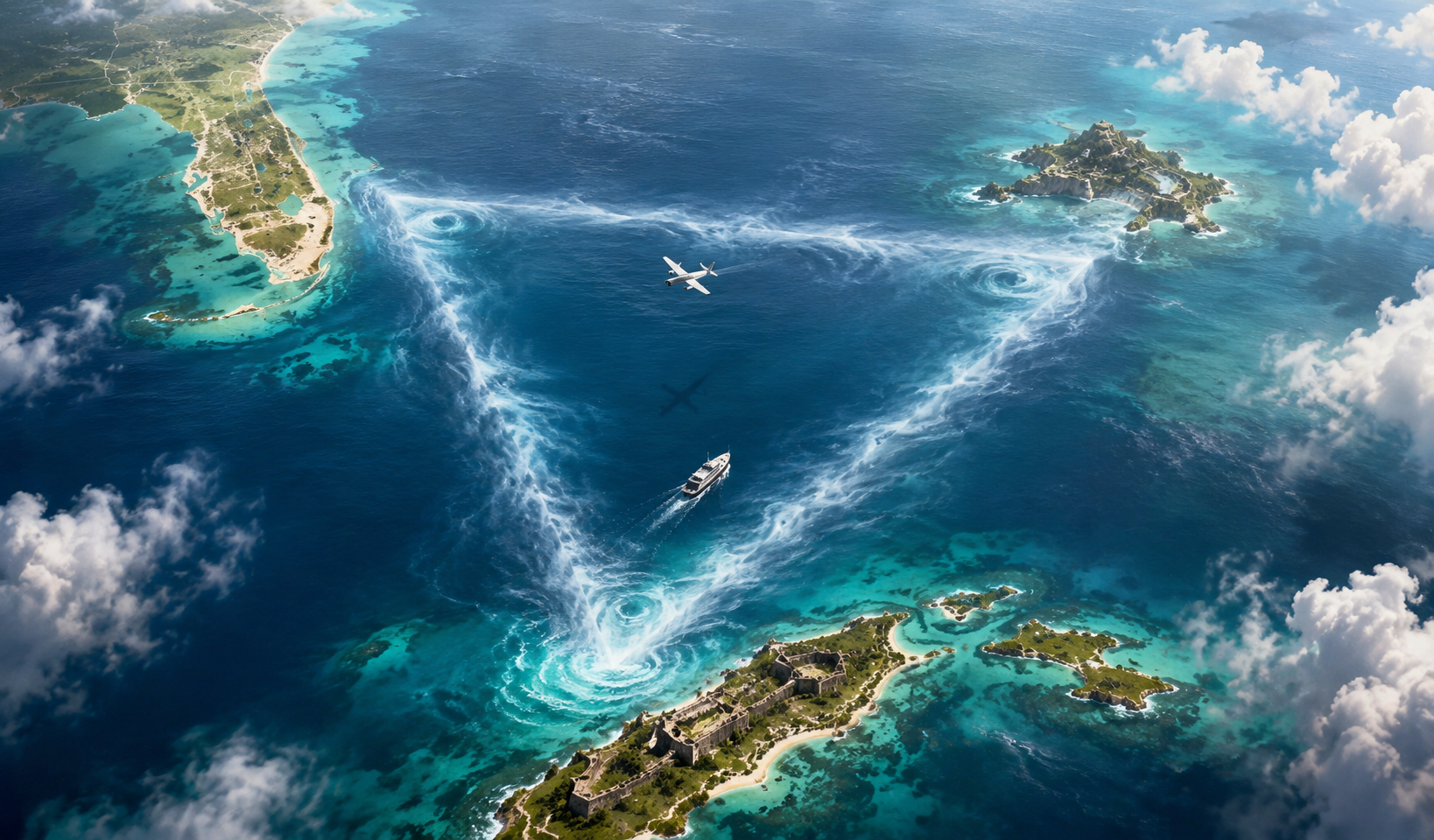
"Draw a line from Florida to Bermuda, another from Bermuda to Puerto Rico, and a third line back to Florida through the Bahamas. Within this area, known as the 'Bermuda Triangle,' most of the total vanishings have occurred."
Vincent Gaddis, The Deadly Bermuda Triangle
Charles Berlitz: The Man Who Turned the Mystery into a Worldwide Phenomenon
In 1974, Charles Berlitz published The Bermuda Triangle, a book that became an international bestseller. Millions of copies were sold, and it was translated into numerous languages.
However, it also received considerable criticism. Later researchers pointed out that the book contained:
- exaggerations;
- omissions;
- incomplete information;
- altered cases;
- partial reconstructions of certain accidents;
- and several factual errors.
The List That Shaped the Myth
"My own incomplete records go back to 1840."
Vincent Gaddis, The Deadly Bermuda Triangle
In his 1950 article, Edward Van Winkle Jones gathered several cases that would later help build the Bermuda Triangle legend:
- 1945 – Flight 19
- 1945 – PBM Mariner
- 1948 — Douglas DC-4
- 1948 – Star Tiger
- 1949 – Star Ariel
- 1950 – Sandra
George X. Sands expanded this list by adding:
- 1948 – Al Snyder
- 1948 – DC-3 NC16002
- 1949 – Atrial
Vincent Gaddis later broadened the collection considerably by including much older incidents—and even some that had little geographical connection to the Bermuda Triangle: Aircraft
- 1947 – Star Dust
- 1954 – Super-Constellation
- 1955 – Connemara IV
- 1956 — U.S. Navy Patrol Bomber
- 1957 – DC-6
- 1962 – KB50
- 1963 – Marine Sulphur Queen
- 1963 – KC-135
- 1963 – Sno’Boy
Abandoned Ships
- 1840 — French ship bound for Havana
- 1881 – Ellen Austin
- 1921 – Carol A. Deering
- 1921 – Rubicon
- 1932 – John and Mary
- 1940 – Gloria Colite
Ships That Disappeared
- 1854 – Bella
- 1880 – HMS Atalanta
- 1918 – USS Cyclops
- 1925 – SS Cotopaxi
- 1926 – Suduffco
The Most Famous Documented Cases
Over the years, numerous ships and aircraft have been associated with the Bermuda Triangle. However, several cases have become particularly representative of the mystery:
- 1918 – USS Cyclops
- 1945 – Flight 19
- 1945 – PBM Mariner
- 1948 – Star Tiger
- 1948 – DC-3 NC16002
- 1949 – Star Ariel
- 1963 – Marine Sulphur Queen
Each case has its own particular circumstances, and in many instances the available documentation remains limited or incomplete. Over time, popular accounts added details that are not always present in the original sources.
The Theories
The lack of a definitive explanation encouraged numerous attempts to explain the disappearances.
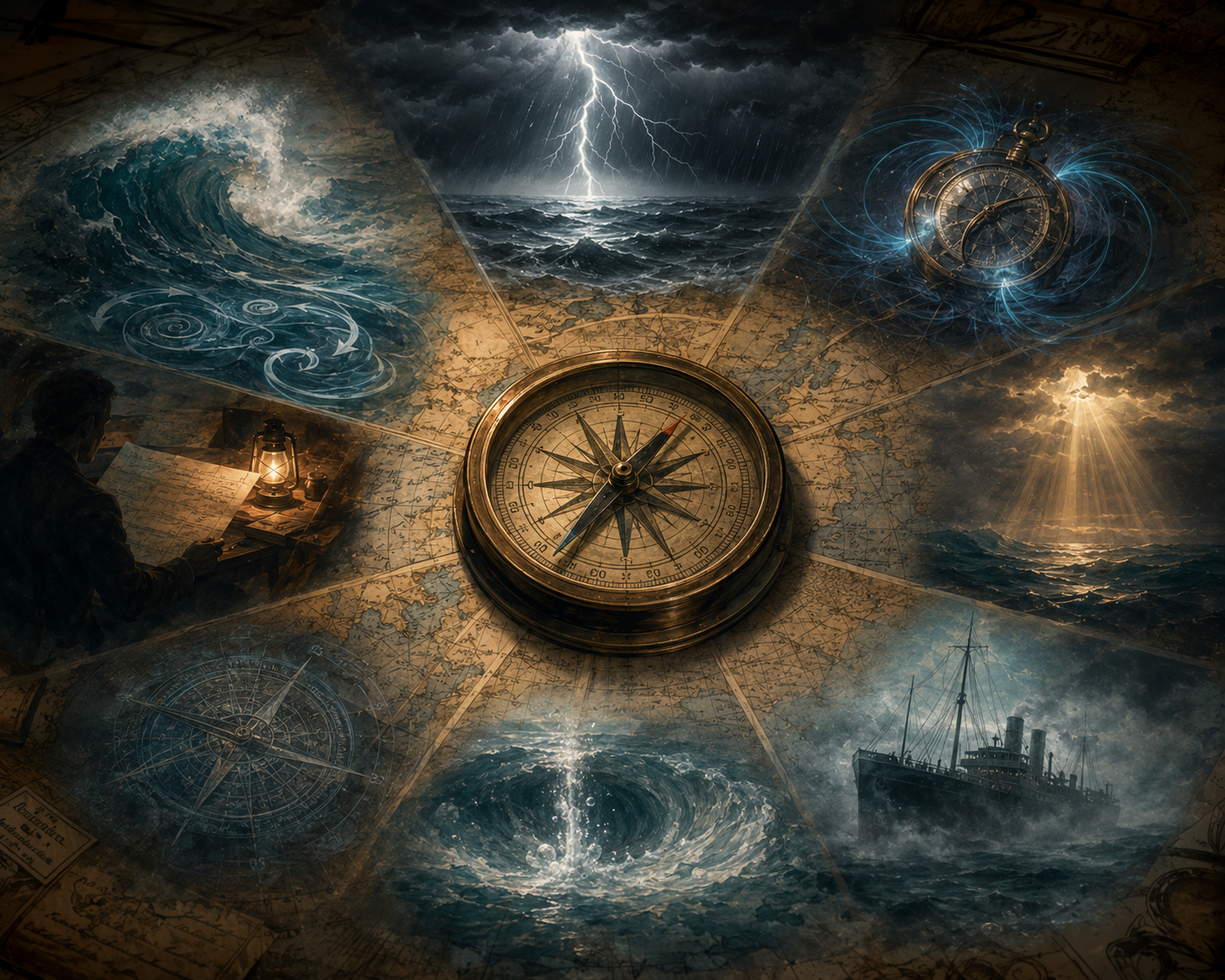
Among the most commonly cited conventional explanations are:
- sudden storms;
- powerful ocean currents;
- hurricanes;
- human error;
- navigational mistakes;
- mechanical failures;
- local variations in Earth's magnetic field;
- extreme weather conditions.
Alongside these appeared much more speculative ideas, including extraordinary magnetic anomalies, unknown electromagnetic fields, and methane gas eruptions from the ocean floor. To date, however, none of these hypotheses has been shown to explain all of the cases associated with the Bermuda Triangle.
Ironically, it is precisely this lack of definitive answers that has kept the mystery alive.
"The Legend of the Bermuda Triangle is a manufactured mystery... It was repeated so many times that it began to take on the aura of truth."
Lawrence David Kusche, The Bermuda Triangle Mystery-Solved
The Most Extraordinary Theories
The fame of the Bermuda Triangle also inspired increasingly imaginative explanations.
Over the years, people have proposed:
- Atlantis;
- extraterrestrial visitors;
- dimensional portals;
- unknown magnetic anomalies;
- time travel;
- lost civilizations.
None of these theories has scientific support. Nevertheless, they have all helped establish the Bermuda Triangle as one of the great modern myths.
Lawrence David Kusche: The Man Who Challenged the Myth
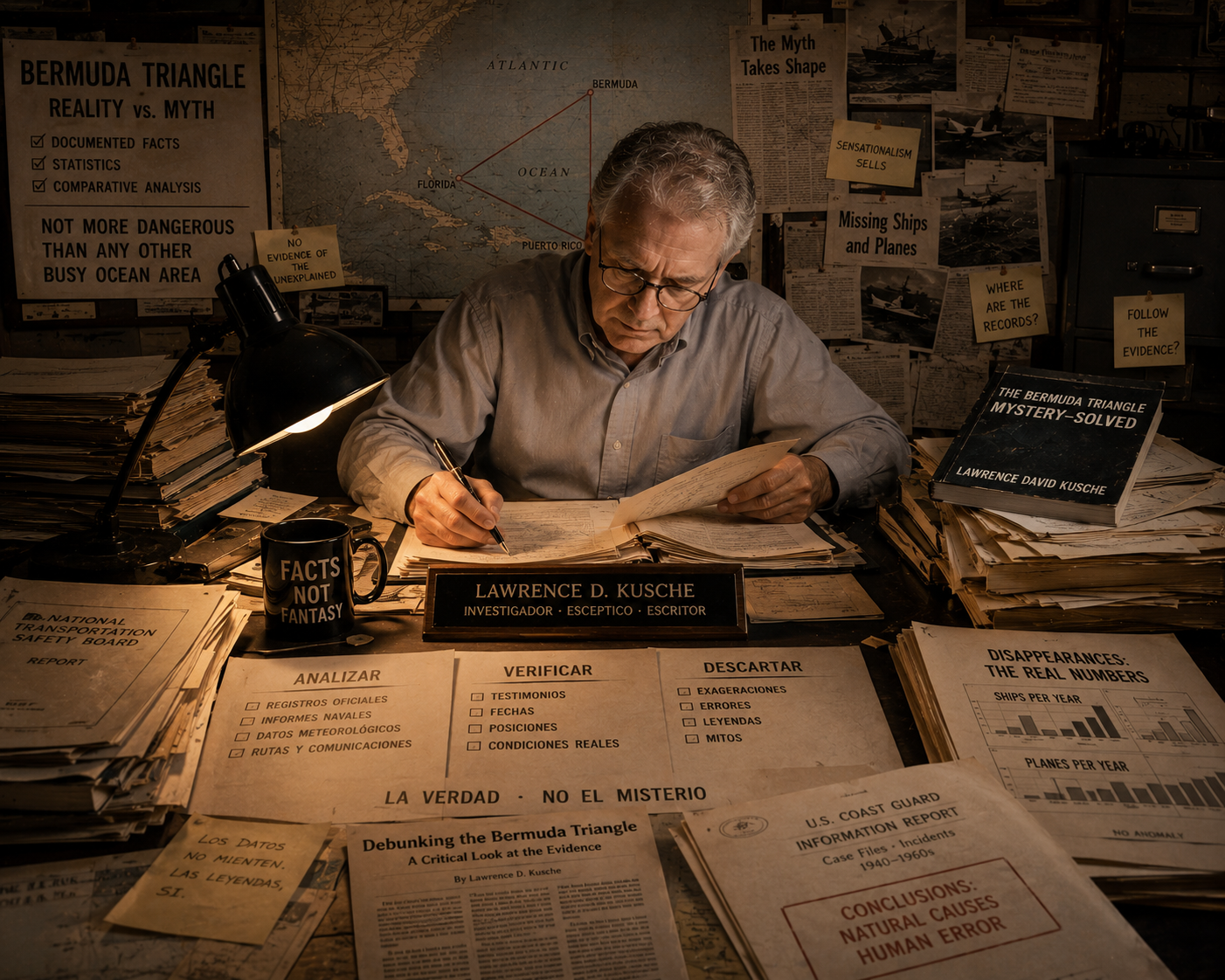
In 1975, pilot and research librarian Lawrence David Kusche published The Bermuda Triangle Mystery-Solved.
Unlike earlier authors, Kusche carefully examined official reports, weather records, naval files, and contemporary documentation relating to many of the alleged Triangle cases.
His investigation concluded that many disappearances had been exaggerated, incompletely reported, or altered over time. He also demonstrated that several accidents occurred outside the Triangle or had far more conventional explanations than popular accounts suggested.
Although his work did not erase the myth from popular imagination, it marked a turning point in the historical study of the phenomenon and remains one of the most rigorous investigations ever published on the Bermuda Triangle.
"After reading all the chapters and articles I realized that the Bermuda Triangle mystery was much more than just an account of the strange disappearance of a large number of vessels."
Lawrence David Kusche, The Bermuda Triangle Mystery-Solved
Beyond the Legend
Perhaps the Bermuda Triangle is not simply a story about missing ships and vanished aircraft.
Perhaps it is, above all, a story about how legends are born.
The journalists and writers who popularized the phenomenon did not invent the disappearances. What they did was gather them together, connect them, and build a narrative that eventually became one of the world's best-known modern myths.
The most surprising thing about the Bermuda Triangle is not that ships and aircraft disappeared. It is that the Triangle itself was created decades after many of those events had already occurred.
Perhaps the greatest mystery is not in the ocean.
Perhaps it lies within our own fascination with the unknown.
For ever since humanity first ventured onto the sea, the ocean has been much more than water.
It has been the place where maps end... and stories begin.
Follow the Footprints
Visit It Today...
The Bermuda Underwater Exploration Institute (BUEI)offers exhibitions and interactive experiences dedicated to the maritime history of Bermuda and the mysteries surrounding the Bermuda Triangle.
Among its main attractions are:
- ship-sinking simulators;
- an interactive 3D hurricane hologram;
- educational games and activities;
- exhibitions devoted to shipwrecks and the history of the Bermuda Triangle.
"My research, which began as an attempt to gather as much information as possible about the Bermuda Triangle, led to an unexpected conclusion. After examining all the evidence, I arrived at this conclusion: there is no single theory that solves the mystery."
Lawrence David Kusche, The Bermuda Triangle Mystery-Solved