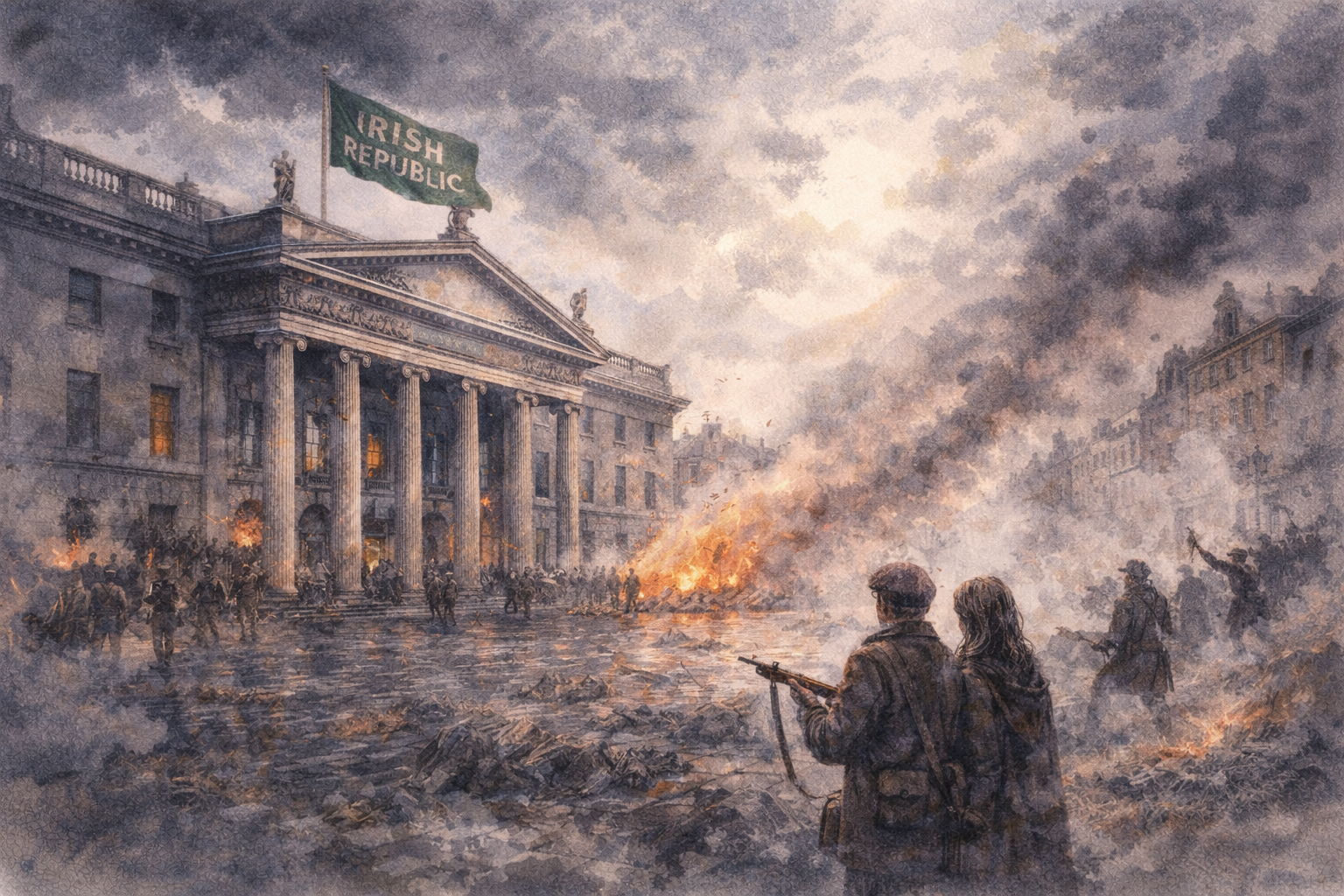
On April 24, 1916, Easter Monday, a small group of Irish revolutionaries launched an insurrection in the center of Dublin against British rule.
The uprising, known as the Easter Rising, lasted only six days and ended with the defeat of the insurgents.
However, its historical impact was enormous. What began as a rebellion apparently doomed to fail would ultimately become one of the most important events on Ireland’s path to independence.
“Ireland, while she remains unfree, shall never be at peace.”
Patrick Pearse
Ireland under British Rule
For centuries, Ireland had been under the political control of England and later the United Kingdom.
Tensions between the two territories intensified particularly during the 19th century, in a context marked by:
- political inequality
- religious conflicts
- economic crises
- the traumatic memory of the Great Irish Famine (1845–1849)
By the late 19th and early 20th centuries, Irish nationalism began to organize more strongly, advocating different paths toward autonomy or independence.
Some movements sought political reforms within the British system. Others believed that only an armed insurrection could change Ireland’s destiny.
The Opportunity: World War I
When the First World War broke out in 1914, the United Kingdom mobilized a large part of its military resources.
For some Irish nationalist groups, this represented an opportunity. They believed that with Britain focused on the European war, a rebellion in Ireland might have a greater chance of success. Several nationalist organizations began preparing an armed uprising.
Among the most important were:
- the Irish Volunteers
- the Irish Citizen Army
Paradoxically, while the rebellion was being planned, tens of thousands of Irish soldiers were fighting in the British Army on the Western Front during World War I, especially in France and Belgium.
Preparations for the Rising
Germany, which was at war with the United Kingdom, attempted to support the Irish uprising.
A ship called SS Libau, disguised as a Norwegian merchant vessel, carried weapons intended for the Irish rebels..
However, the ship was intercepted by the British navy before it could deliver the arms
The Rising Almost Canceled the Day Before
The uprising nearly did not happen.
One of the leaders of the movement, Eoin MacNeill, commander of the Irish Volunteers, discovered shortly before the planned start that the original plan lacked sufficient military support.
Fearing disaster, he published a countermand in the newspapers on Sunday, April 23, 1916, ordering the volunteers not to participate in any military action.
This decision caused enormous confusion among the insurgents and drastically reduced the number of fighters who ultimately took part.
Many historians believe this was one of the factors that prevented the uprising from spreading across the entire country.
The Beginning of the Rising
The rebellion had originally been planned for all of Ireland. However, due to communication problems and MacNeill’s countermand, the insurrection was largely confined to Dublin.
The main headquarters became the General Post Office (GPO) in Dublin.
Today, this building remains one of the most important historical symbols of Ireland.
The Proclamation of the Irish Republic
The uprising began on Monday, April 24, 1916.
The insurgents seized several strategic buildings in central Dublin. The most important was the General Post Office (GPO)on O’Connell Street. From there, Patrick Pearse, proclaimed the creation of an independent Irish Republicby publicly reading a historic document: the Proclamation of the Irish Republic.
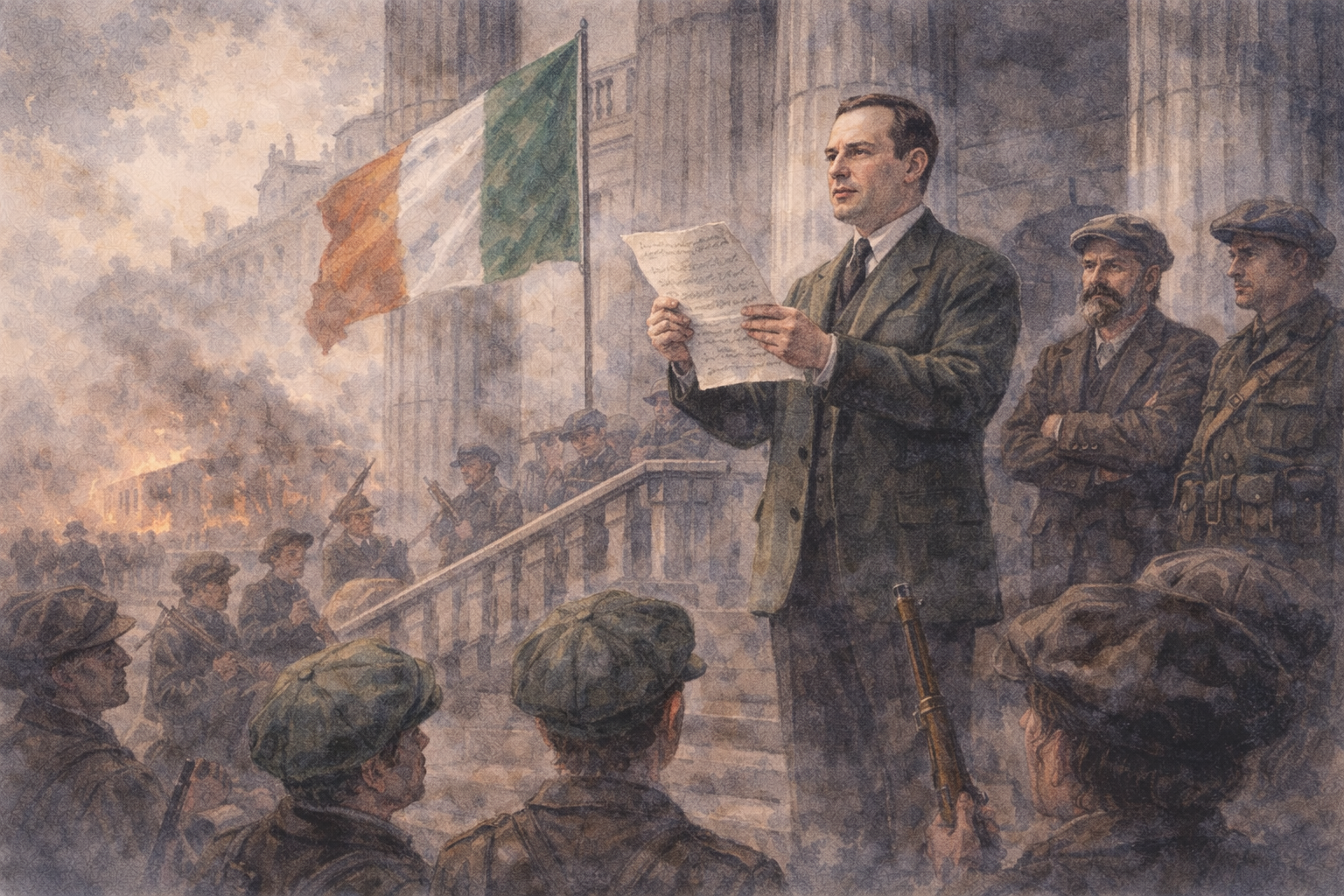
The text began with words that would become famous:
“Irishmen and Irishwomen: In the name of God and of the dead generations…”
At that moment, many residents of the city did not even know that a rebellion had begun.
The document declared the establishment of an independent Irish Republic and affirmed the right of the Irish people to govern themselves.
The proclamation was signed by seven leaders, known today as the seven signatories of 1916..
The Leaders of the Insurrection
Many of the leaders of the Easter Rising were not professional soldiers. They were poets, teachers, journalists, or political activistsconnected to the Irish cultural revival.
Among them were:
- Patrick Pearse, teacher, poet, and revolutionary leader
- James Connolly, trade unionist and leader of the Irish Citizen Army
- Thomas Clarke, shopkeeper and veteran revolutionary
- Joseph Plunkett, journalist and poet
- Seán MacDiarmada, political organizer
- Éamonn Ceannt, public servant
- Thomas MacDonagh, professor at University College Dublin
One of their best-known lines captured the spirit of the uprising:
“Ireland, through us, summons her children to her flag and strikes for her freedom.”
The Flag that Proclaimed the Irish Republic
When the insurgents seized the General Post Office, they raised two flags.
One was the now-famous Irish tricolour.
The other was a green flag bearing a golden inscription: “Irish Republic”
This flag symbolized the proclamation of a new independent state.
During the fighting, the GPO building was severely damaged by British artillery.
Despite the fires and destruction, the flag of the Republic remained flying for much of the uprising.
Six Days of Fighting in Dublin
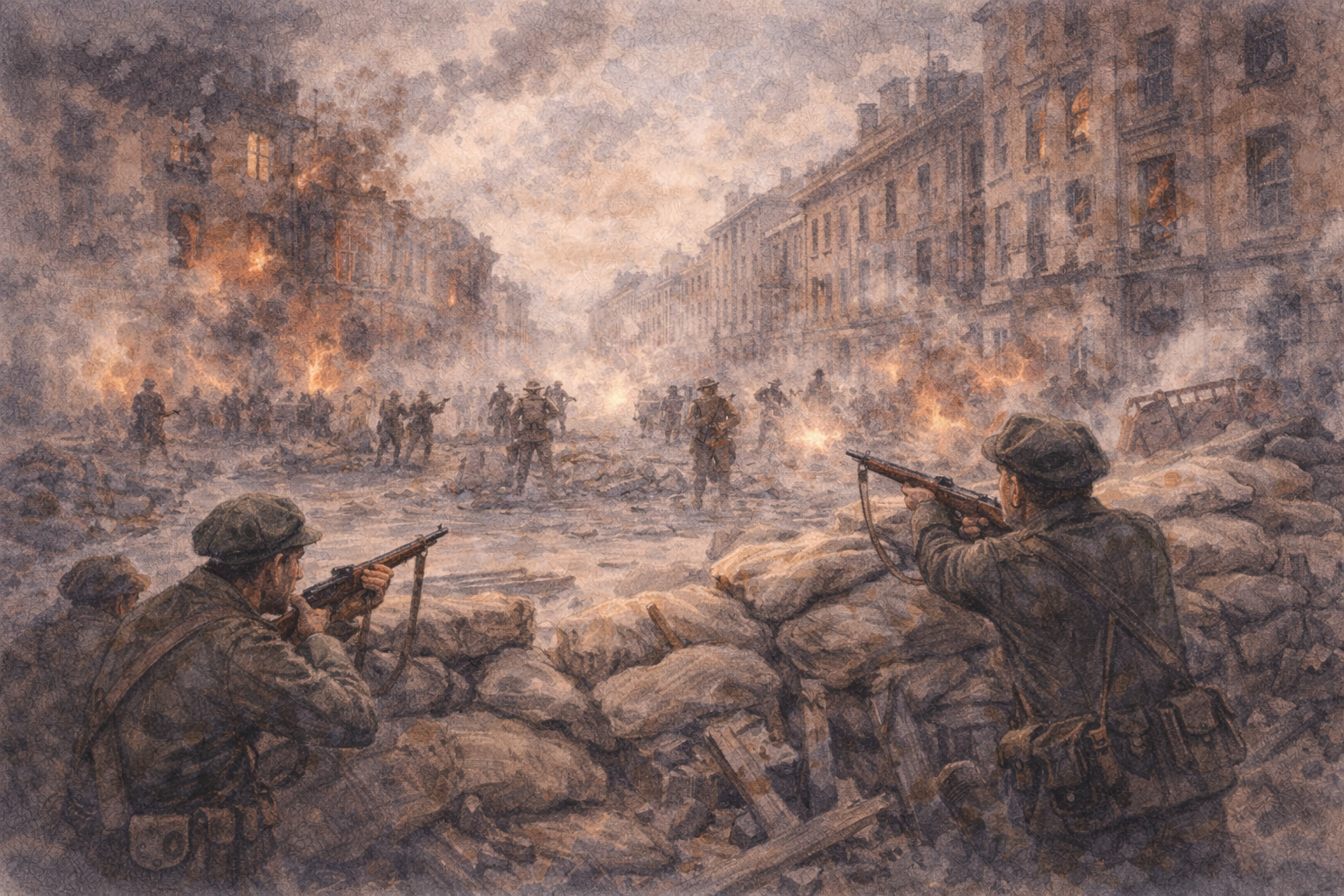
The rebellion was concentrated mainly in Dublin.
The insurgents occupied several strategic buildings, including:
- the General Post Office
- the Four Courts
- the St Stephen’s Green Park
- the Jacob’s Biscuit Factory
The British army responded quickly, sending troops and artillery. Large fires and destruction spread through the city center.
After six days of fighting, the leaders of the uprising decided to surrender on April 29, 1916 , to avoid further civilian casualties.
The Leaders Were Executed
After the surrender, hundreds of insurgents were arrested.
Between May and June 1916, fifteen leaders were executed by firing squad in Kilmainham Gaol prison..
One of the most striking cases was James Connolly.
He had been severely wounded and could not stand. He was therefore tied to a chair before being executed on May 12, 1916.
This event caused widespread outrage in Ireland.
A Wedding Before the Execution
One of the most famous episodes involved Joseph Plunkett.
The night before his execution, on May 3, 1916, he was allowed to marry his fiancée Grace Gifford in the prison chapel. The ceremony lasted only a few minutes.
The following morning, Joseph was executed.
This story later inspired the famous Irish song by Frank and Sean O’Meara. , “Grace” .
From Military Defeat to National Myth
At first, many citizens criticized the rebellion.
The destruction of the city had been enormous. However, the executions radically changed public opinion.
What had been a defeated uprising began to be seen as a heroic sacrifice for Irish freedom.
The Road to Independence
The 1916 Rising strengthened the Irish independence movement.
In the years that followed, several decisive events occurred:
- the rise of the nationalist party Sinn Féin
- the Irish War of Independence (1919–1921)
- the signing of the Anglo-Irish Treaty
This process culminated in the creation of the Irish Free State in 1922.
“I thank God I have lived to see this day.”
James Connolly – May 12, 1916
The Countess Who Fought the British Empire
One of the most remarkable figures was Constance Markievicz. She actively participated in the fighting alongside the Irish Citizen Army.
After the rebellion she was sentenced to death, but her sentence was commuted.
The official document stated:
“Sentenced to death… commuted to penal servitude for life on account of her sex.”
She replied with irony:
“I wish your lot had the decency to shoot me.”
In 1918, she became the first woman elected to the British Parliament,although she never took her seat.
Later she served as Minister for Labour of the Irish Republic, becoming one of the first female ministers in Europe.
The Statue of Cú Chulainn in the GPO
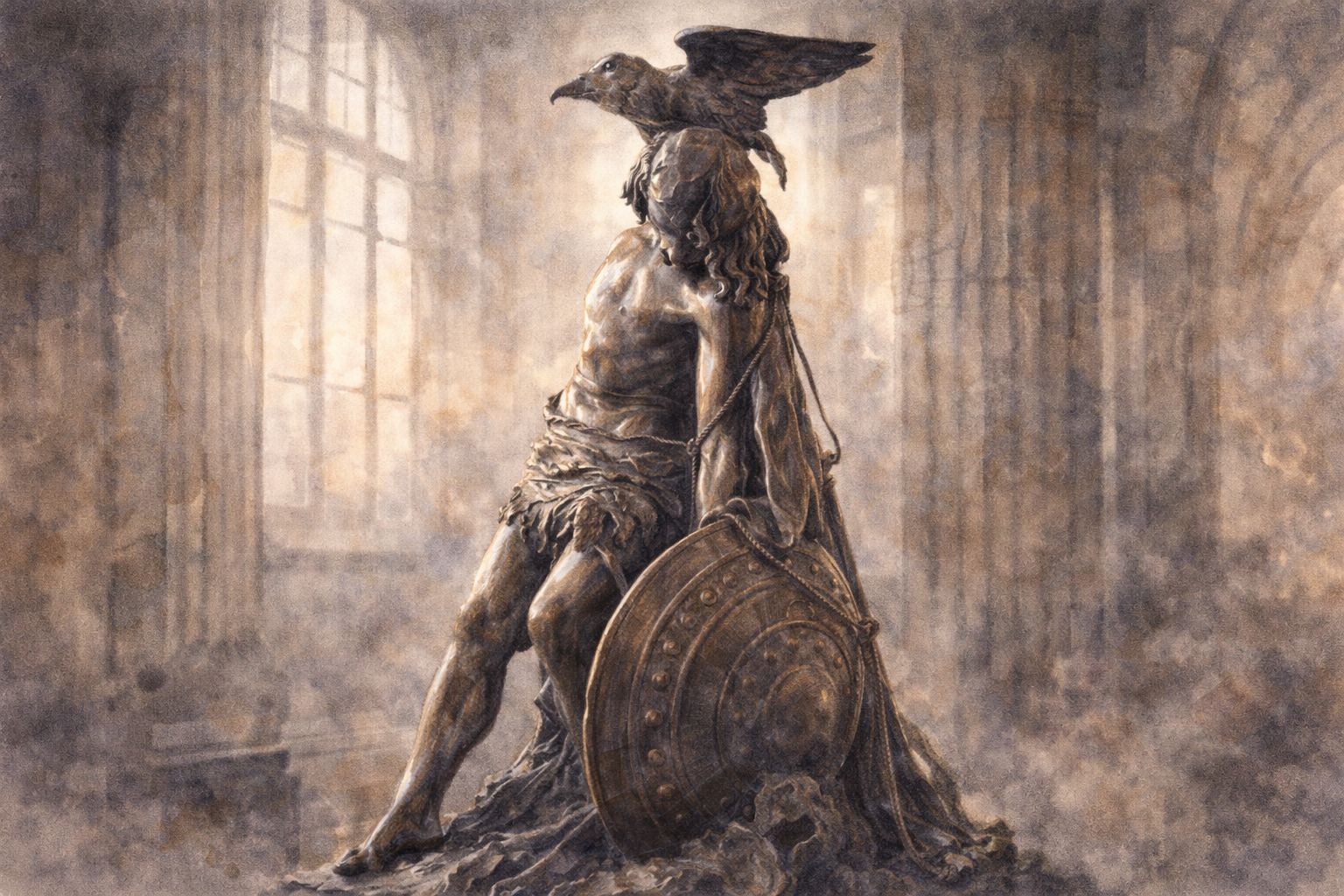
Inside the General Post Office stands a famous sculpture of the Celtic mythology, Cú Chulainn.
It was created by Irish sculptor Oliver Sheppard and installed there in 1935.
The sculpture depicts Cú Chulainn mortally wounded, tied to a stone while still fighting.
It became a powerful symbol of the sacrifice of the rebels of 1916.
Curiosities
The Proclamation Was Printed with Different Letter Sizes
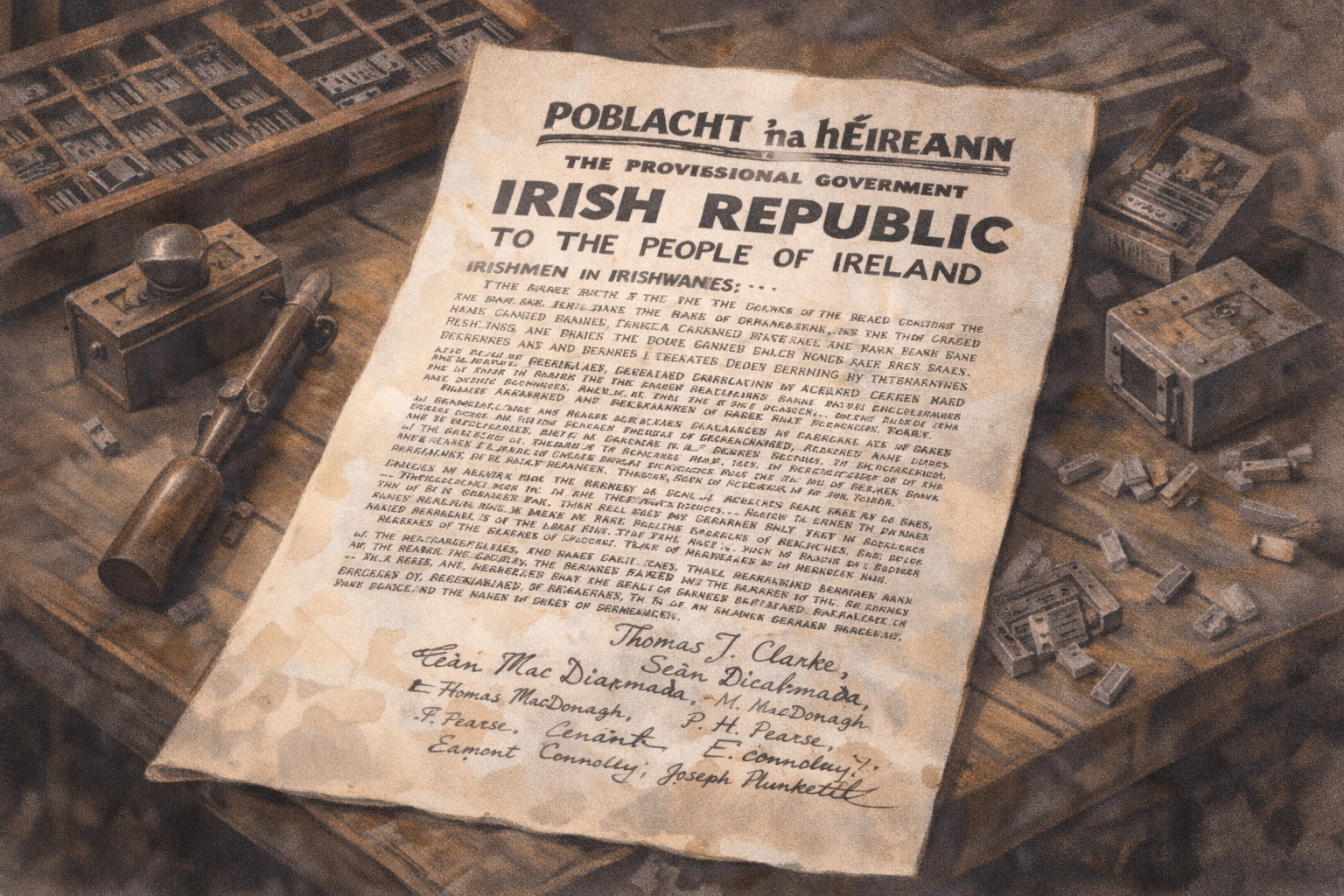
The Proclamation of the Irish Republic was printed secretly the night before the uprising at Liberty Hall.
The printers discovered that they did not have enough typefaces of the same size. As a result, they had to mix different font sizes.
Today this typographical detail has become one of the most recognizable features of the document.
Around 1,000 copieswere printed, and fewer than 50 original copies survive today..
Some are preserved in Irish museums, while others have been sold at auctions for millions of euros due to their historical value.
A Television Centennial
In 2016, marking the centenary of the uprising, the television series RebellionRebellion was released, produced by the Irish public broadcaster RTÉ.
The series tells the story of the uprising from different perspectives.
“I am satisfied that we have saved Ireland’s honour.”
A phrase attributed to Patrick Pearse before his execution on May 3, 1916.
The Easter Rebellion of 1916 was, on the face of it, an uprising doomed to failure. However, the sacrifice of those men and women transformed the history of Ireland and paved the way to independence that would come a few years later.