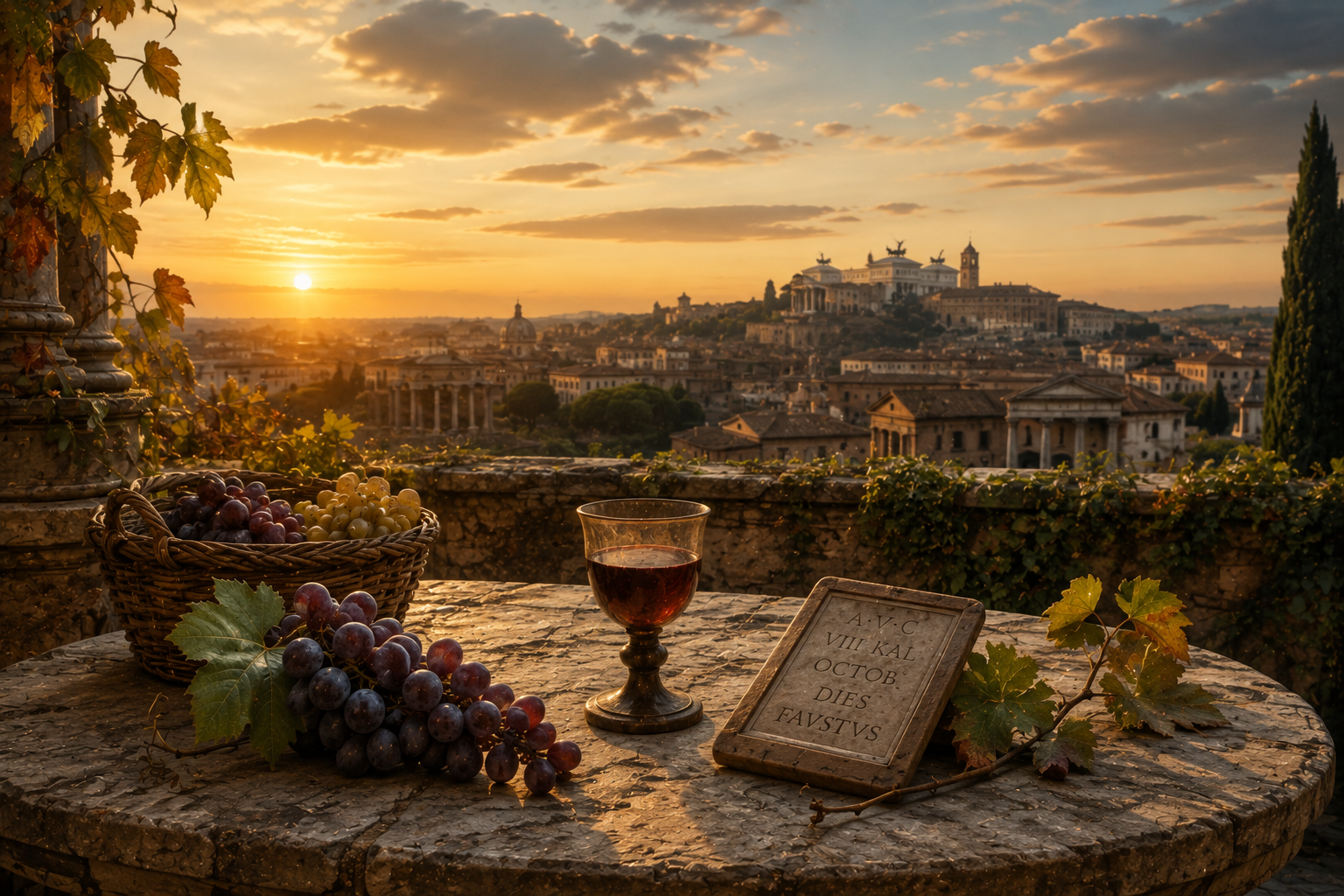
September in Ancient Rome marked the end of summer and the beginning of a new stage of the year.
The fields were still yielding their final fruits, grape harvesting was beginning in many regions, and after the hottest months, public life gradually became active again.
Although today it is the ninth month of the year, its name preserves the memory of a much older calendar.
September was therefore a month of transition: between summer and autumn, between the final agricultural tasks and the return of public activity, and also one of the most important moments in the Roman religious calendar thanks to the Ludi Romani, celebrated in honor of Jupiter.
The Origin of the Name
September derives from septem, meaning “seven.”
In the traditional calendar attributed to Romulus, the year began in March , making September the seventh month. Later, January and February were added to the calendar, shifting September to become the ninth month.
However, its original name survived the successive calendar reforms and has reached the present day almost unchanged.
Gods of September
September was not exclusively associated with or dedicated to a particular deity, as was the case with some other festivals in the Roman calendar. However, one god acquired an extraordinary prominence during this month: Jupiter Optimus Maximus.
. The Ludi Romani, one of Rome's great religious and public festivals, were held in his honor and constituted one of the most important events in the Roman calendar.
Optimus Maximus literally means:
- Optimus = the best.
- Maximus = the greatest.
In other words: “Jupiter, the Best and the Greatest.”
For the Romans, Jupiter was the supreme deity of the state and was closely associated with sovereignty, oaths, treaties, the protection of Rome, and victory. His worship was deeply connected to the political and military life of the Republic.
And September contained one of the great religious moments dedicated to this god.
Temple of Jupiter Optimus Maximus
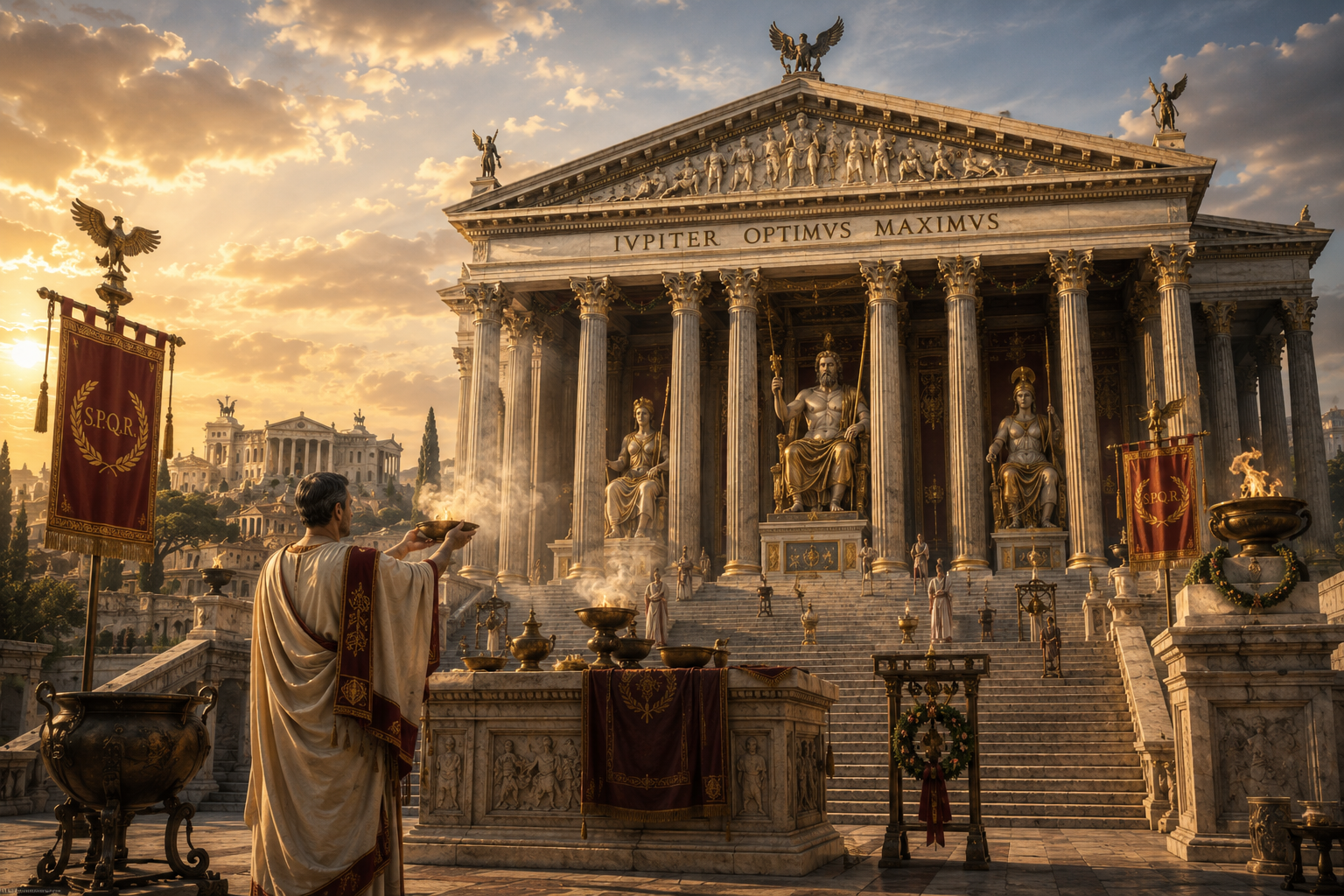
High on the Capitoline Hill stood the Temple of Jupiter Optimus Maximus, also known as Temple of Capitoline Jupiter.
It was Rome's great state temple and was dedicated to the Capitoline Triad: Jupiter, Juno, and Minerva, aunque Júpiter ocupaba la posición principal. El templo estaba estrechamente relacionado con algunos de los acontecimientos más solemnes de la vida romana.
There:
- sacrifices were offered to the gods;
- victorious generals completed their triumphs;
- offerings from military victories were deposited;
- the Sibylline Books, prophetic texts consulted at moments of particular importance to the state, were kept.
The military triumph was especially closely connected with the temple. After processing through the streets of Rome, the victorious general reached the Capitoline Hill to offer sacrifices and part of the spoils to Jupiter.
According to Roman tradition, construction of the temple began during the reign of Lucius Tarquinius Priscus, continued under Servius Tullius , and was completed by Lucius Tarquinius Superbus.
Its traditional dedication date is September 13, 509 BC, a date laden with symbolism because it coincides with the earliest years of the Roman Republic.
The Great Grape Harvest
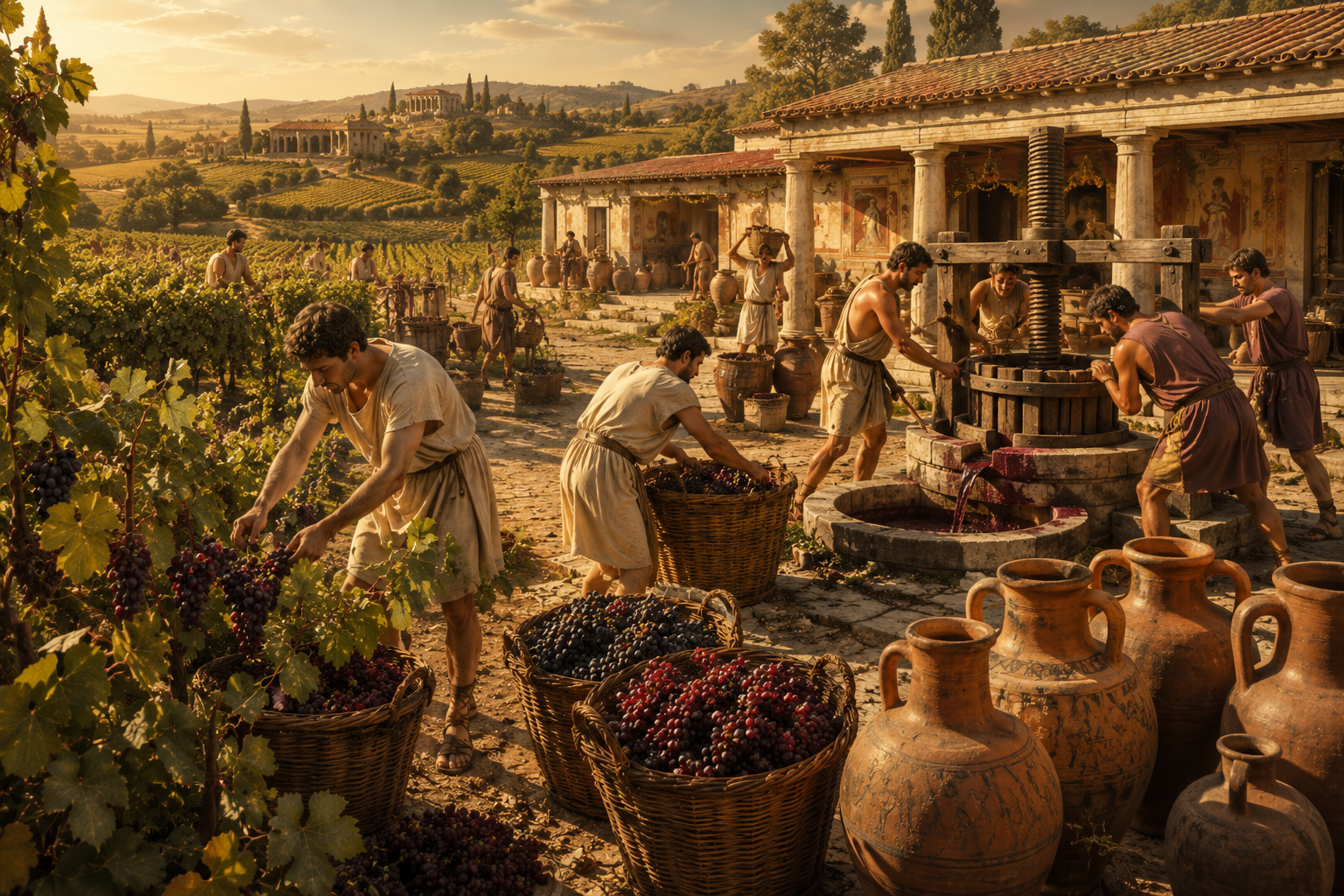
August and September were closely connected with the agricultural cycle.
Rome controlled territories with very different climates, from Hispania and Gaul to Italy, Greece, and North Africa. Consequently, the dates of ripening and harvesting varied according to the region, climate, and type of crop.
In many areas, the end of summer and the beginning of autumn were crucial periods for gathering fruit and, particularly, for the grape harvest. The gathering of grapes marked the beginning of the entire winemaking process: selection, pressing, fermentation, and storage.
Wine was far more than a beverage to the Romans. It was part of their diet, social life, banquets, and, of course, numerous religious rituals.
Thus, September fell at a crucial point in the cycle that transformed grapes into wine.
The City Finds Its Rhythm Again
After the hottest period of the year, Roman public life gradually became active again.
Political, administrative, and judicial activities could intensify once more after the summer, while Rome once again filled with meetings, public affairs, and religious events.
Rome slowly returned to public life after the summer.
September Festivals
The Ludi Romani (September 4–19)
. The Ludi Romani, also known as the Ludis Magni, were one of Rome's oldest and most prestigious public festivals.
They were primarily dedicated to Jupiter Optimus Maximus and, over time, became one of the great religious, political, and social events of the Roman calendar.
The dates changed over the centuries. During the late Republic, they are documented as taking place in September and, later, the festival expanded to cover approximately September 4 to 19.
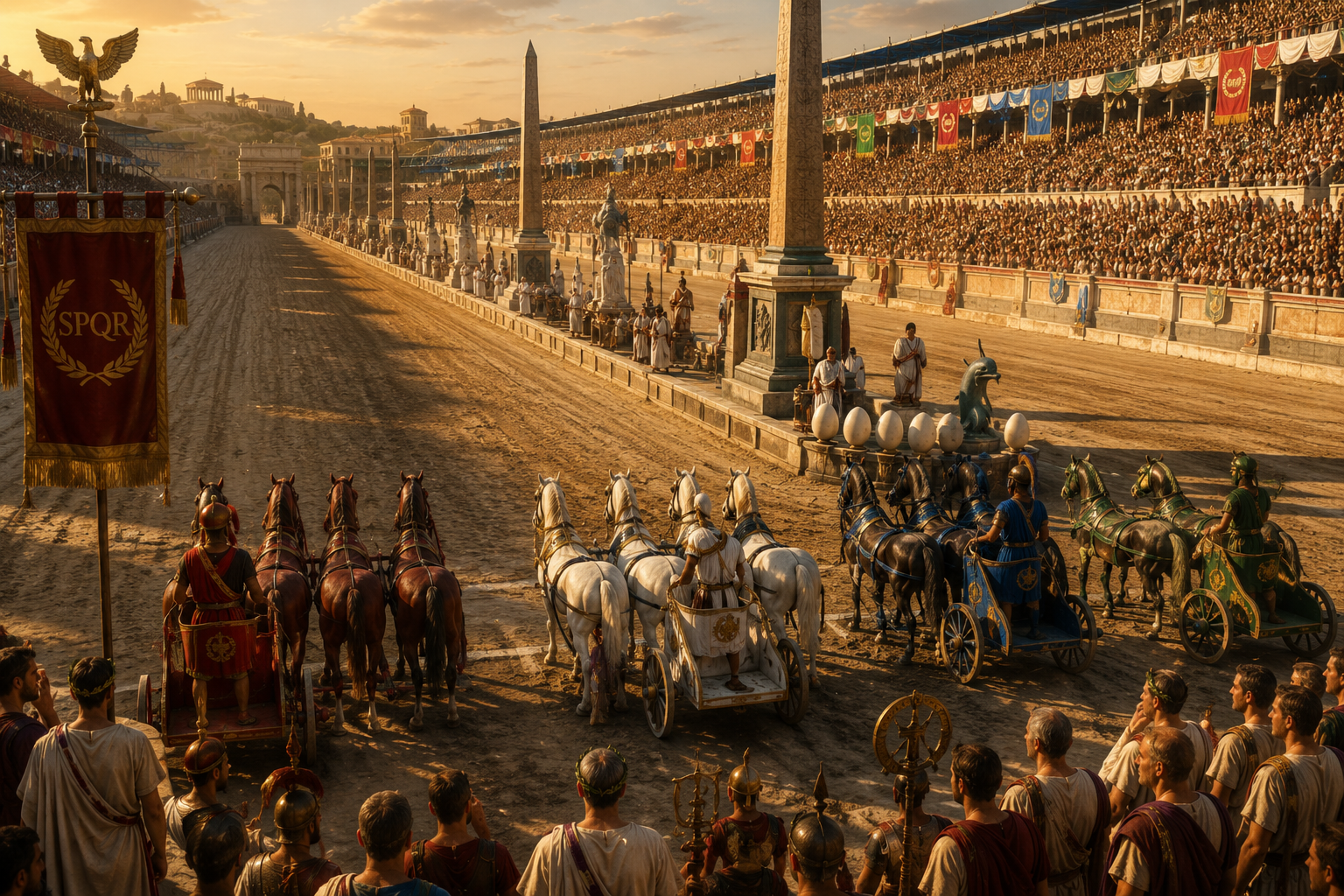
During the Ludi, religious ceremonies and sacrifices, processions, and public spectacles were held. Among the latter, chariot races at the Circus Maximuswere particularly important, although the program expanded over time.
The celebration was closely connected with the worship of Jupiter and with divine protection of the Roman state.
Celebrations of the Ludi Romani
The Ludi Romani allowed Romans to:
- honor Jupiter;
- fulfill established religious rites;
- celebrate and give thanks for victories and divine protection;
- bring the Roman community together;
- strengthen Rome's collective identity.
The magistrates responsible for organizing the games also had an extraordinary opportunity to gain prestige and popularity. The curule aediles played a fundamental role in organizing the games and the ceremonies associated with them.
On September 13, the Epulum lovis, the “Feast of Jupiter,” was celebrated as part of the Ludi Romani. Ancient sources distinguish this feast from the one held in November during the Ludi Plebeii. It also traditionally coincided with the dedication of the great Capitoline temple.
The Origins of the Ludi Romani
The Ludi Romani, also known as the Ludi Magni, were among Rome's most important public religious celebrations.
Their origins reach back to the earliest centuries of the city, and ancient sources offer different accounts of their institution. According to one tradition, they were established by Tarquinius Priscus en el siglo VI a.C., después de una victoria sobre los latinos. Otras tradiciones relacionan su origen con la victoria romana sobre los latinos en el Lake Regillus, at the beginning of the Republic.
In their earliest form, the games were much shorter. Over the centuries, the festival incorporated additional days and new spectacles until, during the late Republic and early Empire, it lasted approximately sixteen days, from September 4 to 19.
What had begun as a religious celebration eventually became an enormous combination of worship, processions, spectacles, and races.
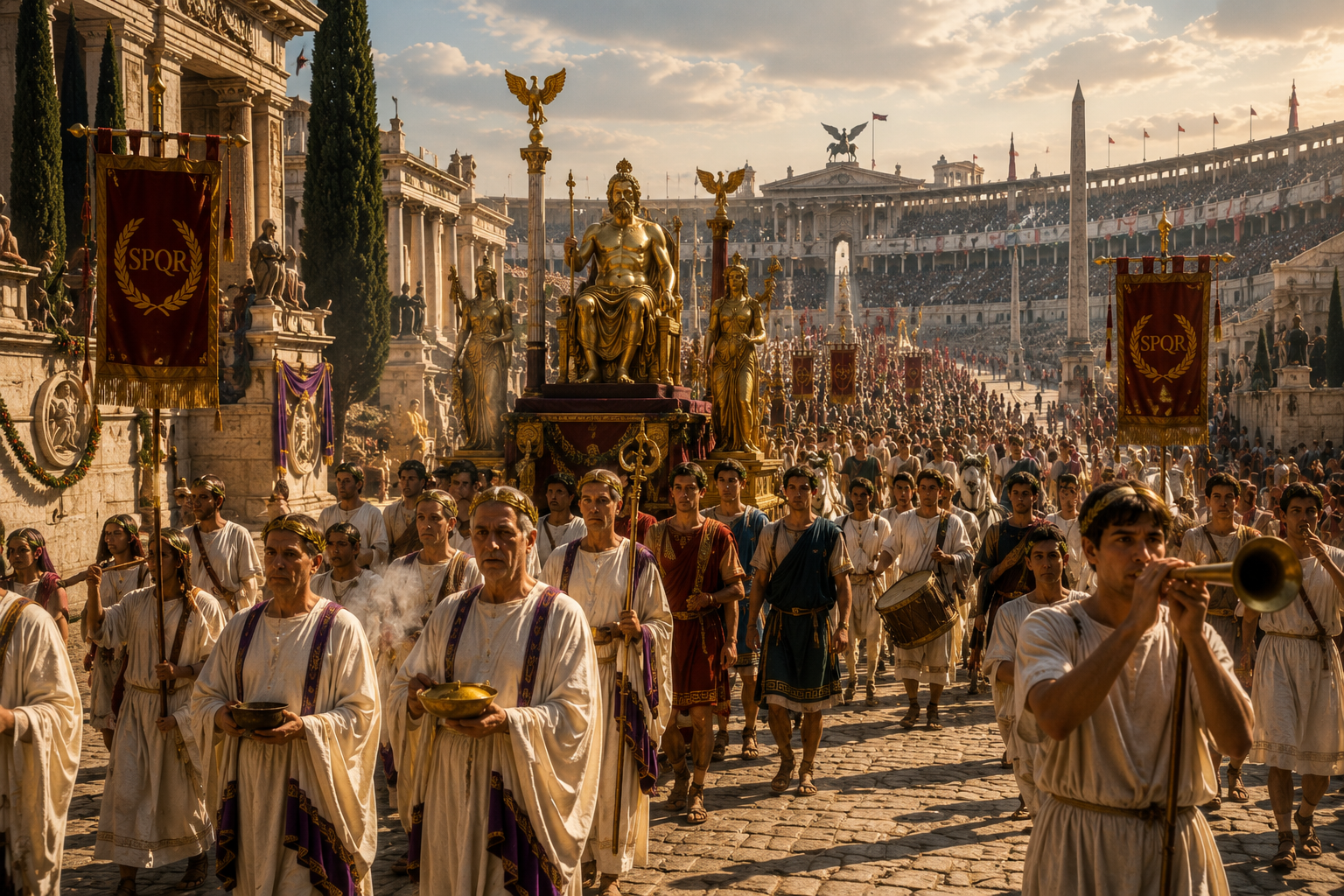
The Great Procession: the Pompa Circensis
The Ludi Romani did not simply begin with a race.
Before the chariots entered the track, an impressive ceremonial procession known as the Pompa Circensistook place—the procession that led the games to the Circus.
The procession traditionally began at the Capitoline Hill, passed through the Roman Forum, and continued to the Circus Maximus.
It could include:
- magistrates;
- young men from noble families;
- priests;
- musicians;
- dancers;
- athletes;
- charioteers and other participants in the games;
- animals and elements associated with the spectacles;
- and, above all, images of the gods.
The divine images were solemnly carried on structures known as fercula, while their attributes and sacred objects could be transported on special carriages called tensae.
The procession also had a fundamental religious significance: the gods were symbolically present at the games. When the procession reached the Circus, the images were placed in a position of honor and the appropriate rites were performed before the spectacles began.
Once the religious ceremony was complete, the Ludi Romani could begin.
The program changed over time, but could include:
- chariot races;
- horse races;
- athletic competitions;
- boxing;
- wrestling;
- other sporting contests;
- theatrical performances;
- music and dance.
. The Circus spectacles, particularly the chariot races, eventually became one of the festival's greatest popular attractions.
The Circus Maximus
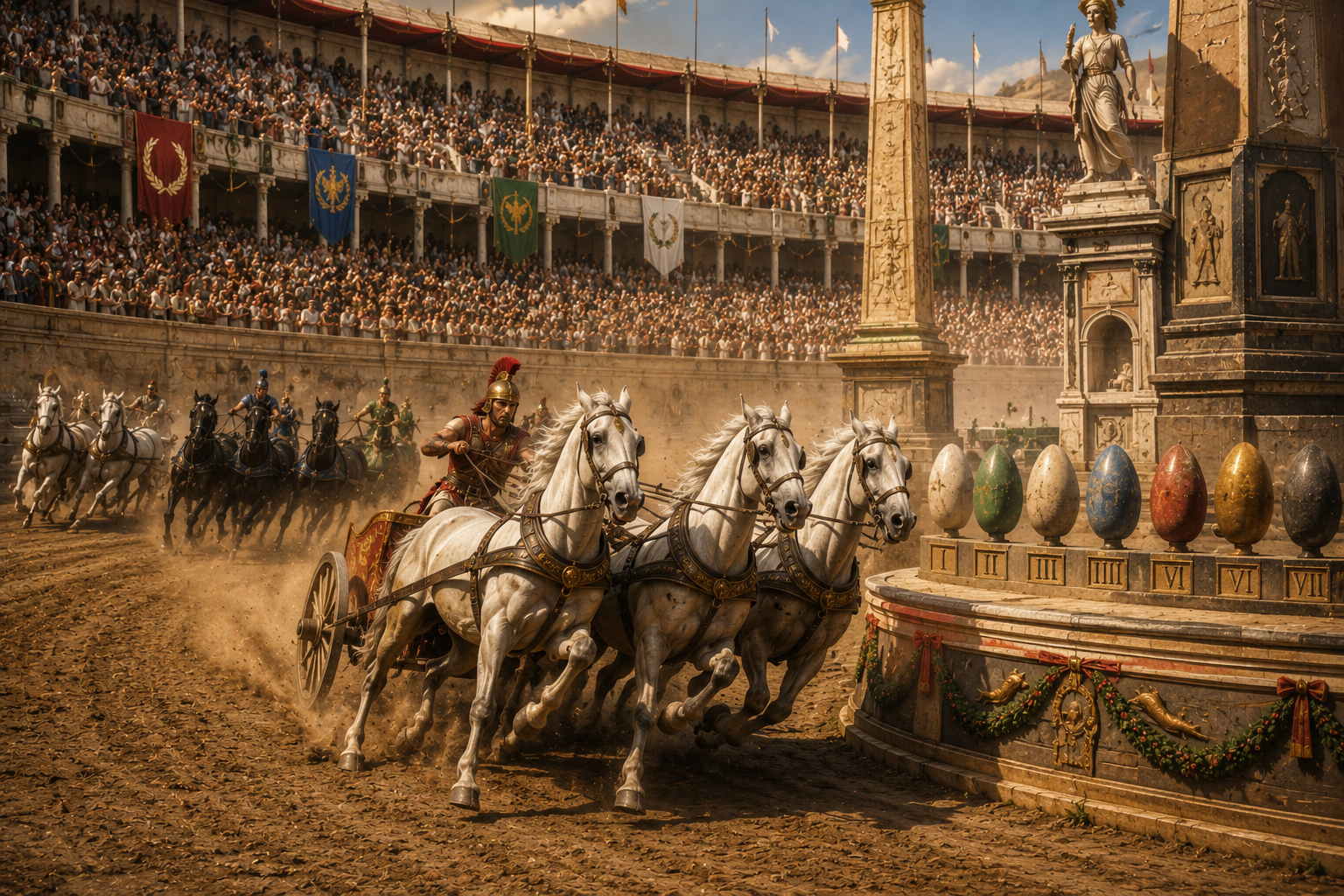
The Circus Maximus was the great venue for chariot racing.
According to tradition, the site began to be developed during the reign of Tarquinius Priscusin the sixth century BC, although the construction and monumentalization of the complex took place gradually over the following centuries.
An ancient source attributed to Dionysius of Halicarnassus estimates that it could accommodate approximately 150,000 spectators, while Pliny the Elder gives a figure of 250,000.
It was one of the largest entertainment venues ever built by human beings.
The Races: The True Stars of the Ludi Romani
The quadriga was a chariot drawn by four horses.
There were also:
- biga → two horses;
- triga → three;
- quadriga → four;
- seiuga → six.
But the quadriga was undoubtedly one of the great stars of the races. The drivers were known as aurigae.
The Factions: Rome Had Its Colors
The races gave rise to a strong identification between the public and the different factions.
The four traditional factions were:
- Reds
- Blues
- Greens
- Whites
Over time, the factions developed devoted followings, and some charioteers became genuine celebrities.
Seven Laps Around the spina
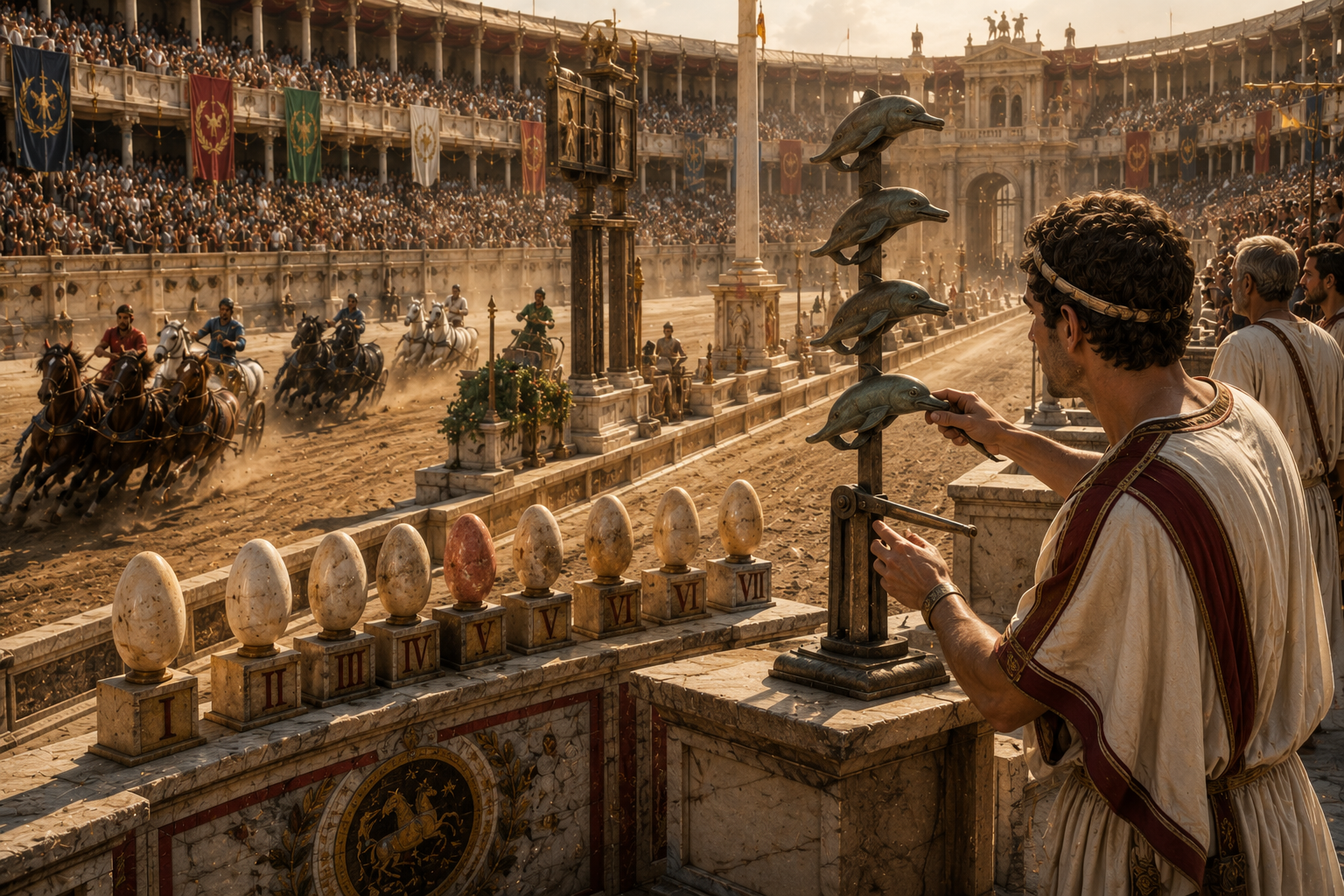
The races normally consisted of seven laps.
At the center of the Circus stood the spina, a long structure dividing the track. It was decorated with monuments, statues, fountains, and obelisks, while at either end stood the metae, the turning points around which the chariots had to race.
The Dolphins and the Eggs
To allow the spectators to know how many laps had been completed, special signaling devices were used. There were seven eggs (ova) and later also seven dolphins, which were moved or lowered to indicate the completed laps.
Archaeological and literary sources allow historians to reconstruct this practice. At the Circus Maximus, the eggs are documented from the second century BC, while the dolphins were added later.
A Extremely Dangerous Race
The races were anything but a peaceful sport.
The aurigae could wrap the reins around their bodies to gain greater control and strength when handling the horses. The problem was that if the chariot overturned, they could become trapped. For this reason, they carried a small knife that allowed them to cut the reins quickly in the event of an accident.
Accidents were so frequent and dangerous that they even had a name: Naufragium, literally meaning “shipwreck.” The term was used to describe the overturning or crashing of a chariot during a race.
The Horses Were Stars Too
Racehorses were highly valuable animals and were carefully selected.
Some became famous in their own right and are mentioned in inscriptions and literary sources.
The importance of the horses was such that the prestige did not rest entirely on the charioteer: the team and its animals could become genuine stars of the spectacle.
Offerings and Sacrifices
The Ludi Romani were not merely entertainment. The religious element was present throughout the festival.
Sacrifices and prayers formed part of the ceremonies, and the rites had to be performed correctly. If a ritual error was made, the games could even have to be repeated.
For the Romans, a public spectacle could be both entertainment for the people and a religious act performed for the gods.
The Epulum Iovis (September 13): The Great Feast Dedicated to Jupiter
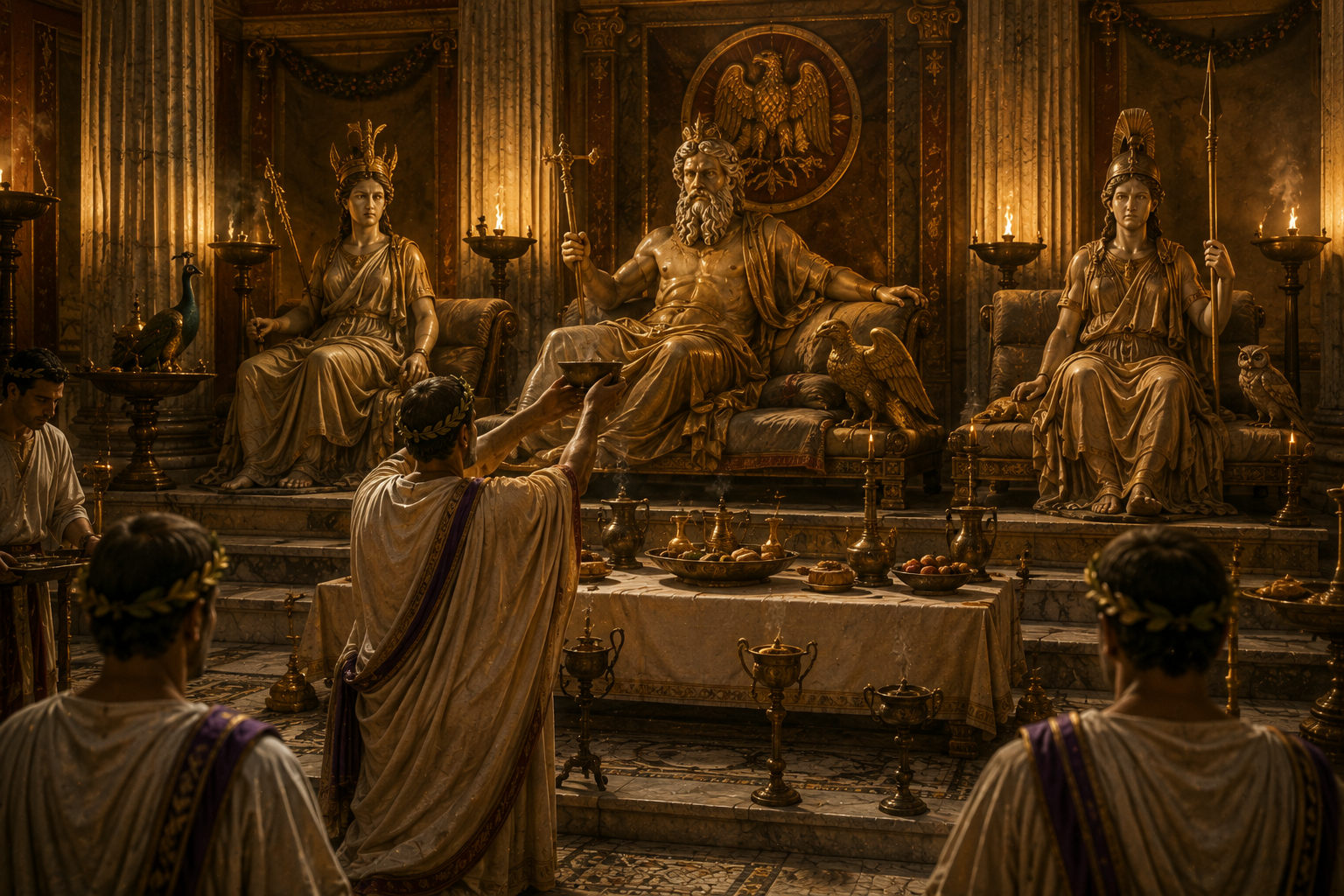
September 13 is associated in the Roman calendars with the ritual feast of the gods of the Capitoline. The ceremony was traditionally connected with the Epulum lovis and the Capitoline Triad: Jupiter, Juno, and Minerva.
During the ritual, a ceremonial table was prepared and the divine images were placed in positions appropriate for banquet guests. Jupiter was shown reclining on a ceremonial couch, while Juno and Minerva could be represented seated. Food and drink were symbolically offered to them as though they were guests at the banquetin a ritual known as a lectisternium).
Lectisterniumderives from:
- lectus → couch or bed;
- sternere → to spread or prepare.
The term referred to the ritual in which images of the gods were placed upon ceremonial couches and food was arranged before them, as though they were taking part in a banquet.
September 13: Jupiter at the Heart of Rome
September 13 held a special place in the Roman religious calendar.
Tradition placed the dedication of the Temple of Jupiter Optimus Maximuson the Capitoline on this date, during the early years of the Republic. Ancient sources associate the consecration with 509 BC.
The temple was dedicated to Jupiter, Juno, and Minerva, the so-called, Capitoline Triad, and became one of Rome's great religious and political centers.
Rome publicly renewed its relationship with Jupiter in an act that was both religious and political, since Jupiter was believed to protect Rome as a whole.
For this reason, September 13 brought together several fundamental elements:
- the commemoration of the temple's dedication;
- the Epulum Iovis, the ritual feast associated with the celebration;
- and the Ludi Romani, which reached one of their central moments during this period.
More than a simple anniversary, it was an occasion to publicly reaffirm the relationship between Rome, its gods, and the state.
Gaius Appuleius Diocles: The Superstar of the Circus
Gayo Apuleyo Dioclesbecame one of the most famous and best-paid charioteers of antiquity.
Born in Lusitania, his career is exceptionally well documented thanks to an inscription dedicated to him.
According to the inscription:
- he competed for 24 years;
- took part in 4,257 races;
- achieved 1,462 victories;
- also secured thousands of high-ranking finishes;
- and accumulated 35,863,120 sesterces in prize money.
He began competing at around the age of 18 and retired at 42, following an exceptionally long career for a charioteer. The inscription places his first recorded participation in AD 122 and his retirement around AD 146.
Diocles did not remain with the same faction throughout his career. He began with the Whites, later moved to the Greens, and eventually achieved his greatest successes with the Reds, where he remained for much of his career.
His fortune was so extraordinary that Diocles has become popularly described as “the highest-paid athlete in history.”
Curiosities
The Horses: Four-Legged Stars
Horses were fundamental to the spectacle.
The finest animals could come from different regions of the Empire, and breeders looked for qualities such as:
- speed;
- endurance;
- obedience;
- strength;
- the ability to make tight turns.
The races demanded an enormous amount from the animals, especially as they approached the metae, the turning points located at the ends of the track.
Some horses achieved extraordinary fame. Diocles' own inscription mentions that he drove numerous horses to victory, including animals that achieved 100 victories, and one that reached 200.
When September Almost Stopped Being Called September
For centuries, the Romans preserved the traditional names of their months. However, some emperors attempted to change them in their own honor or that of members of their families.
Tiberius
During the reign of Tiberius, the Senate proposed changing the name of September to Tiberius and October to Livius, in honor of the emperor and his mother, Livia.
Tiberius rejected the proposal.
Calígula
Caligula also attempted to rename September Germanicus, in honor of his father, Germanicus.
The change did not last.
Domitian
Domitian also used the calendar to reinforce his imperial image, and during his reign September came to be associated with the name Germanicus, although the change likewise did not survive his rule.
Commodus
At the end of the second century, Commodus sought, during the final months of his reign, to reshape Rome's very identity around his own figure.
According to the tradition preserved by the ancient sources, the names of the twelve months were changed to names and titles associated with the emperor.
The Historia Augusta gives September as Hercules and October as Invictus. Cassius Dio, however, provides a different sequence:
- August → Commodus
- September → Augustus
- October → Herculeus
- November → Romanus
- December → Exsuperatorius
Commodus had developed an extraordinarily intense identification with Hercules Hercules. . He presented himself as Hercules Romanus, was depicted with the hero's attributes, and associated his imperial image with him.
Among his most famous attributes were:
- the skin of the Nemean lion;
- the club;
- the apples of the Hesperides.
The sources even describe statues of Commodus dressed as Hercules.
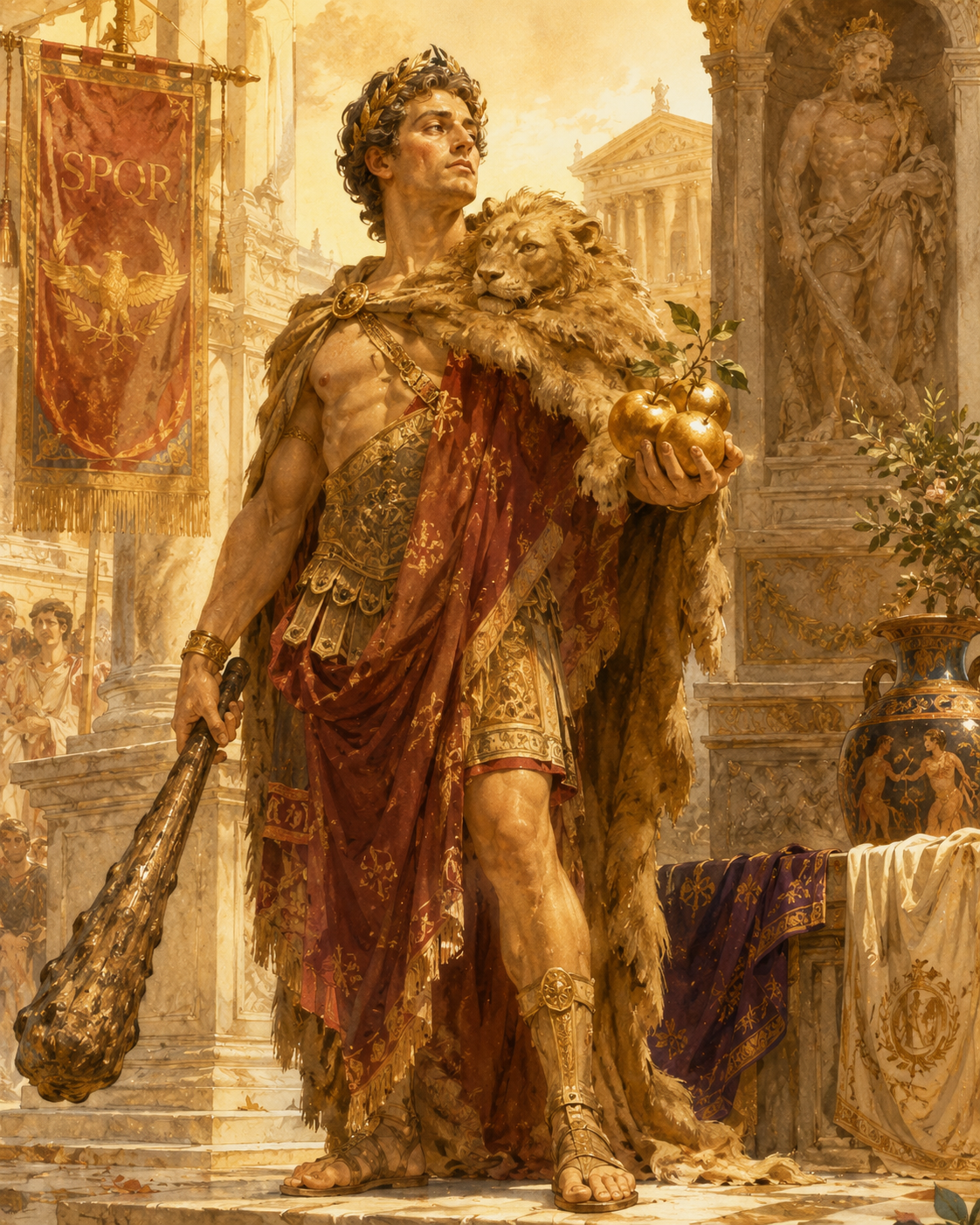
The reform did not survive Commodus. After his assassination on December 31, AD 192, the traditional names were restored.
September: Between the End of Summer and a New Beginning
At the end of September, the autumn equinox astronomically marked the arrival of autumn. Although there was no major Roman festival equivalent to a modern equinox celebration, the change of season formed part of the agricultural cycle and the yearly calendar.
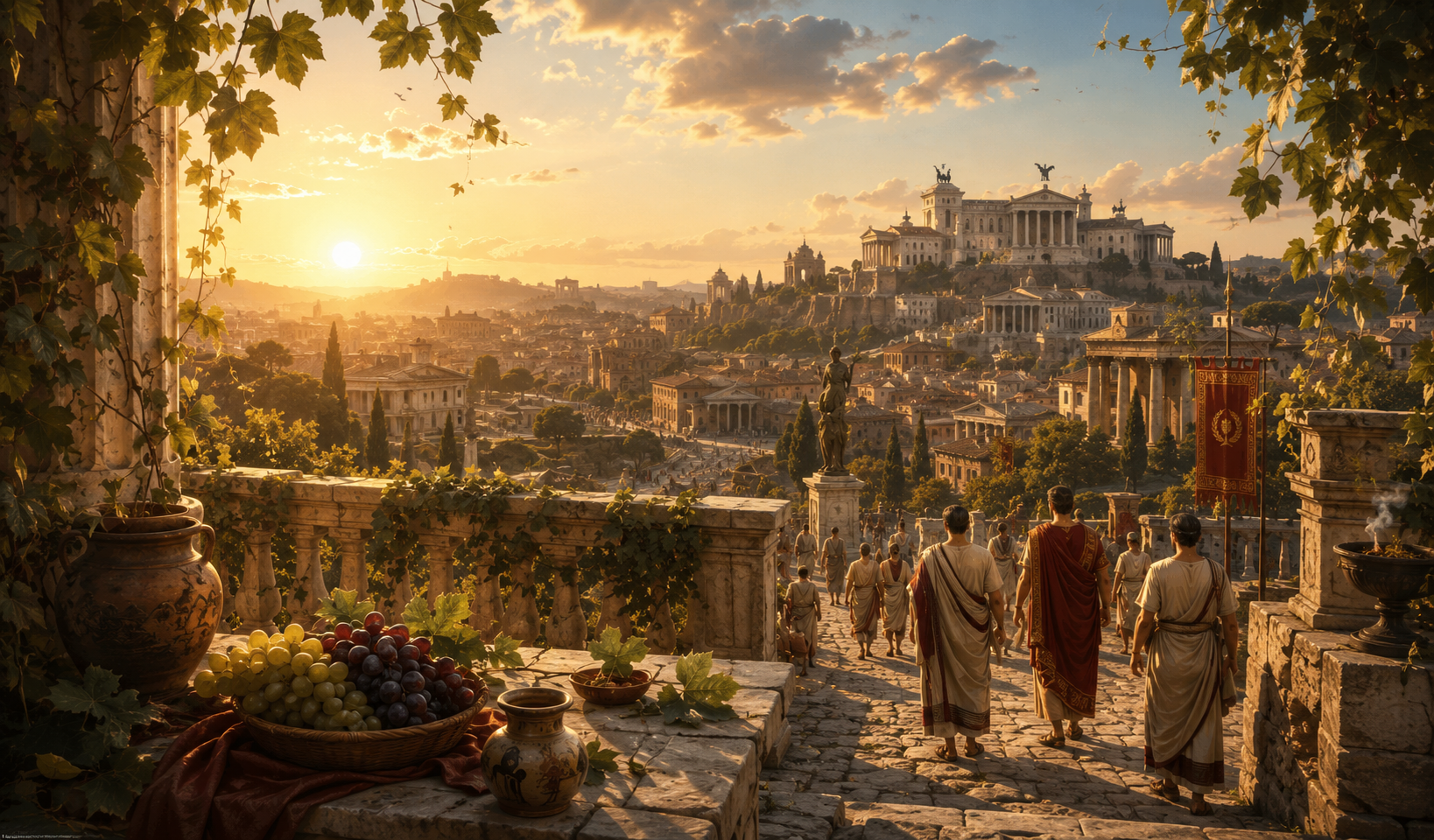
Although September marked the end of summer for the Romans, it could also represent the beginning of a new stage. After the hottest months, public activity regained momentum and Rome once again filled with life.
More than two thousand years ago, Romans experienced September through the final agricultural tasks, the grape harvest, religious celebrations dedicated to Jupiter, and the great public spectacles.
Today, those rituals have disappeared, but some of the activities associated with this time of year remain part of our lives. Vineyards still come alive when the time comes to harvest the grapes, while September continues to mark, for many people, the beginning of a new chapter.
Follow the Footprints
Visit It Today...
Roman Forum
For centuries, the Roman Forum was one of the great centers of Rome's political, religious, judicial, and commercial life. Today, it forms part of the Colosseum Archaeological Park, together with the Palatine Hill and the Colosseum. The site is open to visitors and allows you to walk among the ruins of some of the places where much of Roman public life unfolded.
Temple of Capitoline Jupiter
The original Temple of Jupiter Optimus Maximus disappeared after several destructions and reconstructions, but significant remains of its enormous foundations can still be seen on the Capitoline Hill.
Capitoline Museums
In 1471, Pope Sixtus IV donated an important collection of sculptures to the people of Rome, which became the foundation of the Capitoline Museums. The development of the square and buildings as we know them today took place later, with Michelangelo playing a fundamental role.
The Capitoline Museums allow visitors, through archaeological material and reconstructions, to understand the importance that the Temple of Jupiter held in ancient Rome.
The collections occupy buildings around Piazza del Campidoglio, designed by Michelangelo, and preserve numerous pieces connected with the history of Rome.
Circus Maximus
The Circus Maximus still occupies the valley where chariot races and great spectacles were held for centuries.
Today, its remains can be explored within the archaeological area of the Circus Maximus, where it is still possible to appreciate the enormous scale of one of ancient Rome's greatest venues.