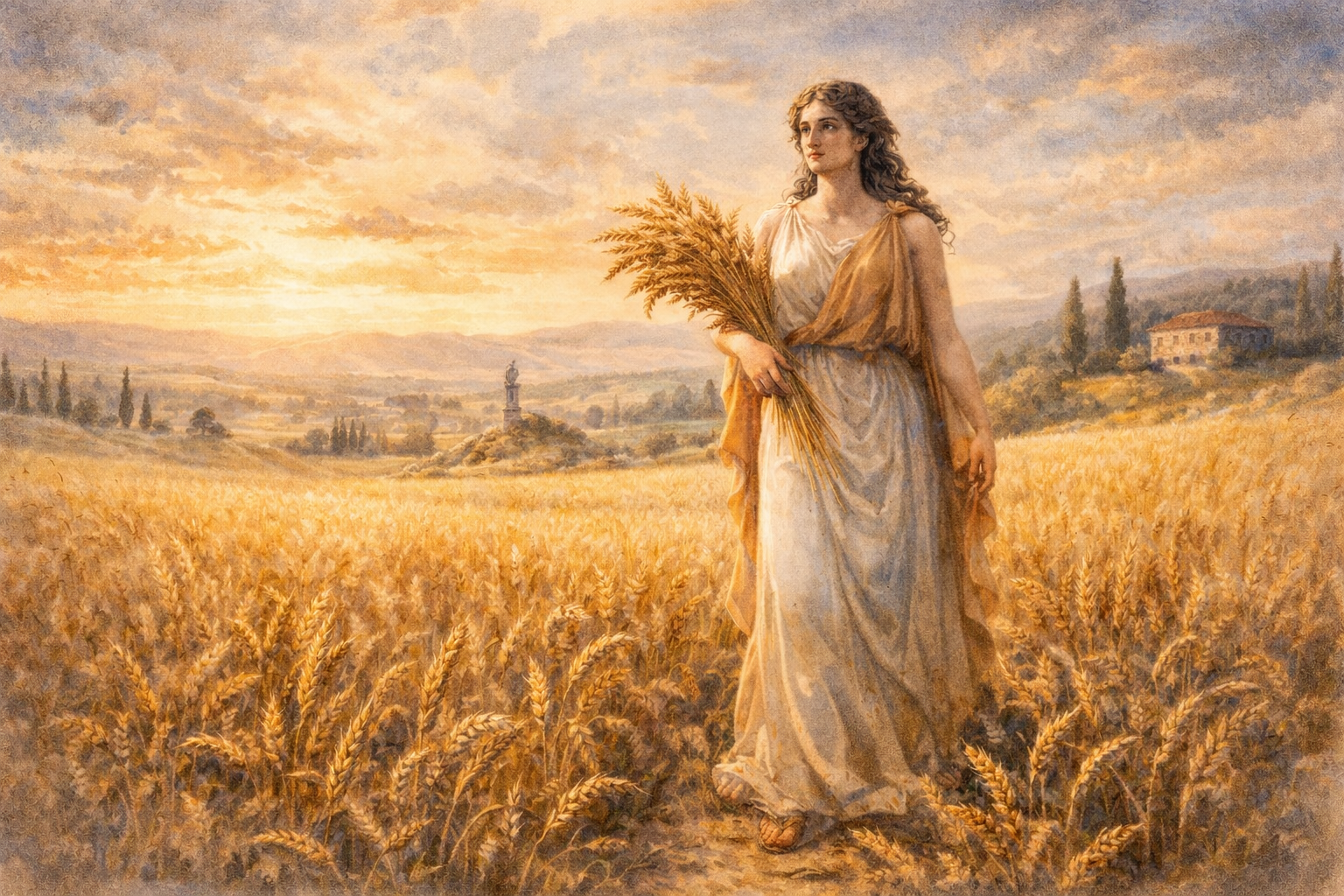
Ceres was the goddess of agriculture, grain, and the fertility of the land. Her cult was deeply connected to everyday life in Rome.
In Roman religion, Ceres and her daughter Proserpina are at the center of one of the most well-known myths of the ancient world.
In a civilization like Rome, where wheat was the foundation of the diet, her worship held enormous importance.
During the Roman Republic, Ceres also became a divinity associated with the common people after the conflicts between patricians and plebeians.
Ceres: the goddess of grain and fertile land
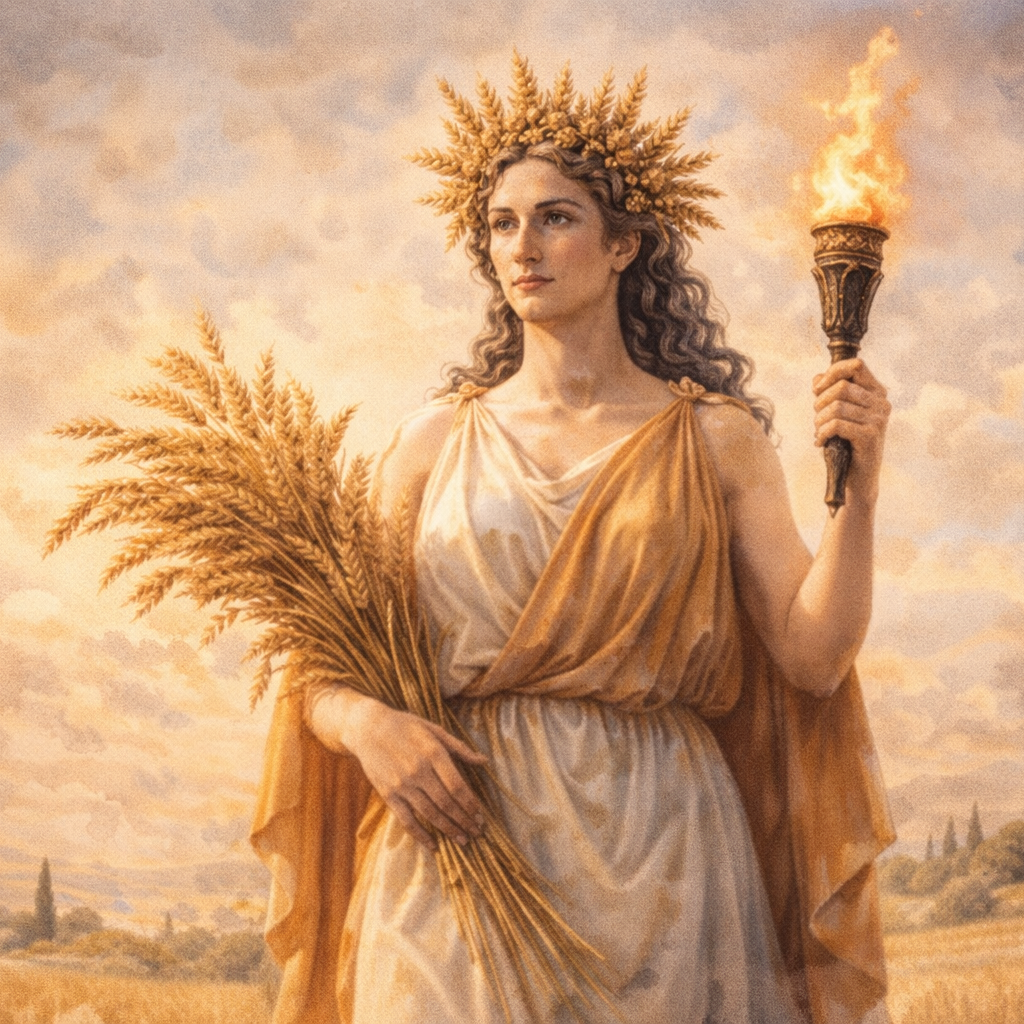
Ceres was the Roman goddess of:
- agriculture
- grain and harvests
- the fertility of the land
- growth of cultivated plants
Her name is directly related to the Latin word cerealis , meaning “related to grain.”
From this Latin term comes the modern word cereal, used today to refer to cultivated grains that form one of the bases of human nutrition, such as wheat, barley, or oats.
For the Romans, grain was not just food—it was the foundation of survival. Rome depended heavily on the production and distribution of wheat to feed its population.
Ceres symbolized food security and agricultural stability. Her cult constantly reminded people of the connection between the fertility of the land, the prosperity of society, and the stability of the State.
Even today, every time we use the word cereal, we are using a term that originates from the name of this ancient Roman goddess.
Origin of Ceres in Roman mythology
Ceres was one of the main agricultural deities of the Roman world and was later identified with the Greek goddess Demeter.
In Roman mythology, she was the daughter of:
- Saturn (equivalent to Cronus)
- Ops (equivalent to Rhea)
This made her the sister of several major Roman deities:
- Jupiter
- Neptune
- Pluto
- Juno
- Vesta
Her daughter: Proserpina
The most important figure in her myth is her daughter Proserpina, traditionally considered the result of her union with Jupiter.
The abduction of Proserpina by Pluto, god of the underworld, is the central episode of the myth.
This story explains the cycle of the seasons:
- when Proserpina is with her mother → the earth flourishes
- when she returns to the underworld → nature withers
This narrative symbolized the agricultural rhythm of the year.
Ceres and Roman agriculture
For the Romans, Ceres was not a distant deity. She was deeply tied to everyday life.
Farmers invoked her protection for:
- sowing grain
- the growth of crops
- the protection of harvests
Wheat was the foundation of Roman nutrition, so the prosperity of Rome depended directly on agricultural success.
For this reason, Ceres was considered a guarantor of the stability of the Roman people.
The temple of Ceres
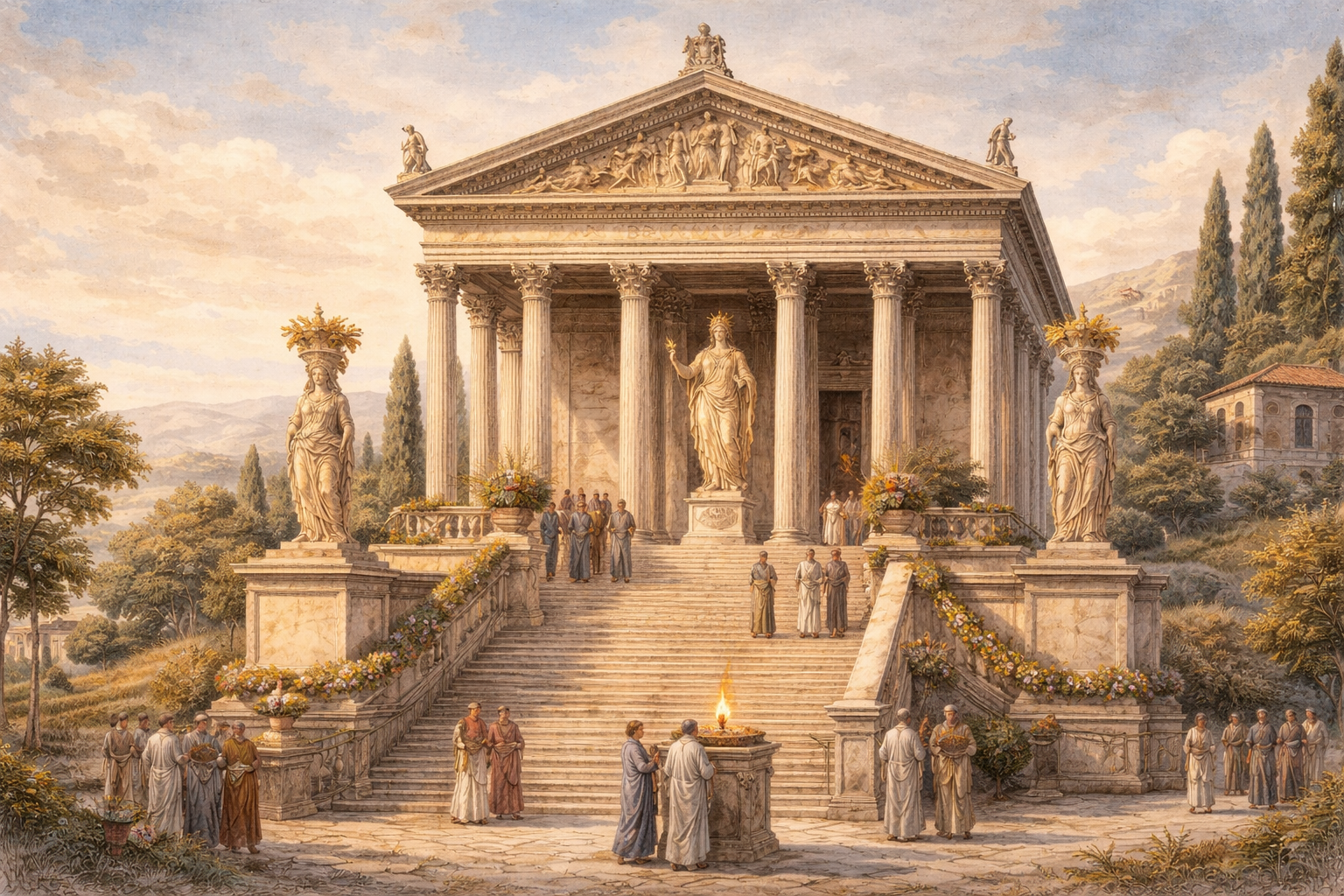
One of the most important temples dedicated to the goddess was located on the Aventine, one of the Rome’s seven hills. It was consecrated in 493 BC, tras una grave crisis social entre patricios y plebeyos.
This temple had a special role because it was closely linked to the Roman plebeians.
There were kept:
- legal archives
- public documents
- important records for the plebeians
For this reason, Ceres was not only a goddess of agriculture, but also a symbolic protector of the common people
The Aventine Triad
In Rome, Ceres was part of a divine triad composed of:
- Ceres
- Liber
- Libera
This group of deities was associated with:
- fertility
- growth
- abundance of nature
Their cult was strongly connected to the lower classes of Roman society.
Representation of the goddess
Ceres is usually depicted with agricultural symbols such as:
- ears of wheat
- a crown of grain
- a sickle or farming tool
- a torch (linked to the search for Proserpina)
These images reflect her direct connection to the fertility of the land.
Ceres and Proserpina: the seasons of the year
This myth, adopted from the Greek tradition of Demeter and Persephone, was fully integrated into Roman religion, where it took on new forms and meanings.
Beyond her agricultural role, Ceres was linked to the fertility of nature and the cycle of life, which explains her connection to the myth of her daughter Proserpina.
Proserpina: the daughter taken to the underworld
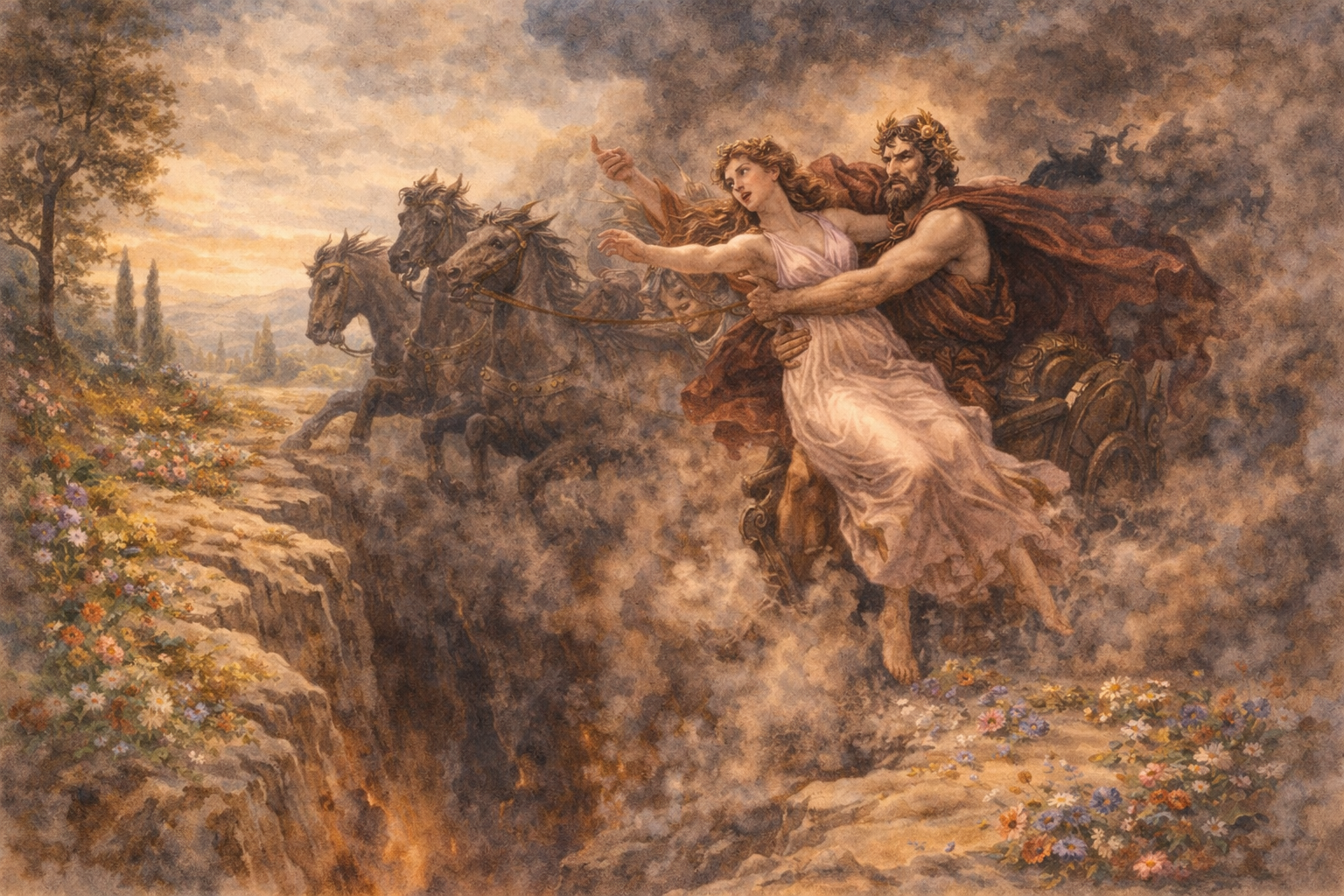
According to the myth, Proserpina, daughter of Ceres, was abducted by Pluto, god of the underworld.
While gathering flowers in a meadow, the earth opened, and Pluto emerged from the underworld to take her to the realm of the dead.
Desperate over her daughter’s disappearance, Ceres wandered the world searching for her.
During her search, she abandoned her divine duties, and the earth began to suffer the consequences:
- fields stopped producing
- crops were lost
- nature withered
The world entered a period of sterility.
The agreement between the gods
Faced with the danger of humanity perishing due to lack of food, Jupiter, king of the gods, intervened.
An agreement was reached: Proserpina could return to her mother for part of the year, but had to spend the rest in the underworld with Pluto.
This was because, while in the realm of the dead, she had eaten some pomegranate seeds—a symbolic act that bound her to Pluto’s domain.
The origin of the seasons
Proserpina’s periodic return to the world of the living explained the natural cycle for the ancients.
When Proserpina returned:
- Ceres rejoiced
- the earth flourished
- the fields filled with life
This corresponded to spring and the summer.
When Proserpina returned to the underworld:
- Ceres fell into sorrow
- the earth lost fertility
- plants stopped growing
This represented autumn and the winter.
In this way, the myth explained the rhythm of the seasons and the agricultural cycle.
Ceralia: festival dedicated to Ceres
The Cerialia were celebrated in Rome from April 12 to April 19..
These festivities were dedicated to Ceres, protector of crops and grains, at a crucial time for agricultural development.
During these celebrations, the Romans held:
- public games
- religious processions
- grain offerings
- rituals linked to fertility
These festivals reflected the symbolic importance of Ceres as protector of food and natural balance.
Rituals of the Cerialia
Foxes with torches
During games held in the Circus Maximus, foxes with burning torches tied to their tails were released.
The animals ran through the arena while the audience watched.
This unusual ritual is mentioned by the Roman poet Ovid, who also attempted to explain its origin.
According to one tradition, it came from a punishment inflicted on a fox that had damaged crops.
A farmer captured the animal and set its tail on fire before releasing it. The fox ran through the fields, setting them ablaze.
Over time, this event became a symbolic ritual within the Cerialia.
A shared myth in the ancient world
The story of Ceres and Proserpina was not exclusive to Rome—it originated from the Greek myth of Demeter and Persephone.
For the Romans, this myth was not just symbolic.
It represented something fundamental: humanity’s dependence on the cycles of nature.
Agriculture, the seasons, and the fertility of the land were deeply connected to divine order.

Thus, every spring recalled the return of Proserpina…
and every winter, the sorrow of Ceres at losing her daughter once again.