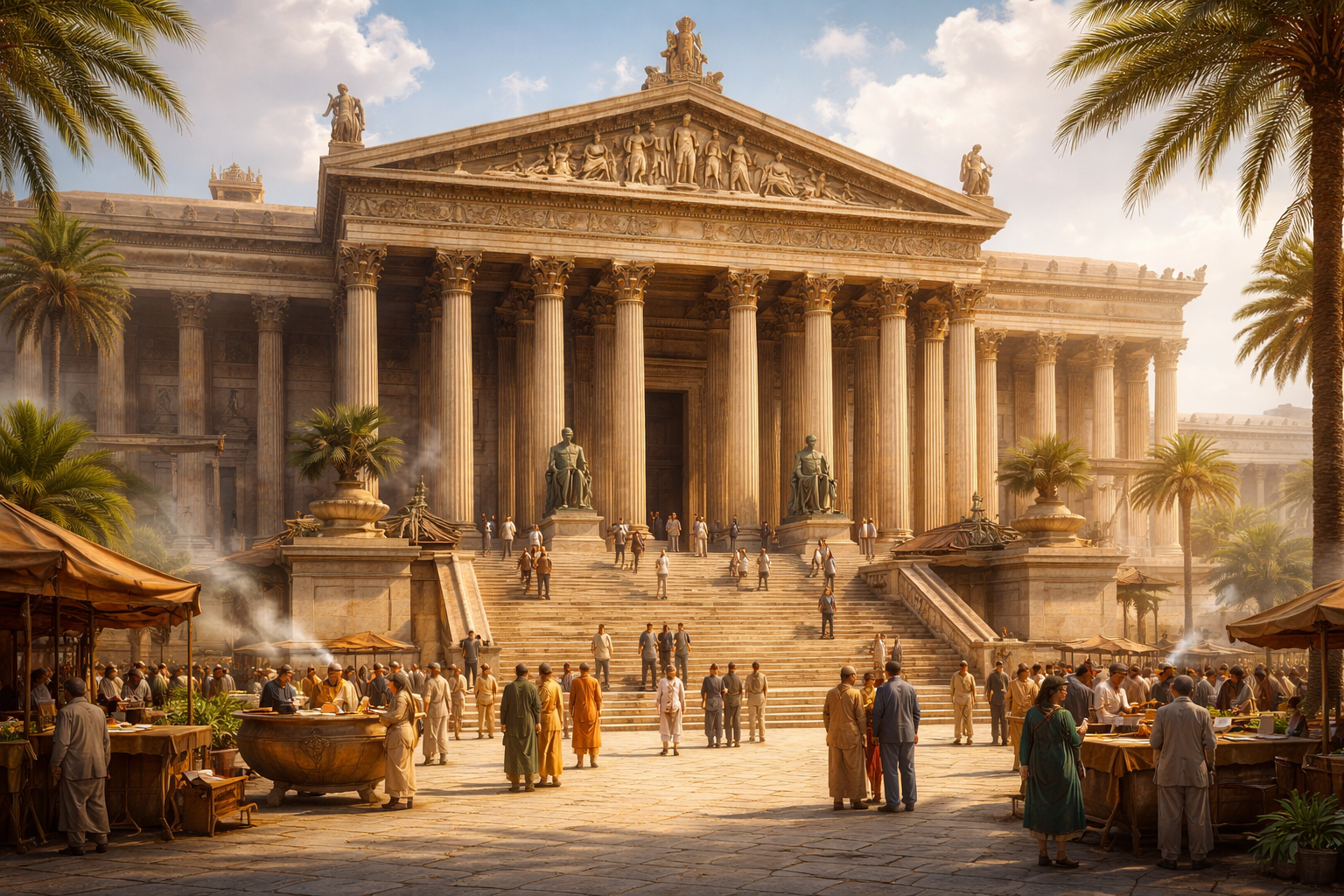
In Antiquity, there was a place that aspired to contain all the knowledge of the world.
It was not a myth or a legend, but a real project: the Library of Alexandria.
Founded in the city of Alexandria, in Egypt, during the Hellenistic period, it became one of the most important intellectual centers in history.
Its goal was as ambitious as it was unprecedented: to gather, preserve, and understand all human knowledge.
Alexandria: the new center of the world
The city of Alexandria was founded by Alexander the Great in 331 BC.
After his death, his empire was divided, and Egypt came under the control of the Ptolemaic dynasty.
It was its rulers who promoted the creation of the Library, especially:
- Ptolemy I
- Ptolemy II
Under their rule, Alexandria was not only a political center, but also a cultural one.
A meeting point between Greece, Egypt, and the East.
The “campus” of knowledge in Antiquity
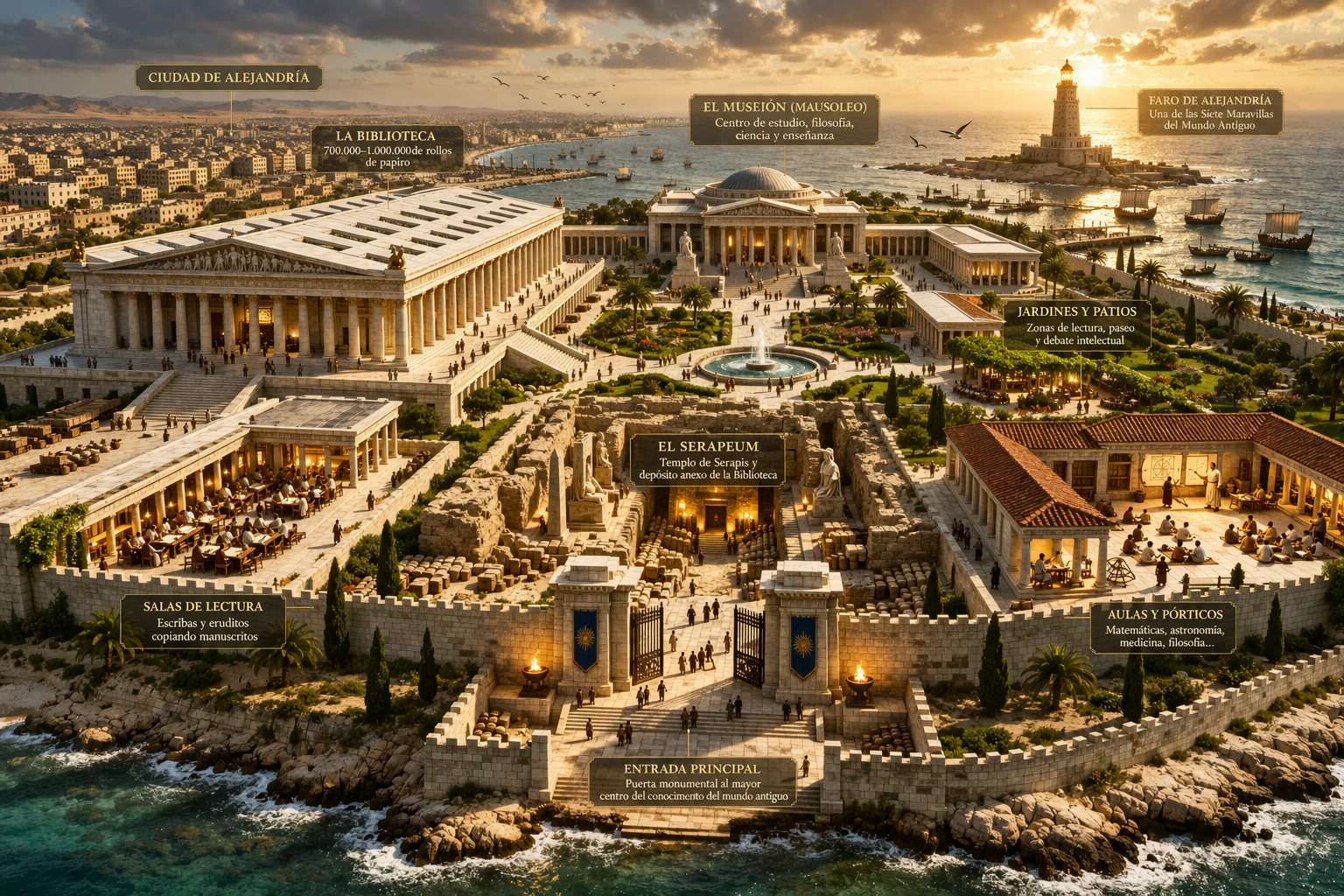
The Library and the Mouseion
It was located in the Royal Palace district, near the harbor.
However, it was not a single isolated building, but part of a larger system of knowledge.
It was integrated into the Mouseion (Museum), an institution dedicated to the Muses and funded by the rulers.
Scholars, philosophers, and scientists lived and worked there.
It was not just a place where books were stored. It was a space where knowledge was studied, debated, and created.
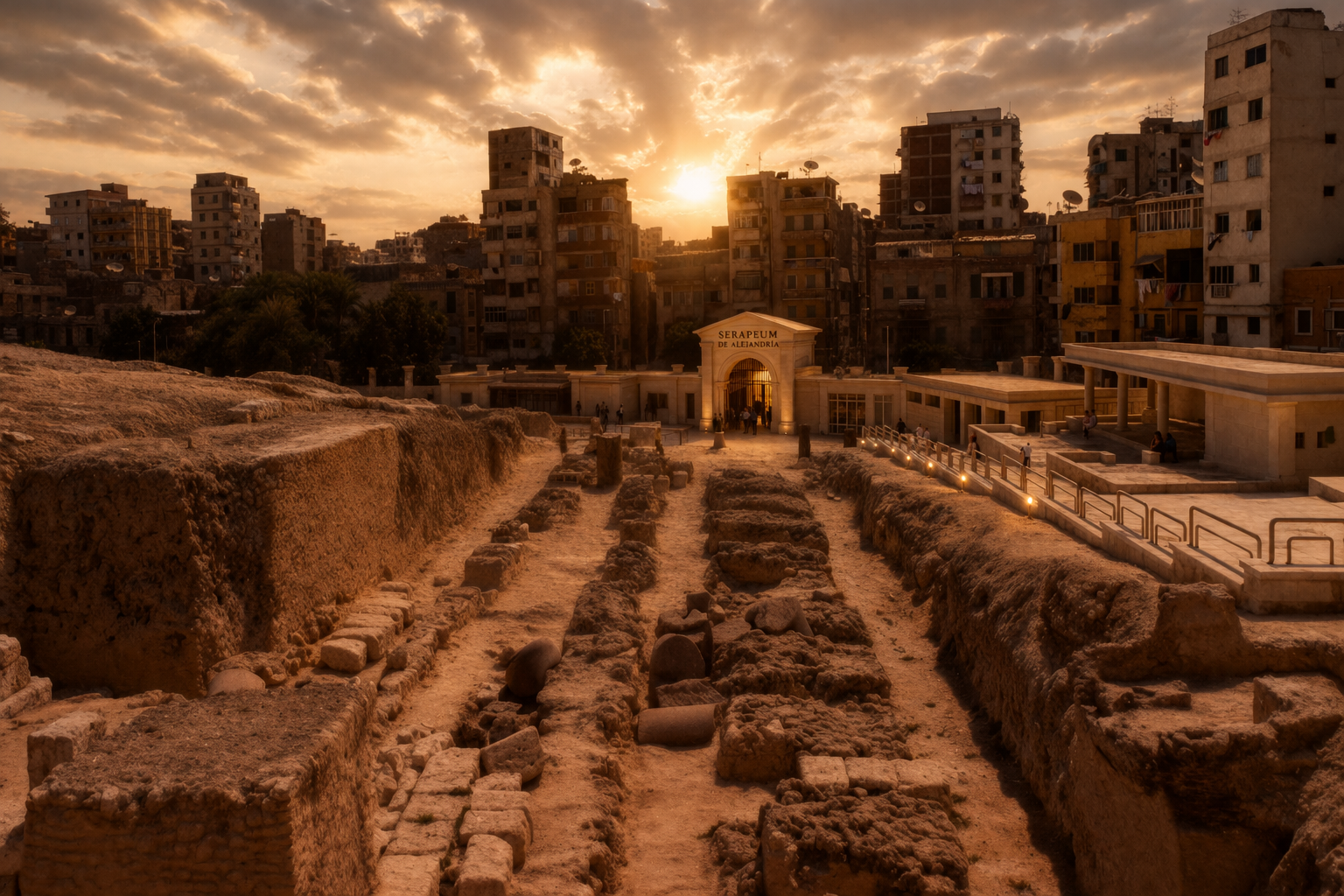
The Serapeum: the “second library”
In addition to the main Library, there was another major collection of texts in the Serapeum, a temple dedicated to the god Serapis.
This space functioned as an extension of the Library.
Some ancient sources suggest that it eventually housed a significant part of its collection.
Alexandria did not have just one library. It had a distributed system of knowledge centers.
The desire to gather all books
One of the most fascinating aspects of the Library of Alexandria was its ambition.
It sought to collect all the texts of the known world.
To achieve this, remarkable methods were used:
- ships arriving at the port were inspected
- manuscripts were copied
- copies were returned
- originals were kept in the Library
This effort turned Alexandria into the greatest repository of knowledge of its time.
It is estimated that it may have housed between 400,000 and 700,000 scrolls, although figures vary depending on the sources.
An unprecedented center of knowledge
Some of the brightest minds of the ancient world worked in the Library:
- Euclid → mathematics
- Eratosthenes → calculation of the Earth's circumference
- Aristarchus of Samos → heliocentric model
- Archimedes
Disciplines studied there included:
- mathematics
- astronomy
- medicine
- philosophy
- literature
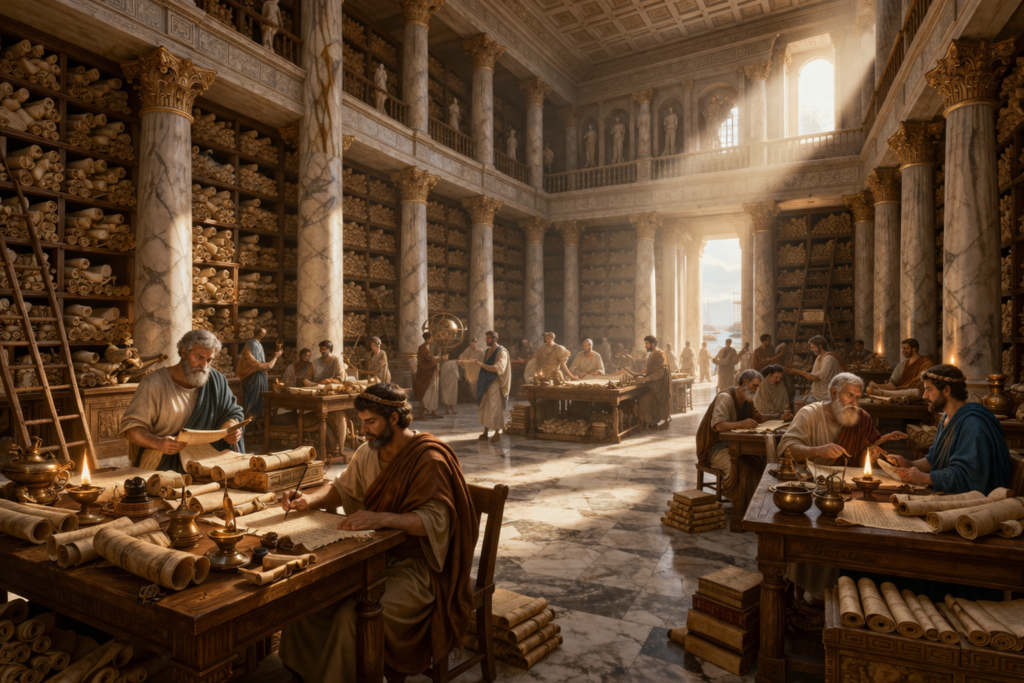
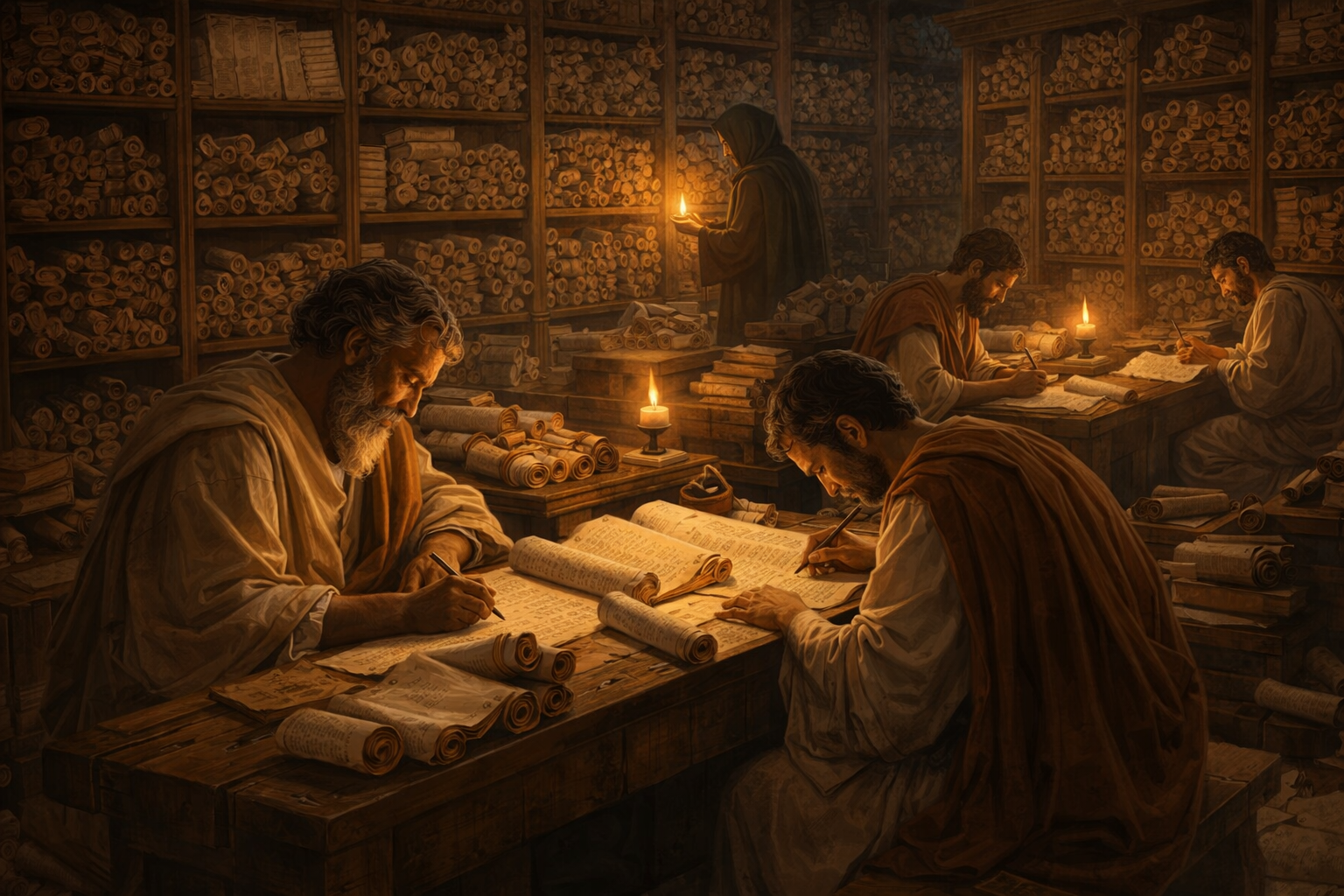
Inside the Library of Alexandria 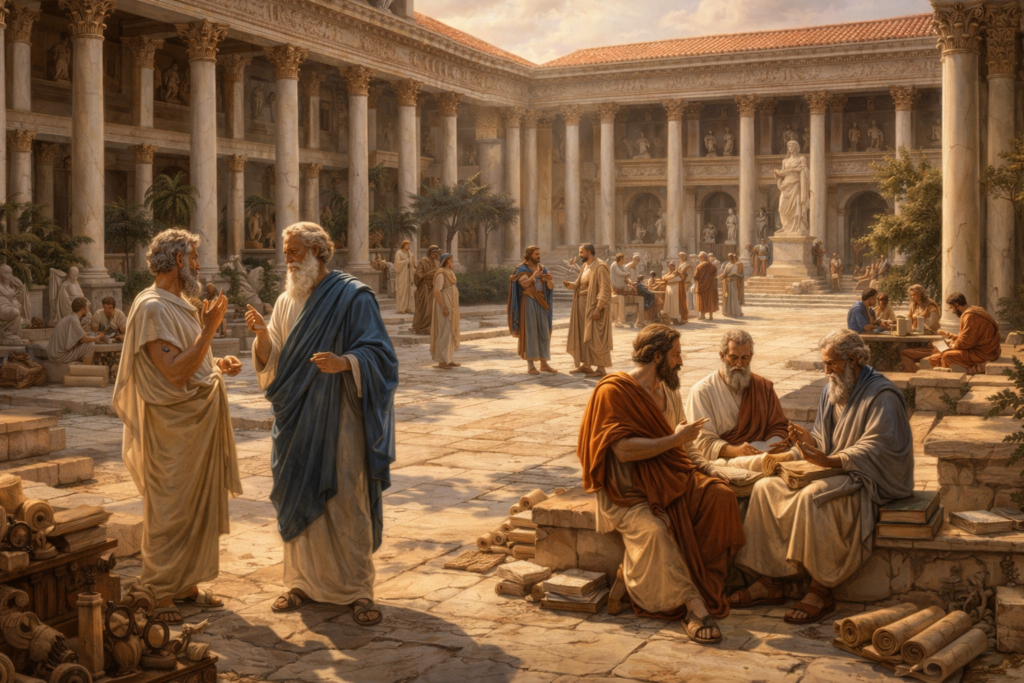
Philosophers in the Mouseion
The Library did not only preserve knowledge.
It created it.
The great mystery: its destruction
The disappearance of the Library of Alexandria remains one of the greatest mysteries in history.
There is no single event that explains its destruction. Several theories exist.
The Fire in the Time of Julius Caesar
During his stay in Alexandria (48 BC), a fire in the harbor may have affected part of the Library.
Later conflicts
Over the centuries, Alexandria suffered:
- wars
- looting
- religious tensions
Cultural changes
With the spread of Christianity and the decline of the classical world, many ancient institutions disappeared.
What was truly lost
Not only were books lost.
What was lost included:
- knowledge accumulated over centuries
- unique works
- ideas we will never know
The Library represented more than texts.
It represented the human attempt to understand the world in its entirety.
Curiosities
Homer and the obsession with the perfect text
In Alexandria, texts were not only collected. They were also studied, compared, and corrected.
One of the most well-known cases is that of Homer’s works.
The Iliad and The Odyssey had been transmitted orally for centuries, which led to multiple versions with small differences:
- added or removed verses
- variations in wording
- changes in the order of passages
Scholars began to compare these versions. They acquired manuscripts, analyzed texts, and attempted to reconstruct a version as faithful as possible to the original.
To do this, they developed methods that we now associate with philology:
- comparison of manuscripts
- critical annotations
- selection of variants
This work not only preserved Homer’s works. It laid the foundations for how we study ancient texts today.
The Septuagint: a bridge between cultures
One of the most influential projects linked to Alexandria was the translation of Hebrew texts into Greek: the Septuagint (Greek Bible).
According to tradition, it was promoted by Ptolemy II in the 3rd century BC.
It is said that seventy-two Jewish scholars translated the texts independently… and all produced identical versions.
Beyond the legendary aspect, its impact was enormous:
- it allowed Hebrew texts to be read in the Greek world
- it facilitated their spread beyond Jewish communities
- it influenced the development of Christianity
The Septuagint was not just a translation.
It was a bridge between cultures.
Follow the Footprints
His legacy continues in…
In 2002, a new library was inaugurated near the original site.
Today, the Library of Alexandria remains a symbol.
Not of what it was. But of what it could have been.
A reminder of the fragility of knowledge… and the importance of preserving it.
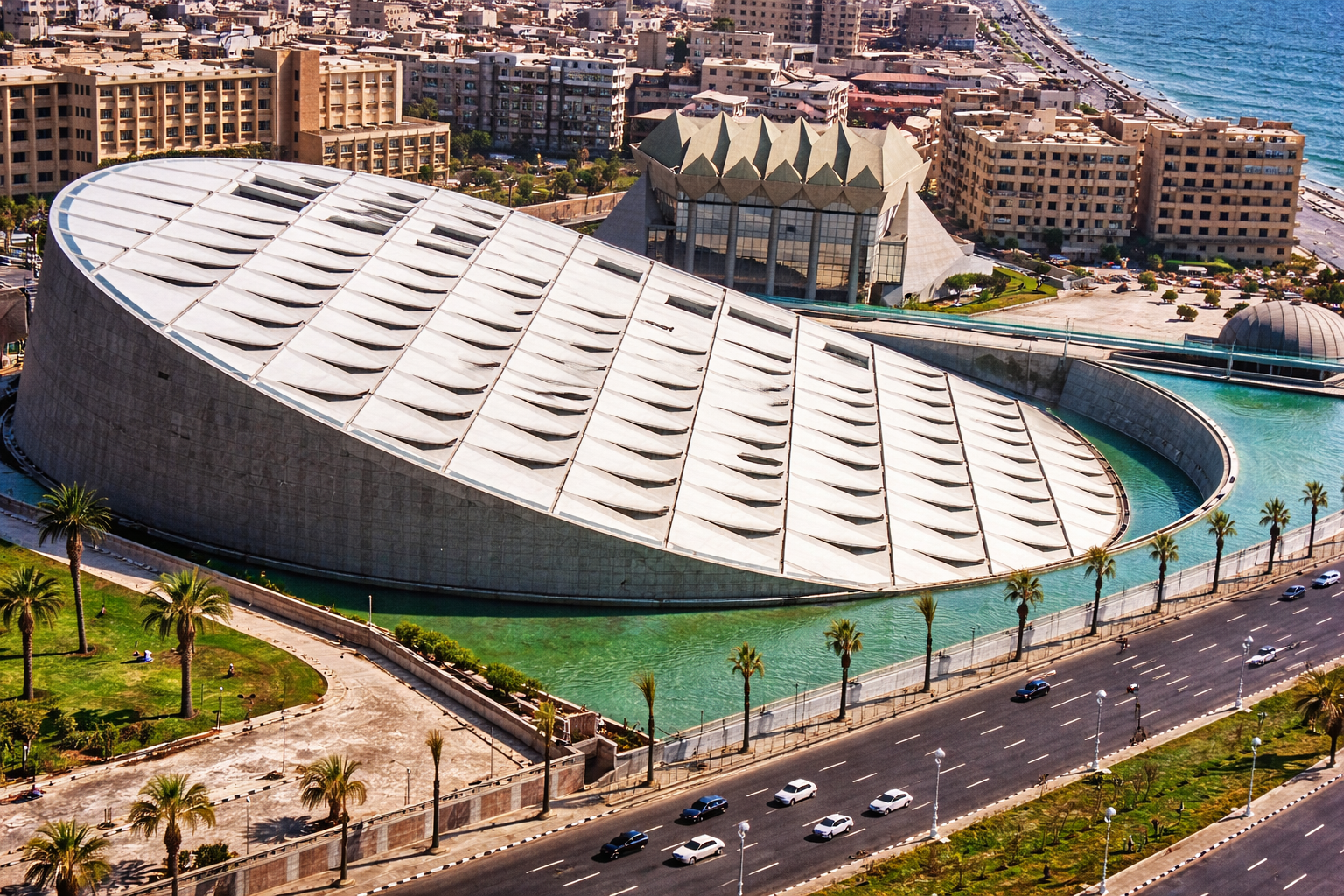
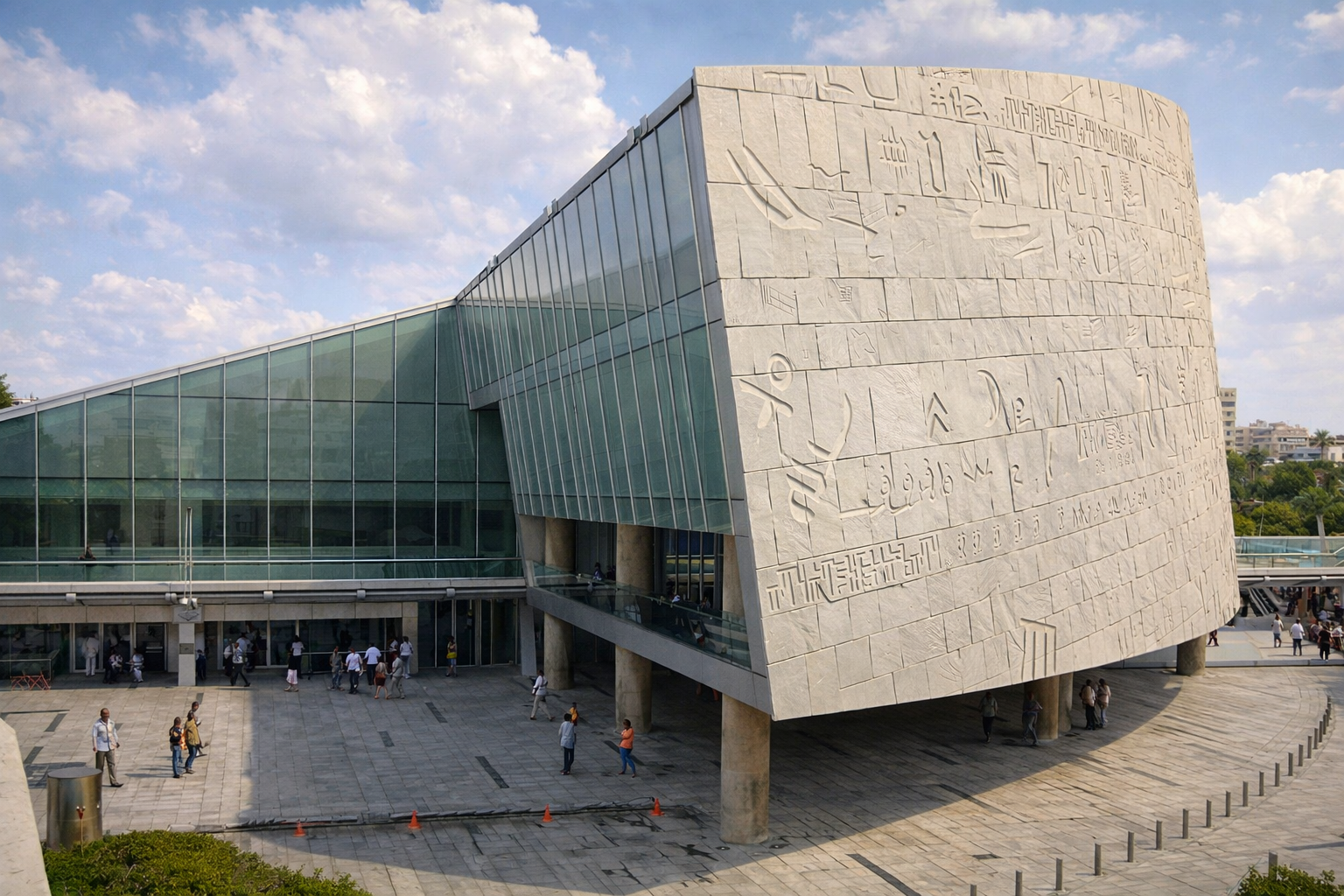
To distinguish it from the ancient one, it is known as the Bibliotheca Alexandrina.