
According to Roman tradition, the city of Rome was founded on April 21, 753 BC.
This date marks not only the origin of a city, but also the beginning of one of the most influential civilizations in history.
For centuries, the Romans told the story of their city’s origin through a myth that blended gods, kings, and family tragedies — a narrative that explained not only how Rome was born, but also the character that would shape its destiny.
Origins: From Troy to Italy
The story of Rome’s origins begins even before the birth of Romulus and Remus.
According to the tradition recorded by authors such as Livy and Virgil, the origins of the Roman people go back to the fall of Troy..
After the destruction of the city by the Greeks, the Trojan prince Aeneas managed to escape, taking his family and a small group of survivors with him.
After a long journey across the Mediterranean, Aeneas arrived in the Italian peninsula, where he settled in the region of Latium.
Over time, his descendants founded the city of Alba Longa, an important city in Latium from which the dynasty that would eventually give rise to Rome emerged.
The Myth of Romulus and Remus
The Birth of the Twins
Generations later, in Alba Longa, King Numitor ruled..
His brother Amulius, eager to seize power, overthrew him and took the throne. To prevent the legitimate family from reclaiming the kingdom, he forced Numitor’s daughter, Rhea Silvia, to become a Vestal Virgin, a priestess who had to remain chaste.
However, according to the myth, the god Mars, the god of war, united with Rhea Silvia.
From this union two twins were born: Romulus and Remus.
When Amulius discovered the birth of the children, he ordered them to be abandoned and thrown into the Tiber River to prevent them from one day claiming power.
The She-Wolf of the Tiber
The fate of the twins changed when the basket in which they had been abandoned became trapped on the riverbank.
According to the traditional story, a she-wolf found the children and nursed them in a cave located on the Palatine Hill..
Later, the twins were discovered by a shepherd named Faustulus, who decided to raise them with his wife Acca Larentia.
As the years passed, Romulus and Remus grew up as strong and courageous young men, still unaware of their true origin.
The Fall of Amulius
When the twins discovered their true lineage, they returned to Alba Longa, overthrew Amulius, and restored the throne to their grandfather Numitor.
After restoring order in the city, they decided to found a new settlement near the place where they had been rescued as children.
That place was the region of the seven hills along the Tiber River..
These hills were:
- Palatine (Palatium)
- Capitoline (Capitolium)
- Aventine (Aventinus)
- Caelian (Caelius)
- Esquiline (Esquilinus)
- Viminal (Viminalis)
- Quirinal (Quirinalis)
The Conflict Between Brothers
However, a dispute soon arose between the twins.
Each wanted to found the new city and become its first king.
To resolve the dispute, they turned to a traditional method of the ancient world: the interpretation of omens.
Remus first saw six birds flying in the sky, but Romulus claimed he had seen twelve. The interpretation of these signs triggered a conflict between them.
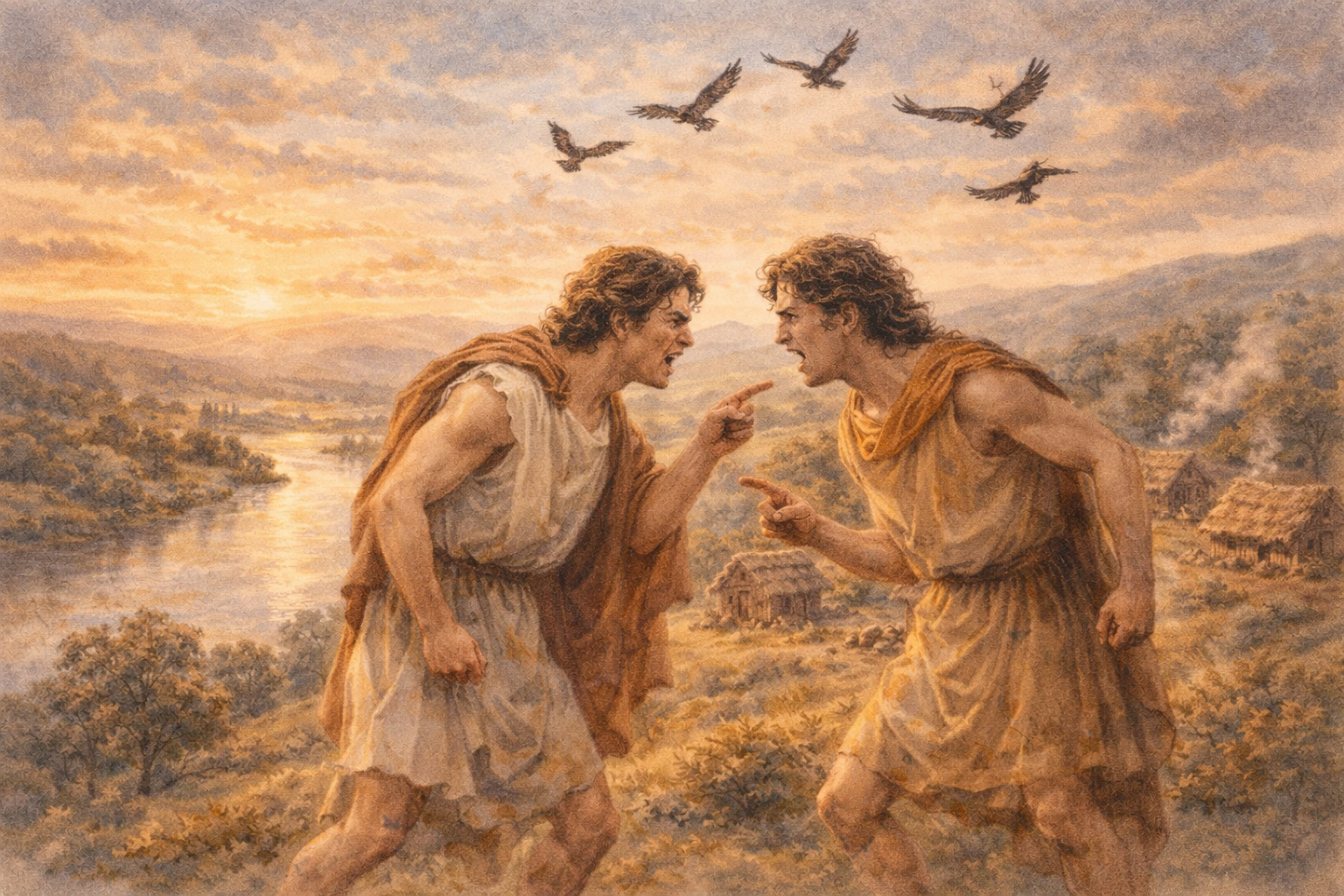
The tension ended in tragedy.
According to the most widespread version of the myth, Romulus killed Remus, becoming the sole founder of the new city.
The Birth of Rome
After the death of his brother, Romulus officially founded the city.
Roman tradition placed this event on April 21, 753 BC.
Romulus traced the sacred boundary of the city, known as the pomerium, and established the first institutions of the new settlement.
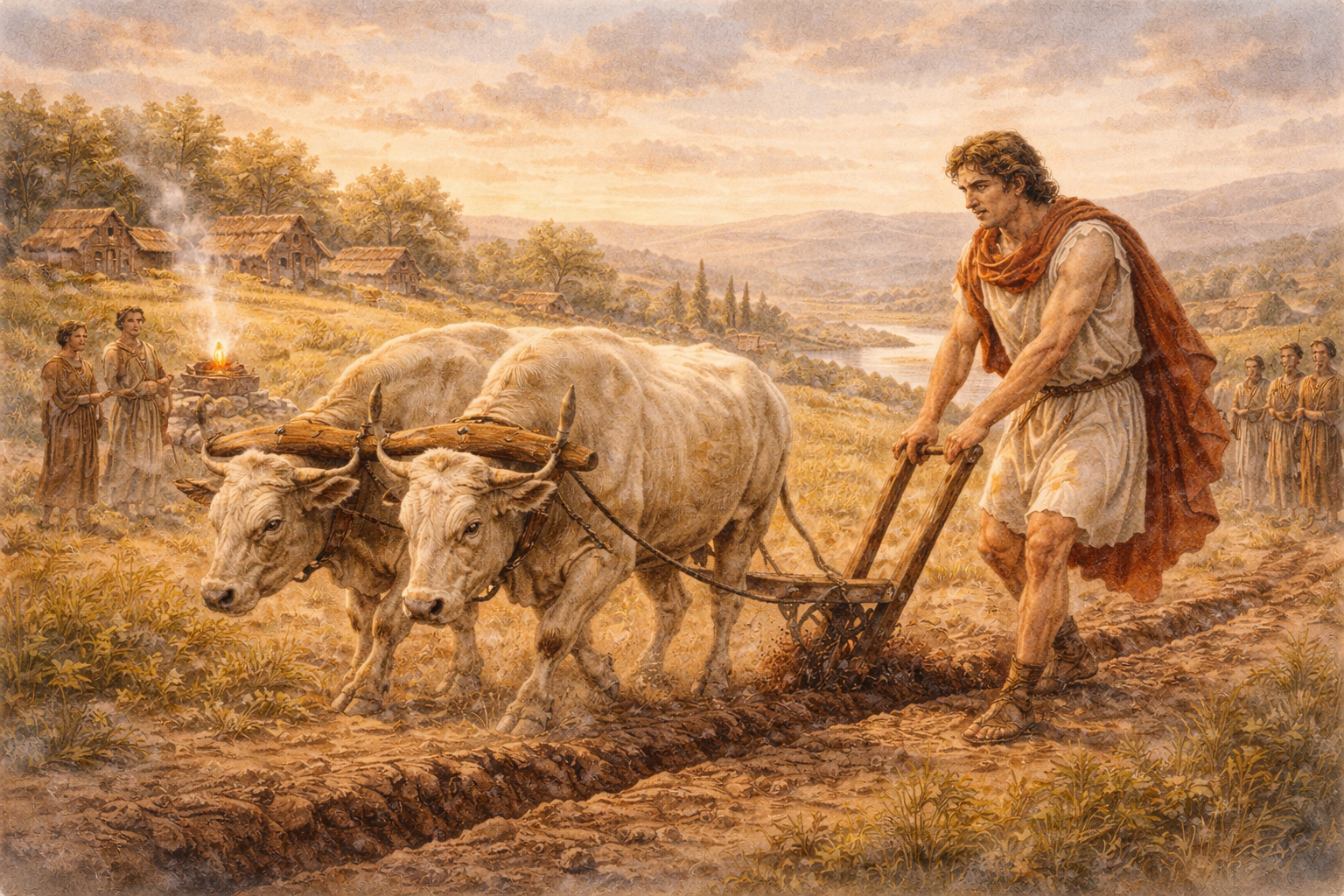
Thus Rome began its history.
The Roman Monarchy
During its first centuries, Rome was a monarchy ruled by kings.
Roman tradition spoke of seven kings of Rome:
- Romulus
- Numa Pompilius (who is credited with reforming the Roman calendar)
- Tullus Hostilius (responsible for the destruction of Alba Longa around the 7th century BC)
- Ancus Marcius
- Tarquinius Priscus
- Servius Tullius
- Lucius Tarquinius Superbus (Tarquin the Proud)
Tarquin the Proud ruled approximately between 534 BC and 509 BC, when he was expelled from Rome.
The Roman Republic
In 509 BC, the Roman Republic was established República romana, a new political system in which power was distributed among several institutions.
Among them:
- the consuls, elected each year
- the Senate
- various magistracies
According to tradition, the first two consuls were:
- Lucius Junius Brutus
- Lucius Tarquinius Collatinus
The Roman Empire
After the civil wars of the 1st century BC, power ultimately concentrated in the hands of Octavian.
In 27 BC, the Senate granted him the title Augustus, and he became known in history as . Augustus Octavian (27 BC – AD 14), considered the first emperor of Rome.
Although Augustus maintained many republican institutions, the emperor held enormous authority:
- military power
- political power
- religious authority
The Senate continued to exist, although with more limited functions.
His rule marked the beginning of a period of stability known as the Pax Romana.
A Foundational Myth
The Romans claimed that their people descended from the hero Aeneas, who escaped the destruction of Troy and arrived in Italy.
This story appears especially in the work of the Roman poet Virgil, in his epic poem The Aeneid.
According to this narrative:
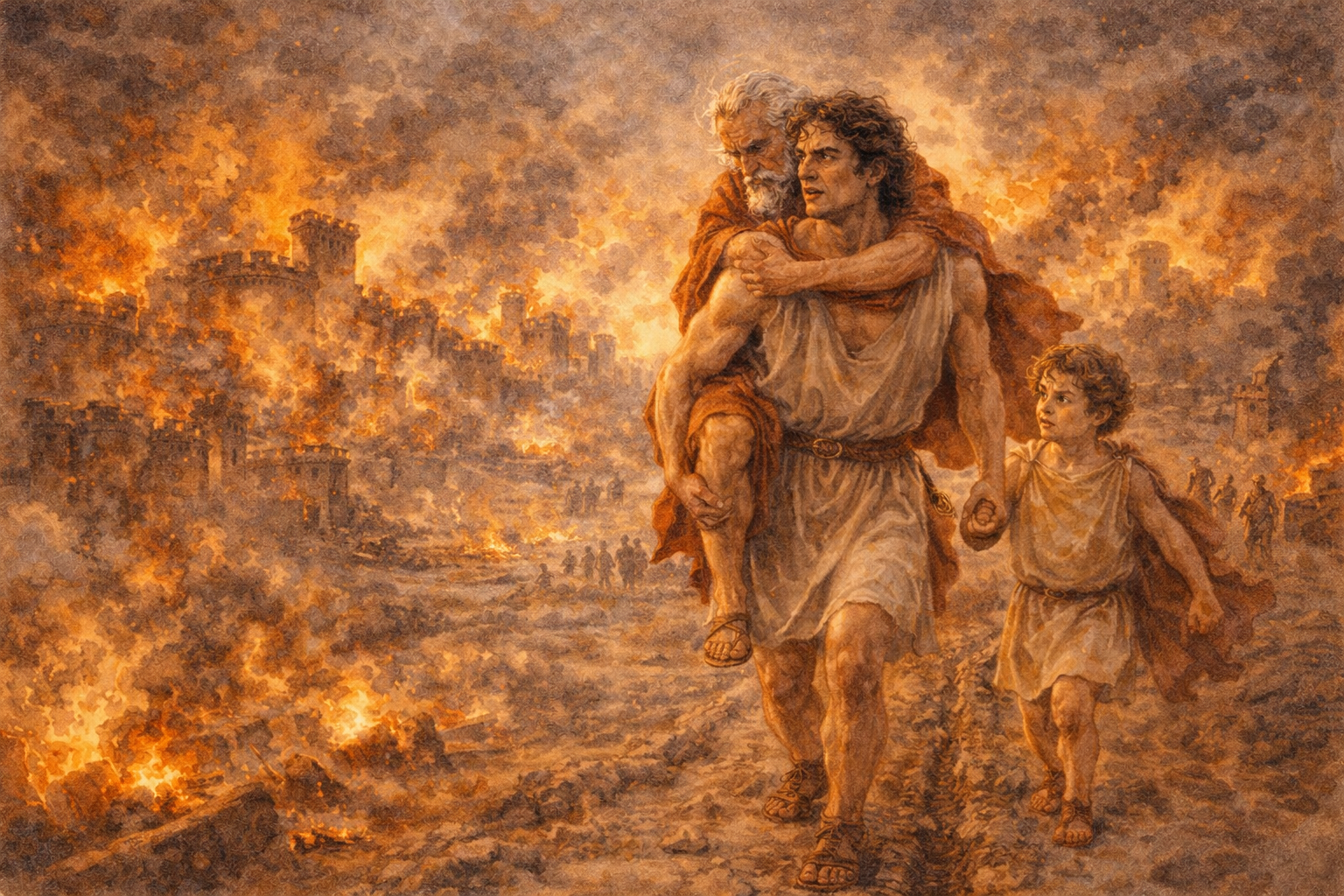
- Troy is destroyed by the Greeks
- Aeneas escapes with survivors
- after a long journey he reaches Latium
- his descendants eventually found Rome
For the Romans, this myth contained essential elements of their identity:
- their divine origin through the god Mars
- their link to the heroic tradition of Troy
- the importance of war and expansion
- the idea that Rome was destined to rule
Between Myth and History
Today, historians consider the story of Romulus and Remus to belong to the realm of myth.
However, archaeology has shown that the region of Rome’s seven hills was already inhabited several centuries before the traditional foundation date.
During the siglo 8th century BC, several small settlements gradually merged around the Tiber River, forming a larger community.
Over time, that community would become the city the Romans called Rome.
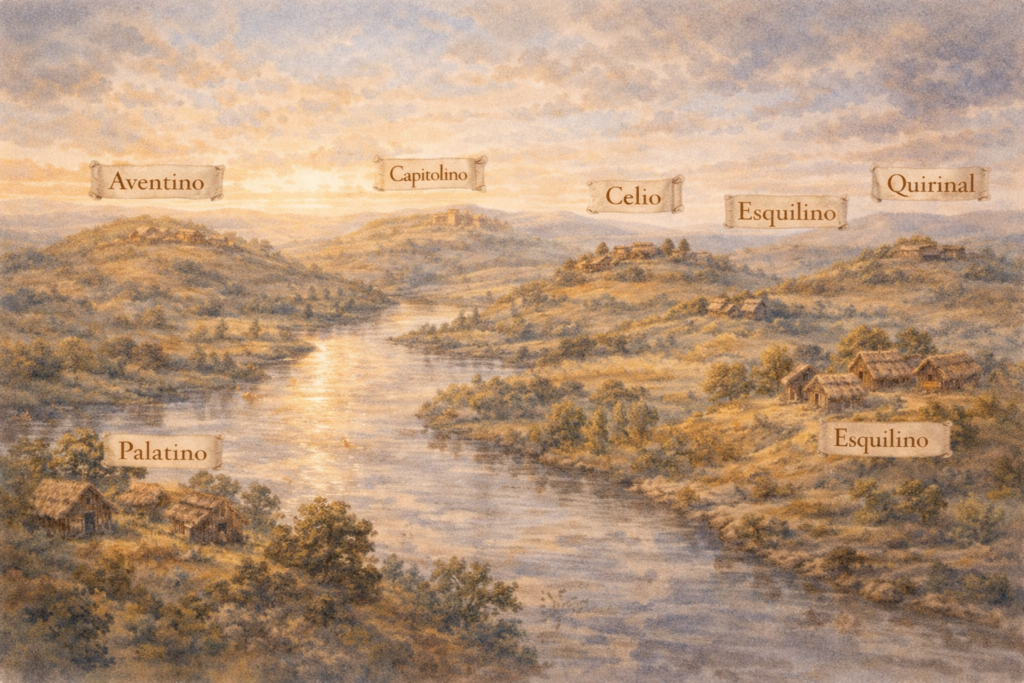
The Seven Hills of Rome 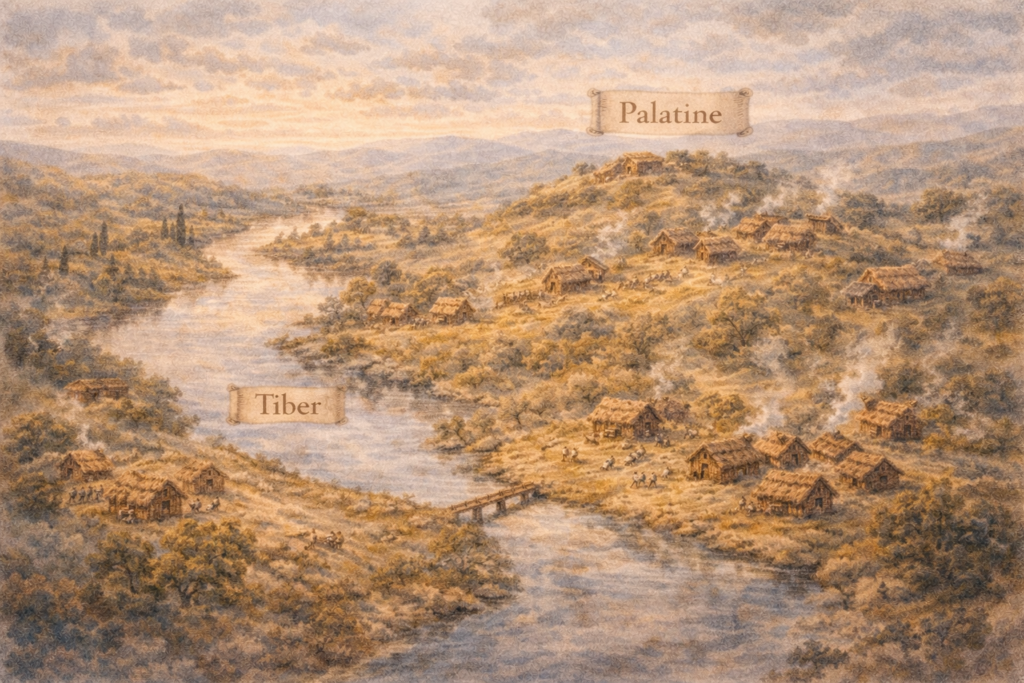
Early settlements near the Tiber, Rome
The Birth of a Civilization
Over the centuries, Rome evolved from a small settlement into a republic, and later into an empire that would dominate much of the Mediterranean world.
But for the Romans, everything began with a story passed down from generation to generation.
A story of gods, abandoned twins, a she-wolf beside the river, and a conflict between brothers that marked the birth of a city destined to change history.
Curiosities
April 21, 753 BC
The traditional date of Rome’s foundation, April 21, 753 BC, comes mainly from a Roman scholar named Marcus Terentius Varro, who lived in the 1st century BC (116–27 BC).
Varro attempted to organize all Roman history into a coherent timeline. To do this, he compiled:
- ancient traditions
- lists of kings
- religious records
- Greek chronologies
The date also 21 de abril coincidía con una antigua fiesta pastoral romana llamada Parilia. , dedicated to Pales, the goddess who protected shepherds.
This festival included purification rituals for fields and livestock.
After establishing this date, the Romans began using a system of timekeeping called Ab urbe condita (AUC), meaning “from the founding of the city.”
However, in practice Romans usually identified years by the names of the consuls in office. cónsules en el poder.
Lupa vs. She-Wolf
Some historians have pointed out that the Latin word lupa means “she-wolf,” but in popular Latin it was also used to refer to a prostitute.
In fact, the word lupanar (brothel)comes from the same root.
According to this interpretation, the figure of the she-wolf who nursed Romulus and Remus may have arisen from a linguistic confusion related to Acca Larentia, the wife of Faustulus, who according to some traditions was nicknamed lupa.
Over time, the term may have been interpreted literally, giving rise to the famous myth of the she-wolf of the Palatine.
Rome also had a strong connection with Mars, and animals associated with Mars included:
- the wolf
- the woodpecker
The image of the she-wolf nursing the twins became one of the most famous symbols of the city.
The famous sculpture known as the Capitoline Wolf represents exactly this scene.
For centuries has been considered one of the most important emblems of Rome.
Follow the Footprints
His legacy continues in…
Even today, April 21 is celebrated in Rome under the name Natale di Roma, which literally means “Birth of Rome”.
During these celebrations there are:
- Roman historical reenactments
- parades.
- cultural events
- public festivities
A tradition that connects directly with the ancient Roman calendar.