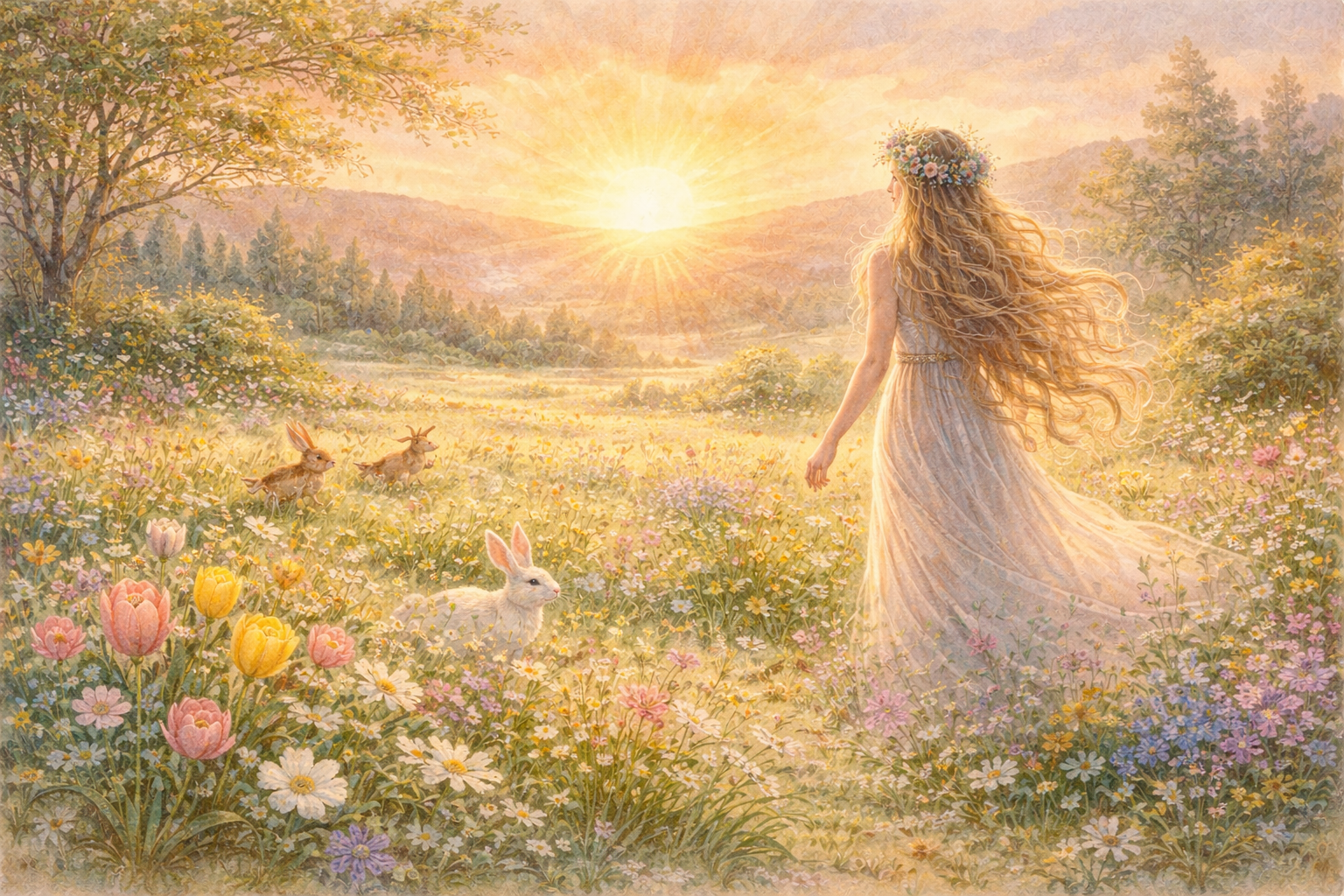
Ēostre or Ostara , was a divinity of the Germanic world associated with dawn and the renewal of spring. Although she does not belong to Celtic mythology, she embodies a far more ancient archetype: the return of life after winter — a theme present across numerous cultures, from Mesopotamia to the Mediterranean.
As winter begins to withdraw and light gradually regains dominance, many ancient societies regarded this transitional moment as sacred. The arrival of spring was not merely a climatic shift; it represented survival, fertility, and the renewal of life itself.
This rebirth found expression in festivals linked to the return of light, the awakening of the earth, and the beginning of a new natural cycle.
Ostara and Her Germanic Roots
In antiquity, the Anglo-Saxon month Ēosturmōnaþ was dedicated to Ostara — both a goddess and a springtime celebration observed around the spring equinox, between late March and early April. She was associated with a feminine divinity connected to dawn, fertility, and the rebirth of nature.
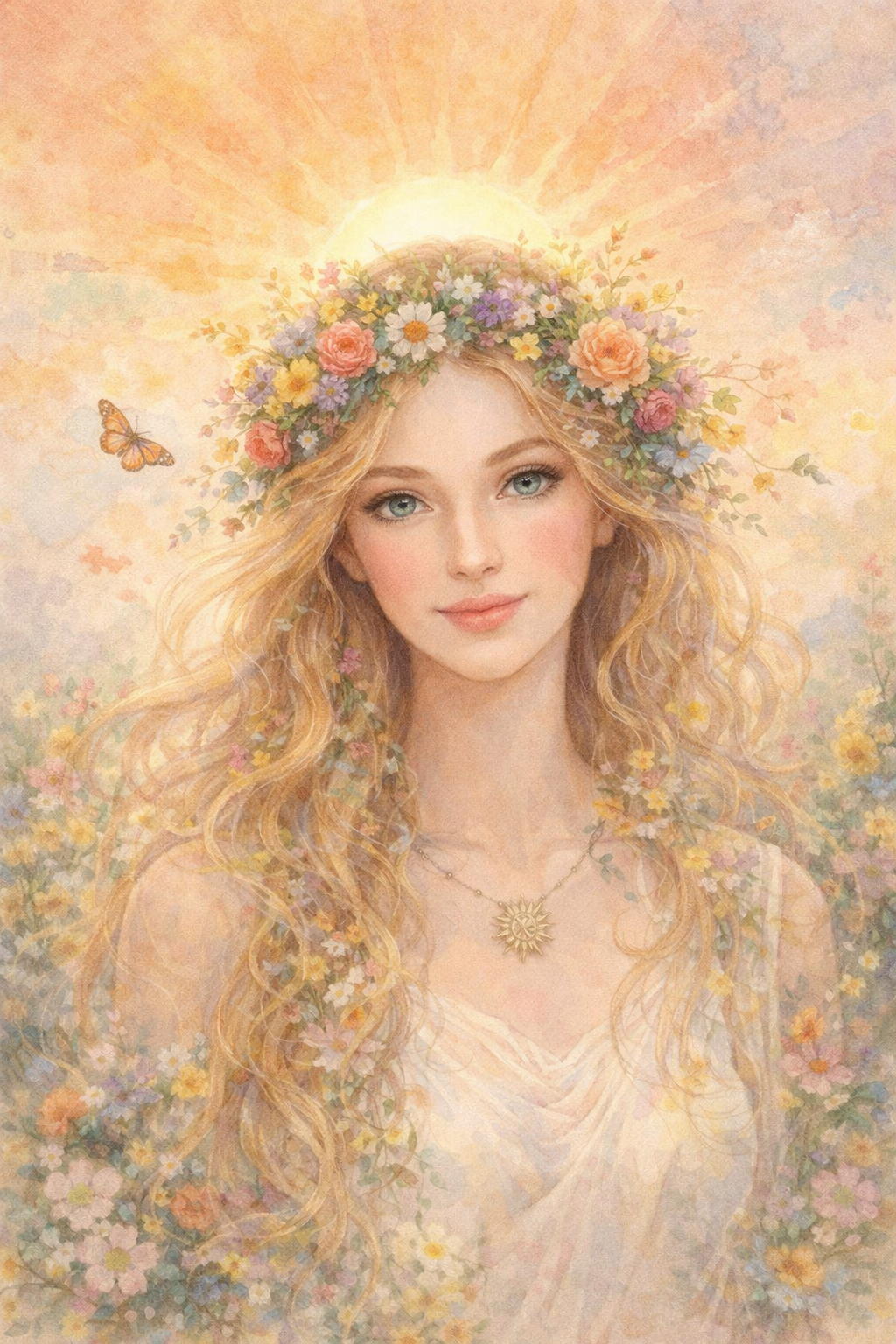
Her principal symbols clearly reflect this message:
- Eggs: representations of new life and latent potential
- Hare or rabbit: ancient symbols of fertility
- Flowers and budding plants: the earth awakening after winter
- Growing light: the balance shifting in favor of the day
Her symbolic function was equally significant:
- Marking the equilibrium between light and darkness
- Presiding over the awakening of the earth
- Opening the new agricultural cycle
The name Ostara is linked to the Indo-European root aus-:
- Dawn
- East
- Sunrise
- The birth of light
Anglo-Saxon and Germanic peoples celebrated the arrival of spring through:
- Spring rites
- agricultural rituals
- Fertility offerings
- Equinox celebrations
Even the English word Easter preserves this same etymological root, unlike the Spanish Pascua, derived from the Hebrew. Pesach. Over time, Christianity adopted the term Easter to designate the Paschal celebration
The Only Historical Reference
The sole historical source explicitly mentioning Ostara appears in the writings of Bede the Venerablein the 8th century (c. 725 CE). In De temporum ratione, he explains the Anglo-Saxon calendar and notes the divinities that gave their names to the ancient months.
Bede refers to Ēostre as an early spring divinity but provides no detailed description of specific rituals. The symbols now associated with Ostara — eggs, fertile animals, and seasonal rebirth — do not originate from a single preserved myth. Rather, they arise from universal agricultural archetypes shared by many cultures throughout antiquity.
From Pagan Festival to Christian Reinterpretation
As Christianity expanded across Europe between the 5th and 7th centuries, these spring celebrations were not entirely erased but gradually reinterpreted. Between the 7th and 9th centuries, many pagan festivals underwent progressive Christianization.
The rebirth of nature was replaced by the resurrection of Christ, yet several elements remained:
- Datesnear the spring equinox
- Certain symbolic motifs, such as the egg
- Ritual structurescentered on renewal
This transformation was neither sudden nor uniform, but long and gradual. In Germanic regions, the Christian Easter came to be celebrated on dates coinciding with earlier seasonal festivities. The names Easter (English) and Ostern (German) likewise endured.
Symbols
The Egg
Across many ancient cultures, the egg symbolized life and regeneration. Civilizations such as Mesopotamia, Persia, and Egypt associated it with birth and vital potential.
In early Christianity (4th–5th centuries), the egg became a symbol of resurrection. During the Middle Ages, the custom of blessing and consuming boiled eggs at Easter is well documented.
The tradition preserved in the decorated egg tradition emerged later, particularly between the 15th and 16th centuries, especially in Central and Eastern Europe (Germany, Austria, and Slavic regions). Examples include the Ukrainian pysanky — painted eggs tied to both spring and Christian Easter, rather than directly to Ostara.
The Hare or Rabbit
Within the Germanic world, the hare was linked to fertility symbolism and often regarded as a liminal creature associated with lunar cycles and natural rhythms.
The rabbit as an Easter figure first appears in the 17th century in Protestant Germany. In 1682, the German physician Georg Franck von Franckenau described the popular belief in the Osterhase — an Easter hare said to bring eggs to well-behaved children.
Modern iconography would develop much later.
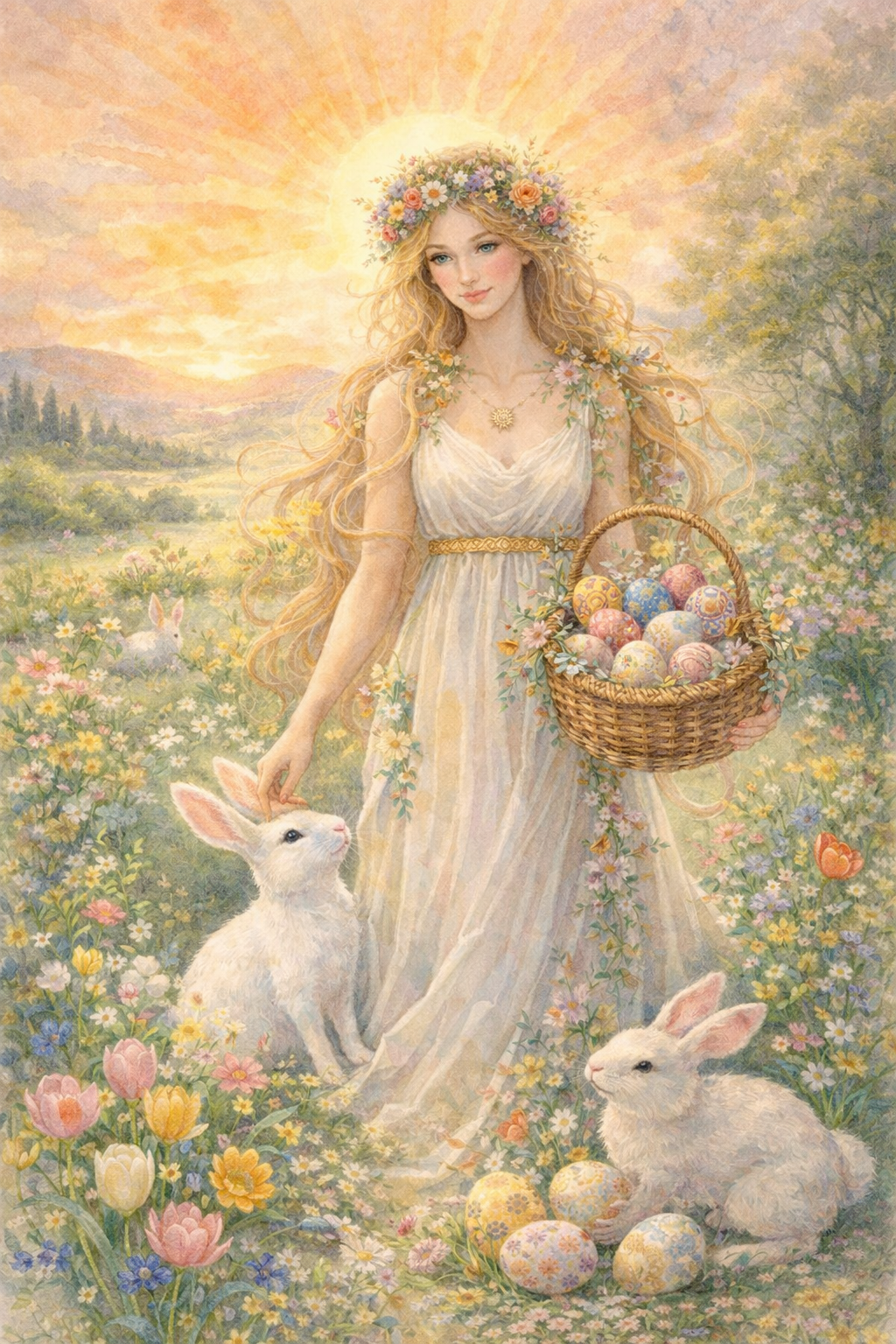
From Ancient Symbols to a Global Celebration
Although springtime symbols are deeply ancient, the modern imagery of decorated eggs and egg-bearing rabbits solidified during the Early Modern period:
- 17th century — earliest references to the Osterhase
- 18th century — spread of regional traditions
- 19th century — emergence in illustrations, children’s literature, and greeting cards
These traditions later traveled to the Americas, where they became widely popularized and eventually globalized.
Far Older Roots of the Spring Archetype
While Ostara belongs to the Germanic tradition, the archetype she represents is vastly older. Long before Christianity, cultures such as Mesopotamia, Egypt, and Greece expressed the cyclical return of life through myths of descent, absence, and renewal.
Mesopotamia: The Origin of the Pattern
Over 4,000 years ago, Mesopotamian mythology preserved one of the earliest written expressions of this cycle: Inanna (Ishtar) descends into the underworld. During her absence, the earth becomes barren. Upon her return, life is restored.
This myth, connected to the Mesopotamian New Year (Akitu), established a recurring symbolic structure:
symbolic death → absence → return → renewal
Egypt: Life Emerging from Death
In Egypt, the cycle appeared through the myth of Osiris and IsisOsiris dies, is reassembled, and is reborn as lord of the afterlife, while the Nile’s flooding renews fertility across the land.
Egyptians even planted seeds in funerary figurines, allowing wheat to sprout from symbols of death itself. Life and death were understood not as opposites, but as inseparable phases of the same eternal cycle.
Greece: The Myth as Emotion
Greek mythology gave this archetype a deeply human dimension. Demeter and Persephone. Persephone descends into the underworld. Demeter mourns, and the earth withers. When Persephone returns, spring begins anew.
Rome: The Cycle Institutionalized
Rome integrated these patterns into its calendar. The month of April (Aprilis), associated with Venus and Flora, celebrated fertility, growth, and the ritualized opening of the earth.
Ostara as a European Expression
Ostara did not arise in isolation. She belongs to a long-standing archetype shared across civilizations:
Life fades, rests, and returns.
A Cycle That Never Breaks
Each spring repeats a message well known to our ancestors: Nothing truly disappears — everything transforms. Ostara is not merely an ancient festival, but a way of understanding time itself: Not as a straight line, but as an endless cycle.
And that knowledge, though renamed and reshaped, remains very much alive.