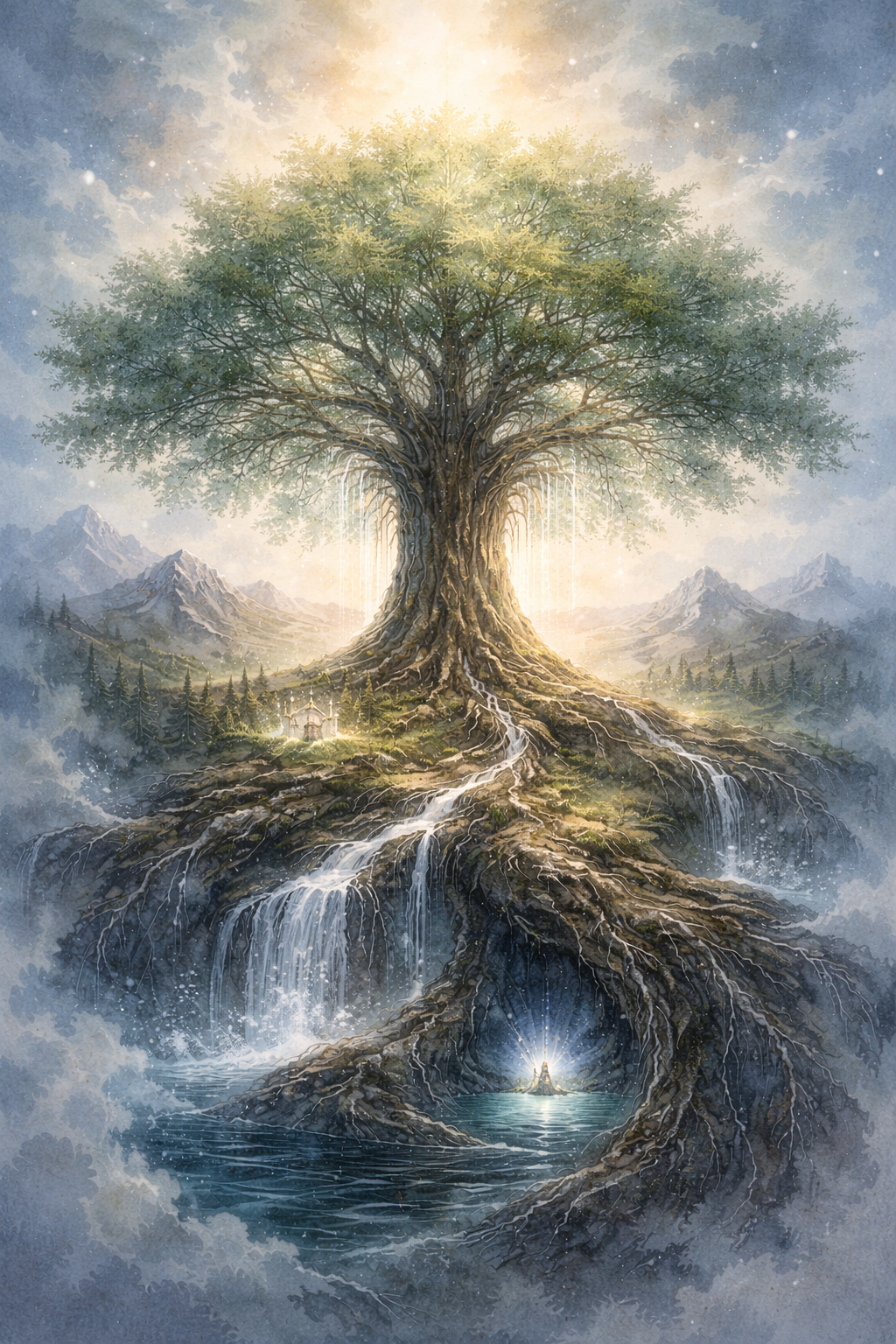
The sacred ash tree that sustains the universe. YggdrasilIt is no ordinary tree, but a cosmic axis (axis mundi) que conecta los Nine Worlds y permite el tránsito entre ellos. Su nombre puede traducirse como “Odin’s horse", referring to the sacrifice Odin made by hanging himself from its branches in order to gain knowledge of the runes.
The Nature and Symbolism of Yggdrasil
Yggdrasil is described as a majestic tree whose branches stretch across the heavens and whose roots sink into the deepest levels of existence.
It represents the structure of the world, but also life, wisdom, and cyclical renewal. It is a living, conscious being, constantly suspended between growth and decay.
The Three Great Roots and the Sacred Wells
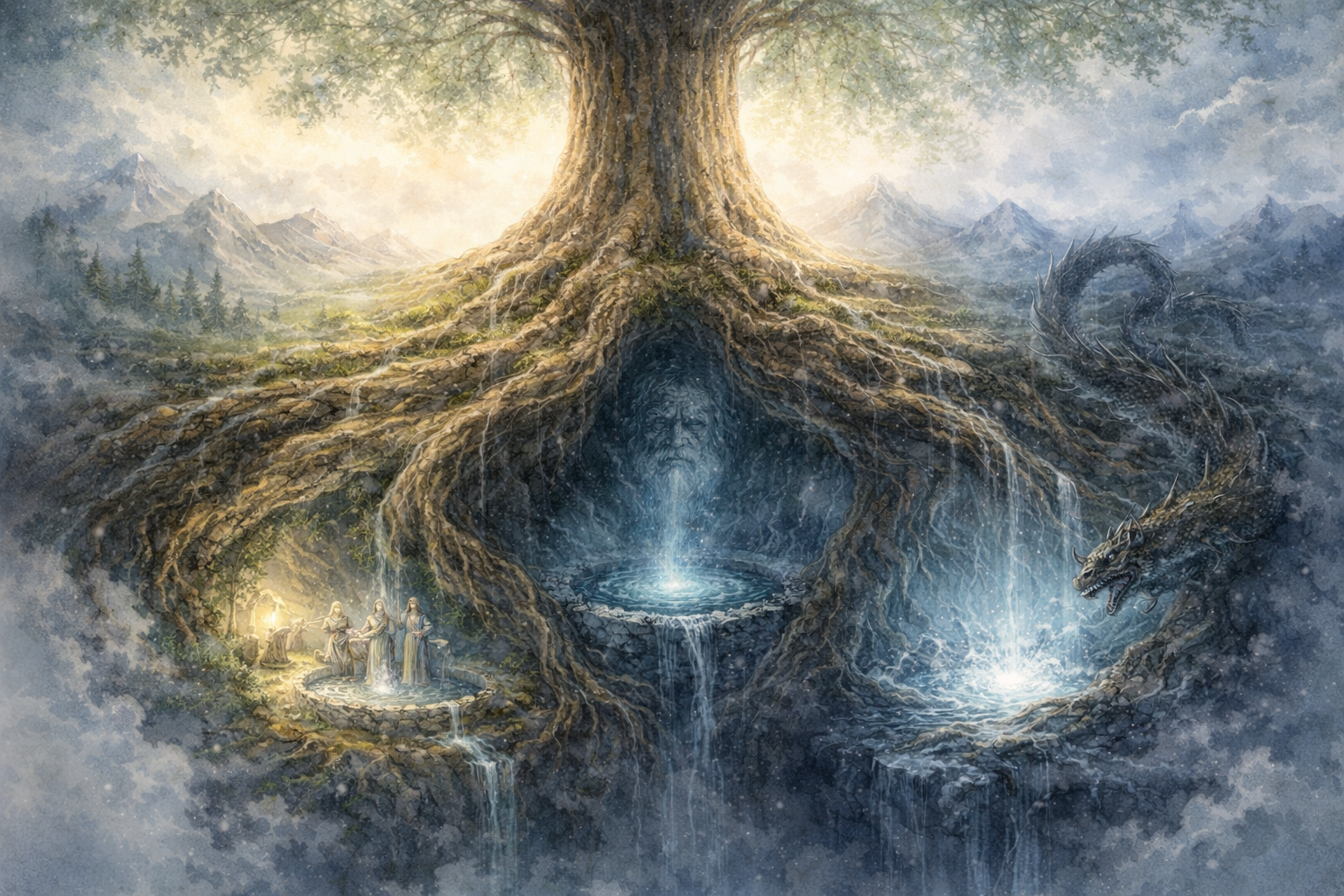
Each of Yggdrasil’s three main roots extends into a different world and is nourished by a sacred well:
- Primera raíz: Asgard
In Asgard , the realm of the Æsir, lies the Well of Urd (Urdarbrunnr), guarded by the Norns, the three wise women who weave the fate of gods and mortals.They water the roots with water from the well and white clay, preserving the vitality of the tree and preventing it from withering.
- Segunda Raíz: Jötunheim
This root stretches into Jötunheim, the land of the frost giants. There lies the Well of Mímir, guardian of ancient wisdom.
Odin sacrificed one of his eyes to drink from its waters and gain access to profound and dangerous knowledge.
- Tercera Raíz: Niflheim
The realm of ice and mist. Here flows Hvergelmir, the primordial source of all waters. Dwelling within it is Níðhöggr, the dragon that relentlessly gnaws at the root.
Creatures That Inhabit Yggdrasil
Yggdrasil is alive and inhabited by numerous creatures that interact with its roots, trunk, and crown. Some protect it, others wear it down, and others simply form part of its delicate balance.
- Níðhöggr (“He Who Strikes with Malice”)
- Form: A gigantic dragon or serpent
- Location: Coiled around the deepest roots of Yggdrasil in Niflheim, near the spring Hvergelmir.
- Function: Gnaws at the root, feeding upon it.
- Symbolism: Destruction, corruption, natural decay, and the necessary cycle of death and renewal.
During Ragnarök, Níðhöggr will take on a prominent role, dragging corpses and symbols of disorder from the underworld.
- Ratatoskr (“Sharp Tooth”)
- Form: A small but agile squirrel, red or chestnut in color.
- Location: Runs along the trunk between the roots and the crown.
- Function: Carries messages and insults between Níðhöggr and the eagle.
- Symbolism: Rumor, conflict, distorted communication.
Ratatoskr is a minor but constant agent of chaos, symbolizing how harmful communication can disrupt the cosmic order.
- The Nameless Eagle
- Form: A gigantic, majestic, and wise eagle.
- Location: At the top of the tree.
- Distinctive feature: perches between its eyes a hawk named, Veðrfölnir..
It is traditionally seen as a symbol of elevated vision and cosmic wisdom. It observes but does not intervene.
- Veðrfölnir (“He Who Stirs the Weather”)
- Form: A hawk with piercing eyes.
- Location: Between the eyes of the great eagle.
- Symbolism: Perception, wind, movement through the air, the link between vision.
And thoughtIts name suggests a connection to the skies and the climate, as if its presence could influence the winds.
- Los cuatro ciervos: Dáinn, Dvalinn, Duneyrr y Dúraprór
- Location: On the middle branches of the tree, near Midgard.
- Function: They graze on the leaves, wearing the tree down.
Symbolism of their names:
- Dáinn: “The dead”
- Dvalinn: “The dormant / delayed”
- Duneyrr: “The roaring one”
- Dúraprór: “The enduring / persevering one”
They represent natural cycles: seasons, life and death, stillness and movement, resistance and change.
- Possible Lesser Serpents
The Eddas mention that, besides Níðhöggr, many serpents dwell among the roots of Yggdrasil, contributing to its gradual erosion.
They symbolize latent dark forces, subtle threats, and contained chaos.
They do not act directly upon the tree, but they are part of the environment that surrounds it.
- The Norns:Weavers of Fate
Names:
- Urd (“That which has been”)
- Verdandi (“That which is becoming”)
- Skuld (“That which shall be / that which is owed”)
- Location: By the Well of Urd, at the roots of Yggdrasil.
- Function: They weave the fate of all living beings, carve runes, and water the roots of the tree with pure water from the Well of Urd.
- Symbolism: The Norns embody the idea that time is a living tapestry rather than a straight line, and that everything is interwoven within the great web of the cosmos.
Without them, Yggdrasil would wither.
Yggdrasil and the Fate of the World
Though immense and sacred, Yggdrasil is not invulnerable. The creatures that inhabit it wear it down, the Norns care for it, and during Ragnarök it will suffer terrible tremors.
Yet it will not be destroyed.
The tree will survive, and after the renewal of the world, it will grow green once more in the new age.