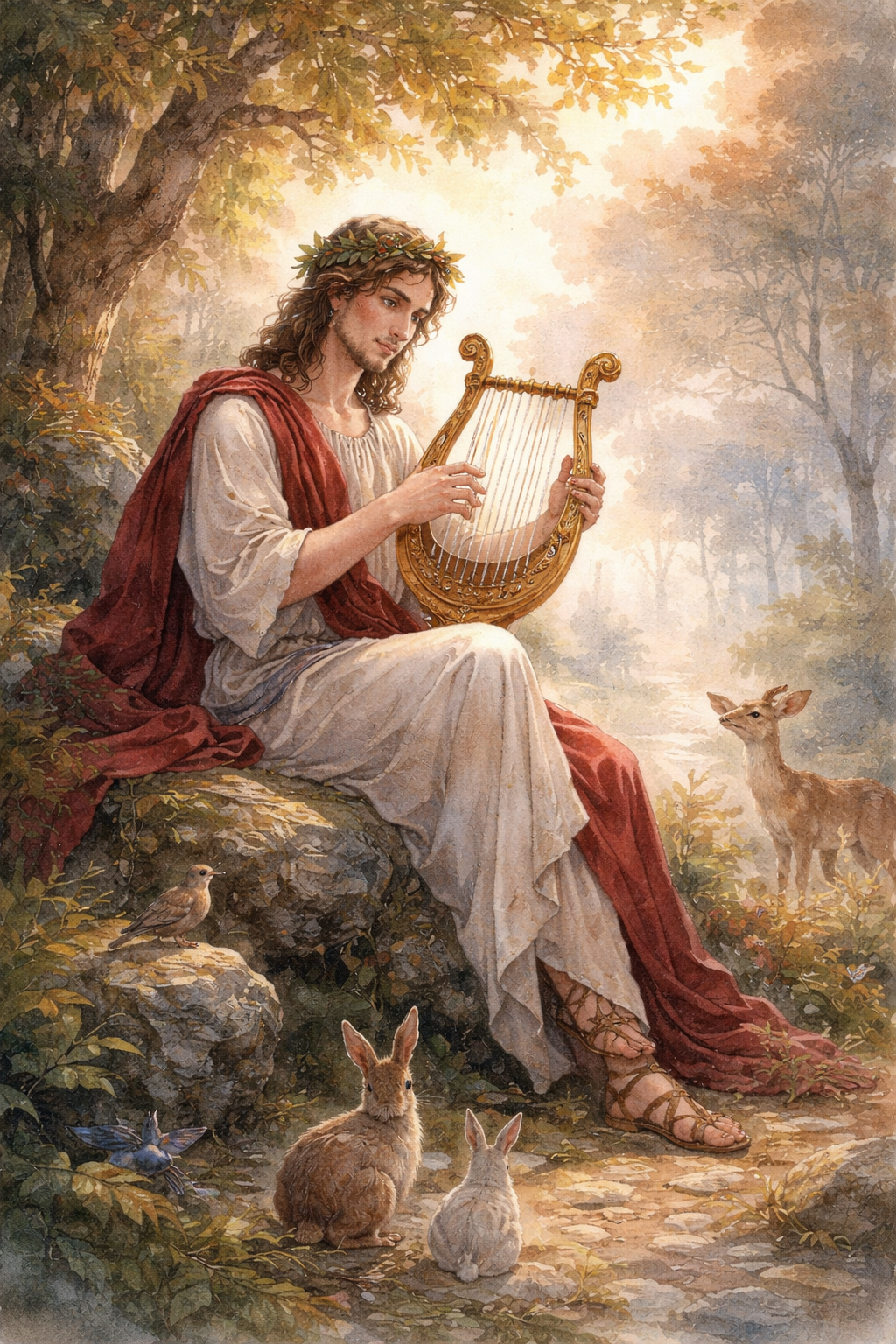
Orpheus was not a hero of sword or strength. He raised no empires. He conquered no cities. He did not slay monsters with iron. His gift was something else.
Orpheus was a musician. They say that when he played the lyre, the world would pause, as if remembering something ancient. Animals stopped in mid-step. Trees bent their branches. Even stones—yes, even stones—seemed to listen. This was not music meant to entertain. It was music that revealed. He had been born with that power in his blood.
Orpheus was the son of Calliope, muse of epic song, and some also claimed he had received his lyre from Apollo himself. Whether true or not, what mattered was this: Orpheus played as if his fingers knew things most humans never learn—sorrow, beauty, consolation… and the precise wound left by love when it disappears.
And then Eurydice appeared.
We know little about her. Myths are unjust to certain figures: they allow them to exist only as destiny, spark, or loss, granting them almost no history. But we know what truly matters, because what truly matters is what breaks the world: Orpheus loved her. And Eurydice loved him.
It was not a dramatic love, nor a passion of war. It was intimate, quiet, profound. A clean love—as if each had found in the other a place to rest.
They married. And for a brief instant, the world seemed whole. There were songs. There were flowers. There was a happiness so simple it was frightening: the happiness of believing joy might last.
Just after the wedding, tragedy arrived.
They say Eurydice was walking through the grass, perhaps still carrying the day’s laughter on her lips. Then something happened—something that changes depending on who tells the story—but every version contains a flight.
Some say a man pursued her: Aristaeus, a hunter or shepherd who became obsessed with her. Eurydice ran, driven by fear or rejection, and in that desperate escape fate awaited her at the lowest place of all: the ground.
A serpent bit her.
In some tellings, Eurydice died instantly, as if life left her all at once. Other versions are crueler: the venom was not immediate. Eurydice had time to feel the pain, to understand something terrible had happened. Orpheus held her as life slowly faded away.
Eurydice died. And the world lost its meaning.
Orpheus did not curse the gods. He did not accuse fate with grand words. It was as if music itself had vanished.
But Orpheus—and his love for Eurydice—refused to surrender. He did the unthinkable. He decided to descend into the underworld.
The Descent into Hades
No mortal was meant to cross that boundary. Death has its laws, and the realm of the dead does not welcome visitors. But Orpheus carried no sword. He carried his lyre. He walked to the edge of the world, passing through caverns and shadowed paths where light struggled to remember what it meant to be light. He descended without stopping. Until he reached the river.
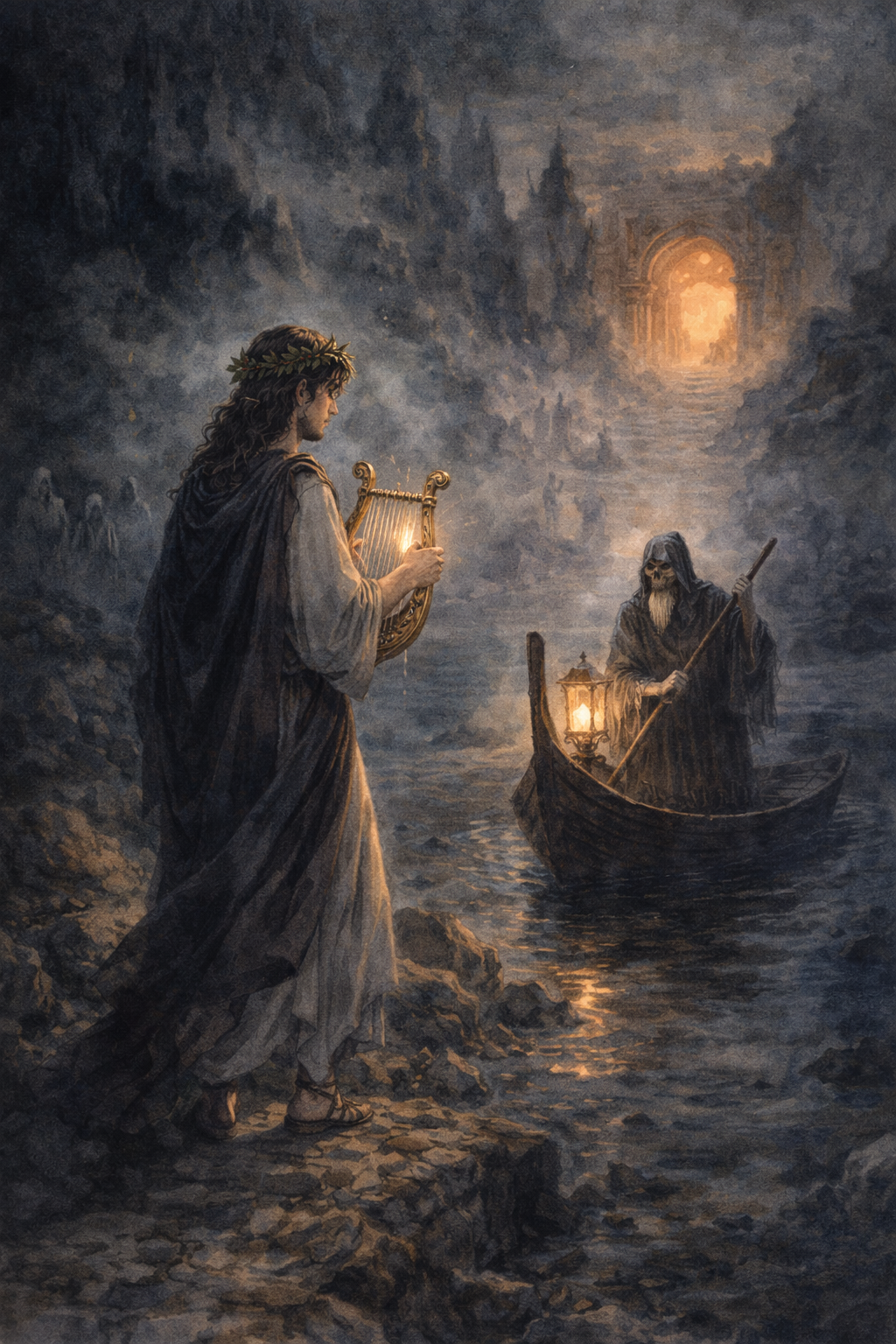
There stood Charon, the ferryman of the dead, his face aged and hardened, tasked with carrying souls across. Charon was not meant to accept the living. But Orpheus played. And the music crossed the air like a prayer. Charon listened—and for a single moment, the impossible happened: the ferryman felt something like compassion. He allowed Orpheus into the boat and carried him over.
Farther on waited Cerberus, the three-headed hound guarding the gate, jaws raised, fangs exposed. Orpheus played. And Cerberus, creature born to guard horror itself, fell asleep.
Orpheus continued, the lyre his only torch. Souls paused as he passed. The Furies—who never weep—let silent tears fall. All of the underworld seemed to listen.
And finally, in the deepest shadow, stood Hades and Persephone: king and queen of the dead. Gods who do not negotiate.
Orpheus knelt and played. The music spoke pain.
It spoke of love and interrupted life, of injustice condensed into a single moment. It spoke of a woman who had died too soon. It spoke of the emptiness death leaves when it enters a young home.
And for a moment…even gods were moved. Persephone lowered her gaze. Hades, who rarely grants anything, remained silent.
When Orpheus finished, the world felt even stiller than before. Then Hades spoke. He could take her back. But under one condition.
The Condition
Orpheus would walk ahead. Eurydice would follow behind. And Orpheus must not look back.
Not once. Not for an instant. Not even when they neared the exit. Not even when the light of the upper world appeared like a distant memory. He could not turn until both had fully left the underworld.
If he did, Eurydice would return to death. Forever.
Orpheus agreed.
The Ascent
They began to walk. Orpheus moved forward, his heart trembling in his chest. He could not see her—but he felt her. Eurydice was there, a few steps behind. He heard the faint trace of her presence, the soft—almost imagined—sound of footsteps following.
The darkness was long. The silence infinite. Orpheus walked blindly, held together by a fragile certainty: she is coming with me.
Gradually, light appeared ahead—a distant clarity, like the memory of day. Orpheus felt the air change. He sensed the exit was near.
And then, just before crossing, doubt bit into his soul:
What if she isn’t there?
What if Hades deceived him?
What if what he hears are not footsteps… but hope inventing sound?
Orpheus felt the terror of losing her a second time. And that terror—fear gnawing even at pure love—became stronger than his promise. Orpheus turned. Only for an instant. And he saw her.
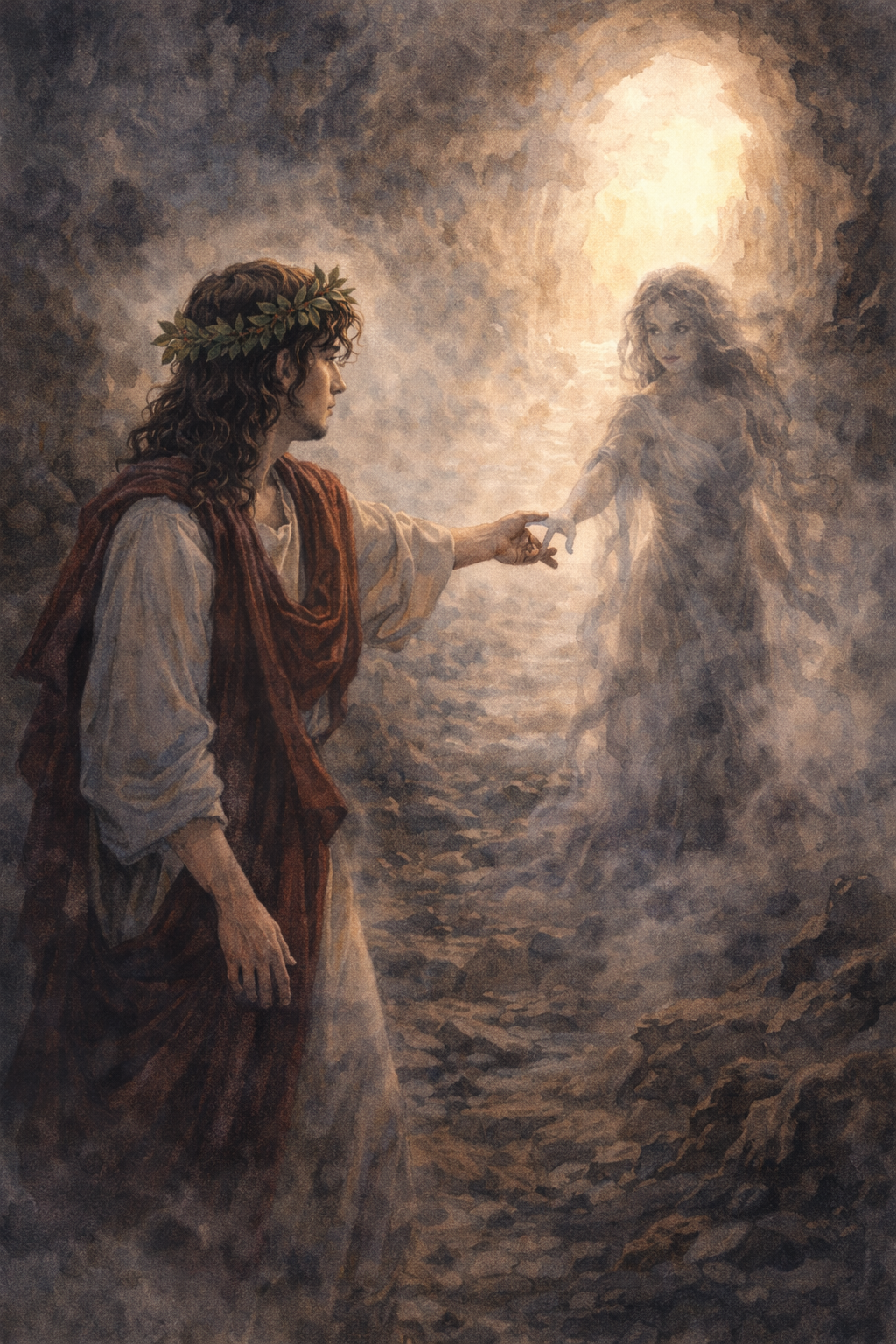
Eurydice stood there, reaching out to him, as if she were about to touch him— but her face was already fading.
There were no screams. No rage. No accusations. Only one word:
-Goodbye.
And Eurydice vanished, returning to Hades.
Orpheus stood staring into nothingness, understanding too late that love alone is not always enough when doubt pierces it.
After Eurydice
Orpheus returned to the upper world. But he was no longer the same. He played again—but the music had changed. It no longer consoled. It wept.
They say Orpheus never loved again. He rejected other women. Rejected desire. Rejected what once felt natural—not because he hated love, but because he still belonged to Eurydice. That fidelity led to his end.
According to one famous version, Orpheus was attacked by Thracian women—maenads, followers of Dionysus—furious, jealous, humiliated by his refusal. In madness, they tore him apart.
And still the myth denied him silence: his severed head, cast into the river, continued to sing.
Other sources tell something darker: Zeus struck him down with lightning. Not from passion or jealousy—but from fear. Because Orpheus had entered the underworld and returned. Because he knew secrets. Because he had seen what lies beyond.
However it happened, Orpheus died.
And only then—when he had no body, no human voice, no fear—did Orpheus finally see Eurydice again.
The shadows say they reunited in the underworld, without promises, without conditions, without trials. Just two souls. And for the first time, no possibility of loss.
The Origin of the Myth
Orpheus and Eurydice is a myth from Greek mythology, born from oral tradition and deeply tied to the religious and spiritual beliefs of the ancient world.
Orpheus is a mythical figure: son of a muse, mortal yet gifted with supernatural powers, capable of crossing forbidden boundaries between life and death.
The myth predates the 6th century BCE and appears in traditions older than Homer. It has no single author; it evolved over centuries. Among those who retold it:
- Pindar
- Plato
- Euripides
- Virgil
- Ovid, in Metamorphoses (who established the most famous version)
Orphism
Orpheus also gave rise to a religious-philosophical movement known as Orphism, centered on:
- the soul
- guilt
- purification
- cycles of death and rebirth
- descent into the underworld
For the Orphics, the soul was trapped in the body, and music, knowledge, and purification could liberate it.
The Meaning of the Myth
This is not merely a love story. It is a story about loss and irreversibility. About the impossibility of recovering what has vanished. About the conflict between love and trust. About human limits before time and death.
Orpheus does not lose Eurydice for lack of love:
- He loses her because of fear.
- He loses her because of doubt.
- He loses her because he looks back.
And that gesture—so small, so instantaneous—is so deeply human…that it still hurts centuries later.