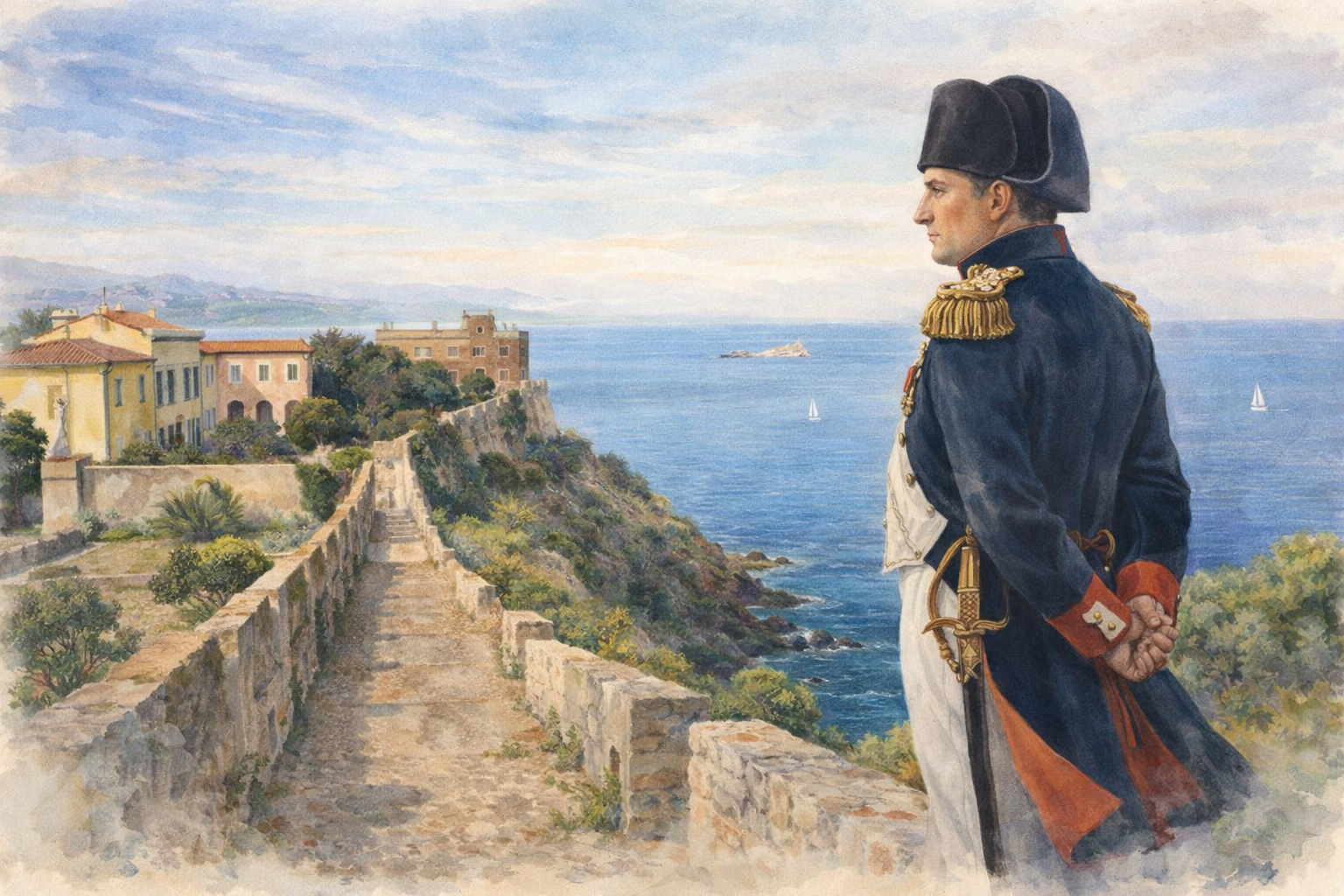
There are places that look peaceful on a map… but if you look closely, they were cages.
The island of Elba is one of them.
Today it’s a Mediterranean destination of turquoise waters, green hills and stone villages. But for one year, Elba was the stage of one of the most famous exiles in history: that of the man who had thrown all of Europe into chaos. And it was also the starting point of an escape no one thought possible.
Because Napoleon Bonaparte was not sent to Elba merely to keep him away from power—he was sent there to bury him alive in oblivion.
But Napoleon didn’t know how to disappear.
The Context: The Collapse of the Empire
In 1814, the Napoleonic Empire fell apart.
After years of constant war, the disastrous Russian campaign, and the growing pressure from the European powers (Austria, Prussia, Russia and Great Britain), Napoleon was defeated. Paris fell, the Senate withdrew its support, and even his own marshals pushed him to surrender.
Napoleon abdicated at Fontainebleau on April 6, 1814. Europe breathed again, believing the storm was finally over.
But the powers didn’t want to execute him—it would have been dangerous—nor did they want to let him go free—it would have been suicidal.
So they chose a more subtle punishment: exile.
Elba: A Prison by the Sea
Napoleon was sent to the island of Elba, a small island off the coast of Tuscany (Italy), not too far from France. The choice was strategic:
- it removed him from Europe’s political center,
- kept him under surveillance,
- and avoided turning him into a martyr.
The agreement was formalized in the Treaty of Fontainebleau (1814). He was allowed to keep a symbolic title (“Emperor of Elba”), a personal guard, and a small island “government.”
Napoleon on Elba: The Emperor Without an Empire
Napoleon arrived on Elba on May 4, 1814..
Allí vivía como emperador en miniatura: tenía residencia, uniformes, escolta, y una corte reducida. Podía desplazarse por la isla, recibir noticias y reorganizar su pequeña administración. Incluso mantenía tropas propias: no un ejército real, pero sí un núcleo militar leal.
And as if he didn’t know how to live any other way, he began to “rule” Elba. During his stay, he:
- promoted public works,
- reorganized the administration,
- improved roads,
- tried to strengthen defenses,
- and maintained an active, intense routine.
Elba was a cage without bars: the island was small, the horizon limited.
The Spark: France Falls Apart Without Him
Mientras Napoleón estaba en Elba, Francia volvió a manos de los Borbones. Luis XVIII subió al trono, pero su gobierno no fue estable. El régimen resultaba frágil e impopular para muchos sectores. El país estaba cargado de resentimiento, hambre y decepción.
Many French people:
- were unhappy,
- feared an aristocratic restoration,
- and saw Napoleon as a symbol of order, glory and merit.
Napoleon received constant updates. And soon, unsettling rumors began to spread: it was said he might be moved to an even more remote destination… or even eliminated.
"Never interrupt your enemy when he is making a mistake".
The Preparation: The Art of Silence
La fuga no fue improvisada. Napoleón la preparó con precisión, pero con un detalle crucial: sólo un círculo reducido lo sabía. Napoleón confió únicamente en oficiales fieles, miembros cercanos de su séquito y soldados que no iban a dudar.
Meanwhile, he acted as if everything were normal: he kept public routines and moved around without raising suspicion.
Until the moment came.
The Day Elba Lost Its Emperor
The February 26, 1815, al caer la tarde, Napoleón se fuga de Elba. No escapó de una prisión. Escapó de una isla.
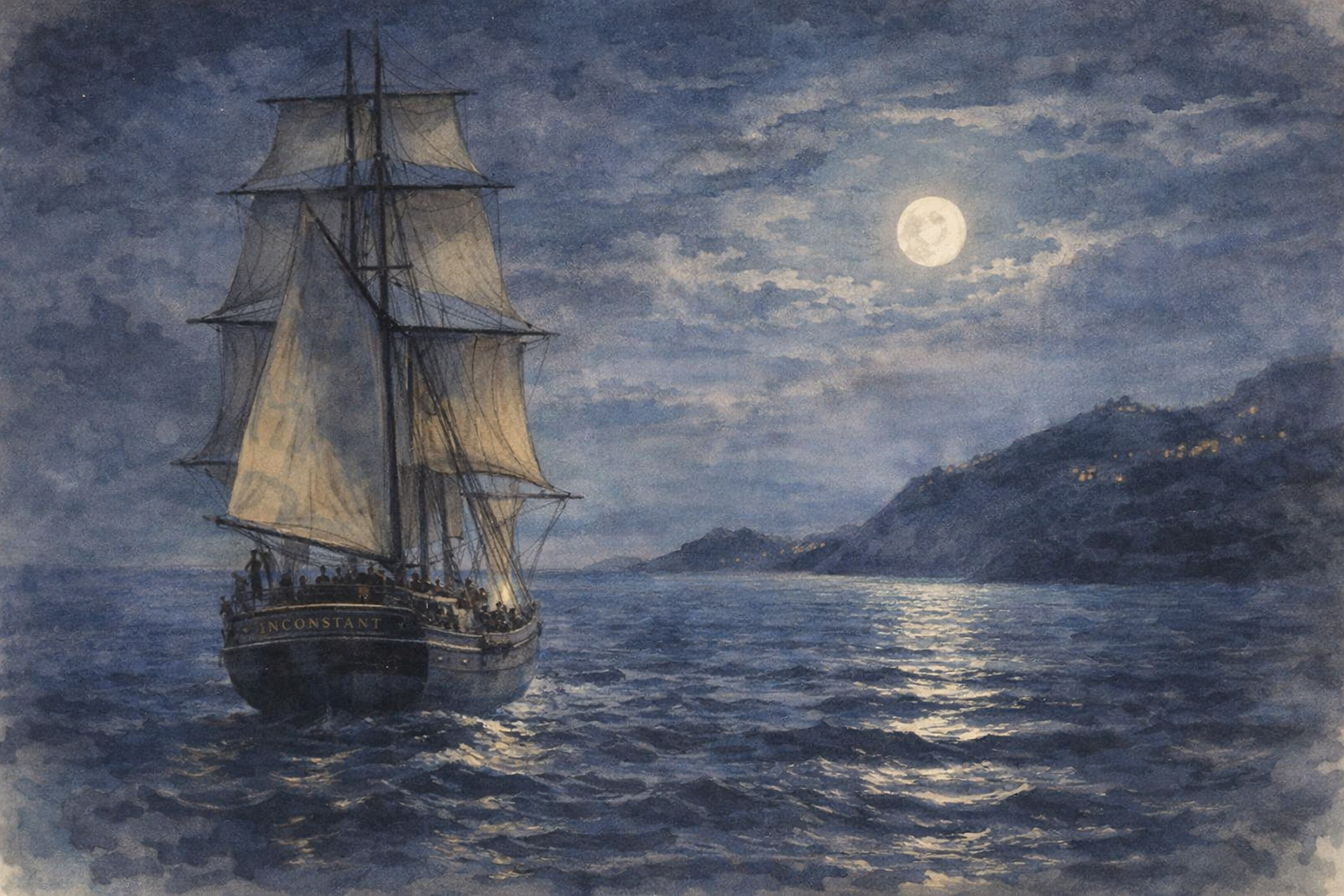
He discreetly boarded the Inconstant, a small vessel, along with his men. He didn’t flee alone: he brought with him a small but solid force:
- soldiers,
- loyal officers,
- part of his guard.
In total, several hundred men. Despite surveillance over the island and patrols across the Mediterranean, Napoleon managed to slip away undetected.
He sailed toward France.
"Victory belongs to the most persevering".
March 1, 1815: Landing in France
After several days at sea, Napoleon landed on March 1, 1815 , on the French coast at the Gulf of Juan (Golfe-Juan), near Cannes.
He did not return with an invasion. The Bourbons sent troops to stop him.
Pero, a medida que Napoleón avanzaba hacia París, los soldados enviados para capturarlo comenzaron a unirse a él. Napoleón caminó hacia ellos y dijo algo parecido a:
“If any man wishes to kill his Emperor, here I am.”
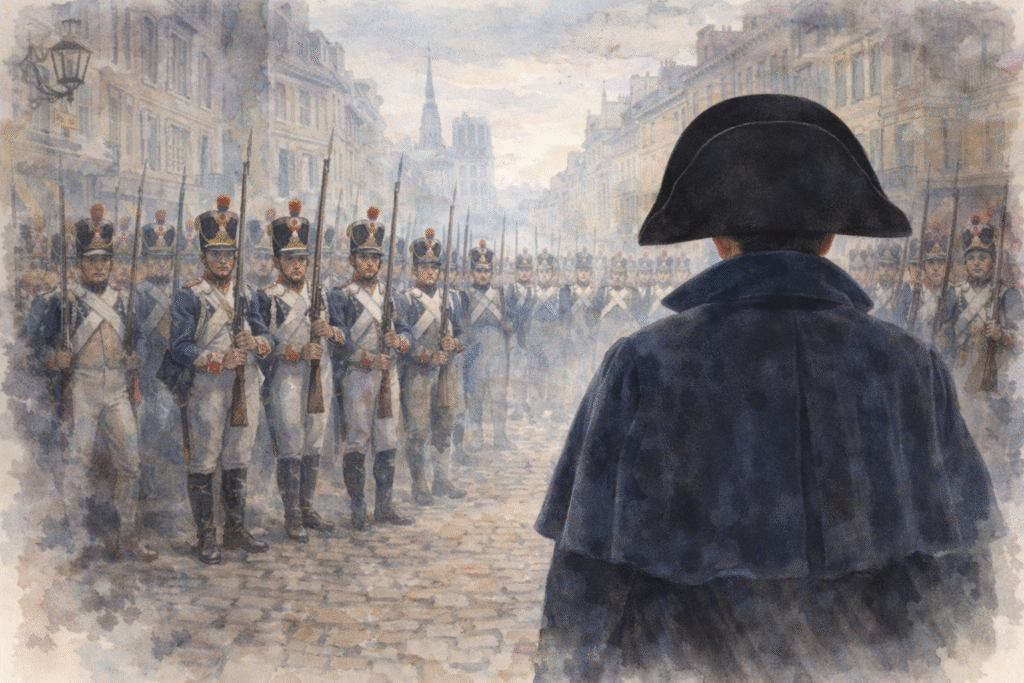
No one fired. On the contrary: the soldiers began to cheer him. Napoleon entered Paris on March 20, 1815. France once again recognized him as its Emperor.
And so, without fighting a major battle. Napoleon regained power.
His Brief Return: The Hundred Days
The period that followed is known as the Hundred Days (March–June 1815)
When Napoleon entered Paris, Louis XVIII fled.
The European powers—gathered at the Congress of Vienna—immediately declared Napoleon an enemy and a disturber of world peace.
The End: Waterloo and the Final Exile
Napoleon was defeated at Waterloo on June 18, 1815.
But this time Europe had learned its lesson: there would be no nearby exile. He was sent to Saint Helena, in the middle of the South Atlantic.
There, he would die years later.
Elba Today: Beauty With Memory
Today, the island of Elba is peaceful, but its history remains forever marked.
On Elba, there are still residences linked to Napoleon, such as:
- Villa dei Mulini (Portoferraio)
- Villa San Martino
Estos lugares son testigos silenciosos de algo más grande: el momento en que Europa creyó que el peligro había terminado, y descubrió que Napoleón todavía tenía un último golpe preparado.
An Island, An Escape, A Symbol
La fuga de Elba no fue solo una huida. Fue un recordatorio: que Napoleón Bonaparte no era solo un hombre.
He was a political phenomenon.
A symbol.
A myth.
"A leader is a dealer in hope".