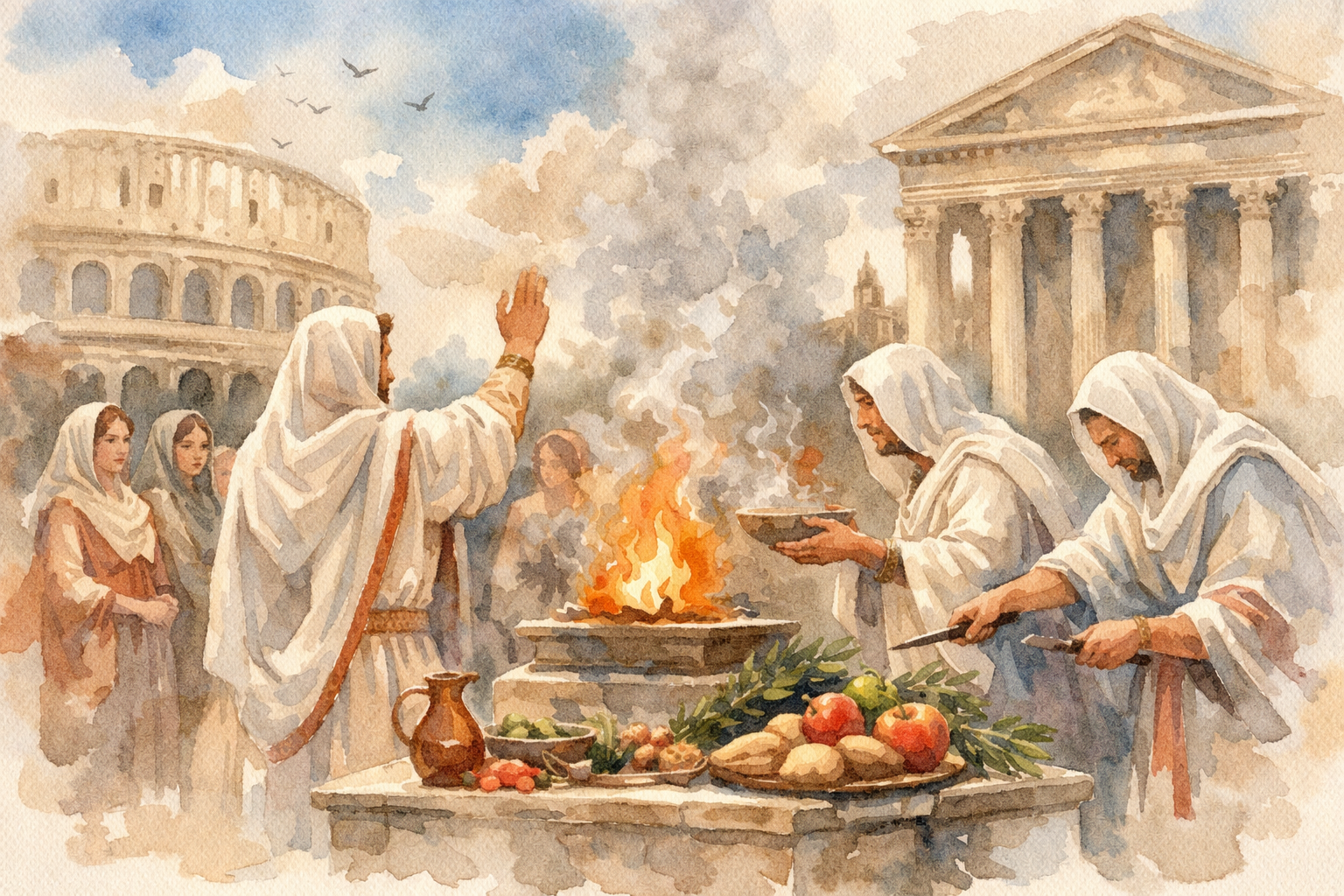
February was not born as the “month of love.” It was born as the month of purification, of the dead, of the spirits… and of rituals so intense that, today, they would seem almost savage. For the Romans, February was a threshold: the end of the old cycle, the time to cleanse what was impure, to reconcile with the ancestors, and to prepare for the rebirth of spring. Because before the year could begin again… Rome had to be purified..
Februarius: the Month of Purification
Roman tradition credited Numa Pompilius (Rome’s second king, 8th century BCE) with reforming the calendar and adding Februarius, which was originally the last month of the year..
Its name comes from februa, a term linked to ritual purification. And that was no coincidence: before the cycle restarted, the world had to be made “clean.”
In Rome, purification was not a metaphor. It involved real practices:
- ritual baths
- offerings
- sacrifices
- symbolic “cleansings” of the home and the city
- rites meant to appease the dead
February was, quite literally, a month to shake off winter —both physically and spiritually..
A Month Between the Living and the Dead
If January looked forward, February looked back. For the Romans, the dead were not completely absent: their memory—and their influence—had to be respected. And if you ignored them, you might awaken restless forces.
That is why, throughout February, Rome carried a special atmosphere: quieter, more solemn… almost as if the city itself were breathing carefully..
Parentalia (February 13–21): Honouring the Ancestors
From February 13 to 21, Rome celebrated the Parentalia, a period dedicated to the ancestors.
During these days:
- families visited graves
- they offered wine, milk, flowers, bread, salt, or grains
- they performed domestic rituals in honour of the dead
It was an intimate, family-centred observance. The Romans did not “celebrate” death: they acknowledged it.. Even public life slowed down: the State respected the belief that, during these days, Rome was symbolically in contact with the beyond.
Feralia (February 21)
The final day of the Parentalia was Feralia, the most serious moment of the cycle: a day of closure, of ritual farewell, reinforcing the idea that the boundary with the dead had to be sealed again.
Lupercalia (February 15): Rome’s Wild Ritual
If the Parentalia were solemn, the Lupercalia were the opposite: a physical, instinctive, archaic ritual—full of blood and primal symbolism.
Held on February 15, the Lupercalia were among Rome’s oldest festivals. They were linked to:
- fertility
- purification
- the protection of the city
- rebirth after winter
The Cave of the Lupercal: Where Rome Was Born (According to Myth)
The Lupercalia were tied to Rome’s founding myth: the cave of the Lupercal, at the foot of the Palatine Hill, where the she-wolf was believed to have nursed Romulus and Remus.
It was not only religion. It was national identity. Rome did not repeat the ritual—it reactivated it, as if the city were being born again each year.
The Rituals
1) Sacrifices
The sacrifices usually included:
- goats → a symbol of fertility
- a dog → associated with protection, guardianship, and the liminal
2) Blood and Laughter
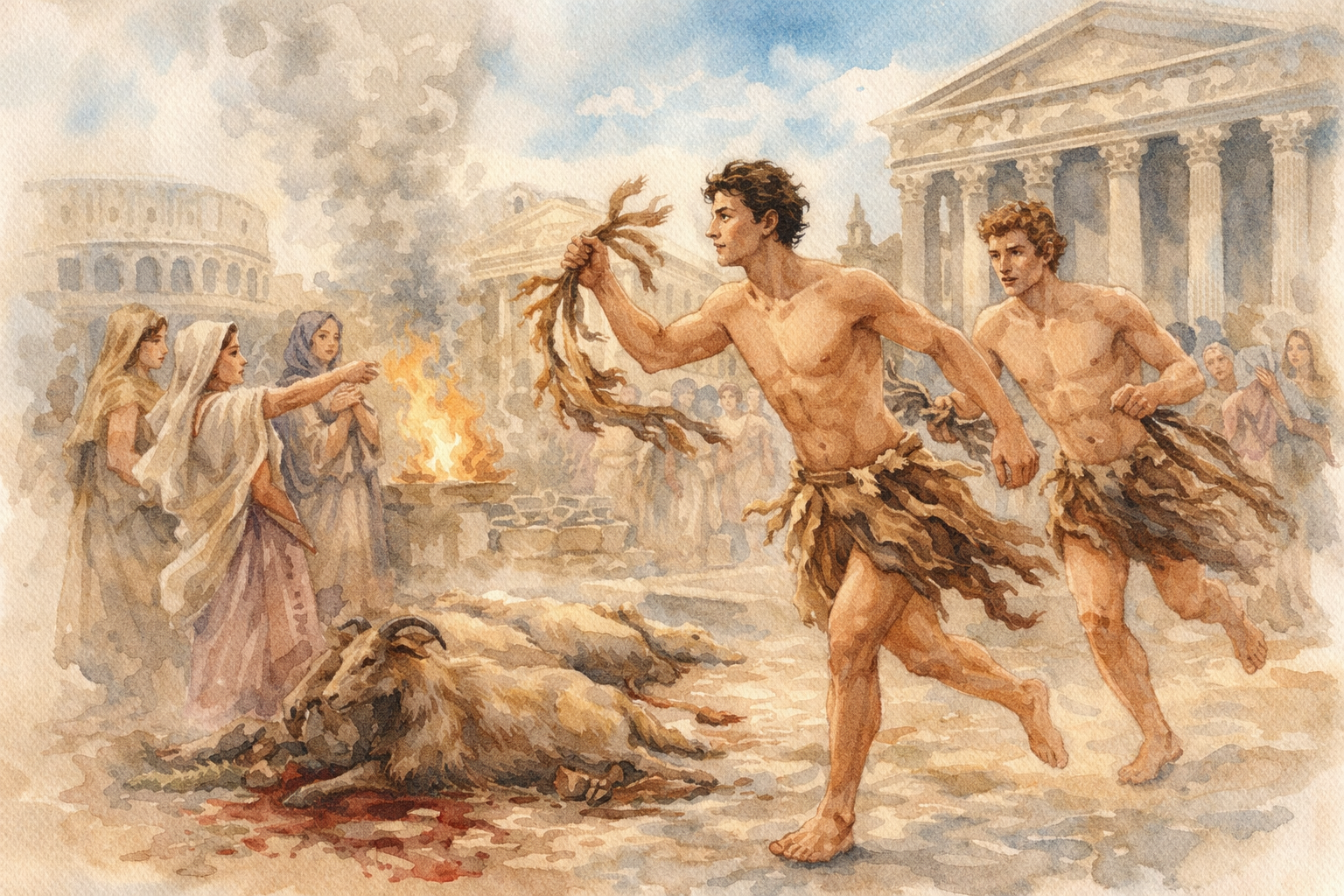
The young priests called the luperci had their foreheads touched with sacrificial blood, then wiped clean with wool soaked in milk. It is said they had to laugh as part of the rite.
This symbolised the passage from winter (death) to renewal (life).
3) The Ritual Run
Then came the moment that made the Lupercalia famous:
- the luperci ran through the city half-naked
- they carried strips of skin called februa
- they lightly struck those they encountered (especially women)
Many women approached voluntarily, believing that this contact:
- promoted fertility
- eased pregnancy or childbirth difficulties
- brought good fortune
This was Rome in its most ancestral form.
February Before Hearts
Long before it became romantic, February was the month when Rome:
- honoured its dead
- cleansed what was old
- expelled what was impure
- awakened life
and embraced spring through rites of blood and hides. And perhaps because of that…even though today we have covered it in hearts, February still carries something of that ancient mystery: the idea that before love—before rebirth—one must be purified..
Curiosity / Historical Note
Christianity, the Lupercalia, and Saint Valentine
When Christianity became dominant in Rome, it did not immediately eliminate the Lupercalia: they were too ancient and too popular.
The Church tried to curb pagan practices, and Pope Gelasius I (5th century) criticised the Lupercalia and attempted to prohibit them.
It is sometimes claimed that the Church “replaced” the Lupercalia (February 15) with the feast of Saint Valentine (February 14). However, a direct historical link between both celebrations is not proven..
The Christian feast of Saint Valentine appears connected to Gelasius I in the 5th century and is associated with a martyr named Valentine.
The romantic meaning, in truth, came much later.
The “Romantic Turn” of Valentine’s Day: Geoffrey Chaucer (14th Century)
The association between February 14 and romantic love does not come from Ancient Rome. It became established much later, during the Middle Ages.
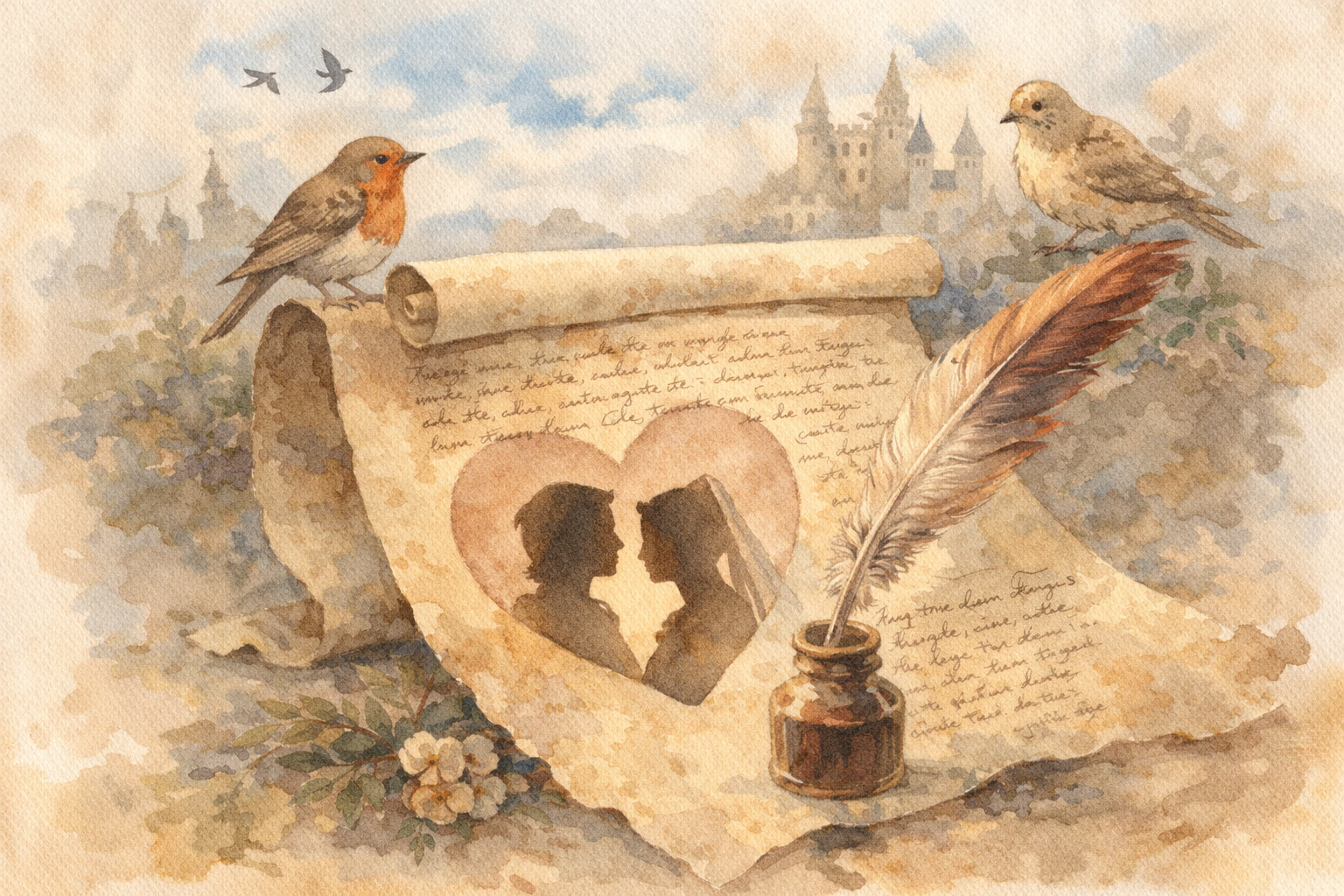
One key figure is Geoffrey Chaucer (14th century), an English poet, who in his work Parliament of Fowls suggested an idea that became hugely influential: Valentine’s Day is the day when birds gather to choose a mate.
Later, other English and French writers followed this association, and people began to:
- write love letters in February
- give poems as gifts
- speak of “my Valentine” as a romantic partnervalentine) como pareja
From that point onward, the date began to be linked to courtship, love poetry, and the medieval ideal of courtly love.