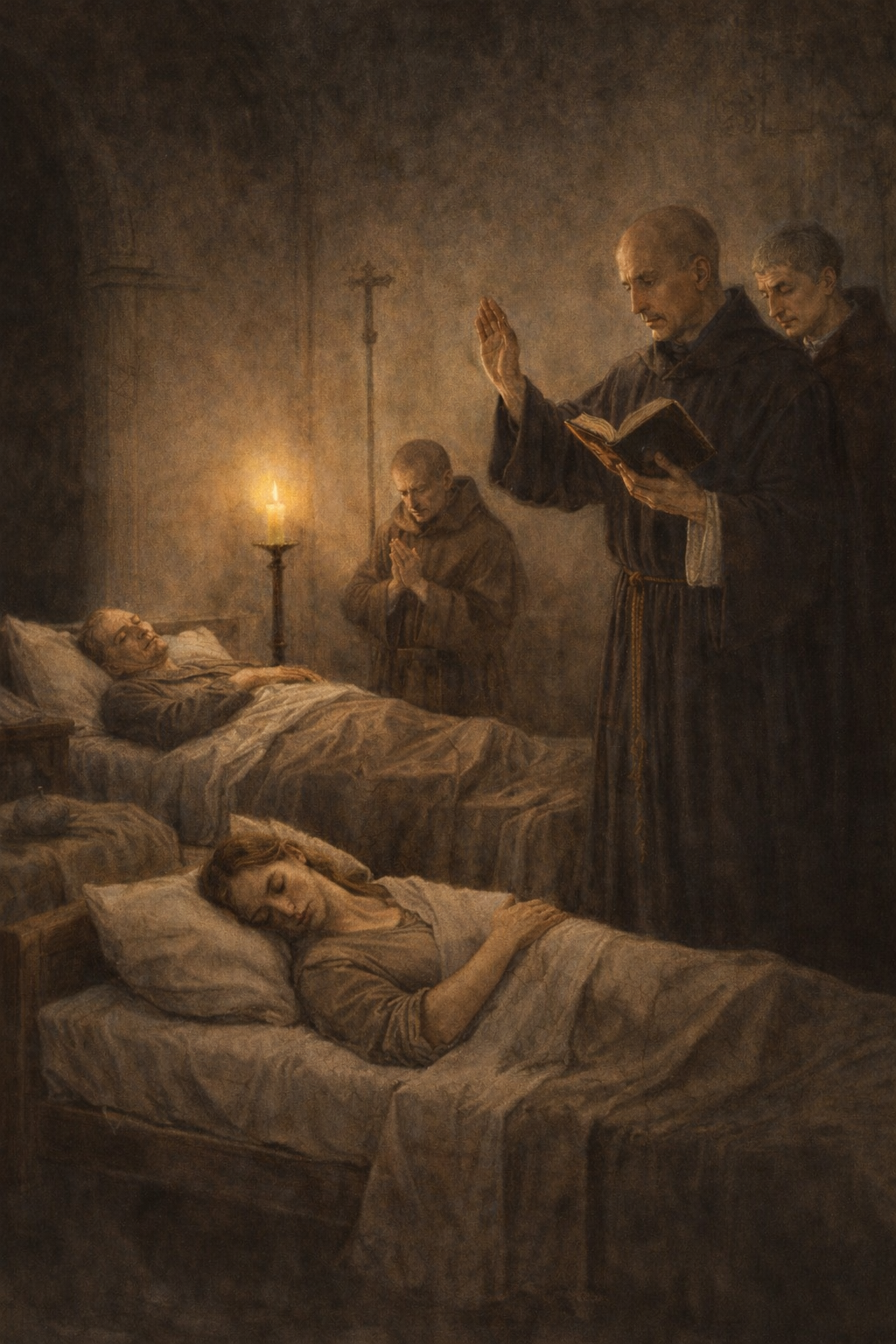
The origin of blessing when sneezing, saying “salud” is such an automatic gesture that we rarely stop to think about its origin. The same is true of saying “Jesus,” “God bless you,” or “bless you” in English.
However, this everyday habit did not begin as a sign of politeness or social courtesy. Its origin is far older, darker, and deeply rooted in fear.
For centuries, sneezing was considered an ominous sign.
Sneezing in Antiquity
Greece: Sneezing as a Divine Sign
In Ancient Greece, sneezing was neither a threat nor a trivial gesture. It could be a divine sign or omen—positive or negative—depending on the context.
Greeks believed that a sneeze could be a manifestation of the gods: a confirmation of truth or a supernatural warning. It was something to be interpreted, not something to be fought against.
- Homer (8th century BCE), in The Odyssey (Book XVII), mentions sneezes as divine signs: when Penelope speaks of Odysseus’s return, Telemachus sneezes loudly, and she interprets it as confirmation that her words are true.
- Xenophon (4th century BCE), in The Anabasis, recounts that during a military speech a soldier sneezes. Those present interpret it as a favorable sign and respond with a ritual exclamation addressed to Zeus.
Rome: Protection Against Evil
For them, it was not merely an omen—it was a risk. Sneezing was understood as something external entering the body, disturbing it, and potentially possessRome: Protection Against Eviling it. It could signal imminent illness, bodily imbalance, or the intrusion of invisible forces.
According to many ancient beliefs, the soul could escape through the mouth or the nose.
- Pliny the Elder (1st century CE), in his Natural History, mentions Roman superstitious customs, including the need to respond verbally to certain bodily signs through ritual words of protection.
After Christianization: Superstition Reinterpreted
With the spread of Christianity, sneezing ceased to be a sign from the gods and came to be understood as a danger to the soul.
The custom did not disappear because it was deeply ingrained. The Church did not eliminate it—it reinterpreted it. An ancient fear was inherited and given a new language.
|
Paganism |
Christianity |
|---|---|
|
Demons |
Spirits |
|
Invisible forces |
Evil / Satan |
|
Omen |
Spiritual trial |
|
Ritual protection |
Blessing |
Fear of the invisible was transformed into fear of evil, and ritual protection became a blessing.
Superstition, Body, and Soul
In a world without scientific explanations, illness was interpreted through superstition and religion. The human body was believed to be vulnerable to invisible forces, and during a sneeze, the soul could weaken or even leave the body.
Some beliefs held that:
- the soul could temporarily escape
- evil spirits could enter
- the devil could exploit the weakness of the sick
Faced with this invisible threat, words became protection.
Sneezing in the Middle Ages
Patristic and medieval sources mention the immediate blessing after bodily signs considered dangerous, such as fainting, illness, or sneezing.
In Latin, formulas such as Deus te adiuvet (“May God help you”) or Dominus tecum (“The Lord be with you”) were used. In the medieval Christian world, invoking the name of Jesus was the most direct form of protection against evil—hence the popular crystallization of saying “Jesus.”
There was a clear consensus: sneezing was associated with spiritual danger, and the response had to be immediate.
When a Sneeze Could Announce Death
In the ancient and medieval world, there was no medical knowledge as we understand it today. Nothing was known about viruses, bacteria, or respiratory infections.
Symptoms we now associate with a simple cold—fever, chills, coughing, or sneezing—were often the beginning of deadly illnesses.
During major epidemics, such as the bubonic plague, many people died just days after showing the first symptoms. Sneezing was not trivial: it could be the first warning of imminent death.
That is why sneezing was not met with indifference, but with fear.
The Plague and the Consolidation of the Custom
During the Black Death in Europe (1347–1351), which killed approximately one third of the European population, fear intensified. Early symptoms included fever, chills, and in some cases, sneezing.
Some historical references attribute the consolidation of the custom to Pope Gregory I (6th century), who recommended processions, collective prayers, and blessing those who showed symptoms during devastating epidemics.
This was not a symbolic gesture. It was a response to a constant and very real threat.

Invoking God as a Shield
Saying “Jesus,” “God bless you,” or “bless you” was not a polite formula—it was a protective invocation. Pronouncing the name of God was a way to ward off evil, protect the soul, and wish survival.
Even the word “salud,” apparently more secular, preserves the same deep meaning: an explicit wish for life in the face of possible illness and death.
It was not said out of courtesy. It was said out of fear.
A Superstition That Became a Global Custom
Over time, medicine advanced and the original meaning faded. Sneezing stopped being directly associated with death, but the custom remained.
Today:
- we say “salud” without thinking of diseas
- we say “Jesus” without reflecting on its origin
- we say “bless you” almost automatically
This superstition spread across the world, adapting to different languages, religions, and cultures, while always preserving the same root: the desire for protection.
When fear disappeared, the custom survived.
Variants Around the World
- Spain, Italy, Portugal:: Health, Jesus
- France:: À tes souhaits (“to your wishes”)
- Germany:: Gesundheit (“health”)
- England / United States:: Bless you
- Muslim countries: religious responses invoking Allah
An Echo of the Past in an Everyday Gesture
Every time we say “salud” after a sneeze, we repeat a gesture born from fear, illness, and superstition. A small trace of the past that has survived ancient cultures, epidemics, religious transformations, and scientific advances.
What today seems like a simple act of politeness is, in reality, a remnant of a time when sneezing could be a death sentence.