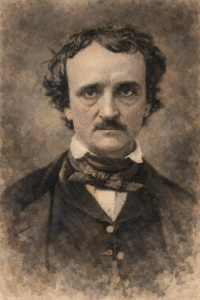
Edgar Allan Poe was a writer of extraordinary talent living in a world that was not made for someone like him. His life was marked by abandonment, loss, and constant hardship, and he wrote from a place few dared to explore: guilt, fear, death, and the fragility of the human mind.
Throughout his life, Poe remained emotionally wounded, without a stable support system, and trapped within a literary world that did not reward originality or extreme sensitivity. His dark work was not an aesthetic pose, but a direct reflection of his lived experience: childhood trauma, the death of beloved women, persistent poverty, a sense of failure, and a profound intellectual fascination with what others preferred to ignore.
Labeled in his homeland as problematic, alcoholic, and eccentric, Poe nonetheless became one of the foundational figures of psychological horror, modern mystery, and Gothic literature.
“Those who dream by day are cognizant of many things which escape those who dream only by night.”
(Essay)
The First Ghosts
Edgar Allan Poe’s father, David Poe Jr., abandoned the family when Edgar was still an infant. His mother, Eliza Poe, a theater actress, died of tuberculosis in 1811, when Edgar was only two years old. She left behind three children:
- William Henry Leonard Poe
- Edgar Allan Poe
- Rosalie Mackenzie Poe
After her death, the siblings were separated and taken in by different families. They never grew up together again.
William, the eldest brother, lived with relatives in Baltimore and died young, also from tuberculosis.
Rosalie, the youngest, was taken in by the Mackenzie family. She had an intellectual disability and spent much of her life in institutions. She died in 1874, many years after Edgar, completely destitute—living in poverty and dependent on charity—while her brother had already become a literary legend.
Raised, but Never Adopted: The Allans
Edgar was taken in by John Allan and Frances Allan, a wealthy family from Richmond, Virginia. Although they never legally adopted him, Poe took “Allan” as a middle name and was known from childhood as Edgar Allan Poe.
Frances Allan was a loving and protective maternal figure. John Allan, by contrast, was cold, authoritarian, and distrustful. After Frances’s death, Allan remarried and had biological children, which deepened the rift and ultimately led to Edgar being excluded from his inheritance.
Poe received a good education in private schools, but when he entered the University of Virginia, John Allan provided him with an insufficient allowance. Edgar accumulated debts that Allan refused to pay, leading to a definitive rupture. From that point on, Poe’s life became one of constant financial instability.
The Writer Who Did Not Fit In: Literary Critic
Poe worked as an editor, proofreader, writer, literary critic, and author of short stories, poems, and essays. Between 1835 and 1849, he developed an intense career as a critic in Richmond, Philadelphia, and New York.
He was brutally honest. He attacked mediocrity without mercy, ignored literary hierarchies, and wielded sharp sarcasm. Many influential authors hated him; a negative review from Poe could ruin a book. He made powerful enemies.
Among the magazines he worked for were:
- Southern Literary Messenger
- Burton’s Gentleman’s Magazine
- Graham’s Magazine
Financial Hardship
Poe lived exclusively from his writing—something rare in his time. Copyright royalties did not exist as they do today; writers were paid per published piece. He rejected stable jobs outside literature, had editorial enemies, and also cared for his sick wife.
He suffered from an extremely low tolerance to alcohol: even small amounts left him disoriented. There has also been speculation about the use of laudanum, a medicinal opiate common in the era.
The Death of Virginia Clemm: Poe’s Collapse
In 1836, Poe married his cousin Virginia Clemm, who was thirteen years old. They were married for eleven years. In 1842, Virginia fell ill with tuberculosis. During those years, Poe worked desperately to support her: writing relentlessly, accepting poorly paid jobs, producing literary criticism, and moving frequently in search of milder climates. He sought financial help from patrons, without success.
Virginia died in 1847 after a long agony. Her death shattered Poe emotionally.
“The death of a beautiful woman is, unquestionably, the most poetical topic in the world.”
(The Philosophy of Composition)
The Erratic Period: Grief, Collapse, and Disintegration
After Virginia’s death, Poe was left completely alone. He lost both his wife and his only stable home. From that moment on, a slow but constant emotional disintegration began.
He suffered deep depressions, documented suicide attempts, and intermittent relapses into alcohol and laudanum. He slept little; during these periods, he either wrote compulsively or was completely blocked.
Witnesses described abrupt mood changes, episodes of mild paranoia, confusion, and a persistent obsession with death, destiny, the soul, and the end of time.
“I became insane, with long intervals of horrible sanity.”
(The Black Cat)
Eureka and Rejection
In the midst of this chaos, Poe published Eureka (1848), his strangest work: a “prose poem” blending science, philosophy, metaphysics, and poetic intuition. Poe believed he had described the origin of the universe, its expansion, and its final collapse.
The work was an editorial failure. It was dismissed as eccentric and delirious. Today, however, it is recognized as anticipating modern cosmological ideas.
Return to Richmond and Promises of Stability
Between 1848 and 1849, after Virginia’s death, Poe desperately sought emotional stability. During this period, he sent several marriage proposals, written with intense emotional urgency.
The most significant was to Sarah Helen Whitman, a widow, poet, and essayist living in Providence. Whitman admired Poe deeply and conditionally accepted the engagement in 1848, demanding total abstinence from alcohol. After one relapse, she broke off the engagement, dealing Poe another devastating blow.
Soon after, Poe reconnected with Elmira Royster Shelton, his first youthful love, also a widow, whom he had loved even before Virginia. In 1849, they reunited in Richmond and planned to marry. The engagement was verbal, but genuine.
During those months, Poe seemed to improve: he appeared sober, lucid, and hopeful. He spoke of new projects, including founding his own literary magazine. It was the last moment of apparent balance before his final disappearance.
The Final Journey and the Great Mystery
In October 1849, Poe left Richmond bound for Philadelphia to prepare for his wedding to Elmira Royster Shelton and to edit new poems. He never arrived.
On October 3, he was found in Baltimore, disoriented and delirious, in a tavern being used as a polling station, wearing clothes that were not his own. He was hospitalized and died four days later, on October 7, 1849.
The official cause of death was never specified. No detailed medical records survive, and the original death certificate is missing.
The attending physician, Dr. John Joseph Moran, stated that Poe drifted in and out of consciousness, suffered delirium, and repeatedly called out the name “Reynolds.” Decades later, Moran’s accounts added further details, increasing the uncertainty.
The exact cause of Poe’s death remains a mystery.
Rosalie Poe: The Forgotten Sister
Rosalie, Poe’s only surviving biological family member, outlived him. She lived in poverty, without inheritance or recognition, while her brother became a universal literary figure. Poe’s tragedy did not end with his death.
A Genius Misunderstood in Life
In the United States, Poe was vilified after his death by Rufus Wilmot Griswold, his personal enemy, who portrayed him as a depraved alcoholic. This image dominated American perception of Poe for decades.
In Europe, thanks to Charles Baudelaire, Poe was recognized as a genius. His fame arrived late—but it reached far.
Legacy: Writing from the Abyss
Poe transformed modern literature:
- He created the first modern detective: C. Auguste Dupin
- He laid the foundations of detective fiction
- He reinvented psychological horror
- He was a precursor of science fiction
- He elevated the modern short story
For Poe, terror did not come from monsters, but from the mind.
“There is no exquisite beauty… without some strangeness in the proportion.”
(Ligeia)
Curiosity: Poe and the Origin of Sherlock Holmes
The most famous detective in literature, Sherlock Holmes, would not exist without Edgar Allan Poe. In 1841, Poe created C. Auguste Dupin, the protagonist of The Murders in the Rue Morgue. With him, Poe established the foundations of modern detective fiction:
meticulous observation, logical reasoning, mental reconstruction of the crime, and the intellectual superiority of the investigator over the police.
Arthur Conan Doyle openly acknowledged that Sherlock Holmes was inspired by Dupin. The brilliant detective, the companion-narrator, and the rational resolution of the mystery all originate with Poe.
Without Edgar Allan Poe, there would be no Sherlock Holmes. And without The Murders in the Rue Morgue, the detective genre as we know it would not exist.
The Most Mysterious Death in Literature
What is truly strange is not that Poe disappeared. What is strange is that his death seems written by his own hand.
He died poor, alone, and disoriented.
And he left the world one of the greatest enigmas in literary history.