Isaac Newton was not only a genius, nor merely a brilliant mind who deciphered the laws of the universe. He devoted most of his life to studying, writing, and thinking—often in solitude.
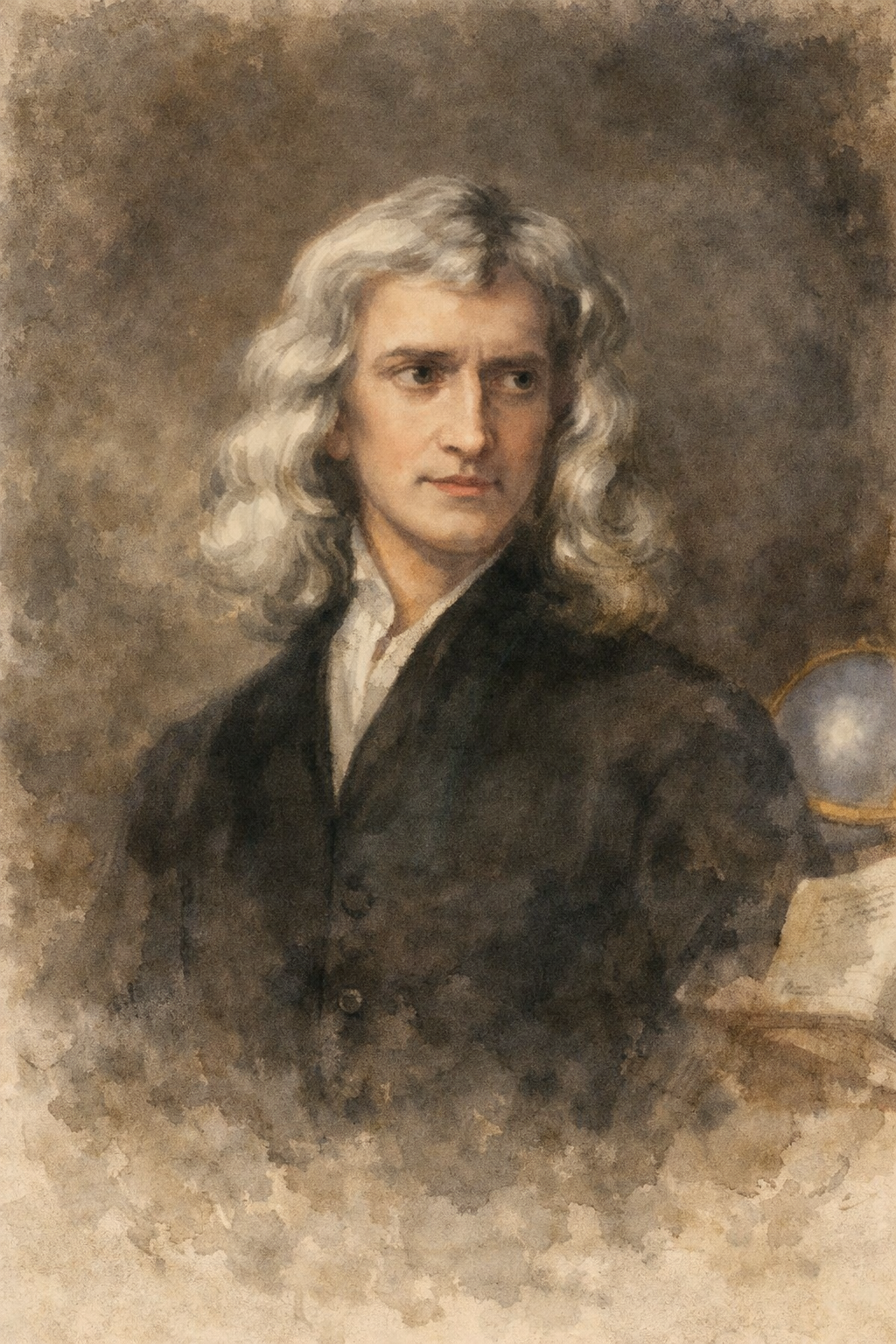
He was not a sociable person. He had few close friends, never married, and no known romantic relationships. He was extremely sensitive to criticism and reacted with fury whenever his work was questioned. Many of his discoveries were kept private for years, even decades, out of fear of criticism or of others claiming his ideas. Part of his work was published only after his death.
He was emotionally intense, obsessive, contradictory, and profoundly curious. He could go long periods without publishing and reacted harshly to intellectual rivals. One of his most famous—and bitter—conflicts was with Gottfried Wilhelm Leibniz over the invention of calculus.
History has turned Sir Isaac Newton into a symbol. But the symbol hides the man.
An Uncommon Scholar for His Time
Newton mastered three languages, something highly unusual even among the scholars of his era:
- Latin, the scientific and academic language of the time. His work Philosophiæ Naturalis Principia Mathematica was written entirely in Latin.
- Greek, which he learned in order to read classical authors—such as Aristotle and Plato—without intermediaries.
- Hebrew, which he studied to analyze the Scriptures in their original language, especially the Old Testament. Even among intellectuals, this was rare knowledge.
The Laws That Changed the World
Newton formulated principles that remain valid today:
The Three Laws of Motion
- Law of inertia
- Force = mass × acceleration
- Action and reaction
The Law of Universal Gravitation
For the first time in history, the motion of celestial bodies and that of terrestrial objects were unified under a single law.
Infinitesimal Calculus
Developed in parallel with Leibniz, it made it possible to describe continuous change: trajectories, velocities, accelerations, and orbits.
Light and Optics
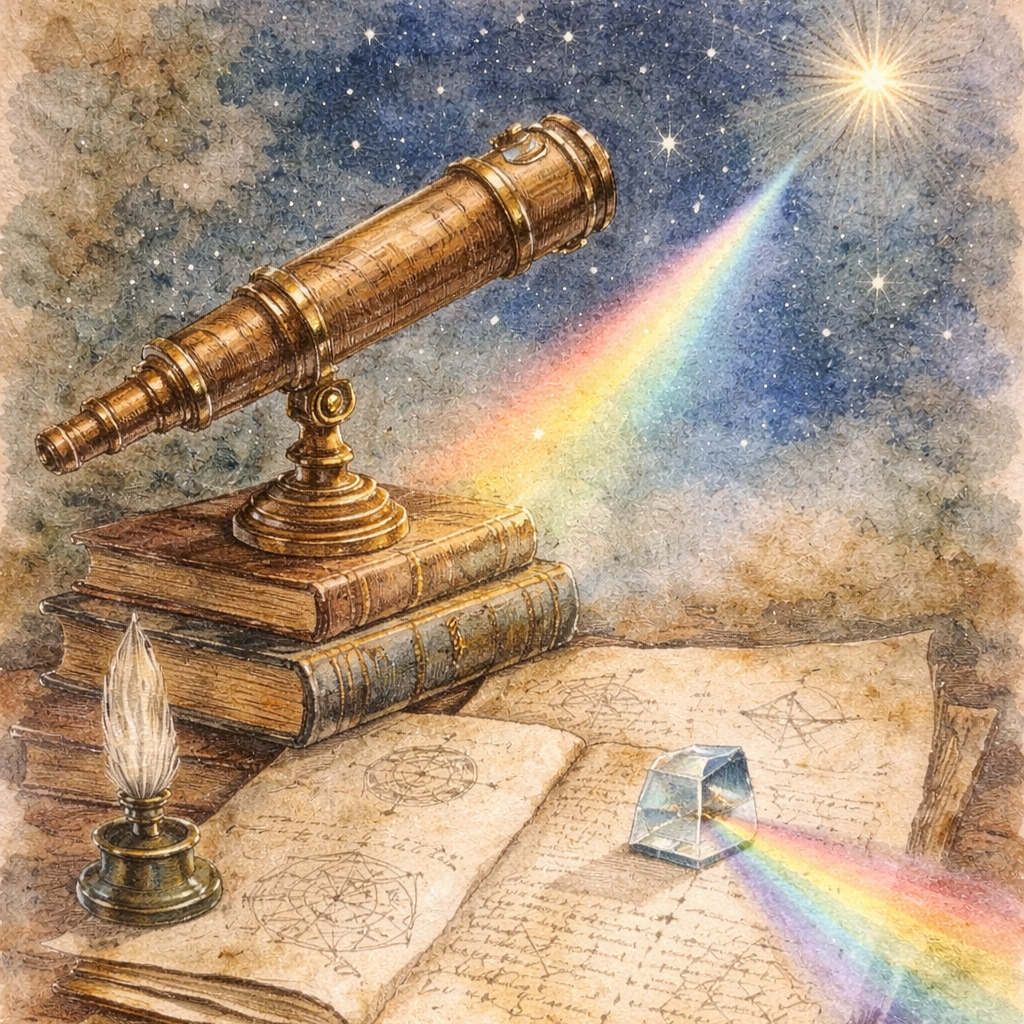
Newton demonstrated that white light contains all colors and that color is not created by objects, but by light itself.
“I keep the subject constantly before me and wait till the first dawnings open slowly, by little and little, into a full and clear light.”
Newton: Inventions and Technical Contributions
The First Reflecting Telescope
In the 17th century, telescopes were refractors, relying on lenses that produced chromatic aberration. In 1668, at just 25 years old, Newton built the first functional reflecting telescope, using a concave mirror instead of lenses.
The result was a sharper image, a shorter and more manageable instrument, and a decisive advance for astronomy. In 1671, he presented it to the Royal Society, which opened the doors of the scientific world to him.
The Hand-Polished Parabolic Mirror
Newton learned to polish his own mirrors, working with copper and tin alloys (speculum), and developed highly precise artisanal techniques.
The Method of Fluxions
His version of calculus was a revolutionary mathematical tool, although he never formally published it. Leibniz presented his version more clearly, fueling the famous dispute between them.
Myths: The Apple and Gravity
Newton’s figure has long been surrounded by simplified and exaggerated stories. The most famous is that of the apple falling on his head. The reality is far less spectacular. Newton himself later recounted that he observed an apple falling while reflecting on why objects always fall toward the ground rather than sideways. That observation did not immediately produce a theory.
The law of universal gravitation was formulated decades later, after years of calculations, doubts, and silence. The concept of gravity already existed before Newton; his true contribution was demonstrating mathematically that it was universal.
The Scientist Who Challenged the Church… in Silence
One of the least known—and most fascinating—aspects of Newton’s life is that he devoted more time to alchemy and theology than to physics.
He wrote thousands of pages on alchemy, hermetic texts, biblical symbolism, prophecy, and the end of the world. He used codes and metaphors to conceal his writings, as alchemy was suspected of heresy and could have severe legal consequences.
For centuries, this side of Newton was suppressed to protect his image as the father of modern reason. Today, more than one million words written by Newton on alchemical and hermetic subjects are preserved.
Some of his most notable manuscripts include:
- Index Chemicus, a personal index of alchemical terms and symbols.
- Clavis (“The Key”), a symbolic text on the secrets of matter.
- Theatrum Chemicum Britannicum, with copies and annotations of medieval texts.
- Manuscripts on the “active spirit”, in which he argued that matter was not passive.
Faith, Heresy, and Prophecy
Newton was deeply religious. For him, science did not contradict God—it was a way to understand His work.
He analyzed the Bible and prophecies with the same mathematical rigor he applied to science. His best-known theological work, Observations upon the Prophecies of Daniel and the Apocalypse of St. John, was published in 1733, after his death.
He believed Christ was divine but subordinate to God the Father, and he rejected the Trinity as defined by the Church—an idea that would have been considered grave heresy in his time.
According to his own biblical calculations, the Apocalypse would not occur before the year 2060, understood not as total destruction, but as the beginning of a new era.
The Royal Mint: Hunter of Forgers
Newton served as director of the Royal Mint:
- 1696: Warden of the Mint
- 1699: Master of the Mint
He reformed the monetary system, introduced anti-counterfeiting techniques, and personally pursued forgers, including the notorious William Chaloner, whose execution he secured after years of investigation. In 1705, Queen Anne knighted him, and he became Sir Isaac Newton.
Death and Legacy
Newton died in 1727. Modern analysis of his hair has revealed high levels of mercury, likely due to his alchemical experiments.
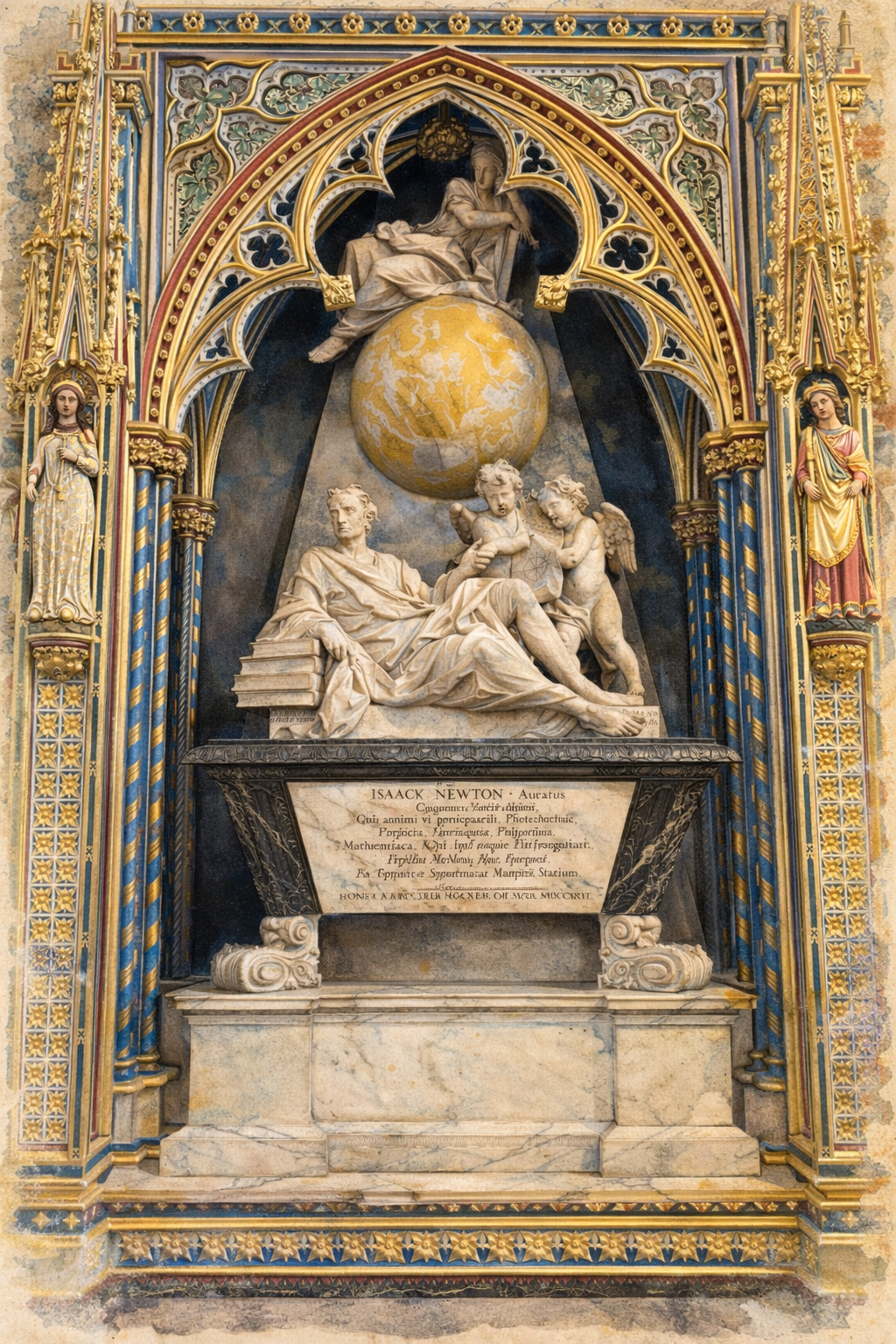
He was the first scientist buried in Westminster Abbey for intellectual merit, an honor previously reserved for kings. His funerary monument depicts books, compasses, a celestial sphere, and geometric diagrams.
A Latin inscription reads:
“Let mortals rejoice that there has existed such a great ornament of the human race.”
Newton was not only the architect of modern science. He was an unrelenting seeker of visible and invisible laws, a man who never separated science, alchemy, and faith.
Curiosities
One of the most striking curiosities of Isaac Newton’s biography is that his date of birth appears in two different forms depending on the source. Some state that he was born on 25 December 1642, while others list 4 January 1643. Both dates are correct.
The confusion arises from the use of different calendars. In 17th-century England, the Julian calendar.was still in use, and the new year did not begin on January 1, but on March 25. Under that system, Newton was born on December 25, 1642.
However, when that date is converted to the Gregorian calendar, which we use today, his birth corresponds to 4 January 1643. England did not adopt the Gregorian calendar until 1752, decades after Newton’s death.
This chronological discrepancy is a perfect example of how changes in the way we measure time can alter even the most basic historical facts—and it connects directly with the evolution of the calendar that governs our lives today.
“I do not know what I may appear to the world, but to myself I seem to have been only like a boy playing on the seashore… while the great ocean of truth lay all undiscovered before me.”
— Phrase attributed to Isaac Newton by William Stukeley (Memoirs of Sir Isaac Newton, 1752, posthumously published)