Few historical figures have inspired as many stories as Erzsébet Báthory. Known as the Blood Countess.
She has been portrayed for centuries as a woman obsessed with preserving her youth who tortured and murdered hundreds of young maidens, even—according to legend—bathing in their blood to preserve her beauty.
Her name has inspired novels, films, video games, and horror stories, turning her into one of the most unsettling figures in the European imagination.
But behind that legend lies the question of whether Erzsébet Báthory was responsible for numerous heinous crimes in early modern Europe, or whether she was transformed into a monster whose notoriety grew far beyond what the documents can substantiate.
A Europe Divided by Wars and Superstition
Erzsébet Báthory was born in 1560, at a time marked by political conflicts, wars, and profound religious transformations.
The Kingdom of Hungary was in an especially complex situation. The expansion of the Ottoman Empire, disputes between the Habsburgs and parts of the Hungarian nobility, religious tensions caused by the Reformation, and internal conflicts made Central Europe a deeply unstable region.
In this environment, belonging to one of the great aristocratic families meant becoming part of a network of alliances, estates, marriages, and political obligations.
And the Báthory family stood at the center of that network.
The Powerful Báthory Family: An Ancient Hungarian Lineage
. The Báthory family, also appearing as Báthorien Báthorien in certain historical forms of the Hungarian name, belonged to one of the most important noble families in the Kingdom of Hungary.
Their lineage was connected to the ancient Gutkeled clan, a noble family of Germanic origin whose ancestors appear in medieval genealogical traditions as having arrived in the kingdom during the reign of Peter Orseoloin the 11th century.
As with many medieval families, the boundary between history and tradition is not always clear. What is documented, however, is the rise of the Báthory family as a noble lineage during the 13th and 14th centuries.
Bereczk Báthory, documented in the late 13th and early 14th centuries, is considered an important figure in the consolidation of the family name and its possessions. The surname became associated with the estate of Bátor —present-day Nyírbátor, Hungary—from which the name Báthory originated.
Over time, the family would become one of the great aristocratic houses of Central Europe.
The Origin of the Name
The name Báthory family is connected with Bátor, one of the estates that became part of the family’s possessions. As happened with other medieval lineages, the family name became associated with the territory over which the family exercised its rights.
During the following centuries, the family divided into several branches. Among the most important were:
- Báthory of Ecsed, to which Erzsébet belonged.
- Báthory of Somlyó, from which several future princes of Transylvania emerged, as well as Stephen Báthory, who would eventually become King of Poland.
The Szaniszlófi branch, which was connected with the Somlyó line.
Although the different branches had their own political interests, they all formed part of the extensive Báthory family.
A Family Accustomed to Ruling
The importance of the Báthorys did not come solely from their estates. For generations, different members of the family held some of the most important positions in the Kingdom of Hungary and the Principality of Transylvania.
Among them were Palatines of Hungary—the highest-ranking official after the king—royal judges, voivodes of Transylvania, military commanders, and major landowners. The Somlyó branch also produced Stephen Báthory, Prince of Transylvania and later King of Poland.
The Ecsed branch likewise possessed considerable political influence. One of its members, Stephen Báthory of Ecsed, served as Voivode of Transylvania in the late 15th century.
The House of Báthory had spent generations directly involved in the politics, administration, and wars of the Kingdom of Hungary. Its influence extended across much of Central Europe.
Erzsébet’s Branch of the Family
Erzsébet was born in 1560 into the Ecsed branch. Her father was György Báthory of Ecsed , while her mother, Anna Báthory, belonged to the Somlyó branch. Their marriage therefore united two important branches of the same family.
Marriages between members of related aristocratic families were not unusual in Europe at the time. Such unions could strengthen family alliances, keep estates within the noble circle, and consolidate political positions.
In the case of the Báthorys, the ties between their various branches also helped maintain extensive networks of kinship and property.
Before becoming the protagonist of one of Europe’s most famous legends, Erzsébet was therefore a young aristocrat born into one of the most powerful families in the Kingdom of Hungary.
Erzsébet’s Childhood and Education
According to the most widespread biographical tradition, Erzsébet was born in Nyírbátor, in the Kingdom of Hungary, on August 7, 1560. She spent much of her childhood among the family estates of Ecsed, where she grew up within the sphere of the Báthory family.
The surviving sources and genealogies do not always provide the same information about all of her siblings. However, her brother István Báthory of Ecsedis documented as having held important political positions in the Kingdom of Hungary.
A Privileged Childhood
Erzsébet grew up in an aristocratic environment in which education formed part of the preparation of members of the great noble families. For a woman of her position, knowing how to read and write, maintaining correspondence, managing estates, and understanding religious and social matters could be particularly important, especially given the role many noblewomen played in managing their households and property.
The surviving biographies portray her as a woman educated in several languages, including Hungarian, Latin, German, and Greek.
Latin was particularly important in the administration, law, and written culture of the Kingdom of Hungary, while German was useful within the complex political environment of the Habsburg world.
Her education included skills considered appropriate to aristocratic life: reading and writing, religion, correspondence, household administration, and the management of estates and servants.
The Báthory family was also part of the complex religious landscape of 16th-century Hungary. In Erzsébet’s case, biographical sources generally identify her as Calvinist, or Reformed.
Her education was not intended to prepare her to become head of the Báthory family, but rather for the role expected of a woman belonging to the high aristocracy of her time.
And very soon, that role would place her alongside another of the kingdom’s great noble families.
A Marriage Between Two Great Families: Erzsébet Báthory and Ferenc Nádasdy
The engagement between Erzsébet Báthory and Ferenc Nádasdy was arranged when both were still very young, as part of a matrimonial strategy common among the great aristocratic families of Europe at the time.
The marriage united two important noble houses of the Kingdom of Hungary and strengthened their family, political, and property networks.
The wedding took place on May 8, 1575, in Vranov, when Erzsébet was fourteen and approaching her fifteenth birthday, while Ferenc was nineteen. The ceremony brought together prominent members of the nobility.
After the marriage, Erzsébet became part of the Nádasdy household, although history would continue to remember her by her birth name: Báthory.
The marriage lasted for almost three decades, until Ferenc’s death in 1604.
Her Children
The sources do not completely agree on the total number of children born to the couple. The Nádasdy Museum in Sárvár states that there may have been five or six and records the names Anna, Orsolya, Ilona, Katalin, András, and Pál. Of these, Anna, Katalin, and Pál reached adulthood, while the fate of Orsolya and Ilona is less clear in the surviving sources.
Ferenc Nádasdy: The “Black Knight of Hungary”
Ferenc Nádasdy was one of the great military figures among the Hungarian nobility of his time.
Much of his career was connected with the wars against the Ottoman EmpireOttoman Empire, particularly the frontier campaigns and, later, the so-called Long War, fought from the late 16th to the early 17th century.
During these campaigns, he gained a reputation as an experienced commander and received the nickname Fekete Bég, meaning the “Black Bey,” or “Black Knight,” by which he entered historical memory. Historian Géza Pálffy highlights his military role during the Long War and notes that from 1598 onward he served as Captain General of Transdanubia and commanded troops in the service of the monarchy.
The frontier between territories under Ottoman control and the Kingdom of Hungary was an almost permanently war-torn region. As a result, Ferenc spent long periods away from his family.
His military career also contributed to increasing the prestige and political standing of the Nádasdy family.
An Effective Administrator
While Ferenc was away taking part in military campaigns, Erzsébet assumed responsibility for managing the family’s estates.
The surviving documentation shows that she maintained correspondence, dealt with financial matters, and supervised issues relating to the properties and the people who depended upon them.
Up to this point, there was nothing in Erzsébet’s life to suggest that, years later, her name would become associated with one of the darkest legends in European history.
Csejte Castle
One of the places that would eventually become inseparably linked with the name of Erzsébet Báthory was Csejte, now known as Čachtice.
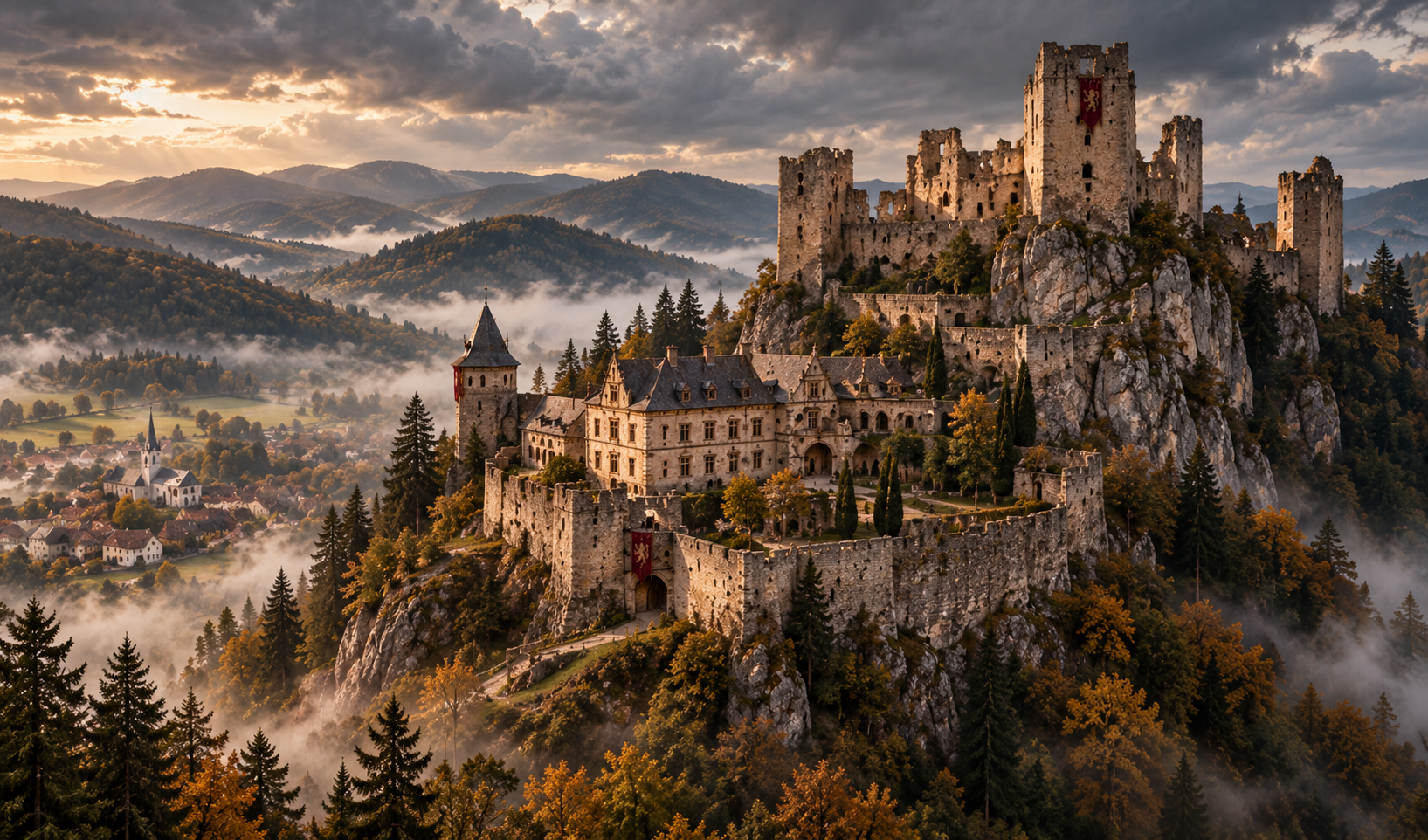
The castle stands on a hill in the Little Carpathians, in present-day Slovakia. In Erzsébet’s time, however, the territory formed part of the Kingdom of Hungary. The fortress had medieval origins and had been developed over centuries as a defensive stronghold. Its walls, courtyards, and fortified structures dominated the surrounding landscape. It was originally built as a frontier fortress and underwent various expansions and modifications throughout the Middle Ages and the early modern period.
The estate had come into the Nádasdy family’s possession as a pledged property, but Ferenc Nádasdy acquired it permanently in 1602, paying a substantial sum to the Crown.
The Manor House Beside the Castle
Next to the castle there was also a manor house, or kaštieľ, vinculada a los Nádasdy, donde la familia podía alojarse cuando se encontraba en Čachtice.
, associated with the Nádasdy family, where the family could stay when they were in Čachtice. Local documentation describes a large residence with private rooms, halls, a kitchen, storage areas, servants’ quarters, and other facilities typical of a great aristocratic household. A later inventory from 1645 described 46 rooms.
The complex formed part of a much larger estate that included land, villages, and agricultural activities.
The Strategic Location
From its position high above the surrounding landscape, Csejte overlooked the surrounding countryside and allowed control of routes crossing a region situated in a politically unstable area. The castle formed part of a network of fortresses and aristocratic estates that served defensive, administrative, and economic purposes.
The Nádasdy family did not live in isolation. Their domains were connected to villages including Čachtice, Višňové, and Podolie, as well as agricultural land, vineyards, and other properties that provided resources for the estate.
Csejte was more than a private residence; it functioned as a small, largely self-sufficient community.
The Death of Ferenc
Ferenc Nádasdy died on January 4, 1604, in Sárvár, after returning from his final military campaigns in poor health. The exact nature of the illness that caused his death has not been established with certainty. Sources indicate that he had been suffering from health problems for some time and returned from the 1603 campaign in a weakened condition.
His death left Erzsébet a widow at the age of 43, with enormous responsibility for the family’s property and affairs.
The Nádasdy family’s wealth included numerous estates, agricultural properties, fortresses, and sources of income. Following her husband’s death, Erzsébet inherited a vast fortune, making her one of the greatest landowners among the Hungarian nobility and within the kingdom.
There are records indicating that the House of Habsburg had accumulated a considerable financial debt to the Nádasdy family, particularly to the magnate and Count Ferenc Nádasdy. The count had frequently financed military campaigns and supplied provisions for the Crown in the face of the Ottoman threat.
The Widow and the Nádasdy Estate
Ferenc’s death made Erzsébet an even more important figure in the administration of the family’s affairs.
Surviving letters and documents show that she continued to manage financial and property matters. A source connected with the Nádasdy family, for example, records that in 1608 she conducted a review of her estates, having information gathered about the populations and revenues of her properties.
Aristocratic inheritance was subject to family rights, legal provisions, and complex property arrangements.
Only a few years after Ferenc’s death, this powerful widow would find herself at the center of an investigation that would permanently transform her name.
The First Accusations
The first accusations against Erzsébet Báthory did not suddenly appear in 1610.
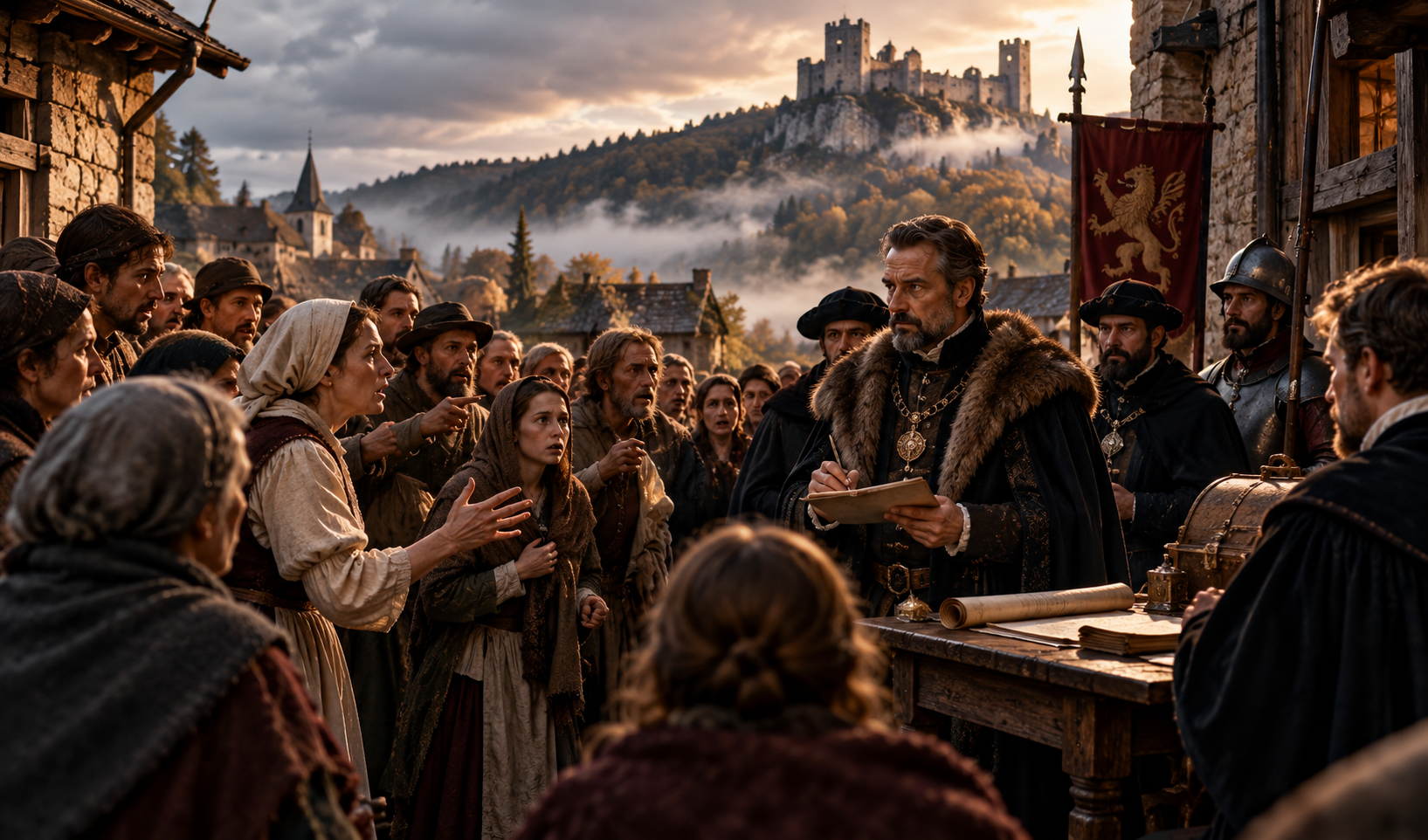
For years, rumors had circulated about mistreatment and deaths involving women who worked for her. Among those traditionally associated with the earliest complaints was István Magyari, a Lutheran pastor who is said to have brought his concerns before the authorities at the beginning of the 17th century.
The rumors spoke of young women who disappeared after entering the countess’s service and of extremely violent punishments.
Over time, these stories reached the authorities at court. In 1610, the matter ceased to be merely a local rumor and became an official investigation.
The Investigation by György Thurzó
In 1610, King Matthias II ordered the Hungarian Palatine György Thurzóto investigate the accusations against Erzsébet Báthory.
Thurzó held one of the highest offices in the Kingdom of Hungary and was directly involved in matters concerning the powerful Nádasdy family.
The investigation continued for months and was not limited to Čachtice and its surroundings. Testimonies were also gathered from other Nádasdy estates, including Sárvár and the surrounding area.
Among those accused of having directly participated in the alleged abuses were:
- IIona Jó: associated with Erzsébet’s household and traditionally identified as her nursemaid. She was accused of taking a direct part in the torture and testified about dozens of deaths.
- Dorottya Szentes: also known as Dorkó — a household servant who was identified as one of the alleged perpetrators of the physical abuse.
- Katalin Beneczky: associated with the household service, she provided details concerning the alleged crimes.
- János Újváry: known as Ficzkó — a young servant who allegedly helped transport and bury the bodies.
The statements of these individuals became a fundamental part of the prosecution’s case. The Hungarian National Archives states that the servants directly accused confessed under torture and were executed shortly afterward.
Ilona Jó and Dorottya Szentes were sentenced to death and executed. Their fingers were subjected to brutal mutilation before they were burned. János Újváry was beheaded, and his body was subsequently burned.
Katalin Beneczky was not executed.
The Raid on Čachtice
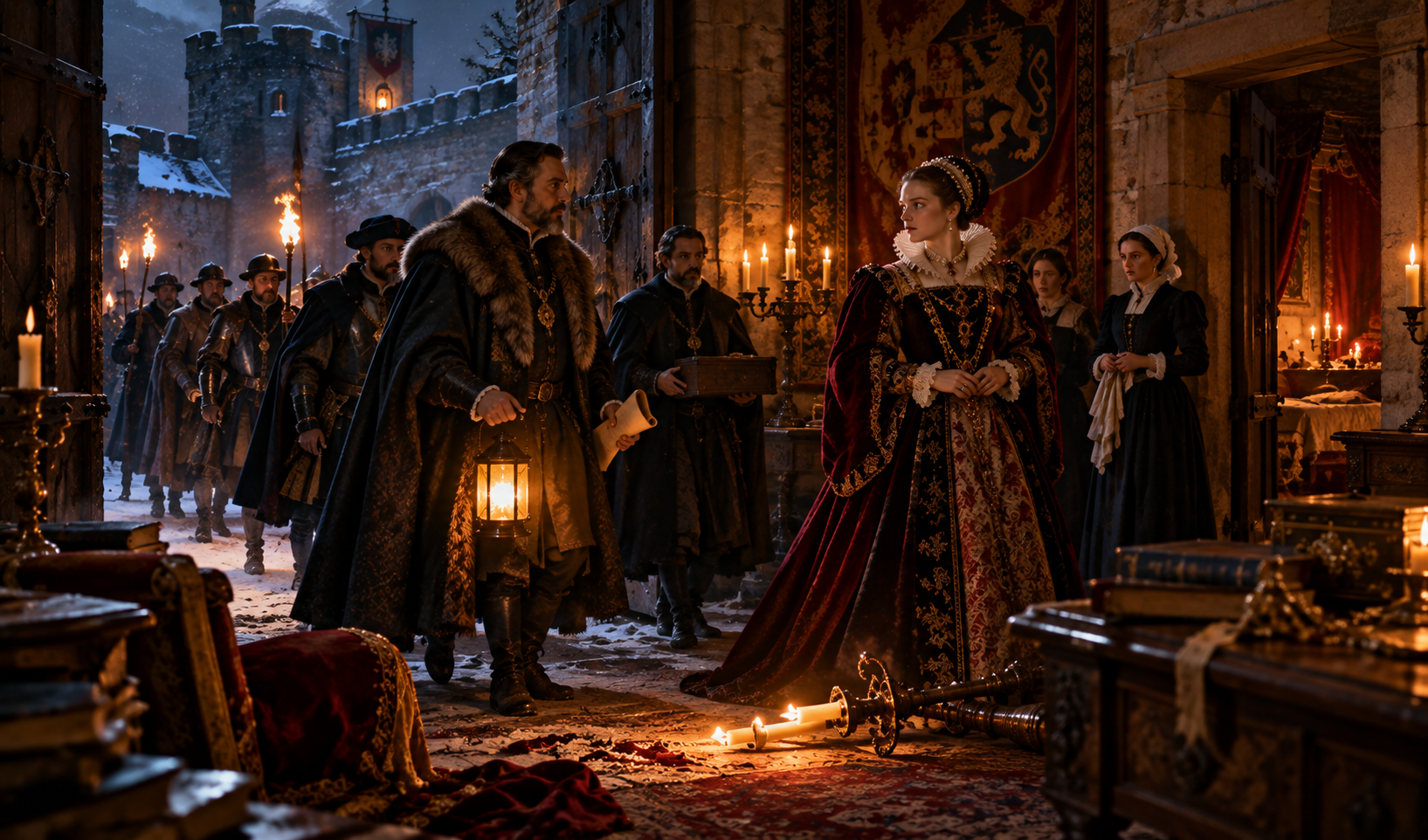
The decisive moment came on December 29, 1610. György Thurzó y sus hombres llegaron a Čachtice y Erzsébet fue puesta bajo arresto.
György Thurzó and his men arrived at Čachtice, and Erzsébet was placed under arrest. According to the contemporary account, during the search Thurzó and his men claimed to have found a young woman dead inside the residence, another seriously injured, and other people being held who showed signs of violence. They also described mutilated bodies, marks of torture, and evidence of extreme violence against young women employed as servants. The documentation relating to the episode later became one of the foundations of the accusations against Erzsébet.
In Thurzó’s written description of what had happened during the search, he used the expression in fraganti, implying that Erzsébet had been caught in the act.
However, his private correspondence with his wife presents a different version of the events.
The Testimonies
The investigation into the countess began in March. Interrogations took place between March 1610 and July 1611.
Documents preserved by the Hungarian National Archives show that statements were collected from people in different locations connected with the Nádasdy estates. The Archives note that the investigation gathered an exceptionally large number of testimonies, totaling approximately 317 witnesses, but also emphasize that many of them spoke about events they had learned about secondhand.
Algunos habían oído hablar de criadas castigadas, otros afirmaban conocer la muerte de determinadas jóvenes, otros habían escuchado rumores sobre un número mucho mayor de víctimas. Y, a medida que la noticia sobre la investigación se extendía, las cifras y testimonios también crecían.
The result was a huge accumulation of statements, but with very different degrees of proximity to the alleged events.
The Victims
One of the most famous aspects of the Erzsébet Báthory story concerns the alleged number of victims.
During the interrogations, a woman identified as Susannah, or Zsuzsanna, testified that there was supposedly a record relating to the countess’s victims. According to her statement, this list had reached more than 650 names.
However, this was not the only figure to emerge during the investigation. The accused themselves provided considerably lower numbers for the people they claimed to have seen die during their years of service. The figure of 80 victims appears in some later reconstructions attributed to the prosecution. The estimates varied enormously.
The exact number of victims cannot be established with certainty from the surviving documentation.
The alleged diary of the countess was never produced as material evidence.
The Trial That Never Took Place
Erzsébet Báthory was never tried and convicted by a court.
The judicial proceedings that followed her arrest were directed against several of her servants and alleged accomplices. Erzsébet herself was kept under confinement.
The countess never received a formal conviction for murder. Nor did she have the opportunity to publicly defend herself before a court.
The Hungarian National Archives itself describes the investigation as a procedure that failed to produce testimony capable of credibly demonstrating that Erzsébet had committed the crimes attributed to her.
The Confined Countess
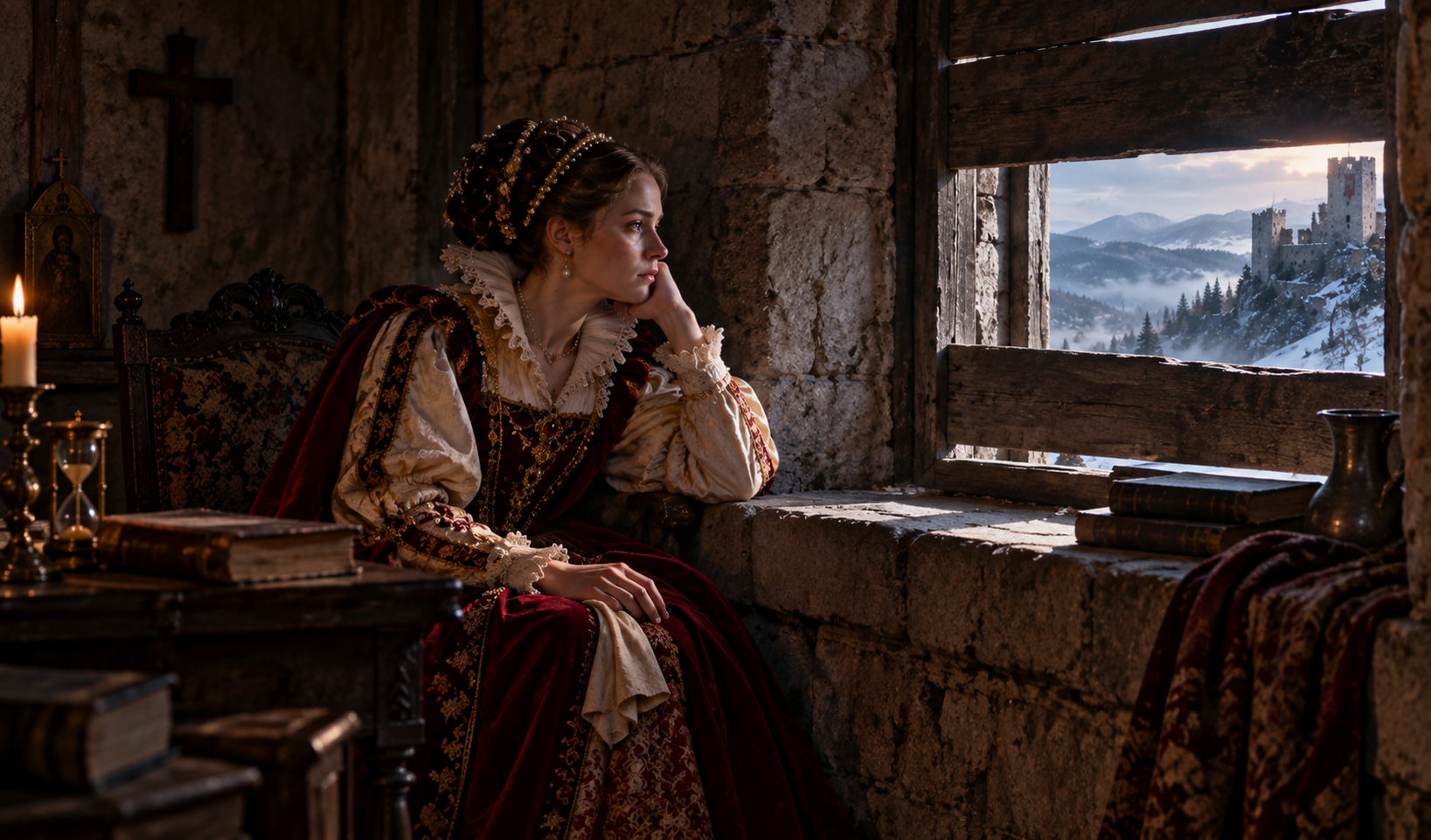
After her arrest, Erzsébet was confined in Čachtice.
Later tradition claims that she was locked inside a room whose doors and windows were sealed, leaving only a small opening through which food could be passed. She remained under house arrest within the Čachtice complex until her death in 1614.
The reason why she was never subjected to a public trial remains one of the most debated aspects of the case. Her social position, family connections, and the importance of her wealth all formed part of the political context in which the investigation took place.
There were also important financial relationships between the nobility and the Crown, particularly during a period of war and enormous military expenditure. The Habsburg monarchy had accumulated substantial debts to Ferenc Nádasdy, who had financed military campaigns and supplied provisions for the monarchy.
For this reason, some researchers have also interpreted the investigation into Erzsébet from a political and property-related perspective.
What We Know from the Archives
The Hungarian National Archives preserves the records of the investigation ordered by György Thurzó, including the proceedings and numerous testimonies. The documents show that the investigation was extraordinarily extensive.
The National Archives itself highlights that:
- despite the exceptionally large number of witnesses, no witness or testimony emerged that credibly demonstrated that Erzsébet had personally committed the crimes;
- many witnesses had only indirect knowledge of the alleged events;
- those who were able to describe specific incidents could only state that deaths had occurred and that some servants had been punished;
- the relatives of the alleged hundreds of missing young women did not appear as witnesses;
- the officials who searched Čachtice in December 1610 did not find objects that indicated or demonstrated the hundreds of murders supposedly committed by the countess;
- the statements of the accused servants were obtained under torture;
- the alleged record containing the names of 650 victims was never found;
- the reported numbers of victims varied enormously.
The surviving documentation does not allow the case to be reconstructed with certainty as either proving or disproving that Erzsébet Báthory committed the alleged murders.
The proceedings concerning her ultimately remained inconclusive and ended without a verdict.
Erzsébet was never formally tried. She was confined in the castle, where she remained until her death in August 1614, and no further proceedings against her were initiated or could be completed.
The documentation therefore leaves us with a story far more complex than the image of a countess who was tried, convicted, and officially recognized as responsible for hundreds of murders.
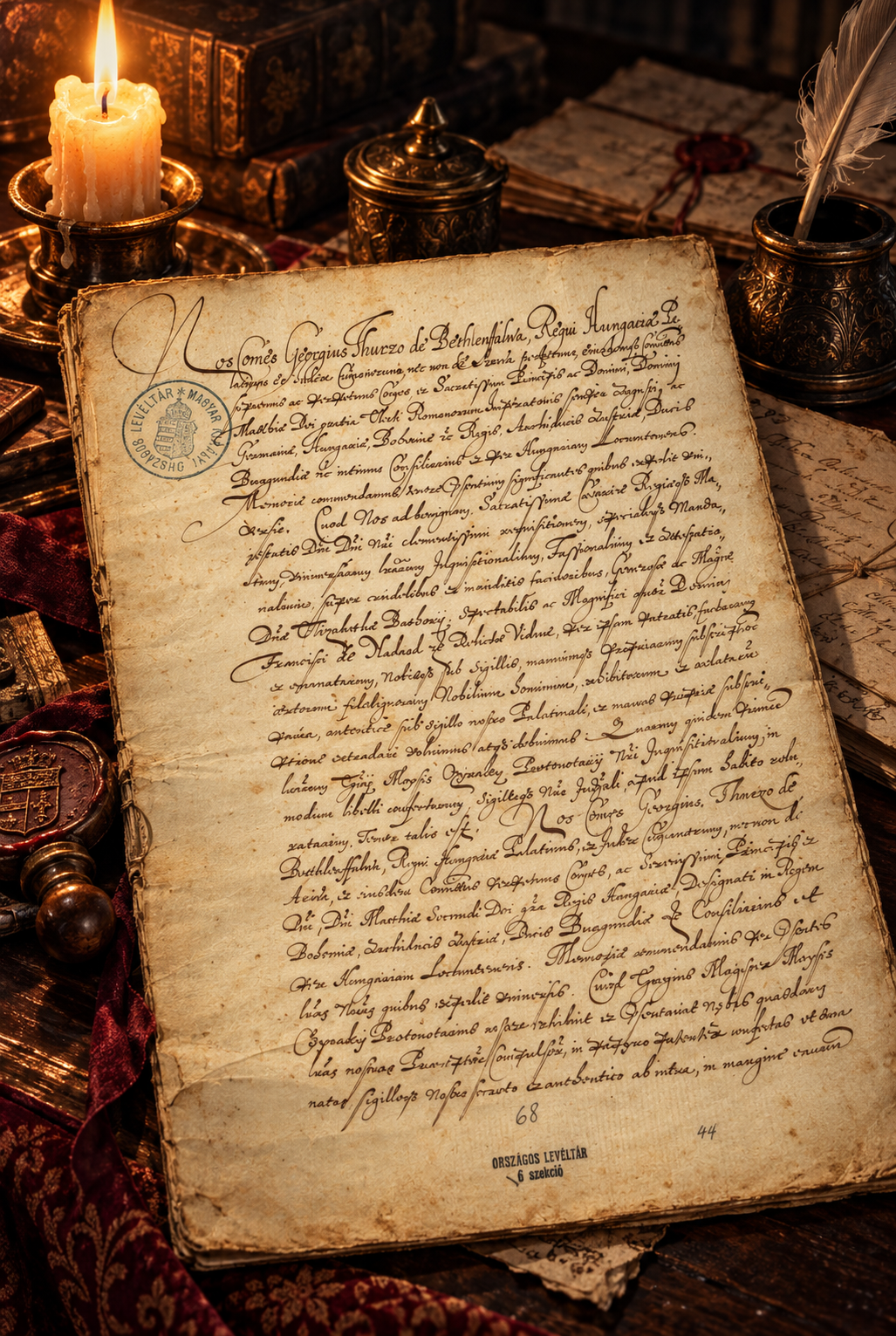
Erzsébet Báthory’s Will
Despite being under confinement, Erzsébet continued to deal with the fundamental issue affecting her family: its property.
In her will, she distributed all her possessions among her children. The legal status of the property belonging to a great aristocratic family was not straightforward. Estates were subject to inheritance rights, family obligations, and the laws of the Kingdom of Hungary.
Under Hungarian law in the early modern period, property distributed in this manner could not simply pass into the hands of the ruler, even if Erzsébet Báthory were declared guilty and sentenced.
A few years after Ferenc’s death, in 1614, Erzsébet Báthory died at Čachtice. She was 54 years old. She had never been tried. She had never received a sentence. But her name was already beginning to transform into something far more powerful than the documents themselves: a legend.
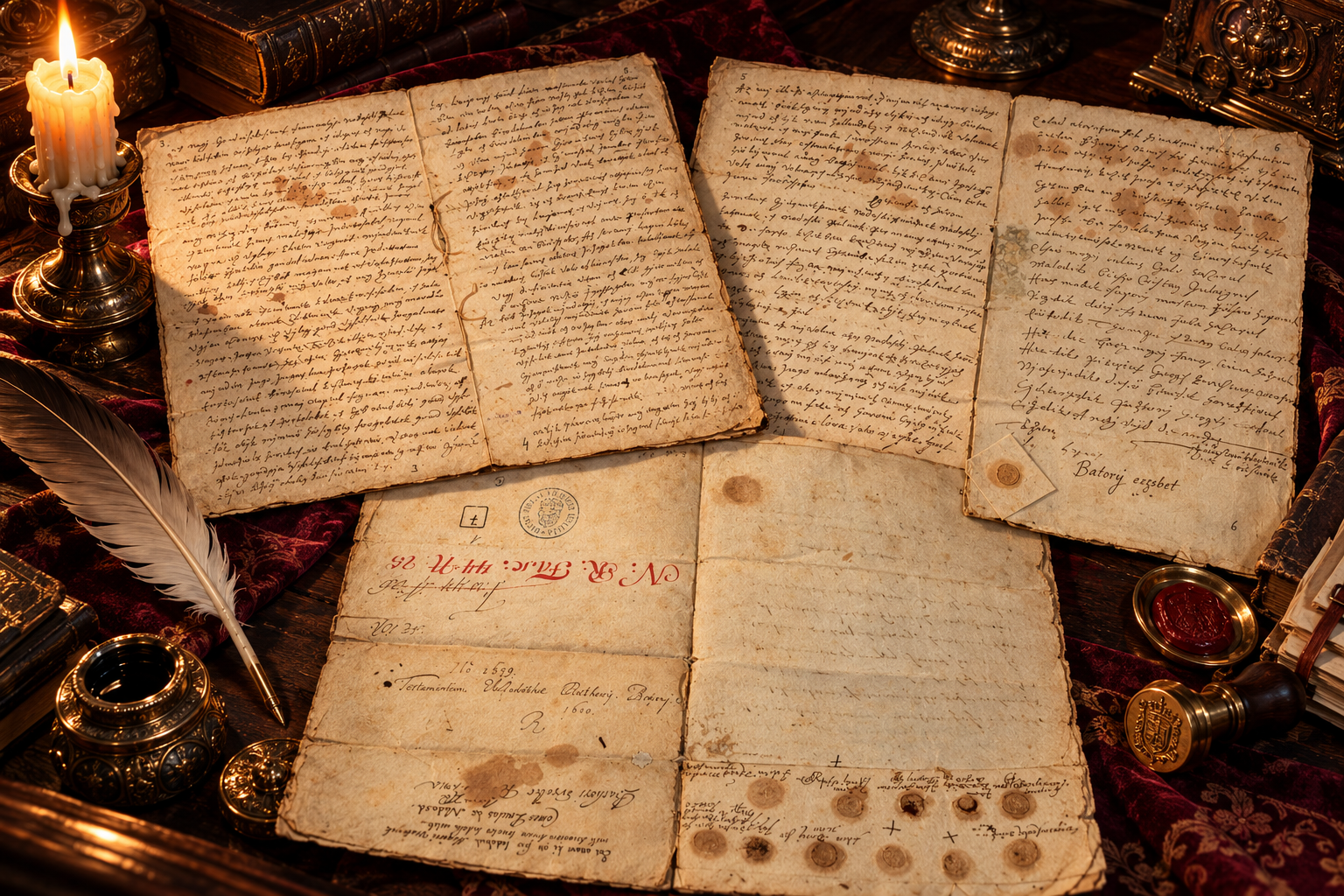
The Myth of the Blood Countess
When Erzsébet Báthory died in 1614, the accusations against her had already generated an extensive and controversial body of documentation. But the story we know today did not yet exist.
During the decades and centuries that followed, accounts of the countess gradually acquired new elements, transforming an aristocratic woman accused of crimes into one of the great female monsters of European culture.
At the beginning of the 17th century, Europe was experiencing a period in which accusations of witchcraft could lead to investigations, torture, and executions. The persecutions disproportionately affected women, and in many regions the accused came from the lower social classes.
Erzsébet occupied a completely different position. She was a member of one of the most powerful families in the Kingdom of Hungary, the widow of an important military commander, and the administrator of an enormous fortune.
This difference in status may have influenced the way the case unfolded.
When the Past Begins to Change
One of the most striking characteristics of the Erzsébet Báthory legend is the way her past changed over time. After her arrest, stories about her alleged crimes began to circulate, but the contemporary accusations focused primarily on events that were supposedly taking place during the years immediately preceding the investigation.
Over time, accounts emerged claiming that Erzsébet had displayed cruelty since childhood, had witnessed executions, had learned magic from an old woman, or had developed a fascination with suffering from a very young age. Stories involving supernatural behavior also began to appear.
Other people from her circle would eventually be incorporated into later versions of the story. Ferenc Nádasdy, for example, became the man who supposedly taught his wife methods of torture he had learned during the wars against the Ottomans.
These stories about her childhood do not appear in the surviving documents from the 1610–1611 investigation.
The cruel child, the young woman fascinated by blood, the woman who learned magic, and the aristocrat supposedly destined from birth to become the Blood Countess are elements that appear too late—even centuries later—in the sources.
1729: The Blood Countess Is Born
The great turning point came in 1729. More than a century after Erzsébet’s death, the Hungarian Jesuit László Turóczi published Ungaria suis cum regibus compendio data, a historical work about the Kingdom of Hungary.
In it, he included an account of Erzsébet Báthory that introduced elements not found in the surviving testimony from the original investigation.
This is where the famous episode that would forever change her image first appeared in written form: the blood bath. According to Turóczi’s account, Erzsébet allegedly struck a maid so violently that she began to bleed. Some drops of blood splashed onto the countess’s skin and, when she wiped them away, she supposedly believed that the area appeared younger and more beautiful. The countess then allegedly concluded that the blood of young women could preserve her beauty.
Turóczi’s story did not simply add a macabre detail. It changed the meaning of the entire story. From that point onward, the ritual could begin: young women murdered; blood collected; baths intended to preserve youth; and an aristocratic woman transformed, almost overnight, into a supernatural monster.
None of the surviving testimonies from the investigation describes Erzsébet bathing in blood, nor was any such ritual discovered during the search of Čachtice.
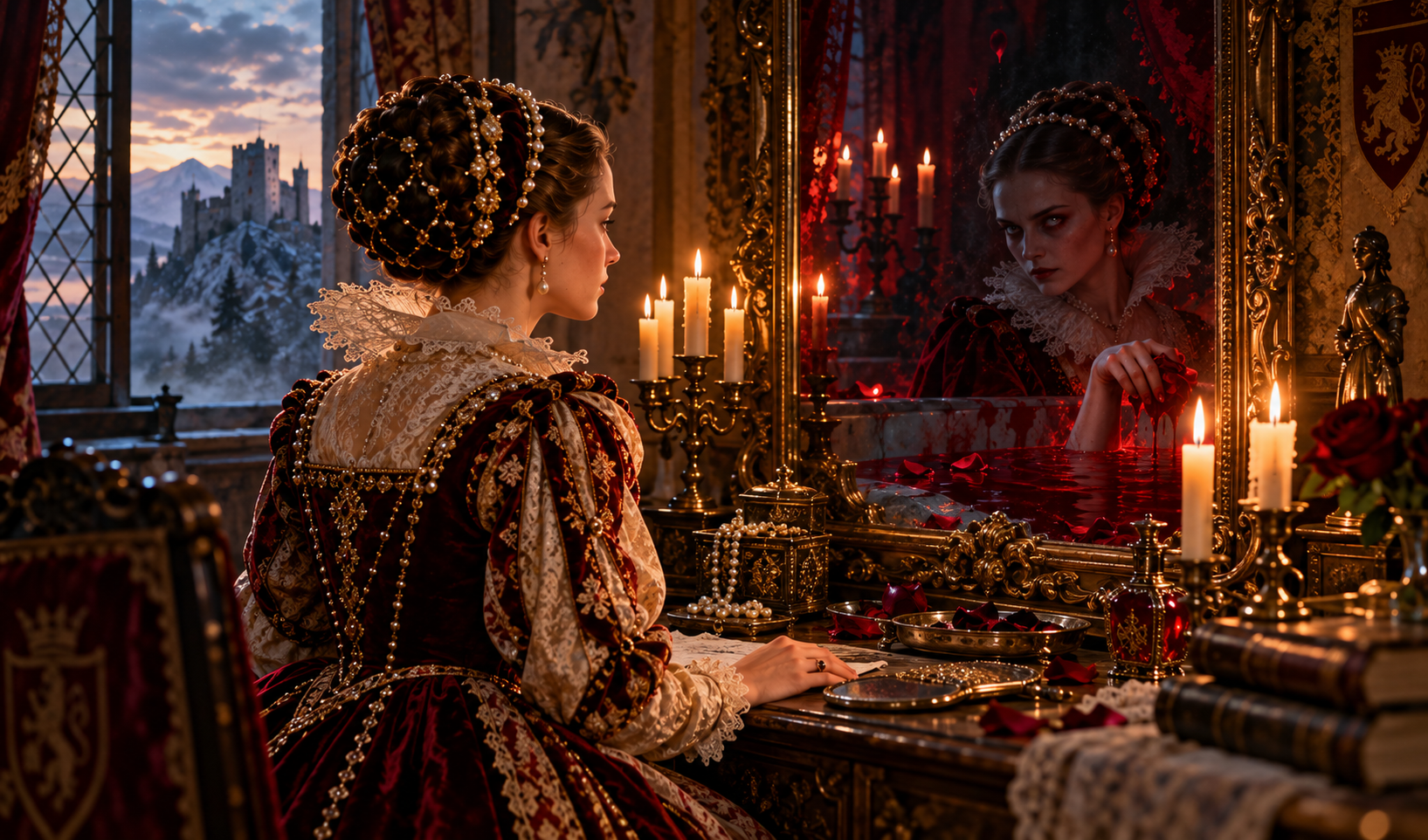
From Accused Aristocrat to Monster
During the 18th and 19th centuries, the story continued to grow. Each new version could add details, remove others, or reinterpret what had come before. The accounts began to merge with Gothic literature, witchcraft stories, and, later, the vampire imagination. The result was an Erzsébet increasingly distant from the woman we can reconstruct from the documents.
The historical countess had been a member of a powerful family, the wife of a military commander, an administrator of estates, an extremely wealthy widow, the subject of an extraordinary investigation, and a woman who died in confinement without ever receiving a formal judicial sentence.
The legendary countess was a woman obsessed with beauty, the murderer of hundreds of young women, bathing in blood and associated with magic and vampirism.
The distance between the two figures grew with each generation, and the legend found an image that was almost impossible to forget.
Erzsébet Báthory in Popular Culture
The legend did not end with books. During the 19th and 20th centuries, Erzsébet Báthory began to become a figure in literature, film, music, and later video games. Her story proved particularly attractive to Gothic culture: a powerful aristocrat, a castle, missing young women, blood, beauty, death, and a possible connection with the world of vampires.
Her influence reached Romantic and Victorian writers, who drew upon the story when shaping or creating aristocratic female vampires for Gothic horror, historical fiction, and dark tales about crime and power.
Some examples of her influence include:
- 1614: Erzsébet Báthory dies in confinement at Čachtice.
- 1729: László Turóczi published Ungaria suis cum regibus compendio , putting into writing the account that introduces the famous blood-bath episode..
- 1742: Mátyás Bél, a Lutheran scholar and historian, publishes Notitia Hungariae novae historico-geographica, which includes Turóczi’s account, helping the legend circulate more widely in Europe and further establishing the image of the “Blood Countess.”
- 1872: Joseph Sheridan Le Fanu published Carmilla, one of the foundational works of vampire literature. Later studies have suggested a possible connection between Báthory and the novella, with the countess having potentially served as an inspiration for Le Fanu.
- 1966: Argentine poet Alejandra Pizarnik published The Bloody Countess. Pizarnik transforms the countess into a literary figure defined by violence, beauty, and death.
- 1972: Spanish director Jordi Grau brings the legend to the screen with Blood Ceremony, combining the Báthory myth with Gothic horror and vampiric imagery.
- 1994: The video game Castlevania: Bloodlines features Elizabeth Bartley, a character inspired by Erzsébet Báthory. She appears as Dracula’s niece.
- 2008: Director Juraj Jakubisko brings the story to the screen in Bathory, a film that questions some of the traditional elements of the legend.
- 2017-2018: In the Japanese video game universe of the Black Souls series , a version of Báthory appears among its dark historical and literary characters.
The Legend Continues
Four centuries later, the story of Erzsébet Báthory continues to divide historians. Contemporary documents show that there was a real investigation, serious accusations, numerous testimonies, and proceedings against several of her servants. But they also reveal contradictions, indirect testimony, confessions obtained under torture, the absence of a sentence against Erzsébet herself, and her confinement until her death.
When we look further back through the sources, we find that the most famous elements of her legend appeared much later. The blood bath does not appear in the surviving contemporary testimonies. The figure of 650 victims comes from a statement concerning an alleged diary that was never found. Stories about her cruel childhood emerged later. Magic and vampirism were gradually incorporated into the character.
The Blood Countess we know today was born from testimonies, rumors, interpretations, books, Gothic literature, film, and video games. The historical woman and the Blood Countess eventually became two overlapping figures.
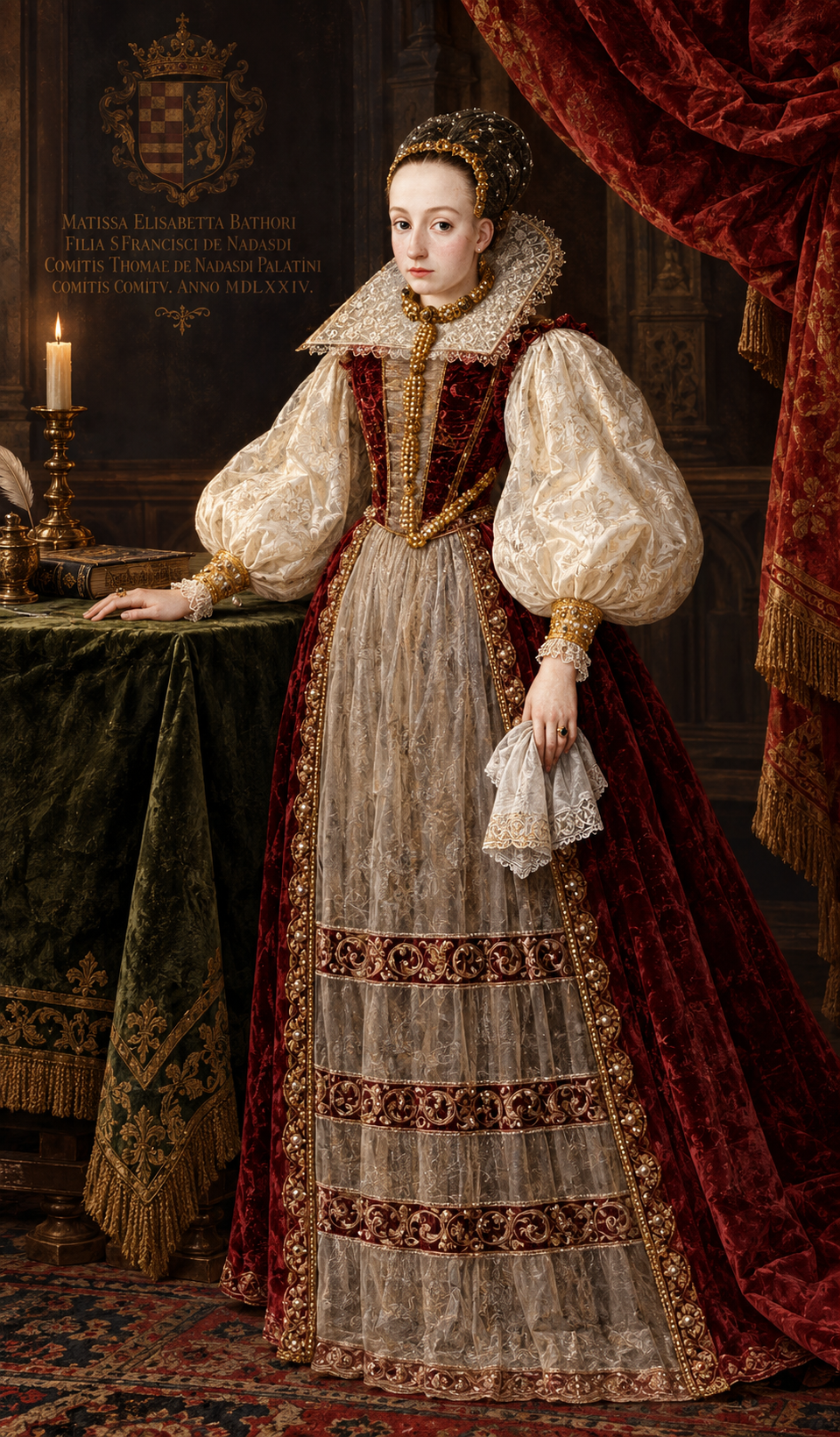
Perhaps we will never know exactly what happened at Čachtice. And that uncertainty is precisely what has transformed the Blood Countess into one of the most mysterious figures in European history.
Follow the Footprints
The story of Erzsébet Báthory is surrounded by castles, documents, rumors, and legends. But some of those traces can still be followed today.
Visit It Today...
Čachtice Castle — Slovakia
The ruins of Čachtice Castle stand on a hill in the Little Carpathians, between the towns of Čachtice and Višňové.
The fortress dates back to the 13th century and passed through the hands of various aristocratic families before becoming associated with the Nádasdy family. The fortress was damaged during the wars of the 18th century. In 1708, it was captured by the rebel forces of Francis II Rákóczi, and over time it fell into ruin. Between 2012 and 2014, consolidation and archaeological excavation work was carried out, and the site reopened to the public in 2014 as a tourist attraction surrounded by a nature reserve.
Múzeum Čachtice, Draškovič Manor — Slovakia
The Draškovič Manor was built in the 17th century and is associated with the Draškovič family and Erzsébet’s descendants. Located in Čachtice, the museum houses several exhibitions dedicated to the history of the town, as well as a permanent exhibition about Erzsébet Báthory, including historical objects and a reconstruction of one of her dresses.
Trenčín Museum — Slovakia
The Trenčín Museum is currently the institution responsible for the Draškovič Manor in Čachtice.
Nádasdy Castle — Sárvár, Hungary
Sárvár was one of the most important centers of the Nádasdy family and is closely associated with Ferenc Nádasdy.
The Ferenc Nádasdy Museum currently occupies part of the castle and offers several exhibitions devoted to the military and cultural history of the region. One of its highlights is the Knights’ Hall, created in 1653 by Hans Rudolf Miller.
MNM Báthori István Múzeum — Hungary
In Nyírbátor, a town closely associated with the Báthory lineage, stands the MNM Báthori István Múzeum.
Among its exhibitions is one dedicated to the history of the Báthory family, as well as to the military traditions of the period associated with the Báthorys.
Hungarian National Archives (Magyar Nemzeti Levéltár Országos Levéltára) – Budapest
March 1610 and July 1611. marzo de 1610 y julio de 1611.
The documents form part of the holdings of the Hungarian archives, which also preserve Erzsébet’s will, dated September 3, 1610.