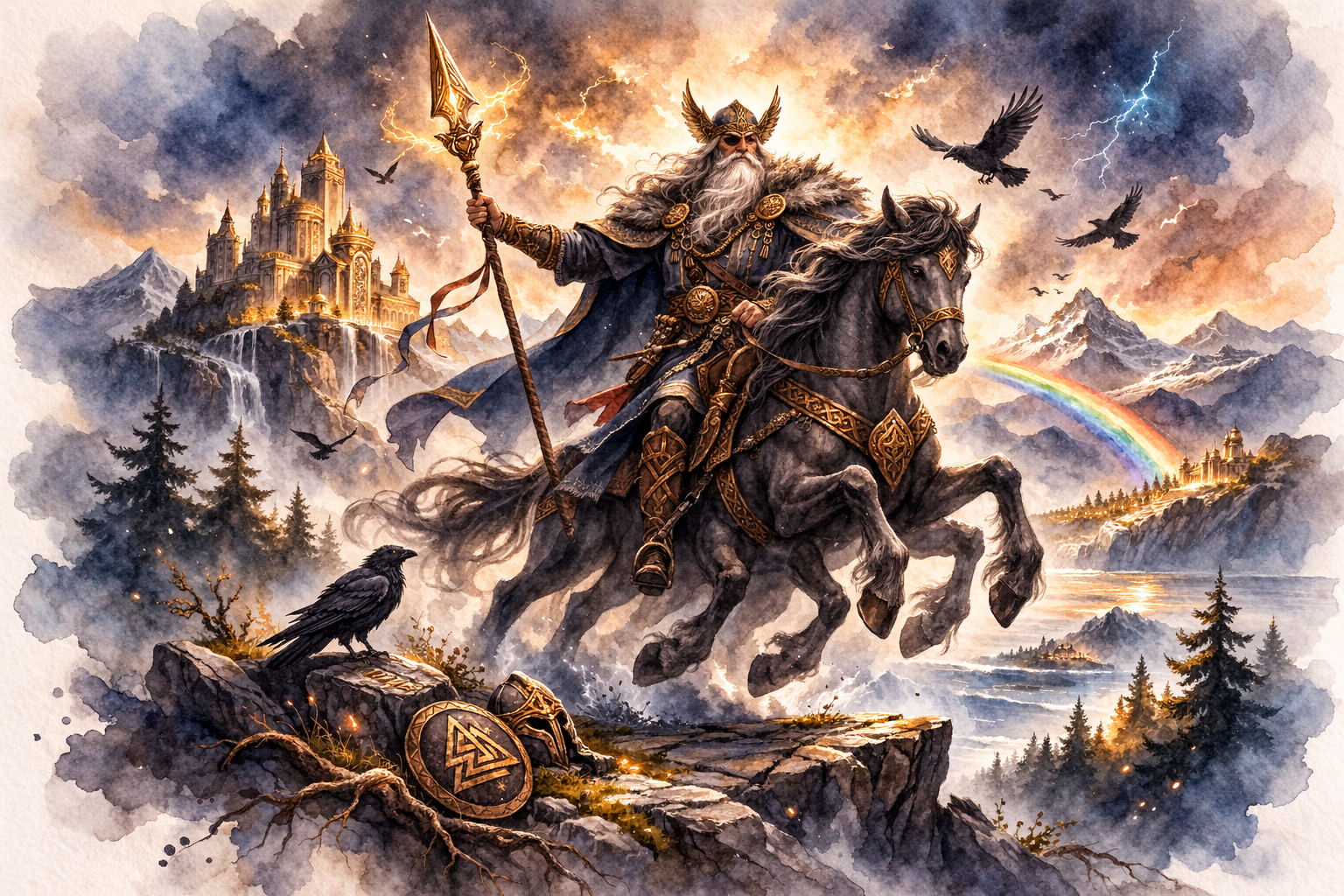
Odin (Óðinn in Old Norse) is the central figure of the Scandinavian pantheon. In medieval Icelandic sources—primarily the Poetic Edda and the Prose Edda by Snorri Sturluson (13th century)—he appears as the sovereign of the Æsir and ruler of Asgard.
His name is related to the term óðr, associated with inspiration, poetic fury, and trance. He is not merely a war god: he is a deity connected to knowledge, magic, sovereignty, and fate.
From his throne Hliðskjálf, located in the hall of Valaskjálf, Odin observes the Nine Worlds. This ability of all-seeing vision, mentioned in various eddic compositions, highlights his role as a vigilant and strategic god.
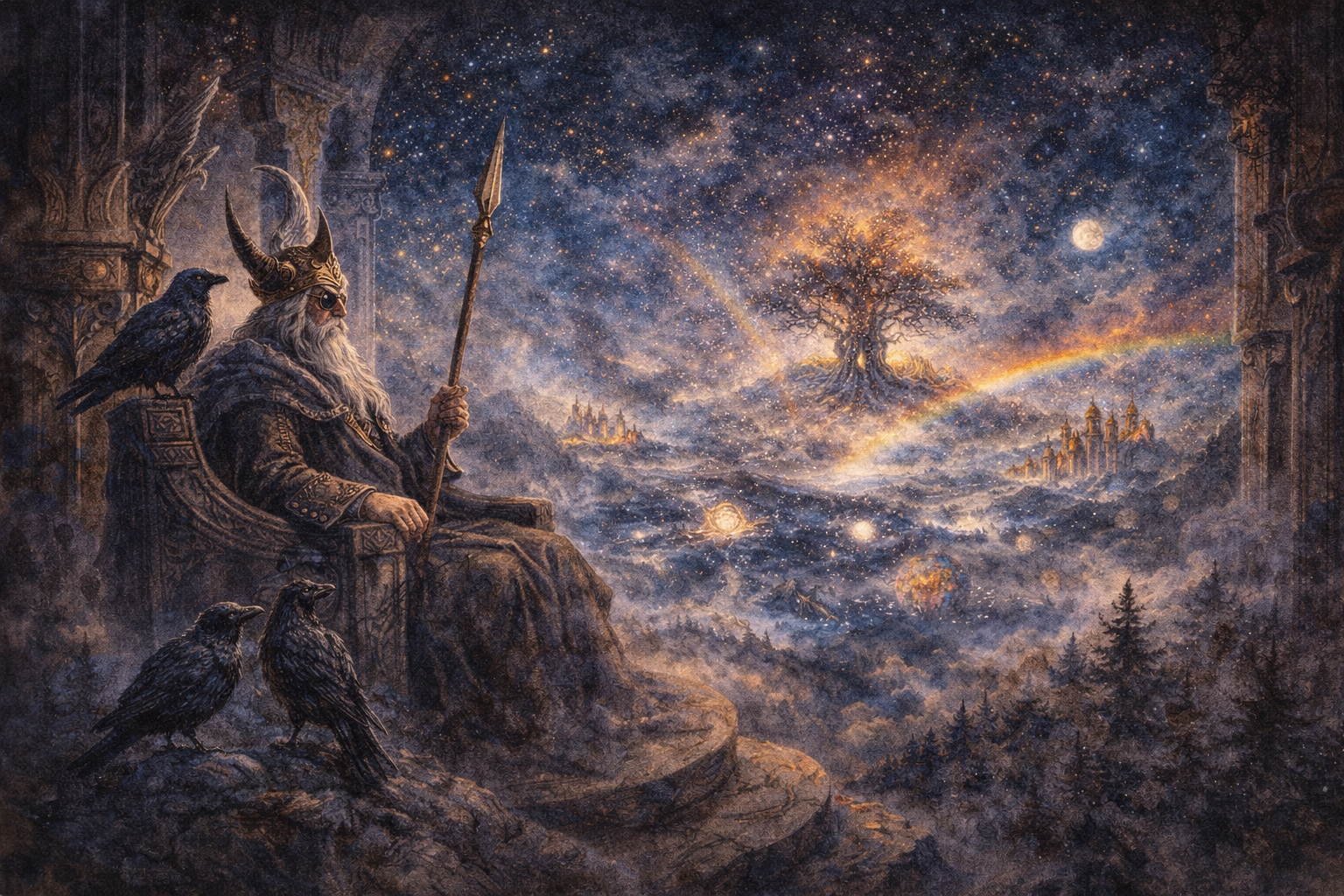
Asgard is not only his residence: it is the center of divine power. Among its most notable places are:
- Valaskjálf, where Hliðskjálf stands
- Valhalla, el salón de los guerreros caídos
- Glaðsheimr, the meeting place of the gods
Origin and lineage
According to the tradition preserved in the Prose Edda, Odin is the son of Borr and the giantess Bestla, daughter of the giant Bölthorn. From this union are born three brothers:
- Odin
- Vili
- Vé
Together, they shape the world after slaying the primordial giant Ymir:. From his body, they form the cosmos: his flesh becomes the earth, his blood the seas, his bones the mountains, and his skull the sky.
This account, preserved in the Gylfaginning , constitutes the fundamental cosmogonic myth of the Norse world.
Odin and the pursuit of knowledge
Among the Norse gods, Odin most clearly embodies the active pursuit of knowledge. In eddic sources, he appears as a god willing to make personal sacrifices to access hidden wisdom.
The sacrifice at Mímir’s well
Beneath one of the roots of Yggdrasillies Mímir’s Well (Mímisbrunnr), a source of ancestral knowledge.
To drink from its waters, Odin offers one of his eyes as payment, reinforcing his nature as a god who sacrifices himself for wisdom. From that moment on, he is depicted as one-eyed.
This episode is mentioned in the Völuspá and the Gylfaginning.
The sacrifice on Yggdrasil and the origin of the runes
The most famous account of Odin’s self-sacrifice appears in the Hávamál. There, Odin hangs himself from the world tree, Yggdrasil, wounded by his own spear, Gungnir, , without food or drink for nine nights.
Suspended between life and death, he offers himself to himself as a sacrifice.
On the ninth day, the runes reveal themselves to him. They are not mere letters, but symbols filled with power, hidden meanings, and magical formulas.
Odin thus acquires knowledge of the futhark, the ancient Germanic writing system. In Norse tradition, runes were not simply written signs—they were believed to possess magical and ritual power.
After this episode, Odin becomes associated with:
- magic (seiðr)
- skaldic poetry
- runic incantations
- hidden knowledge
This act consecrates him as the god of wisdom, runic magic, and occult knowledge.
Animals and associated symbols
In mythological sources, Odin is accompanied by several animals that reinforce his role as a sovereign and all-knowing god:
Huginn and Muninn
His ravens—“Thought” and “Memory”—travel across the Nine Worlds each day and return at dusk to whisper everything they have seen.
Odin fears especially for Muninn, as memory is more fragile than thought.
Geri and Freki
His wolves accompany him in battle and in the feasts of Valhalla. Odin gives them his food and lives only on wine.
They are mentioned in the Grímnismál.
Sleipnir
His mount is the eight-legged horse, born of Loki.
Capable of traveling between worlds, it is considered the finest of all horses.
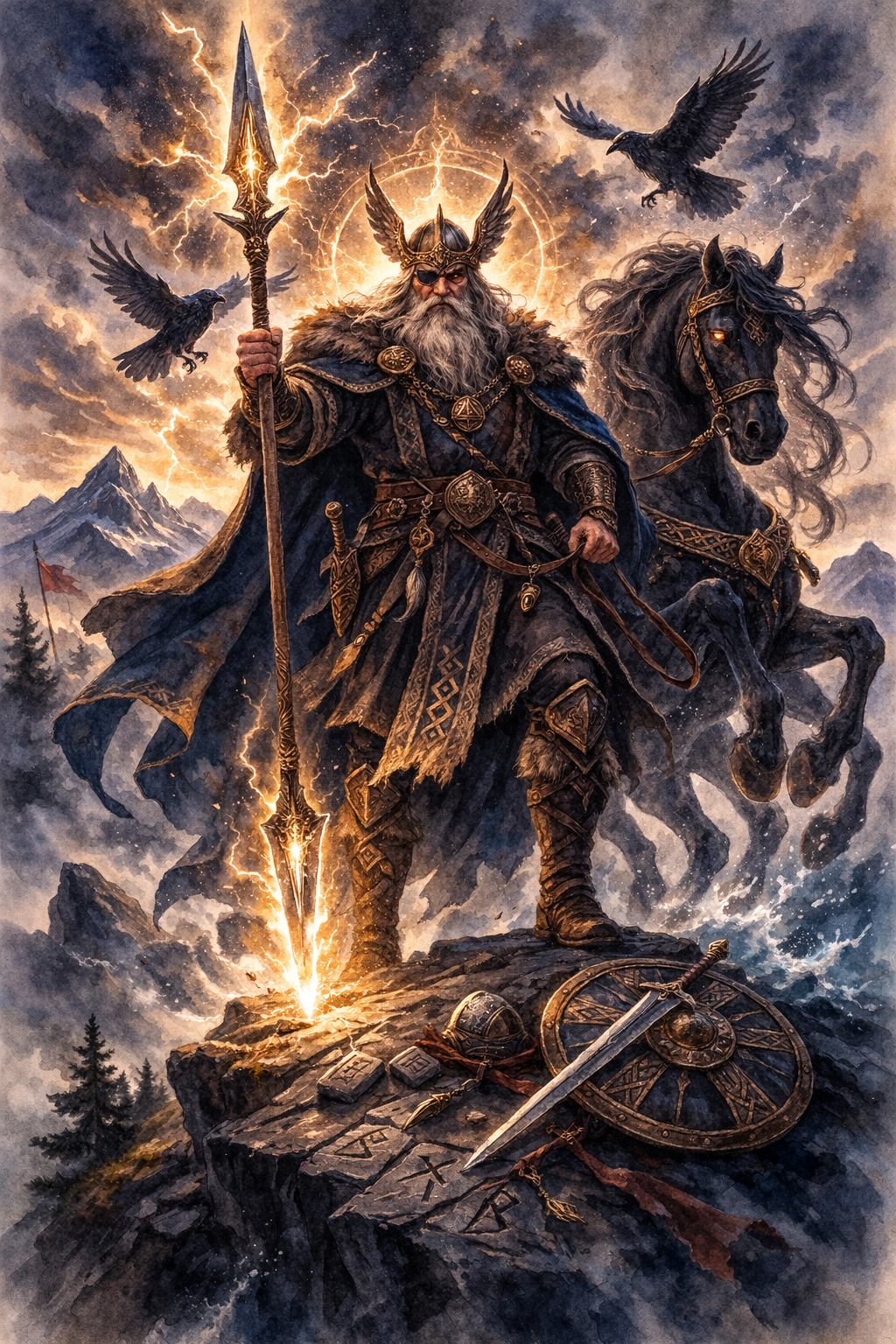
Odin: god of war and the dead
Odin is a war deity, but he does not represent brute strength. In Norse tradition, he is linked to strategy, the ritual fury of the berserker , and the choosing of the slain.
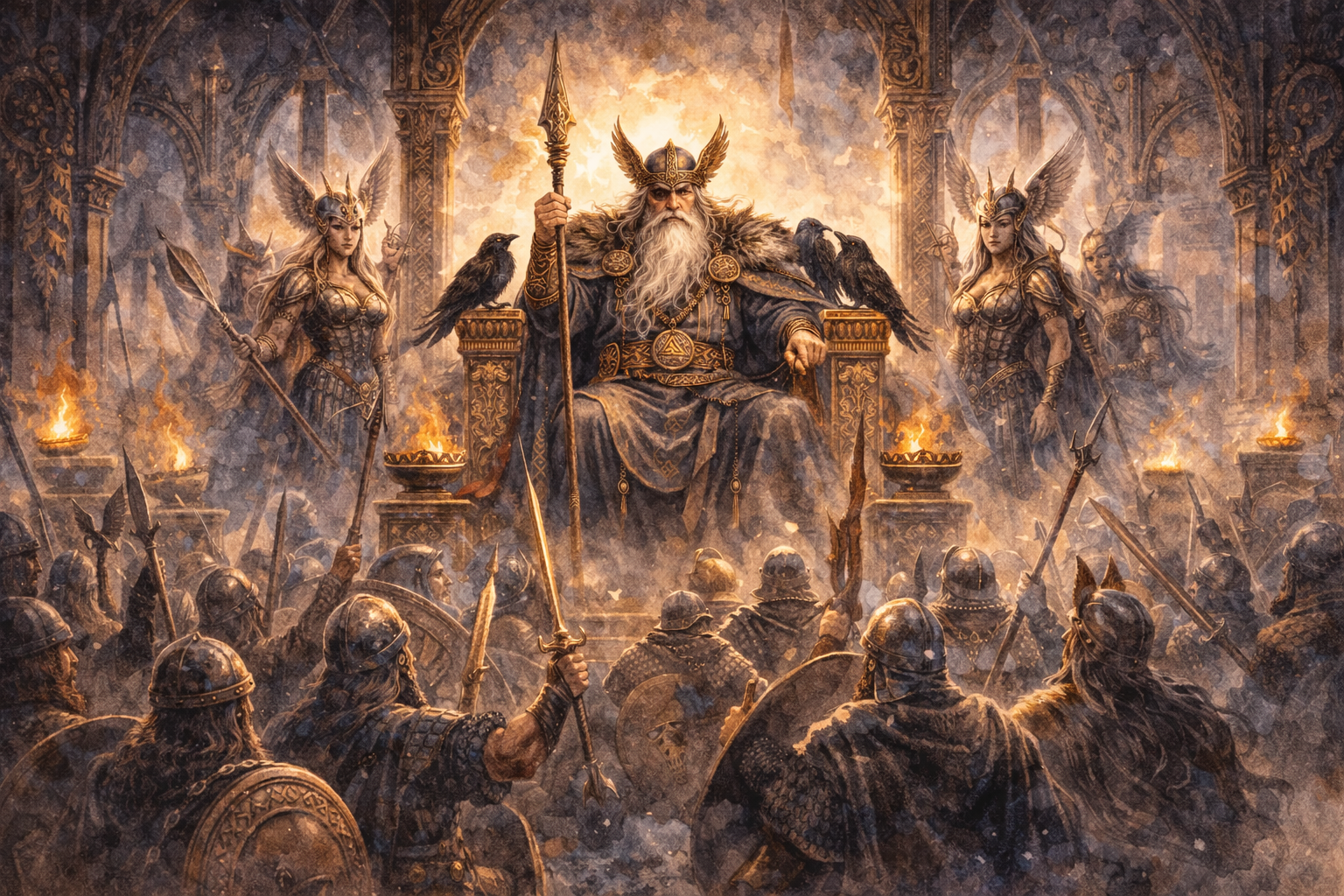
He is the lord of Valhalla, where the einherjar —warriors who died in battle—train daily for the final battle of Ragnarök.
They die and are reborn each evening to partake in eternal feasts. Their purpose is to prepare for the ultimate confrontation against chaos.
“Odin does not reward the strongest, but the one who dies with honor.”
The Valkyries, figuras femeninas enviadas por Odín, son quienes seleccionan a los caídos dignos y los conducen a su salón, mientras que la otra mitad pertenece a Freyja en Fólkvangr.
La lanza Gungnir, forjada por enanos, simboliza su autoridad. En algunas sagas, lanzar una lanza al inicio de la batalla era un gesto consagrado a Odín.
Odin does not represent war as brute force, but as strategy, trance, and conscious sacrifice.
Odin and poetry
Odin is also the god of poetry and inspiration. The myth of the Mead of Poetry, preserved in the Skáldskaparmál, tells how he obtains the magical drink created from the blood of Kvasir.
This mead grants the gift of poetry and wisdom.
Through this act, Odin becomes the patron of skalds.
Odin and his family
The sources present Odin as the center of a complex family network that anticipates Ragnarök.
Frigg. The silent queen
Frigg is his wife, goddess of marriage, motherhood, and the home, but also of fate. It is said that she knows the future, yet remains silent.
Her dwelling is Fensalir.
Baldr. The radiant son
Baldr is the most beloved of Odin’s sons.
He is killed by his blind brother Höðr, manipulated by Loki.
His death marks the beginning of Ragnarök.
Thor. The son of the earth
Though not the son of Frigg, Thor is the son of Odin and the goddess Jörð (the Earth).
He is the god of thunder and protector of Midgard.
Other children
- Höðr, the tragic figure
- Váli, born to avenge Baldr
- Víðarr, destined to avenge Odin
- Hermóðr, the messenger
- Bragi, god of poetry
Loki. Family by oath
Loki is not Odin’s biological son, but he is bound to him by an oath of brotherhood.
His betrayal triggers the events that lead to Ragnarök.
Odin and Ragnarök
In the Völuspá , it is foretold that Odin will be devoured by the wolf Fenrir during Ragnarök. He is a ruler marked by the knowledge of his own end.
And yet, he continues to prepare.
Because in Norse mythology, greatness does not lie in victory.
It lies in facing destiny with open eyes.
Odin does not fight to save himself.
He fights because it is his duty.
Odin beyond the god
Odin is not only the king of the gods. He is a complex figure who embodies sovereignty, war, magic, poetry, and fate.
The medieval sources portray him as an active god, willing to sacrifice himself and fully aware of the end of the world.
In Norse mythology, Odin represents the authority that seeks to understand the order of the cosmos—even knowing that this order is fragile.